Refine search
Actions for selected content:
238152 results in Physics and Astronomy

Numerical studies on detonation propagation in inhomogeneous mixtures with periodic reactant concentration gradient
-
- Journal:
- Journal of Fluid Mechanics / Volume 955 / 25 January 2023
- Published online by Cambridge University Press:
- 16 January 2023, A23
-
- Article
- Export citation
Charge–velocity correlation transport equations in gas–solid flow with triboelectric effects
-
- Journal:
- Journal of Fluid Mechanics / Volume 955 / 25 January 2023
- Published online by Cambridge University Press:
- 16 January 2023, A22
-
- Article
- Export citation

Field Theory of Non-Equilibrium Systems
-
- Published online:
- 15 January 2023
- Print publication:
- 05 January 2023

Quantum Mechanics
- A Mathematical Introduction
-
- Published online:
- 14 January 2023
- Print publication:
- 15 December 2022
-
- Textbook
- Export citation
Lattice Boltzmann modelling of isothermal two-component evaporation in porous media
-
- Journal:
- Journal of Fluid Mechanics / Volume 955 / 25 January 2023
- Published online by Cambridge University Press:
- 13 January 2023, A18
-
- Article
-
- You have access
- Open access
- HTML
- Export citation
-
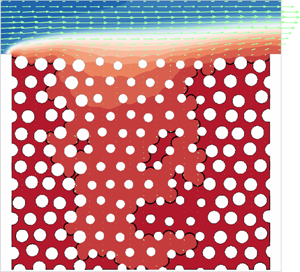
A mesoscopic lattice Boltzmann model is implemented for modelling isothermal two-component evaporation in porous media. The model is based on the pseudopotential multiphase model with two components to mimic the phase-change component (e.g. water and its vapour) and the non-condensible component (e.g. dry air), and the cascaded collision operator is used to enhance the numerical performance. The model is first analysed based on Chapman–Enskog expansion and then validated by the theoretical solution of an isothermal diffusive evaporation problem. We then discuss in detail the implementation of wettability based on a geometric function scheme and further validate the model with microfluidic evaporation experiments. We apply the method to simulate the convective evaporation of a dual-porosity medium and investigate the effects of inflow vapour concentration ( ${Y_{vapour,in}}$) and contact angle ( $\theta$) on the evaporation. Simulation results reproduce the typical transition from the constant evaporation regime (CRP) at large liquid saturation (S) to the receding front period (RFP) at small S, with an intermediate falling rate period in between. The dependence of the average evaporation rates on ${Y_{vapour,in}}$ and $\theta$ during CRP and RFP is investigated. A universal scaling formulation for the evaporation rate during CRP is found with respect to the concentration-related mass transfer number $B_Y$, contact angle $\theta$ and inflow Reynolds number Re, i.e. $E{R_{CRP}} = {k_3}\ln \left ( {1 + {B_Y}} \right ) {\cdot } \left [ {\ln \left ( {1 + {Re}} \right ) + {k_2}} \right ]\left [ {\cos (\theta ) + {k_1}} \right ]$, where ${k_1}$, ${k_2}$ and ${k_3}$ are fitting parameters.


FLM volume 954 Cover and Front matter
-
- Journal:
- Journal of Fluid Mechanics / Volume 954 / 10 January 2023
- Published online by Cambridge University Press:
- 13 January 2023, pp. f1-f2
-
- Article
-
- You have access
- Export citation
Attractors for the motion of a finite-size particle in a cuboidal lid-driven cavity
-
- Journal:
- Journal of Fluid Mechanics / Volume 955 / 25 January 2023
- Published online by Cambridge University Press:
- 13 January 2023, A16
-
- Article
-
- You have access
- Open access
- HTML
- Export citation
-
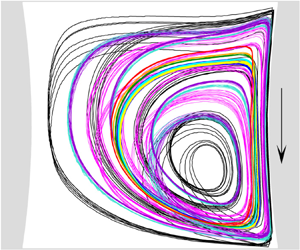
The motion of a finite-size particle in the cuboidal lid-driven cavity flow is investigated experimentally for Reynolds numbers $100$ and $200$ for which the flow is steady. These steady three-dimensional flows exhibit chaotic and regular streamlines, where the latter are confined to Kolmogorov–Arnold–Moser (KAM) tori. The interaction between the moving wall and the particle creates global particle attractors. For neutrally buoyant particles, these attractors are periodic or quasi-periodic, strongly attracting and located in or near KAM tori of the flow. As the density mismatch between particle and fluid increases, buoyancy and inertia become important, and the attractors evolve from those for neutrally buoyant particles, changing their shape, position and attraction rates.


Instability of a thin film of chemotactic active suspension
-
- Journal:
- Journal of Fluid Mechanics / Volume 955 / 25 January 2023
- Published online by Cambridge University Press:
- 13 January 2023, A11
-
- Article
-
- You have access
- Open access
- HTML
- Export citation
Numerical simulation of turbulent, plane parallel Couette–Poiseuille flow
-
- Journal:
- Journal of Fluid Mechanics / Volume 955 / 25 January 2023
- Published online by Cambridge University Press:
- 13 January 2023, A4
-
- Article
- Export citation
-
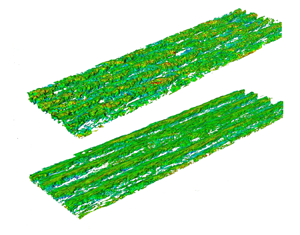
We present numerical simulation and mean-flow modelling of statistically stationary plane Couette–Poiseuille flow in a parameter space $(Re,\theta )$ with $Re=\sqrt {Re_c^2+Re_M^2}$ and $\theta =\arctan (Re_M/Re_c)$, where $Re_c,Re_M$ are independent Reynolds numbers based on the plate speed $U_c$ and the volume flow rate per unit span, respectively. The database comprises direct numerical simulations (DNS) at $Re=4000,6000$, wall-resolved large-eddy simulations at $Re = 10\,000, 20\,000$, and some wall-modelled large-eddy simulations (WMLES) up to $Re=10^{10}$. Attention is focused on the transition (from Couette-type to Poiseuille-type flow), defined as where the mean skin-friction Reynolds number on the bottom wall $Re_{\tau,b}$ changes sign at $\theta =\theta _c(Re)$. The mean flow in the $(Re,\theta )$ plane is modelled with combinations of patched classical log-wake profiles. Several model versions with different structures are constructed in both the Couette-type and Poiseuille-type flow regions. Model calculations of $Re_{\tau,b}(Re,\theta )$, $Re_{\tau,t}(Re,\theta )$ (the skin-friction Reynolds number on the top wall) and $\theta _c$ show general agreement with both DNS and large-eddy simulations. Both model and simulation indicate that, as $\theta$ is increased at fixed $Re$,
$Re$,  $Re_{\tau,t}$ passes through a peak at approximately $\theta = 45^{\circ }$, while $Re_{\tau,b}$ increases monotonically. Near the bottom wall, the flow laminarizes as $\theta$ passes through $\theta _c$ and then re-transitions to turbulence. As $Re$ increases, $\theta _c$ increases monotonically. The transition from Couette-type to Poiseuille-type flow is accompanied by the rapid attenuation of streamwise rolls observed in pure Couette flow. A subclass of flows with $Re_{\tau,b}=0$ is investigated. Combined WMLES with modelling for these flows enables exploration of the $Re\to \infty$ limit, giving $\theta _c \to 45^\circ$ as $Re\to \infty$.


A 100-PW compressor based on single-pass single-grating pair
-
- Journal:
- High Power Laser Science and Engineering / Volume 11 / 2023
- Published online by Cambridge University Press:
- 13 January 2023, e4
-
- Article
-
- You have access
- Open access
- HTML
- Export citation
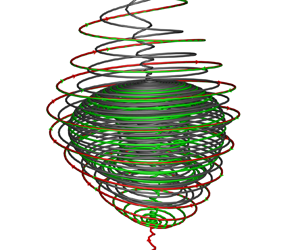
Evolution of tornado-like vortices in three-dimensional compressible rectangular cavity flows
-
- Journal:
- Journal of Fluid Mechanics / Volume 955 / 25 January 2023
- Published online by Cambridge University Press:
- 13 January 2023, A9
-
- Article
- Export citation
-
The spatial structure and time evolution of tornado-like vortices in a three-dimensional cavity are studied by topological analysis and numerical simulation. The topology theory of the unsteady vortex in the rectangular coordinate system (Zhang, Zhang & Shu, J. Fluid Mech., vol. 639, 2009, pp. 343–372) is generalized to the curvilinear coordinate system. Two functions $\lambda (q_1,t)$ and $q(q_1,t)$ are obtained to determine the topology structure of the sectional streamline pattern in the cross-section perpendicular to the vortex axis and the meridional plane, respectively. The spiral direction of the sectional streamlines in the cross-section perpendicular to the vortex axis depends on the sign of $\lambda (q_1,t)$. The types of critical points in the meridional plane depend on the sign of $q(q_1,t)$. The relation between the critical points of the streamline pattern in the meridional plane and that in the cross-section perpendicular to the vortex axis is set up. The flow in a three-dimensional rectangular cavity is numerically simulated by solving the three-dimensional Navier–Stokes equations using high-order numerical methods. The spatial structures and the time evolutions of the tornado-like vortices in the cavity are analysed with our topology theory. Both the bubble type and spiral type of vortex breakdown are observed. They have a close relationship with the vortex structure in the cross-section perpendicular to the vortex axis. The bubble-type breakdown has a conical core and the core is non-axisymmetric in the sense of topology. A criterion for the bubble type and the spiral type based on the spatial structure characteristic of the two breakdown types is provided.


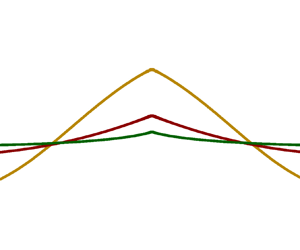
Almost extreme waves
-
- Journal:
- Journal of Fluid Mechanics / Volume 955 / 25 January 2023
- Published online by Cambridge University Press:
- 13 January 2023, A17
-
- Article
-
- You have access
- Open access
- HTML
- Export citation
-
Numerically computed with high accuracy are periodic travelling waves at the free surface of a two-dimensional, infinitely deep, and constant vorticity flow of an incompressible inviscid fluid, under gravity, without the effects of surface tension. Of particular interest is the angle the fluid surface of an almost extreme wave makes with the horizontal. Numerically found are the following. (i) There is a boundary layer where the angle rises sharply from $0^\circ$ at the crest to a local maximum, which converges to $30.3787\ldots ^\circ$, independently of the vorticity, as the amplitude increases towards that of the extreme wave, which displays a corner at the crest with a $30^\circ$ angle. (ii) There is an outer region where the angle descends to $0^\circ$ at the trough for negative vorticity, while it rises to a maximum, greater than $30^\circ$, and then falls sharply to $0^\circ$ at the trough for large positive vorticity. (iii) There is a transition region where the angle oscillates about $30^\circ$, resembling the Gibbs phenomenon. Numerical evidence suggests that the amplitude and frequency of the oscillations become independent of the vorticity as the wave profile approaches the extreme form.


Activity-induced migration of viscous droplets on a solid substrate
-
- Journal:
- Journal of Fluid Mechanics / Volume 955 / 25 January 2023
- Published online by Cambridge University Press:
- 13 January 2023, A10
-
- Article
- Export citation
Feasibility study of laser-driven neutron sources for pharmaceutical applications
- Part of
-
- Journal:
- High Power Laser Science and Engineering / Volume 11 / 2023
- Published online by Cambridge University Press:
- 13 January 2023, e20
-
- Article
-
- You have access
- Open access
- HTML
- Export citation
-
We predict the production yield of a medical radioisotope ${}^{67}$Cu using ${}^{67}$Zn(n, p) ${}^{67}$Cu and ${}^{68}$Zn(n, pn) ${}^{67}$Cu reactions with fast neutrons provided from laser-driven neutron sources. The neutrons were generated by the p+ ${}^9\mathrm{Be}$ and d+ ${}^9$Be reactions with high-energy ions accelerated by laser–plasma interaction. We evaluated the yield to be (3.3 $\pm$ 0.5) $\times$ 10 ${}^5$ atoms for ${}^{67}$Cu, corresponding to a radioactivity of 1.0 $\pm$ 0.2 Bq, for a Zn foil sample with a single laser shot. Using a simulation with this result, we estimated ${}^{67}$Cu production with a high-frequency laser. The result suggests that it is possible to generate ${}^{67}$Cu with a radioactivity of 270 MBq using a future laser system with a frequency of 10 Hz and 10,000-s radiation in a hospital.


Applications of object detection networks in high-power laser systems and experiments
- Part of
-
- Journal:
- High Power Laser Science and Engineering / Volume 11 / 2023
- Published online by Cambridge University Press:
- 13 January 2023, e7
-
- Article
-
- You have access
- Open access
- HTML
- Export citation
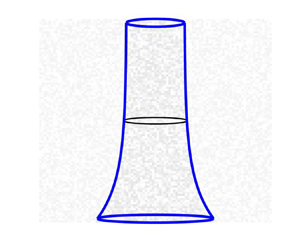
The near-field shape and stability of a porous plume
-
- Journal:
- Journal of Fluid Mechanics / Volume 955 / 25 January 2023
- Published online by Cambridge University Press:
- 12 January 2023, A13
-
- Article
-
- You have access
- Open access
- HTML
- Export citation
-
When a fluid is injected into a porous medium saturated with an ambient fluid of a greater density, the injected fluid forms a plume that rises upwards due to buoyancy. In the near field of the injection point, the plume adjusts its speed to match the buoyancy velocity of the porous medium, either thinning or thickening to conserve mass. These adjustments are the dominant controls on the near-field plume shape, rather than mixing with the ambient fluid, which occurs over larger vertical distances. In this study, we focus on the plume behaviour in the near field, demonstrating that for moderate injection rates, the plume will reach a steady state, whereby it matches the buoyancy velocity over a few plume width scales from the injection point. However, for very small injection rates, an instability occurs in which the steady plume breaks apart due to the insurmountable density contrast with the surrounding fluid. The steady shape of the plume in the near field depends only on a single dimensionless parameter, which is the ratio between the inlet velocity and the buoyancy velocity. A linear stability analysis is performed, indicating that for small velocity ratios, an infinitesimal perturbation can be constructed that becomes unstable, whilst for moderate velocity ratios, the shape is shown to be stable. Finally, we comment on the application of such flows to the context of CO $_2$ sequestration in porous geological reservoirs.

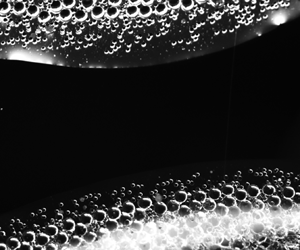
Probing dissipation in spreading drops with granular suspensions
- Part of
-
- Journal:
- Journal of Fluid Mechanics / Volume 955 / 25 January 2023
- Published online by Cambridge University Press:
- 12 January 2023, A7
-
- Article
-
- You have access
- HTML
- Export citation
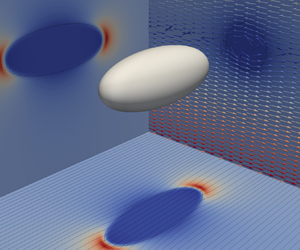
On the rheology and magnetization of dilute magnetic emulsions under small amplitude oscillatory shear
-
- Journal:
- Journal of Fluid Mechanics / Volume 955 / 25 January 2023
- Published online by Cambridge University Press:
- 12 January 2023, A3
-
- Article
- Export citation
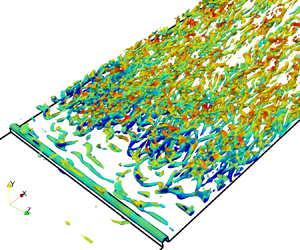
Two-scale solution for tripped turbulent boundary layer
-
- Journal:
- Journal of Fluid Mechanics / Volume 955 / 25 January 2023
- Published online by Cambridge University Press:
- 12 January 2023, A5
-
- Article
-
- You have access
- Open access
- HTML
- Export citation
-
Recent findings on the Reynolds-number-dependent behaviour of near-wall turbulence in terms of the ‘foot-printing’ of outer large-scale structures call for a new modelling development. A two-scale framework was proposed to couple a local fine-mesh solution with a global coarse-mesh solution by He (Intl J. Numer. Meth. Fluids, vol. 86, 2018, pp. 655–677). The methodology was implemented and demonstrated by Chen & He (J. Fluid Mech, vol. 933, 2022, p. A47) for a canonical turbulent channel flow, where the mesh-count scaling with Reynolds number is potentially reduced from $O(R{e^2})$ for a conventional wall-resolved large-eddy simulation (WRLES) to $O(R{e^1})$. The present work extends the two-scale method to turbulent boundary layers. A two-dimensional roughness element is used to trip a turbulent boundary layer. It is observed that large-scale disturbances originating at the trip have a much shorter lifetime and weaker foot-printing signatures on near-wall flow compared to those long streaky coherent structures in well-developed wall-bounded turbulent flows. Modal analyses show that the impact of trip-induced large scales can be adequately captured by a locally embedded fine-mesh block. For the tripped turbulent boundary layer, a Chebyshev block-spectral mapping is adopted to propagate source terms from the local fine-mesh blocks to the global coarse-mesh domain, driving to a target solution for the upscaled equations. The computed mean statistics and energy spectra are in good agreement with corresponding experimental data, WRLES and direct numerical simulation (DNS) results. The overall mesh count– $Re$ scaling is estimated to reduce from $O(R{e^{1.8}})$ for the full wall-resolved LES to $O(R{e^{0.9}})$ for the present two-scale solution.


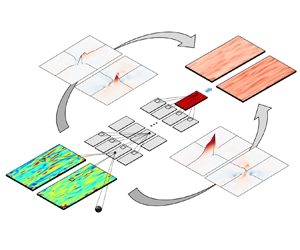
Interpretable deep learning for prediction of Prandtl number effect in turbulent heat transfer
-
- Journal:
- Journal of Fluid Mechanics / Volume 955 / 25 January 2023
- Published online by Cambridge University Press:
- 12 January 2023, A14
-
- Article
-
- You have access
- Open access
- HTML
- Export citation
-
We propose an interpretable deep learning (DL) model that extracts physical features from turbulence data. Based on a conditional generative adversarial network combined with a new decomposition algorithm for the Prandtl number effect, we developed a DL model that is capable of predicting the local surface heat flux very accurately using only the wall-shear stress information and Prandtl number as inputs in channel turbulence. The considered range of Prandtl number is $Pr = 0.001 \sim 7$, with a focus on the subrange of $Pr = 0.1 \sim 7$. Through an investigation of the gradient maps of the trained prediction model, we were able to identify the nonlinear physical relationship between the wall-shear stresses and heat flux, which is quite diverse depending on the Prandtl number. Furthermore, the decomposition algorithm, which is used to separate the Prandtl number dependent field from the common field of the surface heat flux, helps not only in learning for good prediction of an arbitrary Prandtl number but also in analysing the effect of the Prandtl number on the determination of the heat flux for the given turbulent flow fields. We demonstrate that a physical interpretation of a trained network is possible.
