Refine search
Actions for selected content:
238141 results in Physics and Astronomy
Research on plasma vertical displacement calculation based on neural network
- Part of
-
- Journal:
- Journal of Plasma Physics / Volume 89 / Issue 1 / February 2023
- Published online by Cambridge University Press:
- 17 January 2023, 895890104
-
- Article
-
- You have access
- HTML
- Export citation
A general infrastructure for data-driven control design and implementation in tokamaks
- Part of
-
- Journal:
- Journal of Plasma Physics / Volume 89 / Issue 1 / February 2023
- Published online by Cambridge University Press:
- 17 January 2023, 895890102
-
- Article
-
- You have access
- Open access
- HTML
- Export citation
Comparison of the stellar populations of bulges and discs using the MaNGA survey
-
- Journal:
- Publications of the Astronomical Society of Australia / Volume 40 / 2023
- Published online by Cambridge University Press:
- 16 January 2023, e002
-
- Article
-
- You have access
- Open access
- HTML
- Export citation
Bendocapillary instability of liquid in a flexible-walled channel
-
- Journal:
- Journal of Fluid Mechanics / Volume 955 / 25 January 2023
- Published online by Cambridge University Press:
- 16 January 2023, A26
-
- Article
-
- You have access
- Open access
- HTML
- Export citation
Modelling moving contact lines on inextensible elastic sheets in two dimensions
-
- Journal:
- Journal of Fluid Mechanics / Volume 955 / 25 January 2023
- Published online by Cambridge University Press:
- 16 January 2023, A25
-
- Article
-
- You have access
- Open access
- HTML
- Export citation
Impulsive impact of a body fully submerged in an open container
-
- Journal:
- Journal of Fluid Mechanics / Volume 955 / 25 January 2023
- Published online by Cambridge University Press:
- 16 January 2023, A28
-
- Article
- Export citation
Spectral analysis of the evolution of energy-containing eddies
-
- Journal:
- Journal of Fluid Mechanics / Volume 955 / 25 January 2023
- Published online by Cambridge University Press:
- 16 January 2023, R1
-
- Article
-
- You have access
- Open access
- HTML
- Export citation
-
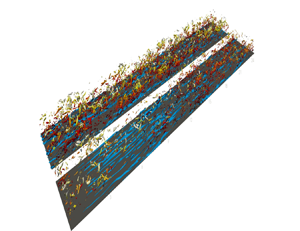
Energy-containing eddies (energy-eddies) are the elementary structures of wall turbulence that carry most of the kinetic energy and momentum. Despite the consensus that energy-eddies can self-sustain at each relevant length scale, their precise origin and spatial evolution are currently not well understood. In this study, we examine the spatial evolution of energy-eddies by quenching them at the inflow of a turbulent channel flow. Our study shows that the eddies involved in the energy cascade cannot be sustained without the energy-eddies. The streamwise velocity spectra of the evolving flow start to recover at a spanwise wavelength of $\lambda _z^+ \simeq 100$, equal to the near-wall spacing of streaks in the buffer layer located at $y^+ \simeq 15$, whereas there are no active vortical motions in the streamwise vorticity spectra until the energy at the streak location is re-established. Hence, the present study demonstrates that in a spatially evolving flow, the formation of near-wall streaks is the primary process necessary in the recovery of energy-eddies.


Global modes of variable-viscosity two-phase swirling flows and their triadic resonance
-
- Journal:
- Journal of Fluid Mechanics / Volume 955 / 25 January 2023
- Published online by Cambridge University Press:
- 16 January 2023, A24
-
- Article
- Export citation
-
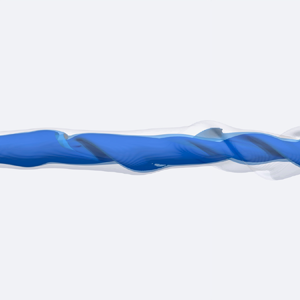
The linear and nonlinear dynamics of two-phase swirling flows produced by the Grabowski–Berger profile under the influence of a viscosity stratification are investigated. We perform axisymmetric nonlinear simulations and fully three-dimensional linear global stability analysis of the flow for several swirl numbers $S$ and viscosity ratios $\tilde {\mu }$. They are accompanied by nonlinear three-dimensional simulations and subsequent modal analysis using the bispectral mode decomposition, recently introduced by Schmidt (Nonlinear Dyn., vol. 102, issue 4, 2020, pp. 2479–2501). We find a pronounced destabilising effect of the viscosity stratification on both the onset of axisymmetric vortex breakdown and helical instability that is linked to the required shear stress continuity across the interface. Consequently, destabilisation is shifted to lower $S$ as compared with an equivalent flow with uniform viscosity. Further, the stability analysis reveals the simultaneous destabilisation of two global modes with wavenumbers $m=1$ and $m=2$ that have harmonic frequencies. The analysis of the nonlinear flow reveals a strong triadic resonance between these modes that governs the nonlinear dynamics and leads to a rapid departure from the linear dynamics. At larger swirl, the bifurcation of additional modes initiates an interaction cascade by means of triadic resonance which is elucidated by the bispectral analysis. It leads to the emergence of a variety of additional modes in the nonlinear flow. This study contributes to an improved understanding of the influence of viscosity stratification on the onset of vortex breakdown and the destabilisation of global modes. Further, it provides a clear picture of the dynamics of swirling flows with a codimension-two point and related triadic interaction of two global modes at harmonic frequencies and wavenumbers.


Global instability and mode selection in flow fields around rectangular prisms
-
- Journal:
- Journal of Fluid Mechanics / Volume 955 / 25 January 2023
- Published online by Cambridge University Press:
- 16 January 2023, A19
-
- Article
- Export citation

Numerical studies on detonation propagation in inhomogeneous mixtures with periodic reactant concentration gradient
-
- Journal:
- Journal of Fluid Mechanics / Volume 955 / 25 January 2023
- Published online by Cambridge University Press:
- 16 January 2023, A23
-
- Article
- Export citation
Charge–velocity correlation transport equations in gas–solid flow with triboelectric effects
-
- Journal:
- Journal of Fluid Mechanics / Volume 955 / 25 January 2023
- Published online by Cambridge University Press:
- 16 January 2023, A22
-
- Article
- Export citation
Field Theory of Non-Equilibrium Systems
-
- Published online:
- 15 January 2023
- Print publication:
- 05 January 2023

Quantum Mechanics
- A Mathematical Introduction
-
- Published online:
- 14 January 2023
- Print publication:
- 15 December 2022
-
- Textbook
- Export citation
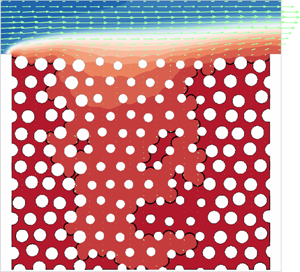
Lattice Boltzmann modelling of isothermal two-component evaporation in porous media
-
- Journal:
- Journal of Fluid Mechanics / Volume 955 / 25 January 2023
- Published online by Cambridge University Press:
- 13 January 2023, A18
-
- Article
-
- You have access
- Open access
- HTML
- Export citation
-
A mesoscopic lattice Boltzmann model is implemented for modelling isothermal two-component evaporation in porous media. The model is based on the pseudopotential multiphase model with two components to mimic the phase-change component (e.g. water and its vapour) and the non-condensible component (e.g. dry air), and the cascaded collision operator is used to enhance the numerical performance. The model is first analysed based on Chapman–Enskog expansion and then validated by the theoretical solution of an isothermal diffusive evaporation problem. We then discuss in detail the implementation of wettability based on a geometric function scheme and further validate the model with microfluidic evaporation experiments. We apply the method to simulate the convective evaporation of a dual-porosity medium and investigate the effects of inflow vapour concentration ( ${Y_{vapour,in}}$) and contact angle ( $\theta$) on the evaporation. Simulation results reproduce the typical transition from the constant evaporation regime (CRP) at large liquid saturation (S) to the receding front period (RFP) at small S, with an intermediate falling rate period in between. The dependence of the average evaporation rates on ${Y_{vapour,in}}$ and $\theta$ during CRP and RFP is investigated. A universal scaling formulation for the evaporation rate during CRP is found with respect to the concentration-related mass transfer number $B_Y$, contact angle $\theta$ and inflow Reynolds number Re, i.e. $E{R_{CRP}} = {k_3}\ln \left ( {1 + {B_Y}} \right ) {\cdot } \left [ {\ln \left ( {1 + {Re}} \right ) + {k_2}} \right ]\left [ {\cos (\theta ) + {k_1}} \right ]$, where ${k_1}$, ${k_2}$ and ${k_3}$ are fitting parameters.


FLM volume 954 Cover and Front matter
-
- Journal:
- Journal of Fluid Mechanics / Volume 954 / 10 January 2023
- Published online by Cambridge University Press:
- 13 January 2023, pp. f1-f2
-
- Article
-
- You have access
- Export citation
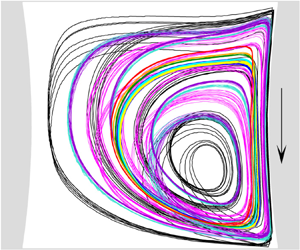
Attractors for the motion of a finite-size particle in a cuboidal lid-driven cavity
-
- Journal:
- Journal of Fluid Mechanics / Volume 955 / 25 January 2023
- Published online by Cambridge University Press:
- 13 January 2023, A16
-
- Article
-
- You have access
- Open access
- HTML
- Export citation
-
The motion of a finite-size particle in the cuboidal lid-driven cavity flow is investigated experimentally for Reynolds numbers $100$ and $200$ for which the flow is steady. These steady three-dimensional flows exhibit chaotic and regular streamlines, where the latter are confined to Kolmogorov–Arnold–Moser (KAM) tori. The interaction between the moving wall and the particle creates global particle attractors. For neutrally buoyant particles, these attractors are periodic or quasi-periodic, strongly attracting and located in or near KAM tori of the flow. As the density mismatch between particle and fluid increases, buoyancy and inertia become important, and the attractors evolve from those for neutrally buoyant particles, changing their shape, position and attraction rates.


Instability of a thin film of chemotactic active suspension
-
- Journal:
- Journal of Fluid Mechanics / Volume 955 / 25 January 2023
- Published online by Cambridge University Press:
- 13 January 2023, A11
-
- Article
-
- You have access
- Open access
- HTML
- Export citation
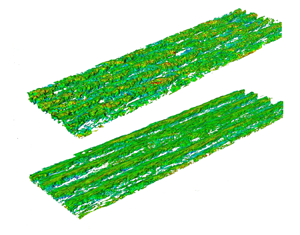
Numerical simulation of turbulent, plane parallel Couette–Poiseuille flow
-
- Journal:
- Journal of Fluid Mechanics / Volume 955 / 25 January 2023
- Published online by Cambridge University Press:
- 13 January 2023, A4
-
- Article
- Export citation
-
We present numerical simulation and mean-flow modelling of statistically stationary plane Couette–Poiseuille flow in a parameter space $(Re,\theta )$ with $Re=\sqrt {Re_c^2+Re_M^2}$ and $\theta =\arctan (Re_M/Re_c)$, where $Re_c,Re_M$ are independent Reynolds numbers based on the plate speed $U_c$ and the volume flow rate per unit span, respectively. The database comprises direct numerical simulations (DNS) at $Re=4000,6000$, wall-resolved large-eddy simulations at $Re = 10\,000, 20\,000$, and some wall-modelled large-eddy simulations (WMLES) up to $Re=10^{10}$. Attention is focused on the transition (from Couette-type to Poiseuille-type flow), defined as where the mean skin-friction Reynolds number on the bottom wall $Re_{\tau,b}$ changes sign at $\theta =\theta _c(Re)$. The mean flow in the $(Re,\theta )$ plane is modelled with combinations of patched classical log-wake profiles. Several model versions with different structures are constructed in both the Couette-type and Poiseuille-type flow regions. Model calculations of $Re_{\tau,b}(Re,\theta )$, $Re_{\tau,t}(Re,\theta )$ (the skin-friction Reynolds number on the top wall) and $\theta _c$ show general agreement with both DNS and large-eddy simulations. Both model and simulation indicate that, as $\theta$ is increased at fixed $Re$,
$Re$,  $Re_{\tau,t}$ passes through a peak at approximately $\theta = 45^{\circ }$, while $Re_{\tau,b}$ increases monotonically. Near the bottom wall, the flow laminarizes as $\theta$ passes through $\theta _c$ and then re-transitions to turbulence. As $Re$ increases, $\theta _c$ increases monotonically. The transition from Couette-type to Poiseuille-type flow is accompanied by the rapid attenuation of streamwise rolls observed in pure Couette flow. A subclass of flows with $Re_{\tau,b}=0$ is investigated. Combined WMLES with modelling for these flows enables exploration of the $Re\to \infty$ limit, giving $\theta _c \to 45^\circ$ as $Re\to \infty$.


A 100-PW compressor based on single-pass single-grating pair
-
- Journal:
- High Power Laser Science and Engineering / Volume 11 / 2023
- Published online by Cambridge University Press:
- 13 January 2023, e4
-
- Article
-
- You have access
- Open access
- HTML
- Export citation
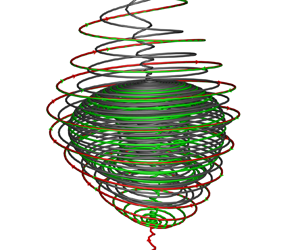
Evolution of tornado-like vortices in three-dimensional compressible rectangular cavity flows
-
- Journal:
- Journal of Fluid Mechanics / Volume 955 / 25 January 2023
- Published online by Cambridge University Press:
- 13 January 2023, A9
-
- Article
- Export citation
-
The spatial structure and time evolution of tornado-like vortices in a three-dimensional cavity are studied by topological analysis and numerical simulation. The topology theory of the unsteady vortex in the rectangular coordinate system (Zhang, Zhang & Shu, J. Fluid Mech., vol. 639, 2009, pp. 343–372) is generalized to the curvilinear coordinate system. Two functions $\lambda (q_1,t)$ and $q(q_1,t)$ are obtained to determine the topology structure of the sectional streamline pattern in the cross-section perpendicular to the vortex axis and the meridional plane, respectively. The spiral direction of the sectional streamlines in the cross-section perpendicular to the vortex axis depends on the sign of $\lambda (q_1,t)$. The types of critical points in the meridional plane depend on the sign of $q(q_1,t)$. The relation between the critical points of the streamline pattern in the meridional plane and that in the cross-section perpendicular to the vortex axis is set up. The flow in a three-dimensional rectangular cavity is numerically simulated by solving the three-dimensional Navier–Stokes equations using high-order numerical methods. The spatial structures and the time evolutions of the tornado-like vortices in the cavity are analysed with our topology theory. Both the bubble type and spiral type of vortex breakdown are observed. They have a close relationship with the vortex structure in the cross-section perpendicular to the vortex axis. The bubble-type breakdown has a conical core and the core is non-axisymmetric in the sense of topology. A criterion for the bubble type and the spiral type based on the spatial structure characteristic of the two breakdown types is provided.


