To save content items to your account,
please confirm that you agree to abide by our usage policies.
If this is the first time you use this feature, you will be asked to authorise Cambridge Core to connect with your account.
Find out more about saving content to .
To save content items to your Kindle, first ensure no-reply@cambridge.org
is added to your Approved Personal Document E-mail List under your Personal Document Settings
on the Manage Your Content and Devices page of your Amazon account. Then enter the ‘name’ part
of your Kindle email address below.
Find out more about saving to your Kindle.
Note you can select to save to either the @free.kindle.com or @kindle.com variations.
‘@free.kindle.com’ emails are free but can only be saved to your device when it is connected to wi-fi.
‘@kindle.com’ emails can be delivered even when you are not connected to wi-fi, but note that service fees apply.
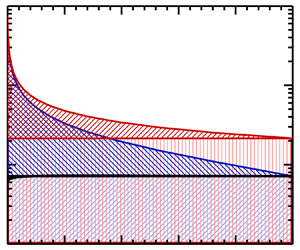
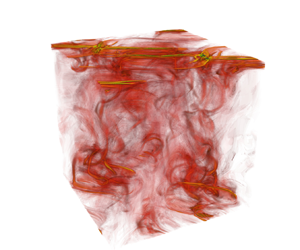
A relation among invariants of filtered velocity gradients with two different filter sizes is derived. Based on this relation and physical reasoning, it is shown analytically that strain self-amplification contributes more to energy transfer than vortex stretching in homogeneous turbulence, as observed in recent numerical investigations of homogeneous isotropic turbulence. We note that the invariant relation studied and hence the inequality between strain self-amplification and vortex stretching apply to all homogeneous flows, not restricted to isotropic turbulence.
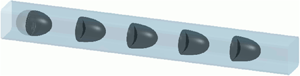
In this paper, we present a generic approach of a dynamical data-driven model-order reduction technique for three-dimensional fluid–structure interaction problems. A low-order continuous linear differential system is identified from snapshot solutions of a high-fidelity solver. The reduced-order model uses different ingredients, such as proper orthogonal decomposition, dynamic mode decomposition and Tikhonov-based robust identification techniques. An interpolation method is used to predict the capsule dynamics for any values of the governing non-dimensional parameters that are not in the training database. Then a dynamical system is built from the predicted solution. Numerical evidence shows the ability of the reduced model to predict the time evolution of the capsule deformation from its initial state, whatever the parameter values. Accuracy and stability properties of the resulting low-order dynamical system are analysed numerically. The numerical experiments show very good agreement, measured in terms of modified Hausdorff distance between capsule solutions of the full-order and low-order models, in the case of both confined and unconfined flows. This work is a first milestone to move towards real-time simulation of fluid–structure problems, which can be extended to nonlinear low-order systems to account for strong material and flow nonlinearities. It is a valuable innovation tool for rapid design and for the development of innovative devices.
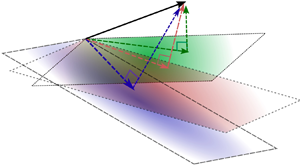
The concept of statistical stability is central to Malkus's 1956 attempt to predict the mean profile in shear flow turbulence. Here we discuss how his original attempt to assess this – an Orr–Sommerfeld (OS) analysis on the mean profile – can be improved by considering a cumulant expansion of the Navier–Stokes equations. Focusing on the simplest non-trivial closure (commonly referred to as CE2) that corresponds to the quasilinearized Navier–Stokes equations, we develop an extended OS analysis that also incorporates information about the fluctuation field. A more practical version of this – minimally extended OS analysis – is identified and tested on a number of statistically steady and, therefore, statistically stable turbulent channel flows. Beyond the concept of statistical stability, this extended stability analysis should also improve the popular approach of mean flow linear analysis in time-dependent shear flows by including more information about the underlying flow in its predictions as well as for other flows with additional physics such as convection.
The main objective of this work is to develop a unified framework that can be used as a lens to quantitatively assess and augment a wide range of coarse-grained models of turbulence, namely large eddy simulations (LES), hybrid Reynolds-averaged/LES methods and wall-modelled (WM)LES. Taking a turbulent channel flow as an example, optimality is assessed in the wall-resolved limit, the hybrid RANS–LES limit and the WMLES limit, via projections at different resolutions suitable for these approaches. These optimal a priori estimates are shown to have similar characteristics to existing a posteriori solutions reported in the literature. Consistent accuracy metrics are developed for scale-resolving methods using the optimal solution as a reference, and evaluations are performed. We further characterise the slip velocity in WMLES in terms of the near-wall under-resolution and develop a universal scaling relationship. Insights from the a priori tests are used to augment existing slip-based wall models. Various a posteriori tests reveal superior performance over the dynamic slip wall model. Guidance for the development of improved slip-wall models is provided, including a target for the dynamic procedure.
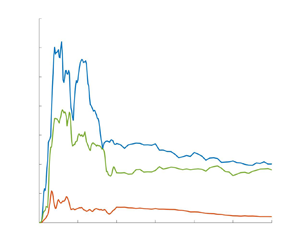
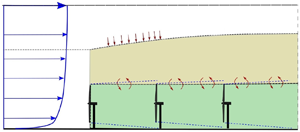
In this article, we present an entrainment-based model for predicting the flow and power output of finite-length wind farms. The model is an extension of the three-layer approach of Luzzatto-Fegiz & Caulfield (Phys. Rev. Fluids, vol. 3, 2018, 093802) for wind farms of infinite length, and assumes dependence of key flow quantities, such as the wind farm bulk velocity, on the streamwise distance from the farm entrance. To assist our analysis and validate the proposed model, we undertake a series of large-eddy simulations with different turbine spacing arrangements and layouts. Comparisons are also made with the top-down model with entrance effects of Meneveau (J. Turbul., vol. 13, 2012, N7) and data from the literature. The finite-length entrainment model is shown to be capable of capturing the power drop between contiguous rows of turbines as well as describing the advection and turbulent transport of kinetic energy in both the entrance and fully developed regions. The fully developed regime is approximated only deep in the wind farm, after approximately 15 rows of turbines. Our data suggest that for the cases considered in this study, the empirical coefficients that can be used to describe turbulent entrainment and transfers above the wind farm exhibit little dependence on the farm layout and may be considered constant for modelling purposes. However, the flow field within the wind farm layer can be strongly modulated by the turbine density (spacing) as well as the array layout, and to that extent it can be argued that they are both primary factors determining the wind farm power output.
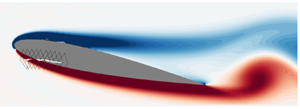
This paper addresses the issue of actuator selection for active flow control by proposing a novel method built on top of a reinforcement learning agent. Starting from a pre-trained agent using numerous actuators, the algorithm estimates the impact of a potential actuator removal on the value function, indicating the agent's performance. It is applied to two test cases, the one-dimensional Kuramoto–Sivashinsky equation and a laminar bidimensional flow around an airfoil at $Re=1000$ for different angles of attack ranging from $12^{\circ }$ to $20^{\circ }$, to demonstrate its capabilities and limits. The proposed actuator-sparsification method relies on a sequential elimination of the least relevant action components, starting from a fully developed layout. The relevancy of each component is evaluated using metrics based on the value function. Results show that, while still being limited by this intrinsic elimination paradigm (i.e. the sequential elimination), actuator patterns and obtained policies demonstrate relevant performances and allow us to draw an accurate approximation of the Pareto front of performances versus actuator budget.
Virtual reality (VR) is increasingly used in learning and can be experienced with a head-mounted display as a 3D immersive version (immersive virtual reality [IVR]) or with a PC (or another computer) as a 2D desktop-based version (desktop virtual reality [DVR]). A research gap is the effect of IVR and DVR on learners’ skill retention. To address this gap, we designed an experiment in which learners were trained and tested for the assembly of a procedural industrial task. We found nonsignificant differences in the number of errors, the time to completion, satisfaction, self-efficacy, and motivation. The results support the view that DVR and IVR are similarly useful for learning retention. These insights may help researchers and practitioners to decide which form of VR they should use.
Ferric heme b (= ferric protoporphyrin IX = hemin) is an important prosthetic group of different types of enzymes, including the intensively investigated and widely applied horseradish peroxidase (HRP). In HRP, hemin is present in monomeric form in a hydrophobic pocket containing among other amino acid side chains the two imidazoyl groups of His170 and His42. Both amino acids are important for the peroxidase activity of HRP as an axial ligand of hemin (proximal His170) and as an acid/base catalyst (distal His42). A key feature of the peroxidase mechanism of HRP is the initial formation of compound I under heterolytic cleavage of added hydrogen peroxide as a terminal oxidant. Investigations of free hemin dispersed in aqueous solution showed that different types of hemin dimers can form, depending on the experimental conditions, possibly resulting in hemin crystallization. Although it has been recognized already in the 1970s that hemin aggregation can be prevented in aqueous solution by using micelle-forming amphiphiles, it remains a challenge to prepare hemin-containing micellar and vesicular systems with peroxidase-like activities. Such systems are of interest as cheap HRP-mimicking catalysts for analytical and synthetic applications. Some of the key concepts on which research in this fascinating and interdisciplinary field is based are summarized, along with major accomplishments and possible directions for further improvement. A systematic analysis of the physico-chemical properties of hemin in aqueous micellar solutions and vesicular dispersions must be combined with a reliable evaluation of its catalytic activity. Future studies should show how well the molecular complexity around hemin in HRP can be mimicked by using micelles or vesicles. Because of the importance of heme b in virtually all biological systems and the fact that porphyrins and hemes can be obtained under potentially prebiotic conditions, ideas exist about the possible role of heme-containing micellar and vesicular systems in prebiotic times.
In this article, the performance parameters of the electric vehicle were investigated, and its operating point was defined using the core components (Battery, Inverter, and Motor). The test vehicle 2023 Cadillac Lyriq, provided by General Motors Inc., was driven on specified road segments, and the real-time data were retrieved using the integrated controller area network architecture. The neoVI–Fire 2 tool was connected to the vehicle system, which records the dynamic data, and Vehicle Spy software was used to convert the data into a readable format. Finally, the vector electric vehicle operating point was proposed, and the corresponding behavior was interpreted. This methodology could assist researchers in understanding the dynamic behavior of electric vehicle parameters to develop integrated techniques which augment the performance in real time.
The cardiac sarcomere is a cellular structure in the heart that enables muscle cells to contract. Dozens of proteins belong to the cardiac sarcomere, which work in tandem to generate force and adapt to demands on cardiac output. Intriguingly, the majority of these proteins have significant intrinsic disorder that contributes to their functions, yet the biophysics of these intrinsically disordered regions (IDRs) have been characterized in limited detail. In this review, we first enumerate these myofilament-associated proteins with intrinsic disorder (MAPIDs) and recent biophysical studies to characterize their IDRs. We secondly summarize the biophysics governing IDR properties and the state-of-the-art in computational tools toward MAPID identification and characterization of their conformation ensembles. We conclude with an overview of future computational approaches toward broadening the understanding of intrinsic disorder in the cardiac sarcomere.
We demonstrate an ultra-broadband high temporal contrast infrared laser source based on cascaded optical parametric amplification, hollow-core fiber (HCF) and second harmonic generation processes. In this setup, the spectrum of an approximately 1.8 μm laser pulse has near 1 μm full bandwidth by employing an argon gas-filled HCF. Subsequently, after frequency doubling with cascaded crystals and dispersion compensation by a fused silica wedge pair, 9.6 fs (~3 cycles) and 150 μJ pulses centered at 910 nm with full bandwidth of over 300 nm can be generated. The energy stability of the output laser pulse is excellent with 0.8% (root mean square) over 20 min, and the temporal contrast is >1012 at –10 ps before the main pulse. The excellent temporal and spatial characteristics and stability make this laser able to be used as a good seed source for ultra-intense and ultrafast laser systems.
The amount and complexity of data delivered by modern galaxy surveys has been steadily increasing over the past years. New facilities will soon provide imaging and spectra of hundreds of millions of galaxies. Extracting coherent scientific information from these large and multi-modal data sets remains an open issue for the community and data-driven approaches such as deep learning have rapidly emerged as a potentially powerful solution to some long lasting challenges. This enthusiasm is reflected in an unprecedented exponential growth of publications using neural networks, which have gone from a handful of works in 2015 to an average of one paper per week in 2021 in the area of galaxy surveys. Half a decade after the first published work in astronomy mentioning deep learning, and shortly before new big data sets such as Euclid and LSST start becoming available, we believe it is timely to review what has been the real impact of this new technology in the field and its potential to solve key challenges raised by the size and complexity of the new datasets. The purpose of this review is thus two-fold. We first aim at summarising, in a common document, the main applications of deep learning for galaxy surveys that have emerged so far. We then extract the major achievements and lessons learned and highlight key open questions and limitations, which in our opinion, will require particular attention in the coming years. Overall, state-of-the-art deep learning methods are rapidly adopted by the astronomical community, reflecting a democratisation of these methods. This review shows that the majority of works using deep learning up to date are oriented to computer vision tasks (e.g. classification, segmentation). This is also the domain of application where deep learning has brought the most important breakthroughs so far. However, we also report that the applications are becoming more diverse and deep learning is used for estimating galaxy properties, identifying outliers or constraining the cosmological model. Most of these works remain at the exploratory level though which could partially explain the limited impact in terms of citations. Some common challenges will most likely need to be addressed before moving to the next phase of massive deployment of deep learning in the processing of future surveys; for example, uncertainty quantification, interpretability, data labelling and domain shift issues from training with simulations, which constitutes a common practice in astronomy.
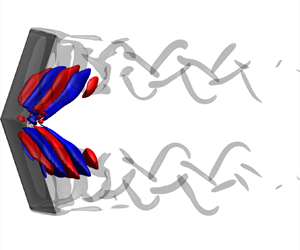
Through triglobal resolvent analysis, we reveal the effects of wing tip and sweep angle on laminar separated wakes over swept wings. For the present study, we consider wings with semi-aspect ratios from $1$ to $4$, sweep angles from $0^\circ$ to $45^\circ$ and angles of attack of $20^\circ$ and $30^\circ$ at a chord-based Reynolds number of $400$ and a Mach number of $0.1$. Using direct numerical simulations, we observe that unswept wings develop vortex shedding near the wing root with a quasi-steady tip vortex. For swept wings, vortex shedding is seen near the wing tip for low sweep angles, while the wakes are steady for wings with high sweep angles. To gain further insights into the mechanisms of flow unsteadiness, triglobal resolvent analysis is used to identify the optimal spatial input–output mode pairs and the associated gains over a range of frequencies. The three-dimensional forcing and response modes reveal that harmonic fluctuations are directed towards the root for unswept wings and towards the wing tip for swept wings. The overlapping region of the forcing–response mode pairs uncovers triglobal resolvent wavemakers associated with self-sustained unsteady wakes of swept wings. Furthermore, we show that for low-aspect-ratio wings optimal perturbations develop globally over the entire wingspan. The present study uncovers physical insights on the effects of tip and sweep on the growth of optimal harmonic perturbations and the wake dynamics of separated flows over swept wings.
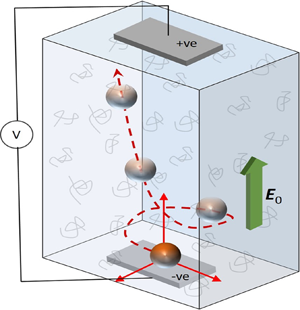
Electrophoretic motion of a particle carrying a weak but arbitrary non-uniform surface charge density in an Oldroyd-B fluid is analysed here in the thin electrical double layer limit. A semi-analytical generic framework, based on regular perturbation, the Lamb's general solutions and the generalized reciprocal theorem, assuming the viscoelastic effects to remain subdominant, is developed for tracing the particle's trajectory using its instantaneous translational velocity and accounting for the temporal evolution of its surface charge driven by rotation. Our results reveal that in a viscoelastic medium, non-uniformly charged particles may generally follow distinct trajectories depending on their sizes, which is in stark contrast to Newtonian fluids. By considering the multipole moments of the surface charge, we show that the particle may initially rotate until its dipole moment becomes collinear with the imposed electric field, and the nature of the surrounding medium does not alter this fundamental behaviour. However, during the course of rotation, the excess polymeric stresses within the electrical double layer and the bulk may cause the particle to migrate perpendicular to the applied field, by forcing the multipole moments of the surface charge to interact with each other. The final steady-state trajectory of the particle and its possible migration normal to the applied electric field are also largely governed by these interactions and more specifically, presence of non-zero quadrupole moments. The present framework may be helpful towards designing tools for particle separation and sorting, relevant in many biological applications.
We present experimental results of irregular long-crested waves propagating over a submerged trapezoidal bar with the presence of a background current in a wave flume. We investigate the non-equilibrium phenomenon (NEP) induced by significant changes of water depth and mean horizontal flow velocity as wave trains pass over the bar. Using skewness and kurtosis as proxies, we show evidence that an accelerating following current could increase the sea-state non-Gaussianity and enhance both the magnitude and spatial extent of the NEP. We also find that below a ‘saturation relative water depth’ $k_p h_2 \approx 0.5$ ($k_p$ being the peak wavenumber in the shallow area of depth $h_2$), although the NEP manifests, the decrease of the relative water depth does not further enhance the maximum skewness and kurtosis over the bar crest. This work highlights the nonlinear physics according to which a following current could provoke higher freak wave risk in coastal areas where modulation instability plays an insignificant role.
We consider a theoretical model for the settling of rod-shaped particles of a dilute, initially homogeneous, suspension in rapid rotation. The particle Reynolds number and the particle Taylor number of the detailed flow around the particles are assumed small, representing a relevant limit for an industrial centrifugal separation process. By applying a statistical approach using the Fokker–Planck equation, and neglecting particle–particle interactions, we obtain an explicit, analytical solution for the time dependent, spatially uniform particle orientation distribution function. Not only does the volume fraction in the bulk of the suspension decrease with time due to the divergent centrifugal field, as similarly described in the literature for suspensions of spherical particles, the orientation of the rod particles also changes with time from an initially uniform distribution to one where the particles tend to align with a plane perpendicular to the axis of rotation. The corresponding particle trajectories, as also influenced by first-order effects from the Coriolis acceleration and gyroscopic effects, are obtained numerically for different initial particle orientation angles.
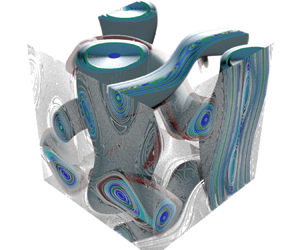
Instantaneous features of three-dimensional velocity fields are most directly visualized via streamsurfaces. It is generally unclear, however, which streamsurfaces one should pick for this purpose, given that infinitely many such surfaces pass through each point of the flow domain. Exceptions to this rule are vector fields with a non-degenerate first integral whose level surfaces globally define a continuous, one-parameter family of streamsurfaces. While generic vector fields have no first integrals, their vortical regions may admit local first integrals over a discrete set of streamtubes, as Hamiltonian systems are known to do over Cantor sets of invariant tori. Here we introduce a method to construct such first integrals approximately from velocity data, and show that their level sets indeed frame vortical features of the velocity field in examples in which those features are known from Lagrangian analysis. Moreover, we test our method in numerical datasets, including a flow inside a V-junction and a turbulent channel flow. For the latter, we propound an algorithm to pin down the most salient barriers to momentum transport up to a given scale providing a way out of the occlusion conundrum that typically accompanies other vortex visualization methods.
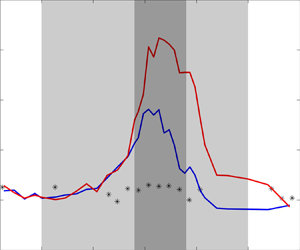
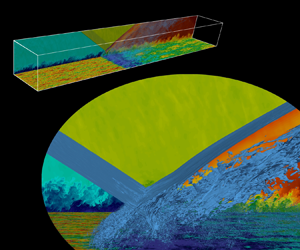
A direct numerical simulation of an oblique shock wave impinging on a turbulent boundary layer at Mach number 2.28 is carried out at moderate Reynolds number, simulating flow conditions similar to those of the experiment by Dupont et al. (J. Fluid Mech., vol. 559, 2006, pp. 255–277). The low-frequency shock unsteadiness, whose characteristics have been the focus of considerable research efforts, is here investigated via the Morlet wavelet transform. Owing to its compact support in both physical and Fourier spaces, the wavelet transformation makes it possible to track the time evolution of the various scales of the wall-pressure fluctuations. This property also makes it possible to define a local intermittency measure, representing a frequency-dependent flatness factor, to pinpoint the bursts of energy that characterise the shock intermittency scale by scale. As a major result, wavelet decomposition shows that the broadband shock movement is actually the result of a collection of sparse events in time, each characterised by its own temporal scale. This feature is hidden by the classical Fourier analysis, which can only show the time-averaged behaviour. Then, we propose a procedure to process any relevant time series, such as the time history of the wall pressure or that of the separation bubble extent, in which we use a condition based on the local intermittency measure to filter out the turbulent content in the proximity of the shock foot and to isolate only the intermittent component of the signal. In addition, wavelet analysis reveals the intermittent behaviour also of the breathing motion of the recirculation bubble behind the reflected shock, and allows us to detect a direct, partial correspondence between the most significant intermittent events of the separation region and those of the wall pressure at the foot of the shock.
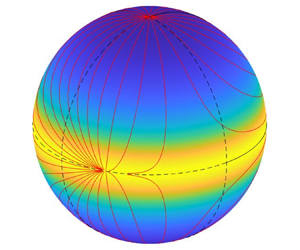
We present a family of exact inviscid three-dimensional Beltrami flows in a horizontally periodic domain lying between two parallel free-slip boundaries. Significantly, these flows are not stress free: the horizontal vorticity varies on each boundary. Using direct numerical simulations (employing horizontal hyperdiffusion only for numerical stability), we find that the largest-scale member of the family is unstable and breaks down into anisotropic turbulence, with relatively large horizontal vorticity at and near each boundary, and associated surface frontal features. We conjecture that all members of the family are similarly unstable. The free-slip boundaries play an important role in the late stages of the instability by constraining the deformation of vortex lines near the boundaries. This study appears to be the first to consider the role of boundary horizontal vorticity in an inviscid context.
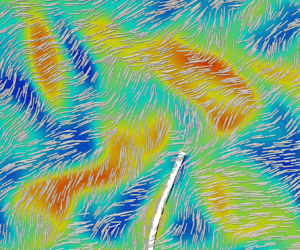
Active elements in active nematics can impose forces on immersed bodies and move them accordingly. We numerically investigate the vibrational motion of a cantilever beam placed in active nematics. The continuous energy transfer from vortices to the beam results in beam oscillation, whose direction and amplitude depend on the vortex strength, size and position. Referring to the kinetic-energy spectrum, we indicate that both the large- and small-scale vortices are the primary mechanism for the energy transfer between the fluid and beam, leading to the beam oscillatory motion, with the contribution from the large-scale vortices being higher. We investigate the effect of fluid properties such as activity, viscosity and elastic constant on the oscillation frequency. We show that the intensification of the activity increases peak frequency, and there is a linear correlation between the peak frequency and activity. We further demonstrate the reciprocal relationship between viscosity and peak frequency. Subsequently, we relate the increase and decrease in the peak frequency to the energy injection/dissipation by activity/viscosity. Moreover, we reveal the negligibly small dependency of beam peak frequency on the elastic constant and discuss free energy's role in accounting for this behaviour. The findings clearly demonstrate that active fluids can impose an oscillatory motion on flexible bodies, which might be used as a novel method for measuring the critical properties of active nematics.