Refine search
Actions for selected content:
238141 results in Physics and Astronomy
Chapter 8 - Mapping Epileptic Networks with Scalp and Invasive EEG
-
-
- Book:
- A Complex Systems Approach to Epilepsy
- Published online:
- 06 January 2023
- Print publication:
- 26 January 2023, pp 99-126
-
- Chapter
- Export citation
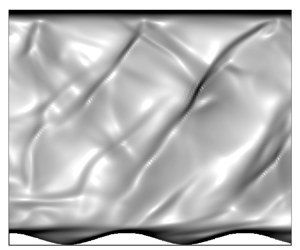
Supersonic turbulent flows over sinusoidal rough walls
-
- Journal:
- Journal of Fluid Mechanics / Volume 956 / 10 February 2023
- Published online by Cambridge University Press:
- 26 January 2023, A3
-
- Article
-
- You have access
- Open access
- HTML
- Export citation
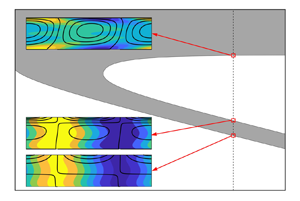
Flow-induced surface instabilities in a flexible-walled channel with a heavy wall
-
- Journal:
- Journal of Fluid Mechanics / Volume 956 / 10 February 2023
- Published online by Cambridge University Press:
- 25 January 2023, A1
-
- Article
-
- You have access
- Open access
- HTML
- Export citation
Image-based searches for pulsar candidates using MWA VCS data
-
- Journal:
- Publications of the Astronomical Society of Australia / Volume 40 / 2023
- Published online by Cambridge University Press:
- 25 January 2023, e003
-
- Article
-
- You have access
- Open access
- HTML
- Export citation
-
Pulsars have been studied extensively over the last few decades and have proven instrumental in exploring a wide variety of physics. Discovering more pulsars emitting at low radio frequencies is crucial to further our understanding of spectral properties and emission mechanisms. The Murchison Widefield Array Voltage Capture System (MWA VCS) has been routinely used to study pulsars at low frequencies and discover new pulsars. The MWA VCS offers the unique opportunity of recording complex voltages from all individual antennas (tiles), which can be off-line beamformed or correlated/imaged at millisecond time resolution. Devising imaged-based methods for finding pulsar candidates, which can be verified in beamformed data, can accelerate the complete process and lead to more pulsar detections. Image-based searches for pulsar candidates can reduce the number of tied-array beams required, increasing compute resource efficiency. Despite a factor of $\sim$4 loss in sensitivity, searching for pulsar candidates in images from the MWA VCS, we can explore a larger parameter space, potentially leading to discoveries of pulsars missed by high-frequency surveys such as steep spectrum pulsars, exotic binary systems, or pulsars obscured in high-time resolution time series data by propagation effects. Image-based searches are also essential to probing parts of parameter space inaccessible to traditional beamformed searches with the MWA (e.g. at high dispersion measures). In this paper we describe the innovative approach and capability of dual-processing MWA VCS data, that is forming 1-s visibilities and sky images, finding pulsar candidates in these images, and verifying by forming tied-array beam. We developed and tested image-based methods of finding pulsar candidates, which are based on pulsar properties such as steep spectral index, polarisation and variability. The efficiency of these methodologies has been verified on known pulsars, and the main limitations explained in terms of sensitivity and low-frequency spectral turnover of some pulsars. No candidates were confirmed to be a new pulsar, but this new capability will now be applied to a larger subset of observations to accelerate pulsar discoveries with the MWA and potentially speed up future searches with the SKA-Low.

A philosophical perspective about the origin, evolution and distribution of life in the Universe
-
- Journal:
- International Journal of Astrobiology / Volume 22 / Issue 3 / June 2023
- Published online by Cambridge University Press:
- 25 January 2023, pp. 216-228
-
- Article
- Export citation
Effects of haptic imagery on purchase intention
-
- Journal:
- Experimental Results / Volume 4 / 2023
- Published online by Cambridge University Press:
- 25 January 2023, e4
-
- Article
-
- You have access
- Open access
- HTML
- Export citation
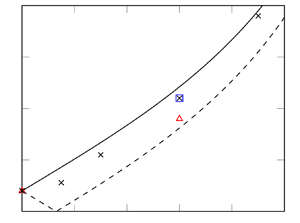
On low-frequency unsteadiness in swept shock wave–boundary layer interactions
-
- Journal:
- Journal of Fluid Mechanics / Volume 956 / 10 February 2023
- Published online by Cambridge University Press:
- 25 January 2023, R1
-
- Article
-
- You have access
- Open access
- HTML
- Export citation
High temporal contrast 1053 nm laser source based on optical parametric amplification and second-harmonic generation
-
- Journal:
- High Power Laser Science and Engineering / Volume 11 / 2023
- Published online by Cambridge University Press:
- 25 January 2023, e1
-
- Article
-
- You have access
- Open access
- HTML
- Export citation
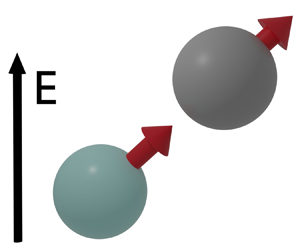
An electrohydrodynamic dance of unequal partners
-
- Journal:
- Journal of Fluid Mechanics / Volume 956 / 10 February 2023
- Published online by Cambridge University Press:
- 25 January 2023, F1
-
- Article
-
- You have access
- HTML
- Export citation
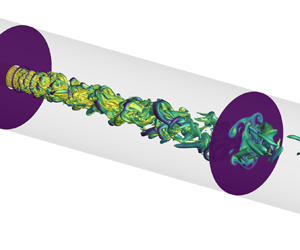
Coaxial jets with disparate viscosity: mixing and laminarization characteristics
-
- Journal:
- Journal of Fluid Mechanics / Volume 955 / 25 January 2023
- Published online by Cambridge University Press:
- 25 January 2023, A43
-
- Article
-
- You have access
- Open access
- HTML
- Export citation
-
Mixing of fluids in a coaxial jet is studied under four distinct viscosity ratios, $m=1$, $10$,
$10$,  $20$ and $40$, using highly resolved large-eddy simulations (LES), particle image velocimetry and planar laser-induced fluorescence. The accuracy of predictions is tested against data obtained by the simultaneous experimental measurements of velocity and concentration fields. For the highest and lowest viscosity ratios, standard RANS models with unclosed terms pertaining to viscosity variations are employed. We show that the standard Reynolds-averaged Navier–Stokes (RANS) approach with no explicit modelling for variable-viscosity terms is not applicable whereas dynamic LES models provide high-quality agreement with the measurements. To identify the underlying mixing physics and sources of discrepancy in RANS predictions, two distinct mixing modes are defined based on the viscosity ratio. Then, for each mode, the evolution of mixing structures, momentum budget analysis with emphasis on variable-viscosity terms, analysis of the turbulent activity and decay of turbulence are investigated using highly resolved LES data. The mixing dynamics is found to be quite distinct in each mixing mode. Variable viscosity manifests multiple effects that are working against each other. Viscosity gradients induce additional instabilities while increasing overall viscosity decreases the effective Reynolds number leading to laminarization of the turbulent jet, explaining the lack of dispersion and turbulent diffusion. Momentum budget analysis reveals that variable-viscosity terms are significant to be neglected. The scaling of the energy spectrum cascade suggests that in the TLL mode the unsteady laminar shedding is responsible for the eddies observed.


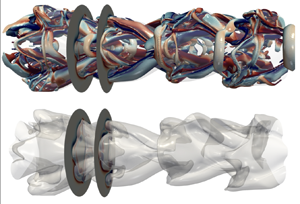
Direct numerical simulations of turbulent jets: vortex–interface–surfactant interactions
-
- Journal:
- Journal of Fluid Mechanics / Volume 955 / 25 January 2023
- Published online by Cambridge University Press:
- 24 January 2023, A42
-
- Article
-
- You have access
- Open access
- HTML
- Export citation
Comparison of the compressible μ(I) class of models and non-local models with the discrete element method (DEM) for steady fully developed flow of cohesionless granular materials through a vertical channel – CORRIGENDUM
-
- Journal:
- Journal of Fluid Mechanics / Volume 955 / 25 January 2023
- Published online by Cambridge University Press:
- 24 January 2023, E1
-
- Article
-
- You have access
- Open access
- HTML
- Export citation

Thermodynamically consistent phase-field modelling of activated solute transport in binary solvent fluids
-
- Journal:
- Journal of Fluid Mechanics / Volume 955 / 25 January 2023
- Published online by Cambridge University Press:
- 24 January 2023, A41
-
- Article
- Export citation
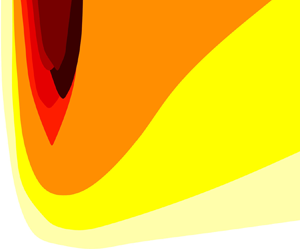
Forced rotation enhances cylinder flow-induced vibrations at subcritical Reynolds number
-
- Journal:
- Journal of Fluid Mechanics / Volume 955 / 25 January 2023
- Published online by Cambridge University Press:
- 24 January 2023, R3
-
- Article
-
- You have access
- Open access
- HTML
- Export citation
-
When a cylinder is mounted on an elastic support within a current, vortex-induced vibrations (VIV) may occur down to a Reynolds number (Re) close to $20$, based on the body diameter ( $D$) and inflow velocity ( $U$), i.e. below the critical value of $47$ reported for the onset of flow unsteadiness when the body is fixed. The impact of a forced rotation of the elastically mounted cylinder on the system behaviour is explored numerically for $Re \leqslant 30$, over wide ranges of values of the rotation rate (ratio between body surface velocity and $U$,
$U$,  $\alpha \in [0,5]$) and reduced velocity (inverse of the oscillator natural frequency non-dimensionalized by $D$ and $U$,
$U$,  $U^\star \in [2,30]$). The influence of the rotation is not monotonic, but the most prominent effect uncovered in this work is a substantial enhancement of the subcritical-Re, flow-induced vibrations beyond $\alpha =2$. This enhancement is twofold. First, the rotation results in a considerable expansion of the vibration/flow unsteadiness region in the $({Re},U^\star )$ domain, down to $Re=4$. Second, the elliptical orbits described by the rotating body are subjected to a major amplification, with a transition from VIV to responses whose magnitude tends to increase unboundedly with $U^\star$, even though still synchronized with flow unsteadiness. The emergence of such galloping-like oscillations close to the onset of vibrations disrupts the scenario of gradual vibration growth with Re, as amplitudes larger than $10$ body diameters may be observed at $Re=10$.


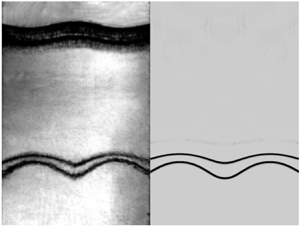
Hydrodynamic instabilities of two successive slow/fast interfaces induced by a weak shock
-
- Journal:
- Journal of Fluid Mechanics / Volume 955 / 25 January 2023
- Published online by Cambridge University Press:
- 23 January 2023, A40
-
- Article
- Export citation
Demonstration of a petawatt-scale optical parametric chirped pulse amplifier based on yttrium calcium oxyborate
-
- Journal:
- High Power Laser Science and Engineering / Volume 11 / 2023
- Published online by Cambridge University Press:
- 23 January 2023, e2
-
- Article
-
- You have access
- Open access
- HTML
- Export citation
Identification of the energy contributions associated with wall-attached eddies and very-large-scale motions in the near-neutral atmospheric surface layer through wind LiDAR measurements
-
- Journal:
- Journal of Fluid Mechanics / Volume 955 / 25 January 2023
- Published online by Cambridge University Press:
- 23 January 2023, A39
-
- Article
-
- You have access
- Open access
- HTML
- Export citation
Locality of triad interaction and Kolmogorov constant in inertial wave turbulence
-
- Journal:
- Journal of Fluid Mechanics / Volume 955 / 25 January 2023
- Published online by Cambridge University Press:
- 23 January 2023, R2
-
- Article
- Export citation
-
Using the theory of wave turbulence for rapidly rotating incompressible fluids derived by Galtier (Phys. Rev. E, vol. 68, 2003, 015301), we find the locality conditions that the solutions of the kinetic equation must satisfy. We show that the exact anisotropic Kolmogorov–Zakharov spectrum satisfies these conditions, which justifies the existence of this constant (positive) energy flux solution. Although a direct cascade is predicted in the transverse ( $\perp$) and parallel ( $\parallel$) directions to the rotation axis, we show numerically that in the latter case some triadic interactions can have a negative contribution to the energy flux, while in the former case all interactions contribute to a positive flux. Neglecting the parallel energy flux, we estimate the Kolmogorov constant at $C_K \simeq 0.749$. These results provide theoretical support for recent numerical and experimental studies.


Turbulent Flows
-
- Published online:
- 20 January 2023
- Print publication:
- 10 August 2000
-
- Book
- Export citation
Particle-size segregation in self-channelized granular flows
-
- Journal:
- Journal of Fluid Mechanics / Volume 955 / 25 January 2023
- Published online by Cambridge University Press:
- 20 January 2023, A38
-
- Article
-
- You have access
- Open access
- HTML
- Export citation
