To save content items to your account,
please confirm that you agree to abide by our usage policies.
If this is the first time you use this feature, you will be asked to authorise Cambridge Core to connect with your account.
Find out more about saving content to .
To save content items to your Kindle, first ensure no-reply@cambridge.org
is added to your Approved Personal Document E-mail List under your Personal Document Settings
on the Manage Your Content and Devices page of your Amazon account. Then enter the ‘name’ part
of your Kindle email address below.
Find out more about saving to your Kindle.
Note you can select to save to either the @free.kindle.com or @kindle.com variations.
‘@free.kindle.com’ emails are free but can only be saved to your device when it is connected to wi-fi.
‘@kindle.com’ emails can be delivered even when you are not connected to wi-fi, but note that service fees apply.
Many individuals with first-episode psychosis experience severe and persistent social disability despite receiving specialist early intervention. The SUPEREDEN3 trial assessed whether augmenting early intervention in psychosis services with Social Recovery Therapy (SRT) would lead to better social recovery.
Aims:
A qualitative process evaluation was conducted to explore implementation and mechanisms of SRT impact from the perspective of SUPEREDEN3 participants.
Method:
A subsample of SUPEREDEN3 trial participants (n = 19) took part in semi-structured interviews, which were transcribed verbatim and analysed thematically. Trial participants were early intervention service users aged 16–35 years with severe and persistent social disability. Both SRT plus early intervention and early intervention alone arm participants were interviewed to facilitate better understanding of the context in which SRT was delivered and to aid identification of mechanisms specific to SRT.
Results:
The six themes identified were used to generate an explanatory model of SRT’s enhancement of social recovery. Participant experiences highlight the importance of the therapist cultivating increased self-understanding and assertively encouraging clients to face feared situations in a way that is perceived as supportive, while managing ongoing symptoms. The sense of achievement generated by reaching targets linked to personally meaningful goals promotes increased self-agency, and generates hope and optimism.
Conclusions:
The findings suggest potentially important processes through which social recovery was enhanced in this trial, which will be valuable in ensuring the benefits observed can be replicated. Participant accounts provide hope that, with the right support, even clients who have persistent symptoms and the most severe disability can make a good social recovery.
Vowels are associated with valence, so that words containing /i/ (as in English meet) compared with /o/ (as in French rose) are typically judged to match positively valenced persons and objects. As yet, valence sound symbolism has been mainly observed for Indo-European languages. The present research extends this to a comparison of Japanese-speaking and German-speaking participants. Participants invented pseudo-words as names for faces with different emotional expressions (happy vs. neutral vs. sad vs. angry). For both Japanese-speaking and German-speaking participants, vowel usage depended on emotional valence. The vowel I was used more for positive (vs. other) expressions, whereas O and U were used less for positive (vs. other) expressions. A was associated with positive emotional valence for Japanese-speaking but not German-speaking participants. In sum, emotional valence associations of I (vs. rounded vowels) were similar in German and Japanese, suggesting that sound symbolism for emotional valence is not language specific.
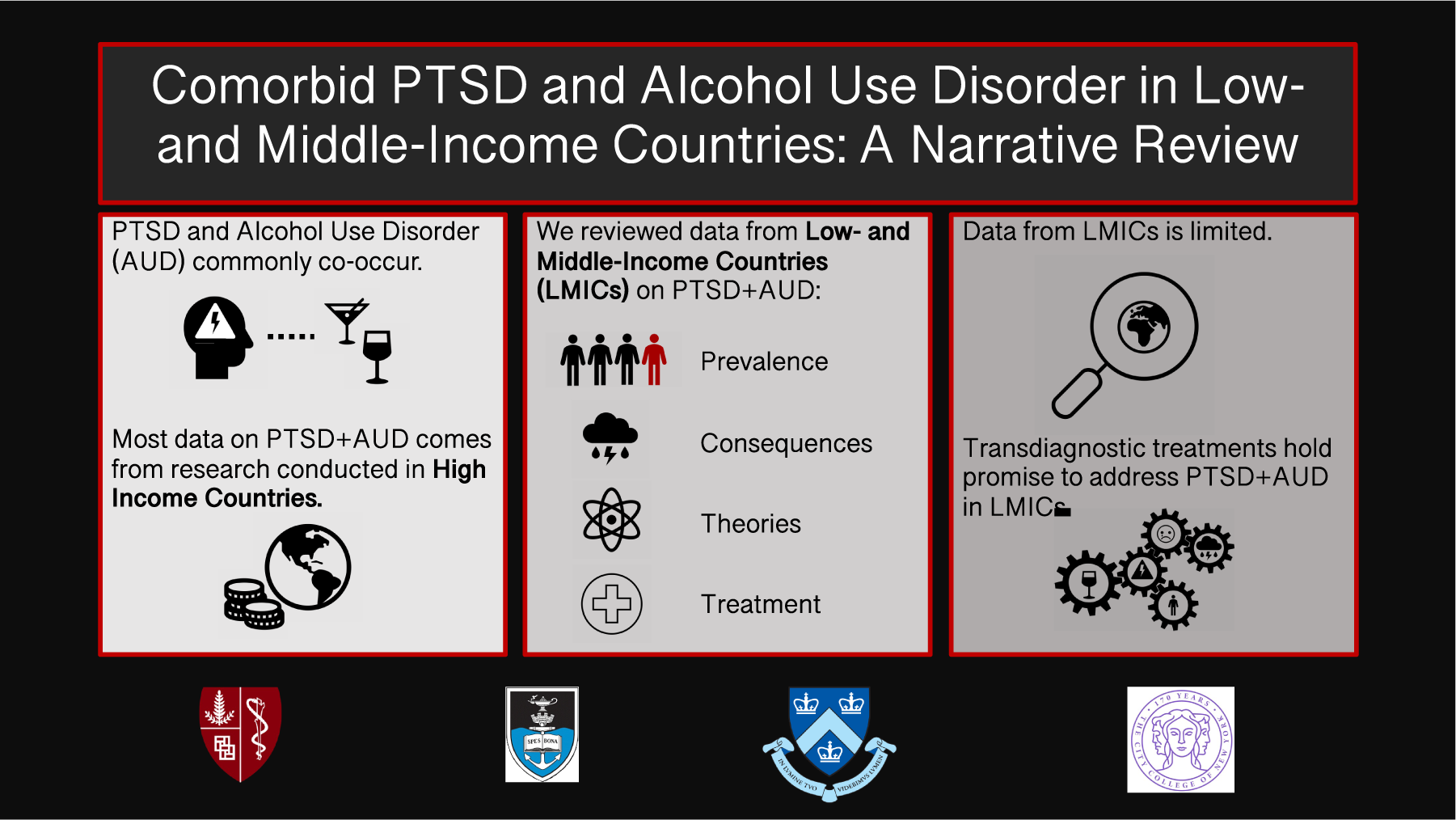
Much of the research on posttraumatic stress disorder (PTSD) and alcohol use disorder (AUD) has been conducted in high-income countries (HICs). However, PTSD and AUD commonly co-occur (PTSD + AUD) are both associated with high global burden of disease, and disproportionately impact those in low- and middle-income countries (LMICs). This narrative review attempts to synthesize the research on prevalence, impact, etiological models, and treatment of PTSD + AUD drawing from research conducted in HICs and discussing the research that has been conducted to date in LMICs. The review also discusses overall limitations in the field, including a lack of research on PTSD + AUD outside of HICs, issues with measurement of key constructs, and limitations in sampling strategies across comorbidity studies. Future directions are discussed, including a need for rigorous research studies conducted in LMICs that focus on both etiological mechanisms and on treatment approaches.
With the launch of the Prisms Global Mental Health series, we are taking the opportunity to make explicit our vision for Global Mental Health. We strongly propose a Public Mental Health approach, incorporating culture and context and prioritizing equity and inclusion, particularly of previously marginalized groups. In using a Public Mental Health approach, we are framing Global Mental Health research as population-oriented research that seeks to understand the etiology, prevention, promotion, and treatment of mental and behavioral health problems with a strong emphasis on ‘knowledge generation’ which is relevant, transferable, and generalizable to different populations and settings. The public health approach also incorporates policy and systems research and evaluation, with a particular focus on accessibility and quality of care and human rights. By using the term Global, we are being explicit in acknowledging the role(s) of culture and context in all stages of research, from conceptualization through interpretation and dissemination. In centering equity and inclusion, we are advocating for a focus on populations who have been marginalized and have not been well represented within Global Mental Health research and active participation of voices of the populations that are included in the research. We are also working to promote participation of individuals from diverse and underrepresented communities and diverse experiences, including those with lived experience, in all stages of research pipeline: from conceptualization to publication of findings. Our readers will see these values and ideas operationalized in the choice of article topics and the published manuscripts as well as in the editorial and advisory board membership and selection of reviewers.
Drawing on naturally-occurring bilingual speech from a well-defined codeswitching community in Southern Arizona, this study examined the influence of semantic gender (a.k.a. biological gender), analogical gender, and other-language phonemic cues in modulating gender assignment in Spanish–English codeswitched speech. Thirty-four Spanish–English early bilinguals completed a forced-choice elicitation task involving two codeswitching environments: Spanish determiner–English noun switches (Task 1) and English–Spanish switched copula constructions (Task 2). The results revealed that for human-denoting nouns, bilinguals assigned grammatical gender based on the presupposed sex of a noun's referent in both syntactic environments tested. As for inanimate nouns, bilinguals were more likely to assign masculine over feminine gender to such nouns in determiner–noun switches, but not in switched copula constructions. Other-language phonemic cues did not influence the assignment mechanism. A methodological implication is that the study replicated the codeswitching patterns observed in naturally-occurring bilingual speech from the same bilingual community.
This study examined children’s exposure to family adversity, hostile reactivity to parental conflict, and negative family representations as mediators of the prospective relation between their temperamental exuberance and externalizing symptoms. Participants included 243 preschool children (Mage = 4.60 years; 56% girls) and parents (48% Black; 16% Latinx) in a multi-method and multi-informant study with three annual measurement occasions. Structural equation model results specifically supported children’s hostile reactivity to parental conflict and negative family representations as mediators. Exuberance predicted residualized increases in children’s hostile reactivity and negative family representations over a 1-year period. In turn, children’s hostile reactivity and negative family representations predicted their greater externalizing symptoms 1 year later after controlling for prior externalizing symptoms. Results are discussed in the context of their relation and refinement of temperamental models of developmental psychopathology.
Children with genetic conditions may experience significant mental health difficulties such as anxiety and challenging behaviour. However, understanding of the feasibility and effectiveness of psychological interventions for emotional and behavioural problems in the context of genetic conditions is limited. Low-intensity psychological interventions have demonstrated promise in paediatric populations and may be able to address their mental health difficulties. A case series design was used to assess the feasibility of low-intensity interventions for emotional and behavioural difficulties in children and young people with genetic conditions recruited from a mental health drop-in centre at a tertiary hospital. Participants received seven weekly sessions with a trained practitioner. The intervention was based on existing modular treatments and evidence-based self-help materials. Feasibility and treatment satisfaction were assessed, as well as measures of symptoms of anxiety and challenging behaviour, treatment goals and quality of life, at baseline, during treatment and 6-month follow-up. Five participants received treatment for challenging behaviour, one for anxiety, and one for obsessive compulsive disorder. All participants completed treatment. Clinically significant change in the SDQ Total score was found in three participants. All participants demonstrated progress in goals and symptoms of emotional and behavioural difficulties over the course of treatment. Low-intensity psychological interventions for emotional and behavioural difficulties in children and young people with genetic conditions is feasible, acceptable and potentially beneficial. Further research is warranted to examine the effectiveness of the intervention and its use in clinical paediatric settings.
Key learning aims
(1) To gain a basic understanding of low-intensity psychological intervention in children and young people with genetic conditions.
(2) To enhance understanding of the practicalities and acceptability of delivering low-intensity psychological intervention to children and young people with genetic conditions and co-morbid emotional and behavioural difficulties.
(3) To learn about the potential clinical benefits of delivering low-intensity psychological intervention to children and young people with genetic conditions in the context of stepped care.
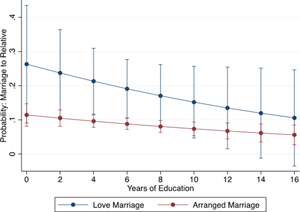
Success in marriage markets has lasting impacts on women's wellbeing. By arranging marriages, parents exert financial and social powers to influence spouse characteristics and ensure optimal marriages. While arranging marriages is a major focus of parental investment, marriage decisions are also a source of conflict between parents and daughters in which parents often have more power. The process of market integration may alter parental investment strategies, however, increasing children's bargaining power and reducing parents’ influence over children's marriage decisions. We use data from a market integrating region of Bangladesh to (a) describe temporal changes in marriage types, (b) identify which women enter arranged marriages and (c) determine how market integration affects patterns of arranged marriage. Most women's marriages were arranged, with love marriages more recent. We found few predictors of who entered arranged vs. love marriages, and family-level market integration did not predict marriage type at the individual level. However, based on descriptive findings, and findings relating women's and fathers’ education to groom characteristics, we argue that at the society-level market integration has opened a novel path in which daughters use their own status, gained via parental investments, to facilitate good marriages under conditions of reduced parental assistance or control.
Children differ in their environmental sensitivity (ES), which can be measured observationally or by self-report questionnaire. A parent-report scale represents an important tool for investigating ES in younger children but has to be psychometrically robust and valid. In the current multistudy, we validated the parent-report version of the Highly Sensitive Child (HSC-PR) scale in Italian children, evaluating its factorial structure (Study 1, N = 1,857, 6.2 years, age range: 2.6–14 years) through a multigroup Confirmatory Factory Analysis in preschoolers (n = 1,066, 4.2 years) and school-age children (n = 791, 8.8 years). We then investigated the HSC-PR relationship with established temperament traits (Study 2, N = 327, 4.3 years), before exploring whether the scale moderates the effects of parenting stress on children’s emotion regulation (Study 3, N = 112, 6.5 years). We found support for a bi-factor structure in both groups, though in preschoolers minor adaptations were suggested for one item. Importantly, the HSC-PR did not fully overlap with common temperament traits and moderated the effects of parenting stress on children emotion regulation. To conclude, the HSC-PR performs well and appears to capture ES in children.
The Tower of London – Freiburg version (TOL-F) was developed in three parallel-test versions (A, B, and C) that only differ in their physical appearance by interchanged ball colors, but not in their cognitive demands. We addressed the question whether the test–retest reliability of an identical problem set differs from the parallel test–retest reliability of a structurally identical problem set with a marginally different physical appearance.
Methods:
Reliabilities were assessed in two samples of young adults over a 1-week interval: In the parallel test–retest sample (n = 93; 49 female), half of the participants accomplished version A at the first session and version B at the second session, while the other half started with version B in the first session and continued with A in the second session. In the identical test–retest sample (n = 86; 48 female), half of the participants performed on version A in both the first and the second session, while the other half went through the same procedure with version B.
Results:
For overall planning accuracy, intraclass correlation coefficients for absolute agreement were r = .501 for the parallel test–retest and r = .605 for the identical test–retest sample, with Pearson correlations of r = .559 and r = .708 respectively. Greatest lower bound estimates of reliability were adequate to high in the two samples (ranging between .765 and .854) confirming previous studies.
Conclusions:
Although the TOL-F revealed only moderate intraclass correlations for absolute agreement, it showed some of the highest psychometric indices compared to repeated assessments with other TOL tests.
Extensive evidence has demonstrated that bilinguals non-selectively activate lexicons of both languages when reading or hearing words in one language. Here, we further investigated the electrophysiological roles of cross-linguistic orthography and phonology in the processing of L2 spoken words in unbalanced Chinese (L1)–English (L2) bilinguals in a cross-modal situation. Relative to unrelated control, the recognition of auditory L2 words showed behavioral interference effects when paired with orthographic or phonological neighbors of the correct translations of L2 words. Moreover, the lexical effects were also exhibited in the electrophysiological data, as reflected by marginally less positive late positive component (500–800 ms) amplitudes in the frontal region. Importantly, the orthographic rather than phonological translation neighbor condition elicited less negative N400 (300–500 ms) amplitudes in the parietal–occipital regions, suggesting that this orthographic translation neighbor condition facilitated the co-activation of spoken L2 words. Taken together, these findings indicate that cross-linguistic orthographic and phonological activation have different temporal dynamics with both bottom-up parallel cross-linguistic activation and the top-down inhibitory control mechanism governing the two-language lexical organization in L2 spoken word recognition.
Adolescence is an important stage for the development of emotion regulation skills, especially for adolescent girls who are at elevated risk for the development of depression and anxiety. Although some emotion regulation strategies are more effective at helping adolescents regulate negative affect on average, research indicates strategy effectiveness varies with the context in which a strategy is deployed. Yet less work has been done examining which contextual factors are associated with adolescents switching emotion regulation strategies in their daily lives. This study examined individual and contextual factors related to negative interpersonal events that are associated with strategy effectiveness, including age, emotional intensity, perceived controllability, and co-regulatory support, and their association with adolescent emotion regulation strategy switching in daily life via ecological momentary assessment. Results indicated that adolescent girls differed in the degree to which they altered their emotion regulation strategies throughout their daily lives, and that switching strategies was associated with age as well as individual and within-person differences in perceived controllability, emotional intensity, and co-regulatory support. This study provides critical proof-of-concept of the utility of emotion regulation strategy switching as a measure of regulatory flexibility and highlights regulatory processes that may hold clues to the mechanisms of developmental psychopathology.
Drawing on the adaptive control hypothesis, we examined whether older adults’ bilingual interactional contexts of conversational exchanges would predict important indices of executive functions (EF). We assessed participants’ engagement in each bilingual interactional context – single-language, dual-language, and dense code-switching – and their performance on a series of nonverbal EF measures. Sixty-nine healthy older adults (Mage = 70.39 years; ages 60–93) were recruited from local community centers. We found that the dense code-switching context was associated with enhanced overall EF, but not individual facets of EF (inhibitory control, shifting, and updating). These findings held true when we controlled for a host of covariates. Our findings shed light on aging bilinguals’ interactional contexts as crucial bilingual experiences that modulate overall EF. Given that bilingualism is a multidimensional construct, rather than a unidimensional variable, our study underscores the importance of more fine-grained operationalisation of bilingualism when studying its impacts on EF.
As word formation can be conceptualized as an act of creativity with considerable space for differences among speakers, we present pilot research aimed at the examination of the role of Big-Five personality domains in the formation of new complex words. The sample consisted of 197 participants who underwent a word formation test and a personality assessment via The Next Big-Five Inventory. The results indicate that when ordinal regression is conducted with an aim of accounting for age and gender, open-mindedness is shown as a potentially important predictor – it positively predicted economy of expression and negatively predicted semantic transparency. Furthermore, a more nuanced approach differentiating three facets of open-mindedness shows that creative imagination predicted semantic transparency positively while esthetic sensitivity predicts semantic transparency negatively (the reverse is true for the economy of expression). These findings provide a promising starting point for future research.
Heavy episodic drinking (HED) is a major public health concern, and youth who engage in HED are at increased risk for alcohol-related problems that continue into adulthood. Importantly, there is heterogeneity in the onset and course of adolescent HED, as youth exhibit different trajectories of initiation and progression into heavy drinking. Much of what is known about the etiology of adolescent HED and alcohol-related problems that persist into adulthood comes from studies of predominantly White, middle-class youth. Because alcohol use and related problems vary by race/ethnicity and socioeconomic status, it is unclear whether previous findings are relevant for understanding developmental antecedents and distal consequences of adolescent HED for minoritized individuals. In the current study, we utilize a developmental psychopathology perspective to fill this gap in the literature. Using a racially and economically diverse cohort followed from adolescence well into adulthood, we apply group-based trajectory modeling (GBTM) to identify patterns of involvement in HED from age 14 to 17 years. We then investigate developmental antecedents of GBTM class membership, and alcohol-related distal outcomes in adulthood (∼ age 31 years) associated with GBTM class membership. Results highlight the importance of adolescent alcohol use in predicting future alcohol use in adulthood.
Previous research has shown that using foreign languages reduces cognitive biases. Here, we investigate whether this foreign-language effect extends to self-related cognition – in particular, the self-positivity bias, which refers to automatic association of oneself with positive information and has a facilitation role in maintaining mental health. We applied event-related brain potentials and oscillations in the implicit association test where Chinese–English bilinguals responded to category words (self vs. others) and attribute words (positive vs. negative) in either their native language Chinese or their foreign language English. In response to Chinese words, a self-positivity bias occurred, indexed by a positive D-score in reaction times as well as by smaller N200, larger P3-like/LPC responses, and lower alpha desynchronization when self words were associated with positive relative to negative traits. However, the bias was diminished in the English context. Overall, our findings provide important implications for language choices when self-protective mechanisms should be enhanced.
The early stages of the COVID-19 pandemic and associated stay-at-home orders resulted in a stark reduction in daily social interactions for children and adolescents. Given that peer relationships are especially important during this developmental stage, it is crucial to understand the impact of the COVID-19 pandemic on social behavior and risk for psychopathology in children and adolescents. In a longitudinal sample (N=224) of children (7-10y) and adolescents (13-15y) assessed at three strategic time points (before the pandemic, during the initial stay-at-home order period, and six months later after the initial stay-at-home order period was lifted), we examine whether certain social factors protect against increases in stress-related psychopathology during the pandemic, controlling for pre-pandemic symptoms. Youth who reported less in-person and digital socialization, greater social isolation, and less social support had worsened psychopathology during the pandemic. Greater social isolation and decreased digital socialization during the pandemic were associated with greater risk for psychopathology after experiencing pandemic-related stressors. In addition, children, but not adolescents, who maintained some in-person socialization were less likely to develop internalizing symptoms following exposure to pandemic-related stressors. We identify social factors that promote well-being and resilience in youth during this societal event.
While recent years have seen a substantial increase of studies investigating vocal iconicity in the lexicon of spoken languages, its presence in grammatical structures is poorly understood. This study investigates the presence of vocal iconicity in nominal classification systems by collecting nominal classification devices from the two main system types: 210 non-agreeing languages (126 families) and 151 agreeing languages (123 families). To detect overrepresentations of sound types in class meanings, the nominal classification devices were grouped according to comparable semantic categories, transcribed using comparable phonetic system, and analyzed through Bayesian mixed models. The strongest results were found for associations between nominal classification devices denoting flat and low, front, unrounded vowels, along with several weak associations relating to shape/size/quantity, function, humanness/animacy, and sex. These associations mostly correlate with previous vocal iconicity findings, but crucially, the involved nominal classification devices are mostly semantically typical for non-agreeing, for example, classifier, systems. These findings were attributed to structural differences between nominal classification system types, which result from grammaticalization processes, for example, phonetic erosion and semantic bleaching. Thus, increased formal predictability through grammatical agreement comes at a cost of semantic transparency which, in turn, dismantles the semantic prerequisites needed for vocal iconic associations to be operational.