We partner with a secure submission system to handle manuscript submissions.
Please note:
Click Proceed to submission system to continue to our partner's website.
Helm Glacier is a World Glacier Monitoring Service reference glacier and is one of three glaciers in Western Canada with a mass balance record which exceeds 40 years. An ice-penetrating radar survey reveals a mean and maximum ice thickness of 13.0 and  $37.2\,\mathrm{m}$, respectively. We combine ice thickness data and altimetric data from repeat LiDAR surveys to project ice disappearance. We use simple extrapolation and a multivariate linear regression to predict surface elevation change based on incoming shortwave radiation, end-of-winter snow depth, positive degree days, slope and aspect. Both approaches project the disappearance of Helm Glacier by 2035. We estimate that Helm Glacier has a current mass balance sensitivity to temperature of ${\mathrm C}_{\mathrm T}=-0.58\,{\mathrm m\boldsymbol\,\mathrm w.\mathrm e.\boldsymbol\,\mathrm a}^{-1}\,^\circ\,\mathrm C^{-1}$, which is slightly less negative than the balance sensitivity of ${\mathrm C}_{\mathrm T}=-0.64\,{\mathrm m\boldsymbol\,\mathrm w.\mathrm e.\boldsymbol\,\mathrm a}^{-1}\,^\circ\,\mathrm C^{-1}$ derived from the in situ balance record. Helm Glacier is more than 4 $\rm{^\circ}C$ out of balance with current climate conditions [2014–24].
Atmospheric warming is causing glaciers worldwide to retreat and disappear, with repercussions for nearby communities. Effects of glacier retreat have been especially consequential for mountain resorts such as Whistler Blackcomb, Canada, where nearly 60 years of summer glacier use by skiing has been terminated due to the ongoing demise of Whistler, Horstman and Blackcomb Glaciers. Over the past five decades, these three glaciers decreased in area by 95%, 75% and 60%, respectively. Using a degree-day model with downscaled CMIP6 data, we project that Whistler Glacier will disappear within the next decade, whereas Horstman and Blackcomb Glaciers will vanish in the next  $20\pm10$ years and $50\pm20$ years, respectively. The large uncertainty in disappearance dates depends primarily on the applied ice-thickness model. Our work demonstrates that ski resorts that rely on glaciers will need to balance current ice-preservation strategies with adaptation in light of ongoing future climate change.
Small glaciers (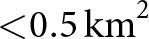 ${ \lt }0.5\,\mathrm{km}^2$), glacierets (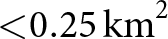 ${ \lt }0.25\,\mathrm{km}^2$) and, in particular, very small glacierets (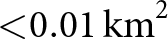 ${ \lt }0.01\,\mathrm{km}^2$), despite being numerous in mountain environments, are underrepresented in scientific inquiry when assessing their response to climate change. We present new insights into the vanishing (no visible surface ice whilst underlain by bedrock or water) of 77 very small glacierets distributed in the Northern and Central Andes of Chile. We also analyse the presumable vanishing (no visible surface ice whilst underlain by regolith) of 244 additional very small glacierets, comprising a total dataset of 321 very small glacierets within the study area, equivalent to the loss of $5.69\times 10^6\,\mathrm{m}^3$ of water equivalent ice volume according to the 2022 Chilean Public Glacier Inventory. Our results show that 45.5% of the sample shrank from individually small glaciers at the beginning of the 21st century, whereas 53.0% of the sample vanished after being fragmented from larger glaciers in the same time span. The observed generalised reduction behaviour and vanishing results after extremely dry conditions at the end of the 2009–2022 Central Andes megadrought. We discuss our results in terms of the minimum area threshold for classifying very small glacierets, and whether their vanishing poses a hydrological impact.