Refine listing
Actions for selected content:
22 results in 08Cxx
Corrigendum: “On the representability of actions of Leibniz algebras and Poisson algebras”
- Part of
-
- Journal:
- Proceedings of the Edinburgh Mathematical Society / Volume 68 / Issue 4 / November 2025
- Published online by Cambridge University Press:
- 11 September 2025, pp. 1419-1420
-
- Article
-
- You have access
- HTML
- Export citation
DUALITY FOR CLANS: AN EXTENSION OF GABRIEL–ULMER DUALITY
- Part of
-
- Journal:
- The Journal of Symbolic Logic , First View
- Published online by Cambridge University Press:
- 15 May 2025, pp. 1-38
-
- Article
- Export citation
RINGS WITH COMMON DIVISION, COMMON MEADOWS AND THEIR CONDITIONAL EQUATIONAL THEORIES
- Part of
-
- Journal:
- The Journal of Symbolic Logic , First View
- Published online by Cambridge University Press:
- 23 December 2024, pp. 1-31
-
- Article
- Export citation
-
We examine the consequences of having a total division operation $\frac {x}{y}$ on commutative rings. We consider two forms of binary division, one derived from a unary inverse, the other defined directly as a general operation; each are made total by setting $1/0$ equal to an error value $\bot $, which is added to the ring. Such totalised divisions we call common divisions. In a field the two forms are equivalent and we have a finite equational axiomatisation E that is complete for the equational theory of fields equipped with common division, which are called common meadows. These equational axioms E turn out to be true of commutative rings with common division but only when defined via inverses. We explore these axioms E and their role in seeking a completeness theorem for the conditional equational theory of common meadows. We prove they are complete for the conditional equational theory of commutative rings with inverse based common division. By adding a new proof rule, we can prove a completeness theorem for the conditional equational theory of common meadows. Although, the equational axioms E fail with common division defined directly, we observe that the direct division does satisfy the equations in E under a new congruence for partial terms called eager equality.


On the representability of actions of Leibniz algebras and Poisson algebras
- Part of
-
- Journal:
- Proceedings of the Edinburgh Mathematical Society / Volume 66 / Issue 4 / November 2023
- Published online by Cambridge University Press:
- 22 November 2023, pp. 998-1021
-
- Article
- Export citation
B-SYSTEMS AND C-SYSTEMS ARE EQUIVALENT
- Part of
-
- Journal:
- The Journal of Symbolic Logic / Volume 89 / Issue 4 / December 2024
- Published online by Cambridge University Press:
- 29 June 2023, pp. 1513-1521
- Print publication:
- December 2024
-
- Article
-
- You have access
- Open access
- HTML
- Export citation
THE EMBEDDING PROPERTY FOR SORTED PROFINITE GROUPS
- Part of
-
- Journal:
- The Journal of Symbolic Logic / Volume 88 / Issue 3 / September 2023
- Published online by Cambridge University Press:
- 20 March 2023, pp. 1005-1037
- Print publication:
- September 2023
-
- Article
- Export citation
-
We study the embedding property in the category of sorted profinite groups. We introduce a notion of the sorted embedding property (SEP), analogous to the embedding property for profinite groups. We show that any sorted profinite group has a universal SEP-cover. Our proof gives an alternative proof for the existence of a universal embedding cover of a profinite group. Also our proof works for any full subcategory of the sorted profinite groups, which is closed under taking finite quotients, fibre products, and inverse limits. We also show that any sorted profinite group having SEP has a sorted complete system whose theory is $\omega $-categorical and $\omega $-stable under the assumption that the set of sorts is countable.


Algebras with representable representations
- Part of
-
- Journal:
- Proceedings of the Edinburgh Mathematical Society / Volume 64 / Issue 3 / August 2021
- Published online by Cambridge University Press:
- 24 June 2021, pp. 555-573
-
- Article
-
- You have access
- Open access
- HTML
- Export citation
-
Just like group actions are represented by group automorphisms, Lie algebra actions are represented by derivations: up to isomorphism, a split extension of a Lie algebra $B$
 by a Lie algebra $X$
 corresponds to a Lie algebra morphism $B\to {\mathit {Der}}(X)$
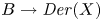 from $B$
 to the Lie algebra ${\mathit {Der}}(X)$
 of derivations on $X$
 . In this article, we study the question whether the concept of a derivation can be extended to other types of non-associative algebras over a field ${\mathbb {K}}$
 , in such a way that these generalized derivations characterize the ${\mathbb {K}}$
 -algebra actions. We prove that the answer is no, as soon as the field ${\mathbb {K}}$
 is infinite. In fact, we prove a stronger result: already the representability of all abelian actions – which are usually called representations or Beck modules – suffices for this to be true. Thus, we characterize the variety of Lie algebras over an infinite field of characteristic different from $2$
 as the only variety of non-associative algebras which is a non-abelian category with representable representations. This emphasizes the unique role played by the Lie algebra of linear endomorphisms $\mathfrak {gl}(V)$
 as a representing object for the representations on a vector space $V$
 .
.


REFLECTORS AND GLOBALIZATIONS OF PARTIAL ACTIONS OF GROUPS
- Part of
-
- Journal:
- Journal of the Australian Mathematical Society / Volume 104 / Issue 3 / June 2018
- Published online by Cambridge University Press:
- 14 August 2017, pp. 358-379
-
- Article
-
- You have access
- Export citation
-
Given a partial action $\unicode[STIX]{x1D703}$ of a group on a set with an algebraic structure, we construct a reflector of $\unicode[STIX]{x1D703}$ in the corresponding subcategory of global actions and study the question when this reflector is a globalization. In particular, if $\unicode[STIX]{x1D703}$ is a partial action on an algebra from a variety $\mathsf{V}$ , then we show that the problem reduces to the embeddability of a certain generalized amalgam of $\mathsf{V}$ -algebras associated with $\unicode[STIX]{x1D703}$ . As an application, we describe globalizable partial actions on semigroups, whose domains are ideals.


DUALITY FOR QUASIPOLYTOPES
- Part of
-
- Journal:
- Journal of the Australian Mathematical Society / Volume 101 / Issue 1 / August 2016
- Published online by Cambridge University Press:
- 26 February 2016, pp. 95-117
-
- Article
-
- You have access
- Export citation
SUPERNILPOTENCE PREVENTS DUALIZABILITY
- Part of
-
- Journal:
- Journal of the Australian Mathematical Society / Volume 96 / Issue 1 / February 2014
- Published online by Cambridge University Press:
- 30 September 2013, pp. 1-24
-
- Article
-
- You have access
- Export citation
DUALIZABILITY OF GRAPHS
- Part of
-
- Journal:
- Journal of the Australian Mathematical Society / Volume 89 / Issue 3 / December 2010
- Published online by Cambridge University Press:
- 24 February 2011, pp. 377-392
-
- Article
-
- You have access
- Export citation
Duality for distributive bisemilattices
- Part of
-
- Journal:
- Journal of the Australian Mathematical Society. Series A. Pure Mathematics and Statistics / Volume 51 / Issue 2 / October 1991
- Published online by Cambridge University Press:
- 09 April 2009, pp. 247-275
-
- Article
-
- You have access
- Export citation
Strong and full dualisability: three-element unary algebras
- Part of
-
- Journal:
- Journal of the Australian Mathematical Society / Volume 73 / Issue 2 / October 2002
- Published online by Cambridge University Press:
- 09 April 2009, pp. 187-220
-
- Article
-
- You have access
- Export citation
Lattices of pseudovarieties
- Part of
-
- Journal:
- Journal of the Australian Mathematical Society. Series A. Pure Mathematics and Statistics / Volume 46 / Issue 2 / April 1989
- Published online by Cambridge University Press:
- 09 April 2009, pp. 177-183
-
- Article
-
- You have access
- Export citation
Radical decompositions of idempotent algebras
- Part of
-
- Journal:
- Journal of the Australian Mathematical Society. Series A. Pure Mathematics and Statistics / Volume 36 / Issue 2 / April 1984
- Published online by Cambridge University Press:
- 09 April 2009, pp. 213-236
-
- Article
-
- You have access
- Export citation
The quest for strong dualities
- Part of
-
- Journal:
- Journal of the Australian Mathematical Society. Series A. Pure Mathematics and Statistics / Volume 58 / Issue 2 / April 1995
- Published online by Cambridge University Press:
- 09 April 2009, pp. 248-280
-
- Article
-
- You have access
- Export citation
The subdirect decomposition theorem for classes of structures closed under direct limits
- Part of
-
- Journal:
- Journal of the Australian Mathematical Society. Series A. Pure Mathematics and Statistics / Volume 30 / Issue 2 / December 1980
- Published online by Cambridge University Press:
- 09 April 2009, pp. 171-179
-
- Article
-
- You have access
- Export citation
Minimal varieties and quasivarieties
- Part of
-
- Journal:
- Journal of the Australian Mathematical Society. Series A. Pure Mathematics and Statistics / Volume 48 / Issue 1 / February 1990
- Published online by Cambridge University Press:
- 09 April 2009, pp. 133-147
-
- Article
-
- You have access
- Export citation
Transferring Optimal Dualities: Theory and Practice
- Part of
-
- Journal:
- Journal of the Australian Mathematical Society / Volume 74 / Issue 3 / June 2003
- Published online by Cambridge University Press:
- 09 April 2009, pp. 393-420
-
- Article
-
- You have access
- Export citation
-
Consider the quasi-variety
 generated by a finite algebra
  and assume that
  yields a natural duality on based on which is optimal modulo endomorphisms. We shoe that, provided satisfies certain minimality conditions, we can transfer this duality to a natural duality on based on
  , which is also optimal modulo endormorphisms, for any finite algebra in that has a subalgebra isomorphic to .
 generated by a finite algebra
  and assume that
  yields a natural duality on
  , which is also optimal modulo endormorphisms, for any finite algebra
 Mono-unary algebras are strongly dualizable
- Part of
-
- Journal:
- Journal of the Australian Mathematical Society / Volume 72 / Issue 2 / April 2002
- Published online by Cambridge University Press:
- 09 April 2009, pp. 161-172
-
- Article
-
- You have access
- Export citation
