Refine listing
Actions for selected content:
87 results in 16Wxx
Fixed-point permanence under actions by finite quantum groups
- Part of
-
- Journal:
- Canadian Mathematical Bulletin , First View
- Published online by Cambridge University Press:
- 16 January 2026, pp. 1-9
-
- Article
-
- You have access
- Open access
- HTML
- Export citation
-
Given an action by a finite quantum group $\mathbb {G}$ on a von Neumann algebra M, we prove that a number of familiar $W^*$ properties are equivalent for M and the fixed-point algebra $M^{\mathbb {G}}$ (i.e., hold or not simultaneously for the two algebras); these include being hyperfinite, atomic, diffuse, and of type I, $II$, or $III$. Moreover, in all cases, the canonical central projections of M and $M^{\mathbb {G}}$ cutting out the summand with the respective property coincide. The result generalizes its classical- $\mathbb {G}$ analog due to Jones–Takesaki.


Signature maps from positive cones on algebras with involution
- Part of
-
- Journal:
- Canadian Journal of Mathematics , First View
- Published online by Cambridge University Press:
- 12 November 2025, pp. 1-26
-
- Article
-
- You have access
- Open access
- HTML
- Export citation
On the central exponent of superalgebras with superinvolution
- Part of
-
- Journal:
- Canadian Mathematical Bulletin , First View
- Published online by Cambridge University Press:
- 22 September 2025, pp. 1-18
-
- Article
- Export citation
-
The growth of central polynomials for matrix algebras over a field of characteristic zero was first studied by Regev in $2016$. This problem can be generalized by analyzing the behavior of the dimension $c_n^z(A)$ of the space of multilinear polynomials of degree n modulo the central polynomials of an algebra A. In $2018$, Giambruno and Zaicev established the existence of the limit $\lim \limits _{n \to \infty }\sqrt [n]{c_n^{z}(A)}.$ In this article, we extend this framework to superalgebras equipped with a superinvolution, proving both the existence and the finiteness of the corresponding limit.


Corrigendum: “On the representability of actions of Leibniz algebras and Poisson algebras”
- Part of
-
- Journal:
- Proceedings of the Edinburgh Mathematical Society / Volume 68 / Issue 4 / November 2025
- Published online by Cambridge University Press:
- 11 September 2025, pp. 1419-1420
-
- Article
-
- You have access
- HTML
- Export citation
Topological Noetherianity of the infinite half-spin representations
- Part of
-
- Journal:
- Forum of Mathematics, Sigma / Volume 13 / 2025
- Published online by Cambridge University Press:
- 21 April 2025, e75
-
- Article
-
- You have access
- Open access
- HTML
- Export citation
Products of commutators in matrix rings
- Part of
-
- Journal:
- Canadian Mathematical Bulletin / Volume 68 / Issue 2 / June 2025
- Published online by Cambridge University Press:
- 14 January 2025, pp. 512-529
- Print publication:
- June 2025
-
- Article
-
- You have access
- Open access
- HTML
- Export citation
-
Let R be a ring and let $n\ge 2$. We discuss the question of whether every element in the matrix ring $M_n(R)$ is a product of (additive) commutators $[x,y]=xy-yx$, for $x,y\in M_n(R)$. An example showing that this does not always hold, even when R is commutative, is provided. If, however, R has Bass stable rank one, then under various additional conditions every element in $M_n(R)$ is a product of three commutators. Further, if R is a division ring with infinite center, then every element in $M_n(R)$ is a product of two commutators. If R is a field and $a\in M_n(R)$, then every element in $M_n(R)$ is a sum of elements of the form $[a,x][a,y]$ with $x,y\in M_n(R)$ if and only if the degree of the minimal polynomial of a is greater than $2$.
$2$.


Enlargements and Morita contexts for rings with involution
- Part of
-
- Journal:
- Glasgow Mathematical Journal / Volume 67 / Issue 2 / May 2025
- Published online by Cambridge University Press:
- 25 November 2024, pp. 131-162
-
- Article
-
- You have access
- Open access
- HTML
- Export citation
-
We study Morita equivalence for idempotent rings with involution. Following the ideas of Rieffel, we define Rieffel contexts, and we also introduce Morita $*$-contexts and enlargements for rings with involution. We prove that two idempotent rings with involution have a joint enlargement if and only if they are connected by a unitary and full Rieffel context. These conditions are also equivalent to having a unitary and surjective Morita $*$-context between those rings. We also examine how the mentioned conditions are connected to the existence of certain equivalence functors between the categories of firm modules over the given rings with involution.


Resolving dualities and applications to homological invariants
- Part of
-
- Journal:
- Canadian Journal of Mathematics / Volume 77 / Issue 6 / December 2025
- Published online by Cambridge University Press:
- 22 October 2024, pp. 1861-1889
- Print publication:
- December 2025
-
- Article
- Export citation
QUASI-HEREDITARY SKEW GROUP ALGEBRAS
- Part of
-
- Journal:
- Nagoya Mathematical Journal / Volume 257 / March 2025
- Published online by Cambridge University Press:
- 24 September 2024, pp. 1-44
-
- Article
- Export citation
Graded extensions of Verma modules
- Part of
-
- Journal:
- Mathematical Proceedings of the Cambridge Philosophical Society / Volume 177 / Issue 2 / September 2024
- Published online by Cambridge University Press:
- 08 November 2024, pp. 285-311
- Print publication:
- September 2024
-
- Article
-
- You have access
- Open access
- HTML
- Export citation
-
In this paper, we investigate extensions between graded Verma modules in the Bernstein–Gelfand–Gelfand category $\mathcal{O}$. In particular, we determine exactly which information about extensions between graded Verma modules is given by the coefficients of the R-polynomials. We also give some upper bounds for the dimensions of graded extensions between Verma modules in terms of Kazhdan–Lusztig combinatorics. We completely determine all extensions between Verma module in the regular block of category $\mathcal{O}$ for $\mathfrak{sl}_4$ and construct various “unexpected” higher extensions between Verma modules.


Pieri rules for skew dual immaculate functions
- Part of
-
- Journal:
- Canadian Mathematical Bulletin / Volume 67 / Issue 4 / December 2024
- Published online by Cambridge University Press:
- 29 April 2024, pp. 902-914
- Print publication:
- December 2024
-
- Article
-
- You have access
- Open access
- HTML
- Export citation
Graphical methods and rings of invariants on the symmetric algebra
- Part of
-
- Journal:
- Canadian Journal of Mathematics / Volume 76 / Issue 6 / December 2024
- Published online by Cambridge University Press:
- 28 November 2023, pp. 2173-2198
- Print publication:
- December 2024
-
- Article
-
- You have access
- Open access
- HTML
- Export citation
-
Let G be a complex classical group, and let V be its defining representation (possibly plus a copy of the dual). A foundational problem in classical invariant theory is to write down generators and relations for the ring of G-invariant polynomial functions on the space $\mathcal P^m(V)$ of degree-m homogeneous polynomial functions on V. In this paper, we replace $\mathcal P^m(V)$ with the full polynomial algebra $\mathcal P(V)$. As a result, the invariant ring is no longer finitely generated. Hence, instead of seeking generators, we aim to write down linear bases for bigraded components. Indeed, when G is of sufficiently high rank, we realize these bases as sets of graphs with prescribed number of vertices and edges. When the rank of G is small, there arise complicated linear dependencies among the graphs, but we remedy this setback via representation theory: in particular, we determine the dimension of an arbitrary component in terms of branching multiplicities from the general linear group to the symmetric group. We thereby obtain an expression for the bigraded Hilbert series of the ring of invariants on $\mathcal P(V)$. We conclude with examples using our graphical notation, several of which recover classical results.


On the representability of actions of Leibniz algebras and Poisson algebras
- Part of
-
- Journal:
- Proceedings of the Edinburgh Mathematical Society / Volume 66 / Issue 4 / November 2023
- Published online by Cambridge University Press:
- 22 November 2023, pp. 998-1021
-
- Article
- Export citation
Finite domination and Novikov homology over strongly $\mathbb {Z}^2$
 -graded rings
- Part of
-
- Journal:
- Proceedings of the Royal Society of Edinburgh. Section A: Mathematics / Volume 154 / Issue 6 / December 2024
- Published online by Cambridge University Press:
- 28 July 2023, pp. 1786-1818
- Print publication:
- December 2024
-
- Article
-
- You have access
- Open access
- HTML
- Export citation
-
Let $R$
 be a strongly $\mathbb {Z}^2$
 -graded ring, and let $C$
 be a bounded chain complex of finitely generated free $R$
 -modules. The complex $C$
 is $R_{(0,0)}$
 -finitely dominated, or of type $FP$
 over $R_{(0,0)}$
 , if it is chain homotopy equivalent to a bounded complex of finitely generated projective $R_{(0,0)}$
 -modules. We show that this happens if and only if $C$
 becomes acyclic after taking tensor product with a certain eight rings of formal power series, the graded analogues of classical Novikov rings. This extends results of Ranicki, Quinn and the first author on Laurent polynomial rings in one and two indeterminates.


SIMPLICITY OF LEAVITT PATH ALGEBRAS VIA GRADED RING THEORY
- Part of
-
- Journal:
- Bulletin of the Australian Mathematical Society / Volume 108 / Issue 3 / December 2023
- Published online by Cambridge University Press:
- 03 March 2023, pp. 428-437
- Print publication:
- December 2023
-
- Article
-
- You have access
- Open access
- HTML
- Export citation
-
Suppose that R is an associative unital ring and that $E=(E^0,E^1,r,s)$ is a directed graph. Using results from graded ring theory, we show that the associated Leavitt path algebra $L_R(E)$ is simple if and only if R is simple, $E^0$ has no nontrivial hereditary and saturated subset, and every cycle in E has an exit. We also give a complete description of the centre of a simple Leavitt path algebra.


Quasisymmetric harmonics of the exterior algebra
- Part of
-
- Journal:
- Canadian Mathematical Bulletin / Volume 66 / Issue 3 / September 2023
- Published online by Cambridge University Press:
- 10 January 2023, pp. 997-1013
- Print publication:
- September 2023
-
- Article
-
- You have access
- Open access
- HTML
- Export citation
-
We study the ring of quasisymmetric polynomials in n anticommuting (fermionic) variables. Let $R_n$ denote the ring of polynomials in n anticommuting variables. The main results of this paper show the following interesting facts about quasisymmetric polynomials in anticommuting variables:
 (1) The quasisymmetric polynomials in $R_n$ form a commutative subalgebra of $R_n$.
(2) There is a basis of the quotient of $R_n$ by the ideal $I_n$ generated by the quasisymmetric polynomials in $R_n$ that is indexed by ballot sequences. The Hilbert series of the quotient is given by where
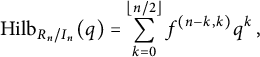 $$ \begin{align*}\text{Hilb}_{R_n/I_n}(q) = \sum_{k=0}^{\lfloor{n/2}\rfloor} f^{(n-k,k)} q^k\,,\end{align*} $$ $f^{(n-k,k)}$ is the number of standard tableaux of shape $(n-k,k)$.
(3) There is a basis of the ideal generated by quasisymmetric polynomials that is indexed by sequences that break the ballot condition.


Twisted algebras of geometric algebras
- Part of
-
- Journal:
- Canadian Mathematical Bulletin / Volume 66 / Issue 3 / September 2023
- Published online by Cambridge University Press:
- 18 October 2022, pp. 715-730
- Print publication:
- September 2023
-
- Article
- Export citation
Graded comodule categories with enough projectives
- Part of
-
- Journal:
- Glasgow Mathematical Journal / Volume 65 / Issue 2 / May 2023
- Published online by Cambridge University Press:
- 08 July 2022, pp. 257-271
-
- Article
-
- You have access
- Open access
- HTML
- Export citation
Auslander’s theorem for dihedral actions on preprojective algebras of type A
- Part of
-
- Journal:
- Canadian Mathematical Bulletin / Volume 66 / Issue 1 / March 2023
- Published online by Cambridge University Press:
- 09 June 2022, pp. 324-339
- Print publication:
- March 2023
-
- Article
-
- You have access
- Open access
- HTML
- Export citation
-
Given an algebra R and G a finite group of automorphisms of R, there is a natural map $\eta _{R,G}:R\#G \to \mathrm {End}_{R^G} R$, called the Auslander map. A theorem of Auslander shows that $\eta _{R,G}$ is an isomorphism when $R=\mathbb {C}[V]$ and G is a finite group acting linearly and without reflections on the finite-dimensional vector space V. The work of Mori–Ueyama and Bao–He–Zhang has encouraged the study of this theorem in the context of Artin–Schelter regular algebras. We initiate a study of Auslander’s result in the setting of nonconnected graded Calabi–Yau algebras. When R is a preprojective algebra of type A and G is a finite subgroup of $D_n$ acting on R by automorphism, our main result shows that $\eta _{R,G}$ is an isomorphism if and only if G does not contain all of the reflections through a vertex.


Casting light on shadow Somos sequences
- Part of
-
- Journal:
- Glasgow Mathematical Journal / Volume 65 / Issue S1 / May 2023
- Published online by Cambridge University Press:
- 10 May 2022, pp. S87-S101
-
- Article
-
- You have access
- Open access
- HTML
- Export citation
-
Recently Ovsienko and Tabachnikov considered extensions of Somos and Gale-Robinson sequences, defined over the algebra of dual numbers. Ovsienko used the same idea to construct so-called shadow sequences derived from other nonlinear recurrence relations exhibiting the Laurent phenomenon, with the original motivation being the hope that these examples should lead to an appropriate notion of a cluster superalgebra, incorporating Grassmann variables. Here, we present various explicit expressions for the shadow of Somos-4 sequences and describe the solution of a general Somos-4 recurrence defined over the $\mathbb{C}$-algebra of dual numbers from several different viewpoints: analytic formulae in terms of elliptic functions, linear difference equations, and Hankel determinants.

