Refine listing
Actions for selected content:
148547 results in Open Access
Chapter 4 - Medical Professionalism and Compassion
- from Part I - Compassion in Healthcare
-
- Book:
- Handbook of Compassion in Healthcare
- Published online:
- 27 June 2025
- Print publication:
- 17 July 2025, pp 35-43
-
- Chapter
-
- You have access
- Open access
- HTML
- Export citation
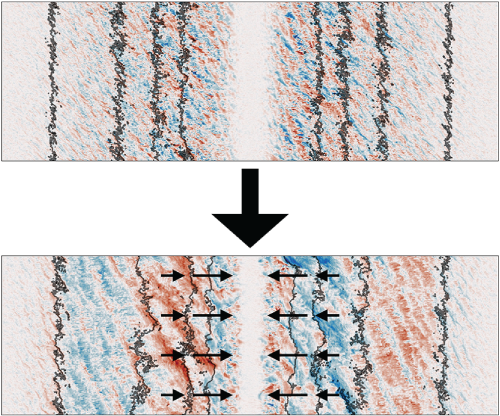
Near-inertial echoes of ageostrophic instability in submesoscale filaments
-
- Journal:
- Journal of Fluid Mechanics / Volume 1015 / 25 July 2025
- Published online by Cambridge University Press:
- 17 July 2025, A17
-
- Article
-
- You have access
- Open access
- HTML
- Export citation
-
Ocean submesoscales, flows with characteristic size $10\,\text{m}{-}10\,\text{km}$, are transitional between the larger, rotationally constrained mesoscale and three-dimensional turbulence. In this paper, we present simulations of a submesoscale ocean filament. In our case, the filament is strongly sheared in both vertical and cross-filament directions, and is unstable. Instability indeed dominates the early behaviour with a fast extraction of kinetic energy from the vertically sheared thermal wind. However, the instability that emerges does not exhibit characteristics that match the perhaps expected symmetric or Kelvin–Helmholtz instabilities, and appears to be non-normal in nature. The prominence of the transient response depends on the initial noise, and for large initial noise amplitudes, saturates before symmetric instability normal modes are able to develop. The action of the instability is sufficiently rapid – with energy extraction from the mean flow emerging and peaking within the first inertial period ( $\sim\! 18\ \text{h}$) – that the filament does not respond in a geostrophically balanced sense. Instead, at all initial noise levels, it later exhibits vertically sheared near-inertial oscillations with higher amplitude as the initial minimum Richardson number decreases. Horizontal gradients strengthen only briefly as the fronts restratify. These unstable filaments can be generated by strong mixing events at pre-existing stable structures; we also caution against inadvertently triggering this response in idealised studies that start in a very unstable state.


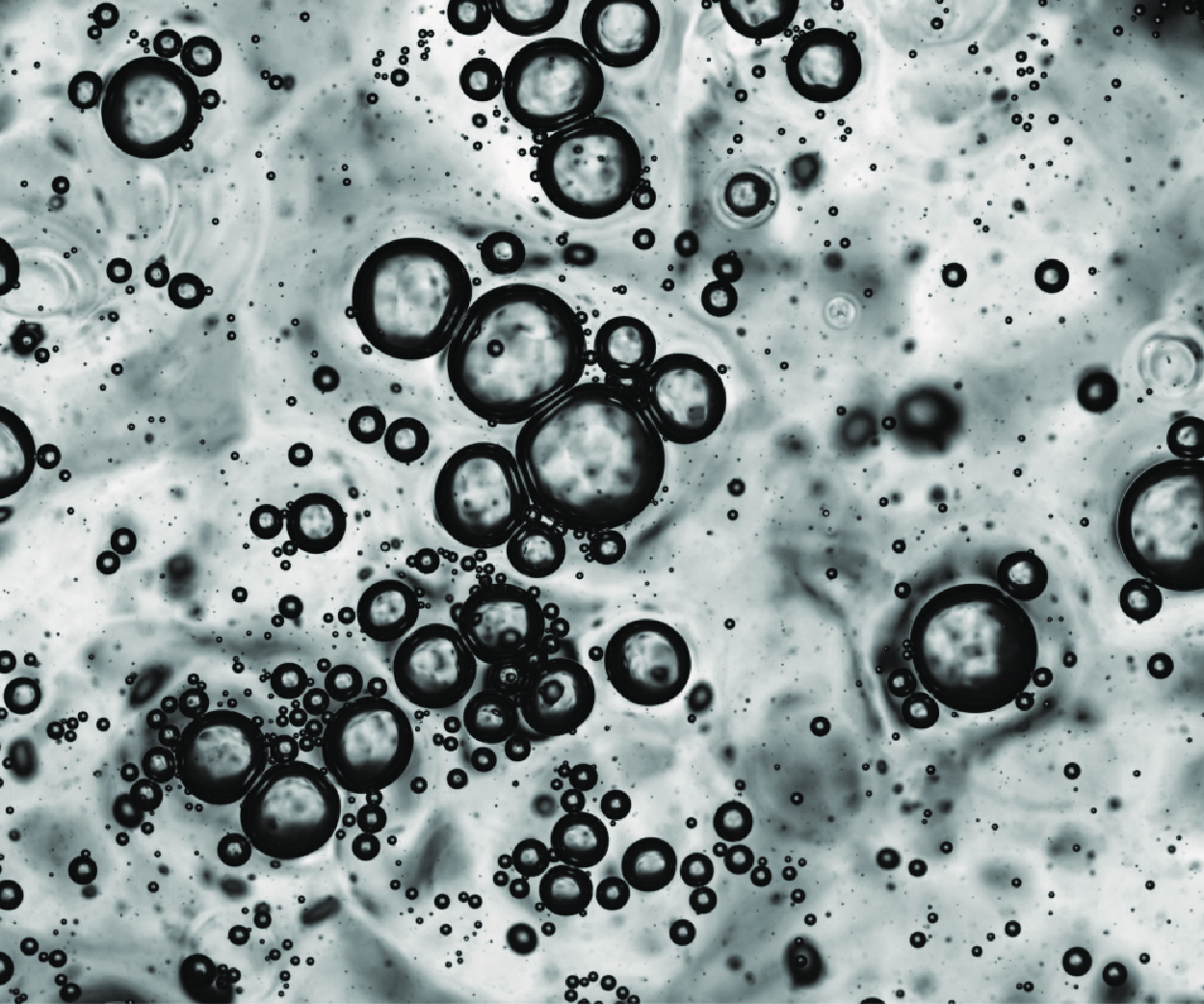
Linking emitted drops to collective bursting bubbles across a wide range of bubble size distributions
-
- Journal:
- Journal of Fluid Mechanics / Volume 1015 / 25 July 2025
- Published online by Cambridge University Press:
- 17 July 2025, A8
-
- Article
-
- You have access
- Open access
- HTML
- Export citation
-
Bubbles entrained by breaking waves rise to the ocean surface, where they cluster before bursting and release droplets into the atmosphere. The ejected drops and dry aerosol particles, left behind after the liquid drop evaporates, affect the radiative balance of the atmosphere and can act as cloud condensation nuclei. The remaining uncertainties surrounding the sea spray emissions function motivate controlled laboratory experiments that directly measure and link collective bursting bubbles and the associated drops and sea salt aerosols. We perform experiments in artificial seawater for a wide range of bubble size distributions, measuring both bulk and surface bubble distributions (measured radii from $30\,\unicode{x03BC} \mathrm{m}$ to $5\,\mathrm{mm}$), together with the associated drop size distribution (salt aerosols and drops of measured radii from $50\,\mathrm{nm}$ to $500\,\unicode{x03BC} \mathrm{m}$) to quantify the link between emitted drops and bursting surface bubbles. We evaluate how well the individual bubble bursting scaling laws describe our data across all scales and demonstrate that the measured drop production by collective bubble bursting can be represented by a single framework integrating individual bursting scaling laws over the various bubble sizes present in our experiments. We show that film drop production by bubbles between $100\,\unicode{x03BC} \mathrm{m}$ and $1\,\mathrm{mm}$ describes the submicron drop production, while jet drop production by bubbles from $30\,\unicode{x03BC} \mathrm{m}$ to $2\,\mathrm{mm}$ describes the production of drops larger than $1\,\unicode{x03BC} \mathrm{m}$. Our work confirms that sea spray emission functions based on individual bursting processes are reasonably accurate as long as the surface bursting bubble size distribution is known.


1 - Wealthy Italy
-
- Book:
- Wealth, Office and Rank in Roman Italy
- Published online:
- 23 July 2025
- Print publication:
- 17 July 2025, pp 12-20
-
- Chapter
-
- You have access
- Open access
- Export citation
Contents
-
- Book:
- Wealth, Office and Rank in Roman Italy
- Published online:
- 23 July 2025
- Print publication:
- 17 July 2025, pp vii-vii
-
- Chapter
-
- You have access
- Open access
- Export citation
11 - Timocracy, Wealth and Resilience
-
- Book:
- Wealth, Office and Rank in Roman Italy
- Published online:
- 23 July 2025
- Print publication:
- 17 July 2025, pp 192-201
-
- Chapter
-
- You have access
- Open access
- Export citation
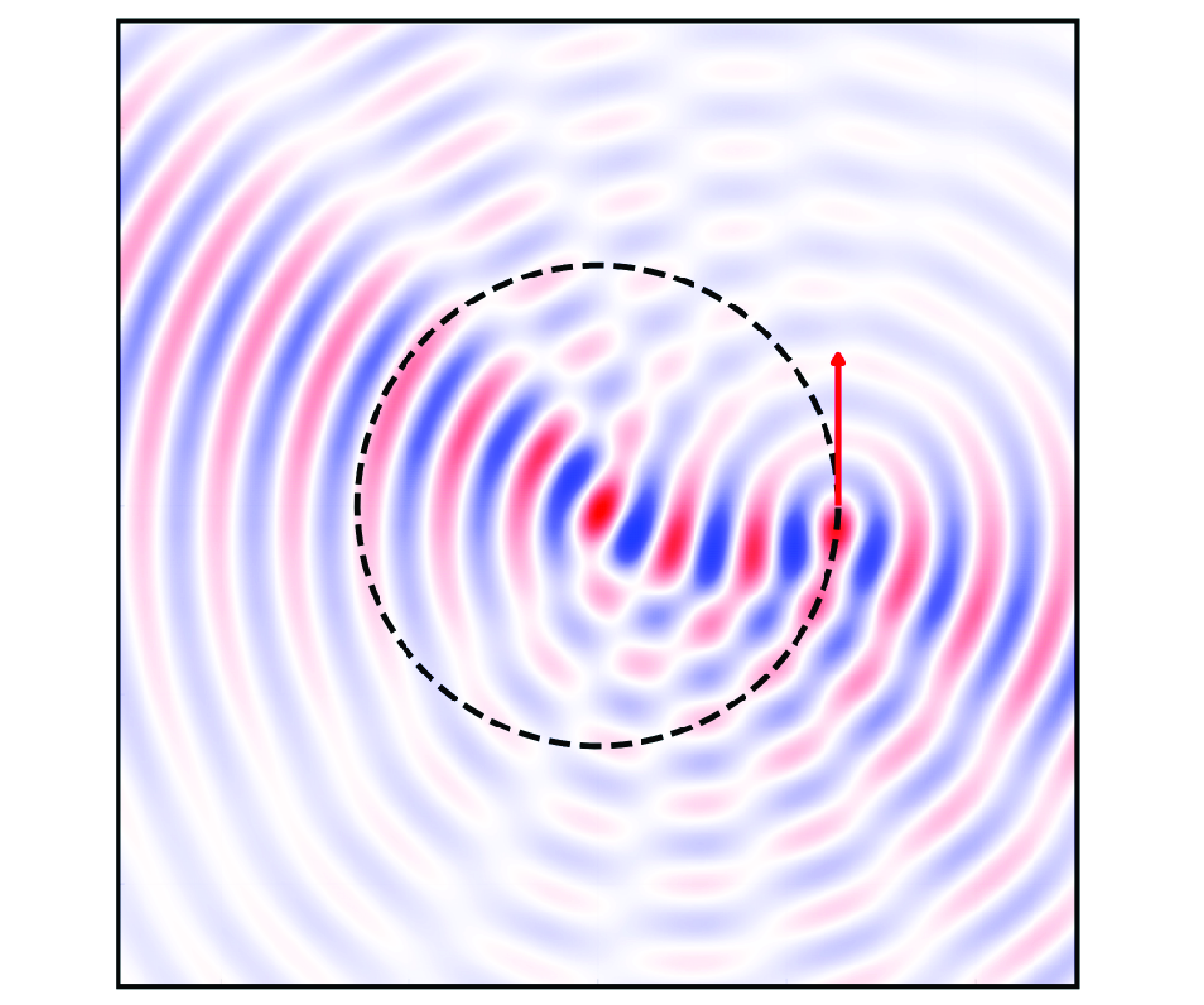
Wave- and potential-driven instabilities in orbital pilot-wave dynamics
-
- Journal:
- Journal of Fluid Mechanics / Volume 1015 / 25 July 2025
- Published online by Cambridge University Press:
- 17 July 2025, A26
-
- Article
-
- You have access
- Open access
- HTML
- Export citation
Contents
-
- Book:
- Handbook of Compassion in Healthcare
- Published online:
- 27 June 2025
- Print publication:
- 17 July 2025, pp v-v
-
- Chapter
-
- You have access
- Open access
- HTML
- Export citation
Favorable tax treatment of older workers in general equilibrium
-
- Journal:
- Macroeconomic Dynamics / Volume 29 / 2025
- Published online by Cambridge University Press:
- 17 July 2025, e119
-
- Article
-
- You have access
- Open access
- HTML
- Export citation
Semi-stable and splitting models for unitary Shimura varieties over ramified places. I.
- Part of
-
- Journal:
- Forum of Mathematics, Sigma / Volume 13 / 2025
- Published online by Cambridge University Press:
- 17 July 2025, e119
-
- Article
-
- You have access
- Open access
- HTML
- Export citation
-
We consider Shimura varieties associated to a unitary group of signature $(n-s,s)$ where n is even. For these varieties, we construct smooth p-adic integral models for $s=1$ and regular p-adic integral models for $s=2$ and $s=3$ over odd primes p which ramify in the imaginary quadratic field with level subgroup at p given by the stabilizer of a $\pi $-modular lattice in the hermitian space. Our construction, which has an explicit moduli-theoretic description, is given by an explicit resolution of a corresponding local model.


Early Exposure to Neurosurgery: Assessment of Perceptions, Mentorship and Competence on Medical Student Interest
- Part of
-
- Journal:
- Canadian Journal of Neurological Sciences / Volume 53 / Issue 3 / May 2026
- Published online by Cambridge University Press:
- 17 July 2025, pp. 439-447
-
- Article
-
- You have access
- Open access
- HTML
- Export citation
Detection of California Serogroup Orthobunyavirus antibodies and Inkoo virus RNA in patients, Finland
-
- Journal:
- Epidemiology & Infection / Volume 153 / 2025
- Published online by Cambridge University Press:
- 17 July 2025, e83
-
- Article
-
- You have access
- Open access
- HTML
- Export citation
2 - Developments in the Early Imperial Italian Economy
-
- Book:
- Wealth, Office and Rank in Roman Italy
- Published online:
- 23 July 2025
- Print publication:
- 17 July 2025, pp 21-39
-
- Chapter
-
- You have access
- Open access
- Export citation
Validation of the Romanian version of the brief negative symptom scale in a heterogeneous schizophrenia inpatient sample
-
- Journal:
- Cambridge Prisms: Global Mental Health / Volume 12 / 2025
- Published online by Cambridge University Press:
- 17 July 2025, e85
-
- Article
-
- You have access
- Open access
- HTML
- Export citation
Welfare Subjects and Autopoiesis
-
- Journal:
- Journal of the American Philosophical Association / Volume 11 / Issue 4 / December 2025
- Published online by Cambridge University Press:
- 17 July 2025, pp. 696-714
-
- Article
-
- You have access
- Open access
- HTML
- Export citation
Copyright page
-
- Book:
- Handbook of Compassion in Healthcare
- Published online:
- 27 June 2025
- Print publication:
- 17 July 2025, pp iv-iv
-
- Chapter
-
- You have access
- Open access
- HTML
- Export citation
Appendix A - Dataset: Pompeian Residences
-
- Book:
- Wealth, Office and Rank in Roman Italy
- Published online:
- 23 July 2025
- Print publication:
- 17 July 2025, pp 206-227
-
- Chapter
-
- You have access
- Open access
- Export citation
Chapter 3 - What Compassion Is Not
- from Part I - Compassion in Healthcare
-
- Book:
- Handbook of Compassion in Healthcare
- Published online:
- 27 June 2025
- Print publication:
- 17 July 2025, pp 27-34
-
- Chapter
-
- You have access
- Open access
- HTML
- Export citation
On the absence of a millennial population rebound in the central Maya lowlands
-
- Journal:
- Ancient Mesoamerica / Volume 36 / Issue 1 / April 2025
- Published online by Cambridge University Press:
- 17 July 2025, pp. 106-122
-
- Article
-
- You have access
- Open access
- HTML
- Export citation
Comparing comparatives: appropriateness ratings of synthetic, analytic and double comparatives in American and British English
-
- Journal:
- English Language & Linguistics / Volume 30 / Issue 1 / March 2026
- Published online by Cambridge University Press:
- 17 July 2025, pp. 32-70
-
- Article
-
- You have access
- Open access
- HTML
- Export citation
