Refine listing
Actions for selected content:
142352 results in Open Access
Experimental investigation on magneto-convective flows around two differentially heated horizontal cylinders
-
- Journal:
- Journal of Fluid Mechanics / Volume 993 / 25 August 2024
- Published online by Cambridge University Press:
- 13 September 2024, A6
-
- Article
-
- You have access
- Open access
- HTML
- Export citation
-
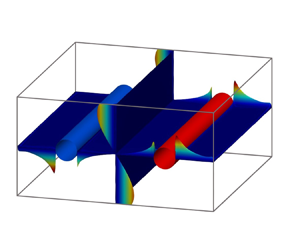
Liquid metal buoyant flow around two differentially heated horizontal cylinders in the presence of a uniform vertical magnetic field is investigated experimentally. While magneto-convection in pipes or ducts has been studied theoretically and experimentally in recent years, data for heat transfer at immersed obstacles are rare and, to our knowledge, detailed experimental investigations on this fundamental magnetohydrodynamic problem do not exist. In the present work, two horizontal cylinders inserted into an adiabatic rectangular cavity filled with gallium–indium–tin are kept at constant temperatures to establish a driving temperature gradient in the surrounding liquid metal. The buoyancy-driven flow, quantified by the Grashof number $Gr$, is varied in the range ${10^{6} \leq Gr \leq ~5\times 10^{7}}$. With increasing magnetic field, expressed via the Hartmann number $Ha$, different flow regimes are identified from measurements for $0 \leq Ha \leq ~3000$. The effect of the electromagnetic force primarily consists in suppressing turbulence and damping the convective flow. The heat transfer is quantified in terms of the non-dimensional Nusselt number $Nu$, and its dependence on $Gr/{Ha}^{2}$, which is identified as the important group governing the flow, is discussed.


The many faces of sovereignty
-
- Journal:
- International Theory / Volume 16 / Issue 2 / July 2024
- Published online by Cambridge University Press:
- 13 September 2024, pp. 211-236
-
- Article
-
- You have access
- Open access
- HTML
- Export citation
Standpipes, Chimmeys, and Memorialization in the Caribbean
-
- Journal:
- Victorian Literature and Culture / Volume 52 / Issue 2 / Summer 2024
- Published online by Cambridge University Press:
- 13 September 2024, pp. 288-306
-
- Article
-
- You have access
- Open access
- HTML
- Export citation
Frege and the Fundamental Abstraction
-
- Journal:
- Canadian Journal of Philosophy / Volume 54 / Issue 2 / February 2024
- Published online by Cambridge University Press:
- 13 September 2024, pp. 74-82
-
- Article
-
- You have access
- Open access
- HTML
- Export citation
Patient comfort with sexual orientation and gender identity questions in adult congenital cardiology clinics
-
- Journal:
- Cardiology in the Young / Volume 34 / Issue 9 / September 2024
- Published online by Cambridge University Press:
- 13 September 2024, pp. 1997-2004
-
- Article
-
- You have access
- Open access
- HTML
- Export citation
Culpeper’s herbal The English Physitian and its debt to apothecary John Parkinson
-
- Journal:
- Medical History / Volume 68 / Issue 3 / July 2024
- Published online by Cambridge University Press:
- 13 September 2024, pp. 237-253
-
- Article
-
- You have access
- Open access
- HTML
- Export citation
Cardiac effects of COVID-19 infection in children
-
- Journal:
- Cardiology in the Young / Volume 34 / Issue 10 / October 2024
- Published online by Cambridge University Press:
- 13 September 2024, pp. 2146-2155
-
- Article
-
- You have access
- Open access
- HTML
- Export citation
‘When intuitions (don't) fail’: combining syntax and sociolinguistics in the analysis of Scots
-
- Journal:
- English Language & Linguistics / Volume 29 / Issue 1 / March 2025
- Published online by Cambridge University Press:
- 13 September 2024, pp. 1-34
-
- Article
-
- You have access
- Open access
- HTML
- Export citation
The Night of the Proletarian Families: Child Labor, Compulsory Education, and the Making of the Working Class around 1830
-
- Journal:
- International Labor and Working-Class History / Volume 107 / April 2025
- Published online by Cambridge University Press:
- 13 September 2024, pp. 16-29
-
- Article
-
- You have access
- Open access
- HTML
- Export citation
Drag coefficient for irregularly shaped grains: rotational dependence at various Reynolds numbers
-
- Journal:
- Journal of Fluid Mechanics / Volume 994 / 10 September 2024
- Published online by Cambridge University Press:
- 13 September 2024, A1
-
- Article
-
- You have access
- Open access
- HTML
- Export citation
-
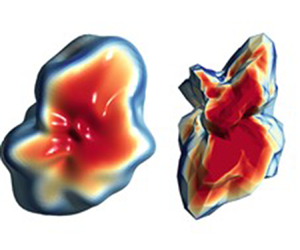
The nature and behaviour of the drag coefficient $C_D$ of irregularly shaped grains within a wide range of Reynolds numbers $Re$ is discussed. The morphology of the grains is controlled by their fractal description, and they differ in shape. Using computational fluid dynamics tools, the characteristics of the boundary layer at high $Re$ has been determined by applying the Reynolds-averaged Navier–Stokes turbulence model. Both grid resolution and mesh size dependence are validated with well-reported previous experimental results applied in flow around isolated smooth spheres. The drag coefficient for irregularly shaped grains is shown to be higher than that for spherical shapes, also showing a strong drop in its value at high $Re$. This drag crisis is reported at lower $Re$ compared to the smooth sphere, but higher critical $C_D$, demonstrating that the morphology of the particle accelerates this crisis. Furthermore, the dependence of $C_D$ on $Re$ in this type of geometry can be represented qualitatively by four defined zones: subcritical, critical, supercritical and transcritical. The orientational dependence for both particles with respect to the fluid flow is analysed, where our findings show an interesting oscillatory behaviour of $C_D$ as a function of the angle of incidence, fitting the results to a sine-squared interpolation, predicted for particles within the Stokes laminar regime ( $Re\ll 1$) and for elongated/flattened spheroids up to $Re=2000$. A statistical analysis shows that this system satisfies a Weibullian behaviour of the drag coefficient when random azimuthal and polar rotation angles are considered.


Characterization of MoS2 films via simultaneous grazing incidence X-ray diffraction and grazing incidence X-ray fluorescence (GIXRD/GIXRF)
-
- Journal:
- Powder Diffraction / Volume 39 / Issue 2 / June 2024
- Published online by Cambridge University Press:
- 13 September 2024, pp. 60-68
-
- Article
-
- You have access
- Open access
- HTML
- Export citation
Treating with minerals in the Middle Ages: the rare substance mūmiyāʾ (pitch-asphalt) and its medicinal uses in Byzantium
-
- Journal:
- Medical History / Volume 68 / Issue 3 / July 2024
- Published online by Cambridge University Press:
- 13 September 2024, pp. 223-236
-
- Article
-
- You have access
- Open access
- HTML
- Export citation
Why Not Phase Out Animal Experimentation? Considering Objections from Freedom of Inquiry and Cross-Border Displacement
-
- Journal:
- Cambridge Quarterly of Healthcare Ethics / Volume 34 / Issue 2 / April 2025
- Published online by Cambridge University Press:
- 13 September 2024, pp. 264-279
-
- Article
-
- You have access
- Open access
- HTML
- Export citation
Surgical management of congenital mitral stenosis in a patient with Kabuki syndrome
-
- Journal:
- Cardiology in the Young / Volume 34 / Issue 8 / August 2024
- Published online by Cambridge University Press:
- 13 September 2024, pp. 1832-1834
-
- Article
-
- You have access
- Open access
- HTML
- Export citation
Thinking freedom relationally: Life projects and care as an ethical orientation for International Studies
-
- Journal:
- Review of International Studies / Volume 51 / Issue 3 / May 2025
- Published online by Cambridge University Press:
- 13 September 2024, pp. 488-503
- Print publication:
- May 2025
-
- Article
-
- You have access
- Open access
- HTML
- Export citation
Politics and Justice at the International Criminal Court
-
- Journal:
- Israel Law Review / Volume 57 / Issue 2 / July 2024
- Published online by Cambridge University Press:
- 13 September 2024, pp. 308-350
-
- Article
-
- You have access
- Open access
- HTML
- Export citation
The first recorded outbreak of epidemic dropsy, 1877–80: Climate, empire, and colonial medical science between India, Bengal, and Mauritius
-
- Journal:
- Medical History / Volume 68 / Issue 4 / October 2024
- Published online by Cambridge University Press:
- 13 September 2024, pp. 436-456
-
- Article
-
- You have access
- Open access
- HTML
- Export citation
GEOMETRY OF CLAIRAUT CONFORMAL RIEMANNIAN MAPS
- Part of
-
- Journal:
- Journal of the Australian Mathematical Society / Volume 118 / Issue 3 / June 2025
- Published online by Cambridge University Press:
- 13 September 2024, pp. 368-406
-
- Article
-
- You have access
- Open access
- HTML
- Export citation
-
This article introduces the Clairaut conformal Riemannian map. This notion includes the previously studied notions of Clairaut conformal submersion, Clairaut Riemannian submersion, and the Clairaut Riemannian map as particular cases, and is well known in the classical theory of surfaces. Toward this, we find the necessary and sufficient condition for a conformal Riemannian map $\varphi : M \to N$ between Riemannian manifolds to be a Clairaut conformal Riemannian map with girth $s = e^f$. We show that the fibers of $\varphi $ are totally umbilical with mean curvature vector field the negative gradient of the logarithm of the girth function, that is, $-\nabla f$. Using this, we obtain a local splitting of M as a warped product and a usual product, if the horizontal space is integrable (under some appropriate hypothesis). We also provide some examples of the Clairaut conformal Riemannian maps to confirm our main theorem. We observe that the Laplacian of the logarithmic girth, that is, of f, on the total manifold takes the special form. It reduces to the Laplacian on the horizontal distribution, and if it is nonnegative, the universal covering space of M becomes a product manifold, under some hypothesis on f. Analysis of the Laplacian of f also yields the splitting of the universal covering space of M as a warped product under some appropriate conditions. We calculate the sectional curvature and mixed sectional curvature of M when f is a distance function. We also find the relationships between the total manifold and the fibers being symmetrical and, in particular, having constant sectional curvature, and from there, we compare their universal covering spaces, if fibers are also complete, provided f is a distance function. We also find a condition on the curvature tensor of the fibers to be semi-symmetric, provided that the total manifold is semi-symmetric and f is a distance function. In turn, this gives the warped product of symmetric, semi-symmetric spaces into two symmetric, semi-symmetric subspaces (under some hypothesis). Also if the Hessian or the Laplacian of the Riemannian curvature tensor fields is zero, or has a harmonic curvature tensor, then the fibers of $\varphi $ also satisfy the same property, if f is also a distance function. By obtaining Bochner-type formulas for Clairaut conformal Riemannian maps, we establish the relations between the divergences of the Ricci curvature tensor on fibers and horizontal space and the corresponding scalar curvature. We also study the horizontal Killing vector field of constant length and show that they are parallel under appropriate hypotheses. This in turn gives the splitting of the total manifold, if it admits a horizontal parallel Killing vector field and if the horizontal space is integrable. Finally, assuming that $\nabla f$ is a nontrivial gradient Ricci soliton on M, we prove that any vertical vector field is incompressible and hence the volume form of the fiber is invariant under the flow of the vector field.



Large-scale circulation reversals explained by pendulum correspondence
-
- Journal:
- Journal of Fluid Mechanics / Volume 993 / 25 August 2024
- Published online by Cambridge University Press:
- 13 September 2024, A3
-
- Article
-
- You have access
- Open access
- HTML
- Export citation
-
We introduce a low-order dynamical system to describe thermal convection in an annular domain. The model derives systematically from a Fourier–Laurent truncation of the governing Navier–Stokes Boussinesq equations and accounts for spatial dependence of the flow and temperature fields. Comparison with fully resolved direct numerical simulations (DNS) shows that the model captures parameter bifurcations and reversals of the large-scale circulation (LSC), including states of (i) steady circulating flow, (ii) chaotic LSC reversals and (iii) periodic LSC reversals. Casting the system in terms of the fluid's angular momentum and centre of mass (CoM) reveals equivalence to a damped pendulum with forcing that raises the CoM above the fulcrum. This formulation offers a transparent mechanism for LSC reversals, namely the inertial overshoot of a forced pendulum, and it yields an explicit formula for the frequency $f^*$ of regular LSC reversals in the high-Rayleigh-number (Ra) limit. This formula is shown to be in excellent agreement with DNS and produces the scaling law $f^* \sim {Ra}^{0.5}$.


Reflections on ‘Have we lost sleep?’
-
- Journal:
- Medical History / Volume 68 / Issue 3 / July 2024
- Published online by Cambridge University Press:
- 13 September 2024, pp. 254-262
-
- Article
-
- You have access
- Open access
- HTML
- Export citation
