Refine listing
Actions for selected content:
142780 results in Open Access
Linear stability of stratified, rotating, viscous plane Couette–Poiseuille flow
-
- Journal:
- Journal of Fluid Mechanics / Volume 991 / 25 July 2024
- Published online by Cambridge University Press:
- 22 August 2024, A16
-
- Article
-
- You have access
- Open access
- HTML
- Export citation
Simulations of shoaling large-amplitude internal waves: perspectives and outlook
-
- Journal:
- Flow: Applications of Fluid Mechanics / Volume 4 / 2024
- Published online by Cambridge University Press:
- 22 August 2024, E11
-
- Article
-
- You have access
- Open access
- HTML
- Export citation
Left Governmental Power and the Reduction of Inequalities in Western Europe (1871–2020)
-
- Journal:
- Perspectives on Politics / Volume 23 / Issue 3 / September 2025
- Published online by Cambridge University Press:
- 20 August 2024, pp. 924-943
- Print publication:
- September 2025
-
- Article
-
- You have access
- Open access
- HTML
- Export citation
Numerical study of a generic ship's airwake for understanding bi‐stability mechanism
-
- Journal:
- Journal of Fluid Mechanics / Volume 991 / 25 July 2024
- Published online by Cambridge University Press:
- 20 August 2024, A6
-
- Article
-
- You have access
- Open access
- HTML
- Export citation
-
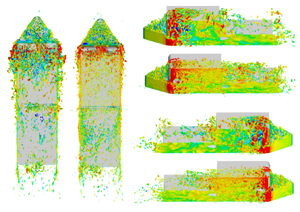
A distinguishing feature of the bi-stable wake is that the wake persists in either of two preferred states for a sufficiently long time. Aiming to understand the persistence mechanism, this paper numerically investigates the airwake characteristics of the Chalmers ship model (CSM) using large eddy simulation with a wall-adapting local-eddy viscosity model and is complemented by experimental testings for validations. There are two cases of interest: (i) the baseline CSM with a sharp-edged superstructure front that induces massive boundary layer separation; (ii) the front-rounded (FR) CSM with suppressed flow separation. During a characteristic time ( $t^*$) of 1142 (26.5 s), the baseline case has a frequently switching wake, whereas the FR wake maintains a stable asymmetric structure with only one switch attempt. To understand the different wake behaviours, the study starts by analysing wake flow structures, vortex cores and the wake dynamics, followed by investigating the instantaneous flow physics. Results suggest that the baseline wake has a weak bi-stable pattern, whereas the FR wake behaves similarly to a reflectional symmetry breaking state of a potential bi-stable wake. The wake switching is found to be driven by the tilting of (vertical-oriented) $z$-vorticity sheets from either side of the base toward the centre. This tilting behaviour is subjected to the high-magnitude vorticity that sheds from the upstream flow separation at the front sharp edges. With the sharp edges rounded in the FR case, the upstream vorticity is mitigated and the tilting effect is significantly reduced, leading to a more stable wake structure. The reasoning provided in the paper potentially explains the persistence mechanism of the bi-stable wake.


Assessment and diagnosis of post-traumatic stress disorders (PTSDs) for medico-legal and other clinical purposes: DSM-5-TR PTSD, ICD-11 PTSD and ICD-11 complex PTSD
-
- Journal:
- BJPsych Advances / Volume 30 / Issue 6 / November 2024
- Published online by Cambridge University Press:
- 20 August 2024, pp. 383-397
- Print publication:
- November 2024
-
- Article
-
- You have access
- Open access
- HTML
- Export citation
Embracing the Status Hierarchy: How Immigration Attitudes, Prejudice, and Sexism Shaped Non-White Support for Trump
-
- Journal:
- Perspectives on Politics / Volume 22 / Issue 4 / December 2024
- Published online by Cambridge University Press:
- 20 August 2024, pp. 1015-1030
- Print publication:
- December 2024
-
- Article
-
- You have access
- Open access
- HTML
- Export citation
Analyzing Ballot Order Effects When Voters Rank Candidates
-
- Journal:
- Political Analysis / Volume 33 / Issue 1 / January 2025
- Published online by Cambridge University Press:
- 20 August 2024, pp. 64-72
-
- Article
-
- You have access
- Open access
- HTML
- Export citation
Fully developed flow through shrouded-fin arrays: exact and asymptotic solutions
-
- Journal:
- Journal of Fluid Mechanics / Volume 991 / 25 July 2024
- Published online by Cambridge University Press:
- 20 August 2024, A2
-
- Article
-
- You have access
- Open access
- HTML
- Export citation
-
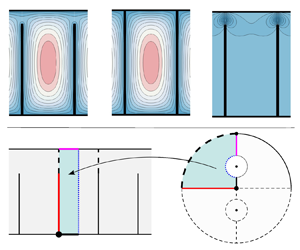
The flow resistance, i.e. friction factor times Reynolds number ( $\,f\,{Re}$), of longitudinal-fin heat sinks with or without clearance between a shroud and the tips of the fins is an important parameter in thermal design. This is because it dictates the caloric resistance of the heat sink, i.e. change in bulk temperature of the fluid flowing through it. When there is no clearance and the common and oft-valid assumption of negligible fin thickness is invoked, $f\,{Re}$ corresponds to simply that of a rectangular duct. However, with clearance, only numerical results are available as per the well-known study by Sparrow, Baliga and Patankar (ASME J. Heat Transfer, vol. 100, 1978). We develop analytical formulae for $f\,{Re}$ for fully developed flow with clearance. The exact solution is provided by an integral formula derived via conformal mappings. Additionally, simple formulae are derived via asymptotic expansions in three cases: (1) the fin spacing is small compared to the fin height and clearance; (2) the clearance is small compared to the fin spacing, which is small compared to the fin height; (3) the same as case (2) but valid for larger clearances. The different asymptotic formulae are compared to the exact formula, and together cover almost the entire relevant parameter range (for fin spacing and clearance) with errors of less than 15 %. A formula for the limiting case of no clearance is shown to be more accurate, for any fin spacing, than a widely used correlation from the literature.


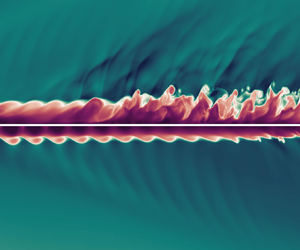
Transition delay in a Mach 6 boundary layer using steady blowing and suction strips
-
- Journal:
- Journal of Fluid Mechanics / Volume 991 / 25 July 2024
- Published online by Cambridge University Press:
- 20 August 2024, R3
-
- Article
-
- You have access
- Open access
- HTML
- Export citation
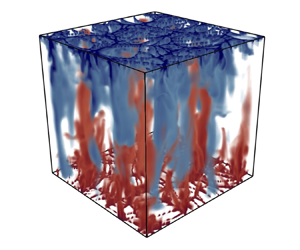
Transport scaling in porous media convection
-
- Journal:
- Journal of Fluid Mechanics / Volume 991 / 25 July 2024
- Published online by Cambridge University Press:
- 20 August 2024, A4
-
- Article
-
- You have access
- Open access
- HTML
- Export citation
-
We present a theory to describe the Nusselt number, $\operatorname {\mathit {Nu}}$, corresponding to the heat or mass flux, as a function of the Rayleigh–Darcy number, $\operatorname {\mathit {Ra}}$, the ratio of buoyant driving force over diffusive dissipation, in convective porous media flows. First, we derive exact relationships within the system for the kinetic energy and the thermal dissipation rate. Second, by segregating the thermal dissipation rate into contributions from the boundary layer and the bulk, which is inspired by the ideas of the Grossmann and Lohse theory (J. Fluid Mech., vol. 407, 2000; Phys. Rev. Lett., vol. 86, 2001), we derive the scaling relation for $\operatorname {\mathit {Nu}}$ as a function of $\operatorname {\mathit {Ra}}$ and provide a robust theoretical explanation for the empirical relations proposed in previous studies. Specifically, by incorporating the length scale of the flow structure into the theory, we demonstrate why heat or mass transport differs between two-dimensional and three-dimensional porous media convection. Our model is in excellent agreement with the data obtained from numerical simulations, affirming its validity and predictive capabilities.


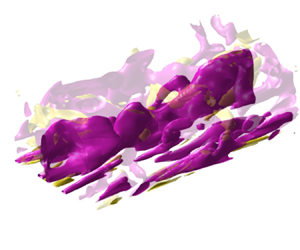
Three-dimensional generative adversarial networks for turbulent flow estimation from wall measurements
-
- Journal:
- Journal of Fluid Mechanics / Volume 991 / 25 July 2024
- Published online by Cambridge University Press:
- 20 August 2024, A1
-
- Article
-
- You have access
- Open access
- HTML
- Export citation
A UK-wide survey of community forensic services for adults with intellectual disability and/or autism
-
- Journal:
- BJPsych Open / Volume 10 / Issue 5 / September 2024
- Published online by Cambridge University Press:
- 20 August 2024, e148
-
- Article
-
- You have access
- Open access
- HTML
- Export citation
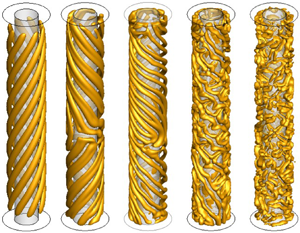
Thermoelectrohydrodynamic convection in a finite cylindrical annulus under microgravity
-
- Journal:
- Journal of Fluid Mechanics / Volume 991 / 25 July 2024
- Published online by Cambridge University Press:
- 20 August 2024, A7
-
- Article
-
- You have access
- Open access
- HTML
- Export citation
Numerical validation of scaling laws for stratified turbulence
-
- Journal:
- Journal of Fluid Mechanics / Volume 991 / 25 July 2024
- Published online by Cambridge University Press:
- 20 August 2024, R1
-
- Article
-
- You have access
- Open access
- HTML
- Export citation
Deviant Cohesion and Unauthorized Atrocities: Evidence from the American War in Vietnam
-
- Journal:
- Perspectives on Politics / Volume 23 / Issue 1 / March 2025
- Published online by Cambridge University Press:
- 20 August 2024, pp. 213-233
- Print publication:
- March 2025
-
- Article
-
- You have access
- Open access
- HTML
- Export citation
Cognitive–behavioural therapy for complex post-traumatic stress disorder
-
- Journal:
- BJPsych Advances / Volume 31 / Issue 1 / January 2025
- Published online by Cambridge University Press:
- 20 August 2024, pp. 39-48
- Print publication:
- January 2025
-
- Article
-
- You have access
- Open access
- HTML
- Export citation
The Meanings of Home: The Case of the Vinan Refugee Families and the 1923 Greek-Turkish Population Exchange
-
- Journal:
- Nationalities Papers / Volume 53 / Issue 3 / May 2025
- Published online by Cambridge University Press:
- 19 August 2024, pp. 702-719
-
- Article
-
- You have access
- Open access
- HTML
- Export citation
Treatment of CACNA1A Encephalopathy and Cerebral Edema with Magnesium and Dexamethasone
-
- Journal:
- Canadian Journal of Neurological Sciences / Volume 52 / Issue 2 / March 2025
- Published online by Cambridge University Press:
- 19 August 2024, pp. 314-317
-
- Article
-
- You have access
- Open access
- HTML
- Export citation
The Long Red Summer on the Railroads: Labor, Race, and Exclusion in Appalachia
-
- Journal:
- The Journal of the Gilded Age and Progressive Era / Volume 23 / Issue 4 / October 2024
- Published online by Cambridge University Press:
- 19 August 2024, pp. 407-430
- Print publication:
- October 2024
-
- Article
-
- You have access
- Open access
- HTML
- Export citation
Ethnopolitics in a Mining Enterprise in Crisis: Revisiting the Albanian Miners’ Protests in Late Socialist Kosovo
-
- Journal:
- Nationalities Papers / Volume 53 / Issue 3 / May 2025
- Published online by Cambridge University Press:
- 19 August 2024, pp. 600-618
-
- Article
-
- You have access
- Open access
- HTML
- Export citation
