Refine search
Actions for selected content:
95 results
Optimal bounds in Bend-and-Break
- Part of
-
- Journal:
- Forum of Mathematics, Pi / Volume 14 / 2026
- Published online by Cambridge University Press:
- 06 May 2026, e16
-
- Article
-
- You have access
- Open access
- HTML
- Export citation
Remarks on the minimal model theory for log surfaces in the analytic setting
- Part of
-
- Journal:
- Nagoya Mathematical Journal / Volume 261 / 2026
- Published online by Cambridge University Press:
- 10 April 2026, e27
-
- Article
-
- You have access
- Open access
- HTML
- Export citation
K-stability of Thaddeus’ moduli of stable bundle pairs on genus two curves
- Part of
-
- Journal:
- Forum of Mathematics, Sigma / Volume 14 / 2026
- Published online by Cambridge University Press:
- 27 February 2026, e33
-
- Article
-
- You have access
- Open access
- HTML
- Export citation
-
The moduli space of bundle stable pairs $\overline {M}_C(2,\Lambda )$ on a smooth projective curve C, introduced by Thaddeus, is a smooth Fano variety of Picard rank two. Focusing on the genus two case, we show that its K-moduli space is isomorphic to a GIT moduli of lines in quartic del Pezzo threefolds. Additionally, we construct a natural forgetful morphism from the K-moduli of $\overline {M}_C(2,\Lambda )$ to that of the moduli spaces of stable vector bundles $\overline {N}_C(2,\Lambda )$. In particular, Thaddeus’ moduli spaces for genus two curves are all K-stable.


NORMAL SPLIT DIVISORS IN RATIONAL HOMOGENEOUS SPACES
- Part of
-
- Journal:
- Nagoya Mathematical Journal / Volume 261 / 2026
- Published online by Cambridge University Press:
- 12 January 2026, e11
-
- Article
-
- You have access
- Open access
- HTML
- Export citation
Minimal model program for algebraically integrable foliations on klt varieties
- Part of
-
- Journal:
- Compositio Mathematica / Volume 161 / Issue 12 / December 2025
- Published online by Cambridge University Press:
- 30 March 2026, pp. 3213-3276
- Print publication:
- December 2025
-
- Article
-
- You have access
- Open access
- HTML
- Export citation
-
For log canonical (lc) algebraically integrable foliations on Kawamata log terminal (klt) varieties, we prove the base-point-freeness theorem, the contraction theorem, and the existence of flips. The first result resolves a conjecture of Cascini and Spicer, while the latter two results strengthen a result of Cascini and Spicer by removing their assumption on the termination of flips. Moreover, we prove the existence of the minimal model program for lc algebraically integrable foliations on klt varieties and the existence of good minimal models or Mori fiber spaces for lc algebraically integrable foliations polarized by ample divisors on klt varieties. As a consequence, we show that $\mathbb{Q}$-factorial klt varieties with lc algebraically integrable Fano foliation structures are Mori dream spaces. We also show the existence of a Shokurov-type polytope for lc algebraically integrable foliations.

Optimal bound for singularities on Fano type fibrations of relative dimension one
- Part of
-
- Journal:
- Forum of Mathematics, Sigma / Volume 13 / 2025
- Published online by Cambridge University Press:
- 24 November 2025, e193
-
- Article
-
- You have access
- Open access
- HTML
- Export citation
-
Let $\pi :X\rightarrow Z$ be a Fano type fibration with $\dim X-\dim Z=d$ and let $(X,B)$ be an $\epsilon $-lc pair with $K_X+B\sim _{\mathbb {R}} 0/Z$. The canonical bundle formula gives $(Z,B_Z+M_Z)$ where $B_Z$ is the discriminant divisor and $M_Z$ is the moduli divisor which is determined up to $\mathbb {R}$-linear equivalence. Shokurov conjectured that one can choose $M_Z\geqslant 0$ such that $(Z,B_Z+M_Z)$ is $\delta $-lc where $\delta $ only depends on $d,\epsilon $. Very recently, this conjecture was proved by Birkar [8]. For $d=1$ and $\epsilon =1$, Han, Jiang, and Luo [13] gave the optimal value of $\delta =1/2$. In this paper, we give the optimal value of $\delta $ for $d=1$ and arbitrary $0<\epsilon \leqslant 1$.


Pathological MMP singularities as αp-quotients
- Part of
-
- Journal:
- Forum of Mathematics, Sigma / Volume 13 / 2025
- Published online by Cambridge University Press:
- 11 November 2025, e185
-
- Article
-
- You have access
- Open access
- HTML
- Export citation
-
We construct pathological examples of MMP singularities in every positive characteristic using quotients by $\alpha _p$-actions. In particular, we obtain non- $S_3$ terminal singularities, as well as locally stable (respectively stable) families whose general fibers are smooth (respectively klt, Cohen–Macaulay, and F-injective) and whose special fibers are non- $S_2$. The dimensions of these examples are bounded below by a linear function of the characteristic.


On the MMP for rank one foliations on threefolds
- Part of
-
- Journal:
- Forum of Mathematics, Pi / Volume 13 / 2025
- Published online by Cambridge University Press:
- 25 September 2025, e20
-
- Article
-
- You have access
- Open access
- HTML
- Export citation
-
We prove existence of flips for log canonical foliated pairs of rank one on a ${\mathbb Q}$-factorial projective klt threefold. This, in particular, provides a proof of the existence of a minimal model for a rank one foliation on a threefold for a wider range of singularities, after McQuillan.

On semi-ampleness of the moduli part
- Part of
-
- Article
-
- You have access
- Open access
- HTML
- Export citation
EFFECTIVE BOUND FOR SINGULARITIES ON TORIC FIBRATIONS
- Part of
-
- Journal:
- Nagoya Mathematical Journal / Volume 260 / December 2025
- Published online by Cambridge University Press:
- 17 September 2025, pp. 779-795
-
- Article
- Export citation
-
It was conjectured by McKernan and Shokurov that for any Fano contraction $f:X \to Z$ of relative dimension r with X being $\epsilon $-lc, there is a positive $\delta $ depending only on $r,\epsilon $ such that Z is $\delta $-lc and the multiplicity of the fiber of f over a codimension one point of Z is bounded from above by $1/\delta $. Recently, this conjecture was confirmed by Birkar [9]. In this article, we give an explicit value for $\delta $ in terms of $\epsilon ,r$ in the toric case, which belongs to $O(\epsilon ^{2^r})$ as $\epsilon \rightarrow 0$. The order $O(\epsilon ^{2^r})$ is optimal in some sense.


Boundedness of slc degenerations of polarized log Calabi–Yau pairs
- Part of
-
- Journal:
- Forum of Mathematics, Sigma / Volume 13 / 2025
- Published online by Cambridge University Press:
- 12 September 2025, e144
-
- Article
-
- You have access
- Open access
- HTML
- Export citation
Minimal Model Program for Normal Pairs along log Canonical Locus
- Part of
-
- Journal:
- Forum of Mathematics, Sigma / Volume 13 / 2025
- Published online by Cambridge University Press:
- 11 September 2025, e143
-
- Article
-
- You have access
- Open access
- HTML
- Export citation
-
Let $(X,\Delta )$ be a normal pair with a projective morphism $X \to Z$ and let A be a relatively ample $\mathbb {R}$-divisor on X. We prove the termination of some minimal model program on $(X,\Delta +A)/Z$ and the abundance conjecture for its minimal model under assumptions that the non-nef locus of $K_{X}+\Delta +A$ over Z does not intersect the non-lc locus of $(X,\Delta )$ and that the restriction of $K_{X}+\Delta +A$ to the non-lc locus of $(X,\Delta )$ is semi-ample over Z.


Elliptic singularities and threefold flops in positive characteristic
- Part of
-
- Journal:
- Proceedings of the Edinburgh Mathematical Society / Volume 68 / Issue 4 / November 2025
- Published online by Cambridge University Press:
- 27 May 2025, pp. 1188-1244
-
- Article
- Export citation
PROJECTIVELY FLAT FOLIATIONS
- Part of
-
- Journal:
- Journal of the Institute of Mathematics of Jussieu / Volume 24 / Issue 3 / May 2025
- Published online by Cambridge University Press:
- 18 March 2025, pp. 763-812
- Print publication:
- May 2025
-
- Article
- Export citation
-
We describe the structure of regular codimension $1$ foliations with numerically projectively flat tangent bundle on complex projective manifolds of dimension at least $4$. Along the way, we prove that either the normal bundle of a regular codimension $1$ foliation is pseudo-effective, or its conormal bundle is nef.


Local Normal Forms of Noncommutative Functions
- Part of
-
- Journal:
- Forum of Mathematics, Pi / Volume 13 / 2025
- Published online by Cambridge University Press:
- 18 February 2025, e8
-
- Article
-
- You have access
- Open access
- HTML
- Export citation
Complements and coregularity of Fano varieties
- Part of
-
- Journal:
- Forum of Mathematics, Sigma / Volume 13 / 2025
- Published online by Cambridge University Press:
- 07 February 2025, e39
-
- Article
-
- You have access
- Open access
- HTML
- Export citation
-
We study the relation between the coregularity, the index of log Calabi–Yau pairs and the complements of Fano varieties. We show that the index of a log Calabi–Yau pair $(X,B)$ of coregularity $1$ is at most $120\lambda ^2$, where $\lambda $ is the Weil index of $K_X+B$. This extends a recent result due to Filipazzi, Mauri and Moraga. We prove that a Fano variety of absolute coregularity $0$ admits either a $1$-complement or a $2$-complement. In the case of Fano varieties of absolute coregularity $1$, we show that they admit an N-complement with N at most 6. Applying the previous results, we prove that a klt singularity of absolute coregularity $0$ admits either a $1$-complement or $2$-complement. Furthermore, a klt singularity of absolute coregularity $1$ admits an N-complement with N at most 6. This extends the classic classification of $A,D,E$-type klt surface singularities to arbitrary dimensions. Similar results are proved in the case of coregularity $2$. In the course of the proof, we prove a novel canonical bundle formula for pairs with bounded relative coregularity. In the case of coregularity at least $3$, we establish analogous statements under the assumption of the index conjecture and the boundedness of B-representations.


Equivariant geometry of singular cubic threefolds
- Part of
-
- Journal:
- Forum of Mathematics, Sigma / Volume 13 / 2025
- Published online by Cambridge University Press:
- 24 January 2025, e9
-
- Article
-
- You have access
- Open access
- HTML
- Export citation
FANO FOURFOLDS WITH LARGE ANTICANONICAL BASE LOCUS
- Part of
-
- Journal:
- Journal of the Institute of Mathematics of Jussieu / Volume 24 / Issue 3 / May 2025
- Published online by Cambridge University Press:
- 20 January 2025, pp. 1021-1051
- Print publication:
- May 2025
-
- Article
-
- You have access
- Open access
- HTML
- Export citation
TWO NON-VANISHING RESULTS CONCERNING THE ANTI-CANONICAL BUNDLE
- Part of
-
- Journal:
- Nagoya Mathematical Journal / Volume 258 / June 2025
- Published online by Cambridge University Press:
- 20 January 2025, pp. 201-218
-
- Article
-
- You have access
- Open access
- HTML
- Export citation
-
Let $(X, \Delta )$ be a klt threefold pair with nef anti-log canonical divisor $-(K_X+\Delta )$. We show that $\kappa (X, -(K_X+\Delta ))\geq 0$. To do so, we prove a more general equivariant non-vanishing result for anti-log canonical bundles, which is valid in any dimension.


BIGNESS OF THE TANGENT BUNDLE OF A FANO THREEFOLD WITH PICARD NUMBER TWO
- Part of
-
- Journal:
- Nagoya Mathematical Journal / Volume 257 / March 2025
- Published online by Cambridge University Press:
- 27 December 2024, pp. 104-133
-
- Article
- Export citation
-
In this paper, we study the positivity property of the tangent bundle $T_X$ of a Fano threefold X with Picard number $2$. We determine the bigness of the tangent bundle of the whole $36$ deformation types. Our result shows that $T_X$ is big if and only if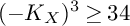 $(-K_X)^3\ge 34$. As a corollary, we prove that the tangent bundle is not big when X has a standard conic bundle structure with non-empty discriminant. Our main methods are to produce irreducible effective divisors on ${\mathbb {P}}(T_X)$ constructed from the total dual VMRT associated to a family of rational curves. Additionally, we present some criteria to determine the bigness of $T_X$.


