To save content items to your account,
please confirm that you agree to abide by our usage policies.
If this is the first time you use this feature, you will be asked to authorise Cambridge Core to connect with your account.
Find out more about saving content to .
To save content items to your Kindle, first ensure no-reply@cambridge.org
is added to your Approved Personal Document E-mail List under your Personal Document Settings
on the Manage Your Content and Devices page of your Amazon account. Then enter the ‘name’ part
of your Kindle email address below.
Find out more about saving to your Kindle.
Note you can select to save to either the @free.kindle.com or @kindle.com variations.
‘@free.kindle.com’ emails are free but can only be saved to your device when it is connected to wi-fi.
‘@kindle.com’ emails can be delivered even when you are not connected to wi-fi, but note that service fees apply.
Chapter 3 first elaborates on the view of context-sensitivity as a nontrivial context-shift-dependence. Drawing on Chapter 2, it makes explicit the fibration of semantic contents over contexts of utterance. The latter makes it natural to introduce a generic context and to identify linguistic meanings with the semantic contents attached to that context. The correspondence established between linguistic items and mathematical ones leads to the hypothesis that the fibration of contents over contexts constitutes a “stack” (with respect to a natural Grothendieck topology). This correspondence is the final reconsideration, proposed in the book, of Russell’s logical analysis. The rest of Chapter 3 distinguishes two different concepts of meaning (as obtained by collation or as transposable to more specific contexts) and thereby supports a constructive conciliation of minimalism, indexicalism, and contextualism. It also puts forward a new picture of the demarcation between semantic and pragmatic components, as well as a more flexible notion of compositionality. It finally develops various applications to philosophy of language and to cognitive linguistics.
This Element aims to expand the theoretical and methodological boundaries of Cognitive Linguistics. Research on language contact from a cognitive perspective has been neglected despite the omnipresence of linguistic contact situations. This Element addresses questions of language contact research from a cognitive perspective. The aims of this Element are twofold: first, to present the current state of the art in cognitive contact linguistics; second, to discuss existing and original theoretical approaches in this field. The focus is on four key topics that can be examined within a cognitive framework: manifestations of language contact in language processing and production, contact-induced language change at different linguistic levels, contact-induced variation in discourse and conversation, and the combination of a social and cognitive perspective in the analysis of loan processes and their linguistic effects. This title is also available as Open Access on Cambridge Core.
This chapter concludes the volume by reflecting on the ongoing value of concept analysis in the social sciences. It revisits the tension between hyperfactualism – obsessive attention to granular detail – and the necessary abstraction that enables generalization. Conceptualization, the authors argue, helps scholars not only communicate more clearly but also observe and describe phenomena more effectively. Far from being a distraction, conceptual work sharpens empirical inquiry. The chapter highlights the interplay between conceptualization and measurement, especially in validity assessment, and underscores how concepts represent and structure knowledge. Attention to concepts also facilitates integration and translation across time, space, and disciplines, as seen in such examples as the V-Dem project. Issues of conceptual boundedness, typologies, and traveling are revisited, drawing on contributions from cognitive linguistics and classic debates between lumpers and splitters. The authors also reflect on how digital tools and formal modeling offer new avenues for concept innovation. Finally, they affirm the importance of teaching concept analysis as a way to clarify students’ thinking, research design, and disciplinary communication. In sum, the chapter defends the overconscious scholar: one who sees in concepts not distraction, but a path toward cumulative, communicable, and intellectually satisfying scholarship.
This autobiographical essay by David Collier traces the evolution of his interest in concept analysis within political science. Sparked by a challenging dissertation defense on the distinction between squatter settlements and slums, Collier was motivated to better understand and refine social science concepts. He reflects on foundational influences, including Sartori’s notion of concepts as “data containers,” and explores how defining and variable properties can structure meaningful comparisons. Collier highlights the role of vivid, resonant terminology in shaping scholarly communication, drawing on examples from Hirschman, Krasner, and Murra. He credits influential mentors such as Philippe Schmitter and colleagues such as Henry Brady, as well as inspiration from the Ostroms and cognitive linguists such as Lakoff and Rosch. The essay underscores the importance of typologies, disaggregation, and sensitivity to conceptual stretching in empirical research, using the concept of corporatism and the idea of “critical junctures” as case illustrations. Collier also recounts his teaching experiences and collaborations, which reinforced his belief in the methodological and substantive value of rigorous concept work. The piece serves as both a personal narrative and a theoretical introduction to the study of concepts, setting the stage for the volume’s broader exploration of conceptual innovation in the social sciences.
Focusing on the third-person formulation of many of the texts on the question tablets, and drawing on psychological and narratological research, this essay explores the mind-set of those who came to consult Zeus, asking if these texts reveal a sense of the self as fragmented in the face of crisis – which may also suggest how processes of consultation at an oracle could have provided psychological relief to pilgrims. Using analytical approaches from cognitive linguistics, this essay examines these texts for what they may reveal in terms of a cognitive blending of Viewpoints – both mortal and divine – aiding self-integration and, thus, decision making. Finally, this essay argues that awe in the face of the divine may have been a key component of the experience of consultation, with significant impacts on our brain and body.
In this chapter, multiple anti-oppressive and liberative lenses are reviewed and discussed as application to anti-oppressive decolonial clinical social work supervision and leadership practice. This chapter both review of the theory or practice lens and an emphasis on application to practice. By design subsequent chapters will overlap, deep dive, and offer multiple practice views of several concepts offered in this chapter.
Constructions are long-term pairings in memory of form and meaning. How are they created and learned, how do they change, and how do they combine into new utterances (constructs, communicative performances) in working memory? Drawing on evidence from word-formation (blending, Noun-Noun-compounds) over idioms and argument structure constructions to multimodal communication, we argue that computational metaphors such as 'unification' or 'constraint-satisfaction' do not constitute a cognitively adequate explanation. Instead, we put forward the idea that construction combination is performed by Conceptual Blending – a domain-general process of higher cognition that has been used to explain complex human behavior such as, inter alia, scientific discovery, reasoning, art, music, dance, math, social cognition, and religion. This title is also available as Open Access on Cambridge Core.
This chapter explores the role of central aspects of cognition in historical linguistics. After describing and discussing the cognitive commitment and its theoretical background, this chapter highlights the relation to cognitive archaeology as well as historical psychology and explores the methodological prerequisites for cognitive approaches to the history of English, particularly the quantitative turn in cognitive linguistics. Case studies from different periods of English illustrate how cognitive factors can shed light on synchronic historical language stages and diachronic developments, and how these in turn can help us to further explore the cognitive commitment. Finally, we argue for a feedback loop, where modern cognitive linguistic theories feed into and guide historical enquiries, but are also checked and modified, if necessary, on the basis of historical findings.
Construction Grammar and Systemic Functional Grammar take different approaches to the study of lexico-grammar, based on language as a cognitive and as a social phenomenon respectively. This is the first book to bring the two approaches together, using corpus-based Pattern Grammar as an underlying descriptive framework, in order to present a comprehensive and original treatment of verb-based patterns in English. It describes in detail two processes: deriving over 800 verb argument constructions from 50 verb complementation patterns; and using those constructions to populate systemic networks based on 9 semantic fields. The result is an approach to the lexis and grammar of English that unifies disparate theories, finding synergies between them and offering a challenge to each. Pattern Grammar, Construction Grammar and Systemic-Functional Grammar are introduced in an accessible way, making each approach accessible to readers from other backgrounds. This title is also available as open access on Cambridge Core.
This cross-dialectal diachronic study focuses on actualization—the gradual mapping out of structural innovations across linguistic environments—and asks: to what extent can the route by which actualization unfolds be explained by appealing to common cognitive constraints, and to what extent are pathways of actualization shaped by community-specific patterns in language use? I analyze real-time syntactic change in Spanish oblique relative clauses (ORCs), which are undergoing an enhancive change towards increasing use of antecedent-agreeing definite articles (e.g., la casa en [la] que nací ‘the house in which I was born’). Over 8,000 occurrences of ORCs were compiled from three Latin American varieties. A Bayesian mixed-effects logistic regression analysis shows that various constraints representing the cognitive accessibility of the antecedent influence actualization similarly across varieties. The discussion addresses the cognitive realism of historical corpus data and formulates testable predictions that present profitable lines of inquiry in future cognitively oriented cross-dialectal diachronic research.
The Latin translators of the New Testament often rendered the middle/passive verb διακρίνοµαι with words for doubt or indecision (haesito, dubito). However, in post-classical Greek, διακρίνοµαι never means ‘to doubt’. Earlier practitioners of a theologically driven philology supposed that the New Testament authors themselves created a new meaning for the word – an untenable position from the perspective of modern lexicography. How then did διακρίνοµαι become ‘doubt’? This article offers a two-pronged answer through literary-historical and cognitive linguistic analysis. First, I trace how the Greek words διακρίνοµαι and δίψυχος (‘double-minded’) became associated with the concept of ‘doubt’ through the Christian reception of the Jewish Two Ways tradition and the Letter of James. I show how the discursive connections between διακρίνοµαι, δίψυχος and ‘doubt’ (διστάζω) influenced the rendering of both terms within Coptic and Latin translation traditions. Second, I show how the same data can be analysed within a cognitive linguistic perspective, offering a model for lexicographical analysis that is grounded in modern linguistic theory.
This chapter returns to the theoretical concerns of the study, and to the principles at the heart of a cognitive-functional approach to modeling the cognitive processes in language use. Central are the basic principles of depth and dynamism, and the three issues emerging from them when comparing cognitive and traditional functionalist approaches in current linguistics: the (non)concern with conceptualization in linguistic analysis, the processual vs. representationalist concept of grammar, and the complex meaning-form relationship. The chapter rounds up and reflects on what the analyses of the attitudinal and other semantic and functional dimensions in the preceding chapters have shown with relevance to these principles and issues. Moreover, it uses these insights to dwell on wider implications, beyond the analysis of the qualificational dimensions, for our understanding of the cognitive systems involved in language use.
Interaction in Poetic Imagery was my first book. It was based on my doctoral researches at Cambridge in the mid-1960s. I set out to formulate a theory of a significant, but previously untheorised, aspect or potentiality of poetic imagery – indeed an aspect or potentiality not previously demarcated, either under the name I gave it, ‘interaction’, or any other name. With ‘imagery’ understood as ‘metaphor, simile and the various forms of comparatio’, I identified interaction as ‘any local cross-terminological relation between the tenor and vehicle of an image’, explicitly adapting ‘tenor’ and ‘vehicle’ from I. A. Richards’ The Philosophy of Rhetoric. I then categorised the modes of interaction into four groups (with subsequent subdivisions). The cross-terminological relation might be effected aurally or extra-grammatically or by intrusion or (most commonly) by neutral terminology. All this was established on the basis of a corpus of Greek poetry – early lyric and dramatic poetry, from Archilochus to Aeschylus – with additional examples from English poetry, from Shakespeare to the twentieth century.
This paper aims to examine Wolfhart Pannenberg’s theology of divine action using the conceptual framework of cognitive linguistics. Central to this exploration is Pannenberg’s use of the scientific concept of force field in an analogical/metaphorical way, enabling him to present a trinitarian-pneumatological understanding of divine action through divine omniscience and omnipresence. This paper argues that, despite justified criticisms of Pannenberg’s reliance on Faraday’s outdated concept of a universal force field, recent developments in cognitive linguistics affirm the legitimacy of Pannenberg’s panentheistic metaphorical approach to the theology of divine action while calling for revisions.
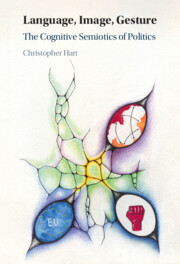
Politics is an inherently symbolic practice. This innovative book advances a framework for the critical analysis of political texts and talk based in cognitive linguistics. Through detailed analyses of attested semiotic practices, it provides a current, comprehensive and authoritative statement on the paradigm of Cognitive Critical Discourse Analysis (Cognitive CDA). The ideological effects of dominant conceptualisations and their implications for the legitimation of social action are explored with reference to political topics that have defined the last decade, including immigration, the rise of nationalism, the right to protest, Brexit and Covid-19. A range of conceptual phenomena are addressed, including image schematic patterning, attentional distribution, viewpoint and metaphor, as they feature in various contexts, genres and modes of political discourse. In a major advancement of the paradigm, the book extends Cognitive CDA to images and gesture to consider the role played by multiple semiotic modes in the discursive performance of politics.
Word Grammar is a linguistic theory which best known as a variant of Dependency Grammar. However, it has a number of other properties, and its architectural assumptions are consistent with its theory of how human cognition works and its theory of how representations work. In this chapter we relate Word Grammar (WG) to a number of different trends in linguistic theorising and explain the various traditions that the theory belongs to. Word Grammar belongs in three main theoretical traditions: Dependency Grammars, Constraint-based Grammars and Cognitive Linguistics. We show how WG relates to these approaches and explore how the network model of linguistic representation adopted by WG relates to each tradition. The key claim of WG is that language is represented in a symbolic network, which is part of a more general human cognitive network and which is in a relationship with a discreet neural network.
This article unpacks a Nahuatl metaphor based on the kin term hueltiuh, “man's elder sister,” used in multiple sixteenth-century Nahuatl texts and their Spanish derivatives. Through a minute analysis of several Nahua stories, the article identifies various roles described with this term: spies, “toothed-vagina” femmes fatales, heart-eating monsters, and seducers. Applying a method borrowed from cognitive linguistics, it then constructs a model of “man's elder sister,” which explains the application of this metaphor to different contexts. In Nahua stories, hueltiuh is usually a female mediator who throws the male characters off balance, leading to a new status quo. Confusingly, this metaphor often appears where one would expect a real kinship term and in a way that makes identifying its symbolic meaning difficult. These complications have led scholars to see (only) genealogical information in stories concerned with symbolic rather than genealogical relations between elite members or deities. The results presented here allow for refining our understanding of some famous Nahua narratives, such as the one on Topiltzin Quetzalcoatl's abandonment of Tollan. They also invite a rethinking of our views on the Nahua (Aztec) pantheon of gods, whose figurative “family bonds” may, in fact, indicate complex nonkinship relations and dependencies.
This Element presents a Cognitive Grammar (CG) approach to a range of signed language grammatical phenomena. It begins with a background on the history of sign linguistics, focusing on what was a widely held belief that signs are simply gestures. The first section traces the modern linguistic examination of signed languages, focusing on Stokoe and his demonstration that these languages exhibit phonology and duality of patterning. Next, we present some fundamental principles that are foundational for cognitive linguistics and sign linguistics. In a section on Cognitive Grammar, we present a brief overview of CG principles, constructs, and models. Section 4 presents extensive analyses of signed language constructions applying CG, including nominal grounding; the concepts of Place and placing; a CG approach to 'agreement' constructions in signed languages; reported dialogue; grammatical modality; and the grammatical meaning of facial displays. The final section examines the controversial role of gesture in grammatical constructions.
This study aims to explore the target concepts of metonymical and metaphorical uses of ‘head’ in Jordanian Arabic (JA) compared to those used in Tunisian Arabic (TA). Extended conceptual metaphor theory (ECMT) as envisaged by Kövecses (2020, Review of Cognitive Linguistics, 18, 112–-130) is adopted as the theoretical framework. Data analysis reveals that through metonymic metaphors, the head in JA is used to profile character traits, mental faculty, cultural values and emotions. The head in JA is also capitalized upon to provide explanations of several daily life experiences. The primacy of head in JA was clear in the informants’ comprehension of the means by which embodiment provides the grounding for cognition, perception and language, which supports Gibbs’ (2014, The Bloomsbury companion to cognitive linguistics, pp. 167–184) ‘embodied metaphorical imagination’. Similarities in the cultural model of head between the two dialects were found, yet differences were also detected. In contrast to TA, the head is more productive in JA in profiling character traits and emotions. These differences were attributed to the existence of a cultural filter that has the ability to function between two cultures that belong to one matrix Arab culture and differences in experiential focus between the two examined speech communities.
This Element introduces a usage-based computational approach to Construction Grammar that draws on techniques from natural language processing and unsupervised machine learning. This work explores how to represent constructions, how to learn constructions from a corpus, and how to arrange the constructions in a grammar as a network. From a theoretical perspective, this Element examines how construction grammars emerge from usage alone as complex systems, with slot-constraints learned at the same time that constructions are learned. From a practical perspective, this work is accompanied by a Python package which enables linguists to incorporate construction grammars into their own corpus-based work. The computational experiments in this Element are important for testing the learnability, variability, and confirmability of Construction Grammar as a theory of language. All code examples will leverage the cloud computing platform Code Ocean to guide readers through implementation of these algorithms.