To save content items to your account,
please confirm that you agree to abide by our usage policies.
If this is the first time you use this feature, you will be asked to authorise Cambridge Core to connect with your account.
Find out more about saving content to .
To save content items to your Kindle, first ensure no-reply@cambridge.org
is added to your Approved Personal Document E-mail List under your Personal Document Settings
on the Manage Your Content and Devices page of your Amazon account. Then enter the ‘name’ part
of your Kindle email address below.
Find out more about saving to your Kindle.
Note you can select to save to either the @free.kindle.com or @kindle.com variations.
‘@free.kindle.com’ emails are free but can only be saved to your device when it is connected to wi-fi.
‘@kindle.com’ emails can be delivered even when you are not connected to wi-fi, but note that service fees apply.
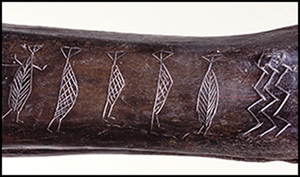
Twenty-nine petroglyphs found in 15 archaeological sites in Brazilian Amazonia, previously selected as possible representations of primates, were analyzed in detail in search of shapes or postures that could be used for identifying taxa. Identification was based on the assumption that each artist would have depicted local fauna. After genera had been determined, geographic distribution of the respective species in the region was examined. This method allowed for the identification of nine species, in addition to one animal at genus level and another to family level. Archaeological publications dealing with representations of animals often disregard methodological procedures used for taxon identification. A more refined procedure would include examining taxon diagnostic characters, life history and behavior, and geographic distribution. All observed taxa are endemic to Amazonia. Among the identified species, three are currently considered vulnerable to extinction. Two species were found to be represented in sites located in geographic areas where they supposedly do not occur, which suggest the need for more thorough faunal inventories and should stimulate research on the displacements of ancient human communities in those regions.
Keywords:
Rock art, Archaeology, Zoology, Morphology, Behavior
Nonhuman primate subfossils have been excavated from 20 prehistoric (37,000– 2,940 BP) cave sites across Sri Lanka. These nonhuman primates were sources of food for the inhabitants. One of these sites, the Sigiriya Potana cave situated in the intermediate climatic zone in north central Sri Lanka, belongs to a complex of 12 caves located in the Central Province at 70 m above sea level. An excavation was conducted between 1990 and 1991 by the Post Graduate Institute of Archaeology, Colombo. The cave deposits were dated at ca. 6000 BP and the calibrated age ranges from cumulative probability (one sigma) 3913–3727 BCE (UA 5685) and 3913–3709 BCE (UA5686) using carbon-14 dating techniques. These nonhuman primate subfossils were found along with two complete human skeletons. These nonhuman primates are suspected to be the equivalents of the three diurnal species currently present in the area; namely two langur species (Semnopithcus vetulus, Semnopithecus priam thersites) and a macaque (Macaca sinica). The total number of nonhuman primate subfossils found were 23 mandible fragments with teeth and 6 maxillary fragments with teeth. The postcranial material was badly fragmented, rendering impossible any meaningful analyses. Some of this material was burnt, and it is presumed that the human inhabitants consumed these nonhuman primates during their occupation of the cave. Odontometrical comparison of the dental morphology of these subfossil samples with those of the three extant nonhuman primate species confirmed that these are the same species. Consistent with other sites in Sri Lanka and elsewhere in South Asia during the Terminal Pleistocene/Holocene (~12,000 to 3000 BP) nonhuman primates are considered to have been an important food resource.
Keywords:
Nonhuman primate subfossils, Prehistoric cave site, ca. 6000 BP, Macaca sinica, Semnopithecus priam thersites, S. vetulus
South Africa is host to no less than seven extant primate species and also boasts a long history of findings of hominin fossils. Large primates, such as baboons and hominins, have coexisted and interacted for some three million years in the region. This coexistence changed radically over the millennia. During the Plio-Pleistocene, baboons and hominins were both prey to predators, such as leopards and saber-toothed cats, and they often slept in caves at night to escape predation. By the Later Stone Age, baboon remains are anthropologically modified, and the new social connotations are likely associated with ritual contexts. The potential ritual role of baboons changed with the arrival of the Iron Age farmers, when baboons were attracted to cultivated fields. Ethnoprimatologically, baboons became known as familiars of evil persons, reflecting largely a negative image of these primates. Europeans introduced rifles to South Africa, and this new technology assisted in the extermination of baboons in many parts of South Africa. Today, baboons are confined to nature reserves and rural areas.
One’s apprehension of the natural world, of ecosystems, and the species living therein, almost always takes shape in the contexts of (1) interspecific relational practices, (2) modalities and forms of naturalistic knowledge, and (3) institutionalized practices of encounter with nonhuman animals. The elaboration of particular cultural representations of nonhuman primates is no exception: it too largely depends on cultural variables. Scientific thought as disseminated for popular consumption, blockbuster films, and bourgeois entertainments, such as zoos and circuses, have contributed substantially to modern humans’ conceptions of primates, especially anthropomorphic apes. The ancient Roman world between the end of the first millennium BCE and the beginning of first millennium CE, however, was characterized by relational practices, cultural categories, and forms of scientific knowledge of nonhuman primates very different from those now operating in the Western imaginary. It is significant, for example, that the Romans most commonly interacted not with gorillas and chimpanzees, but with macaques and baboons. By investigating how nonhuman primates were integrated into Roman cultural encyclopedia, this article will center not on ape lore per se but instead upon the distinct cultural matrix within which primates were perceived, their behavior interpreted, and their relationship to humans understood.
Keywords:
Ancient Rome, Imitation, Animal–human relation, Nonhuman primates, Ancient zoological knowledge
This chapter presents a comprehensive review of the interaction between circum-Caribbean indigenous peoples and nonhuman primates before and at early European contact. It fills significant gaps in contemporary scholarly literature by providing an updated archaeological history of the social and symbolic roles of monkeys in this region. We begin by describing the zooarchaeological record of primates in the insular and coastal circum-Caribbean Ceramic period archaeological sites. Drawing from the latest archaeological investigations that use novel methods and techniques, we also review other biological evidence of the presence of monkeys. In addition, we compile a list of indigenously crafted portable material imagery and review rock art that allegedly depicts primates in the Caribbean. Our investigation is supplemented by the inclusion of written documentary sources, specifically, ethnoprimatological information derived from early ethnohistorical sources on the multifarious interactions between humans and monkeys in early colonial societies. Finally, we illustrate certain patterns that may have characterized interactions between humans and monkeys in past societies of the circum-Caribbean region (300–1500 CE), opening avenues for future investigations of this topic.
Keywords:
Archaeoprimatology, Ceramic period, Greater and Lesser Antilles, Island and coastal archaeology, Saladoid, Taíno, Trinidad, Venezuela
Chapter 7 defines the Epipaleolithic and Neolithic periods using the archeological record to explain how humans eventually organized themselves into larger sedentary groupings, developing symbolic communication networking as a convenient tool for controlling growing population densities.
Chapter 11 examines human migrations through time – past, present and future. It explains how what we learn from human prehistory is useful for dealing with the problems of racism and nationalism plaguing humanity in today’s world.
Primates are mammals with high cultural significance in ancient societies. The objective of this research is to explore the material culture and biological remains of primates found in Teotihuacan, one of the largest pre-Hispanic urban areas of Mexico. Remains of Mesoamerican spider monkeys (Ateles cf. A. geoffroyi) were found in the Pyramid of the Moon, Xalla, and the Plaza of the Columns. Portable material culture that resembles primates was recovered elsewhere within Teotihuacan, but mostly in Tetitla and La Ventilla. Murals with representations of monkeys were found at these last two Teotihuacan sites. Possibly, primates reached Teotihuacan because of relationships with peoples from more distant lands such as the Mayan region as well as the Oaxacan province ruled by Monte Albán. The rise of the presence of primates in Teotihuacan occurred during the Classic period (~200–550 CE); however, it is relatively scarce considering the large size of the city and the long period of time in which Teotihuacan had been researched. Nevertheless, the existence of monkeys in Teotihuacan, either as exotic animals or as portable objects, does also seem to indicate that they were disseminated within different parts of the city. Thus, living primates and their representations circulated with their symbolic value in Teotihuacan, particularly among members of the ruling elite, and likely among members of other neighboring Mesoamerican societies.
After a rapid survey of the contents of the Baboon Catacomb at Saqqara in Egypt, most of the remains of an estimated 180 monkey individuals (the surviving 40%) were temporarily removed for further study. The predominant species is Papio anubis, but 21 Macaca sylvanus and 2 Chlorocebus aethiops were present. Late Dynastic Egyptians employed a unique method of encasing linen-wrapped baboon mummies in plaster at the catacomb, but most of the monkey corpses were probably macerated before interment. Most of the skulls show symptoms of dietary deficiency or sunlight deprivation; some show signs of violence. The disproportionate male representation indicates that little breeding occurred. Males were probably preferred because of human reverence for the characteristic sitting posture, often with penis erect, that monkeys adopt when advertising land occupancy. Humans once displayed in a similar manner, later using effigies as stand-ins, but as civilization developed, this territorial behavior was suppressed.
Keywords:
Cage paralysis, Herodotus, Imhotep, Osteomalacia, Sun worship, Thoth
Chapter 4 is dedicated to a full description of ancient stone tool technologies, explaining how they evolved into human culture. It discusses how these early technologies evolved, eventually carving out the first notions of identity and belonging to a specific territorial range. Lower Paleolithic cultural complexes of the Oldowan and the Acheulian are presented using examples from some of the most pertinent discoveries made so far in Africa and Eurasia.
A recent paper in Britannia explored some of the potential factors which might have led to potters in the Silchester area continuing the production of flint-tempered pottery, already established in the Iron Age, into the start of the Roman period. This paper attempts to expand the discussion by considering the viewpoint of the potters’ customers and what they might have been looking for when purchasing their pots, with particular emphasis on the characteristics required of cookwares.
I argue that Avicenna allows for at least one case where we can intellectually grasp a particular individual as such: Each human intellect can intellect itself as numerically this one intellect without relying on any general notion or concept. This is because humans can retain their individuality when separated from their bodies. I discuss passages in which Avicenna appears to affirm and deny that humans can intellect themselves. I conclude that in contrast to the self-awareness that Avicenna showcases in his “floating human” thought experiment, human self-intellection is a rare achievement, and I explain how it differs from the more perfect self-intellection of the divine intellect.
This article analyses Avicenna's Ḥayawān III, 1, which deals with the well-known disagreement between physicians and philosophers on the origination of blood vessels (arteries and veins) and nerves. However, the proposed analysis is not limited to this chapter and its main topic. The more general purpose of this article is to reconstruct the psycho-medical context in which Avicenna's exposition lies, that is, the soul's oneness and the consequent conditions for body ensoulment (i. e. the soul's need for a primary, unitary attachment to the body through the heart and the cardiac pneuma). The article then outlines the strategy through which Avicenna presents medical positions (heart, brain, and liver are all on an equal footing) that challenge his (and Aristotle's) anatomical model, which is coherent with his theory of the soul. In this connection, firstly, the article shows how Avicenna takes physicians’ arguments apart in a philosophical context (he usually points at their logical shortcomings). Then, it clarifies the contribution of anatomy to determine the conditions of body ensoulment and, ultimately, how to reconcile medical practice with philosophical truths, if need be.
In the next 10 years, the US cultural resource management (CRM) industry will grow in terms of monies spent on CRM activities and the size of the CRM labor force. Between US fiscal years 2022 and 2031, annual spending on CRM will increase from about $1.46 to $1.85 billion, due in part to growth in the US economy but also to an added $1 billion of CRM activities conducted in response to the newly passed infrastructure bill. The increased spending will lead to the creation of about 11,000 new full-time positions in all CRM fields. Archaeologists will be required to fill more than 8,000 positions, and of these, about 70% will require advanced degrees. Based on current graduation rates, there will be a significant MA/PhD-level job deficit. Accordingly, there is a compelling need to (a) stop the trend to close or decrease the size of current graduate programs, (b) reorient academic programs to give a greater emphasis to the skills needed to be successful in CRM, and (c) better integrate academic and applied archaeology to leverage the vast amount of data that will be generated in the next decade to best benefit the public.