To save content items to your account,
please confirm that you agree to abide by our usage policies.
If this is the first time you use this feature, you will be asked to authorise Cambridge Core to connect with your account.
Find out more about saving content to .
To save content items to your Kindle, first ensure no-reply@cambridge.org
is added to your Approved Personal Document E-mail List under your Personal Document Settings
on the Manage Your Content and Devices page of your Amazon account. Then enter the ‘name’ part
of your Kindle email address below.
Find out more about saving to your Kindle.
Note you can select to save to either the @free.kindle.com or @kindle.com variations.
‘@free.kindle.com’ emails are free but can only be saved to your device when it is connected to wi-fi.
‘@kindle.com’ emails can be delivered even when you are not connected to wi-fi, but note that service fees apply.
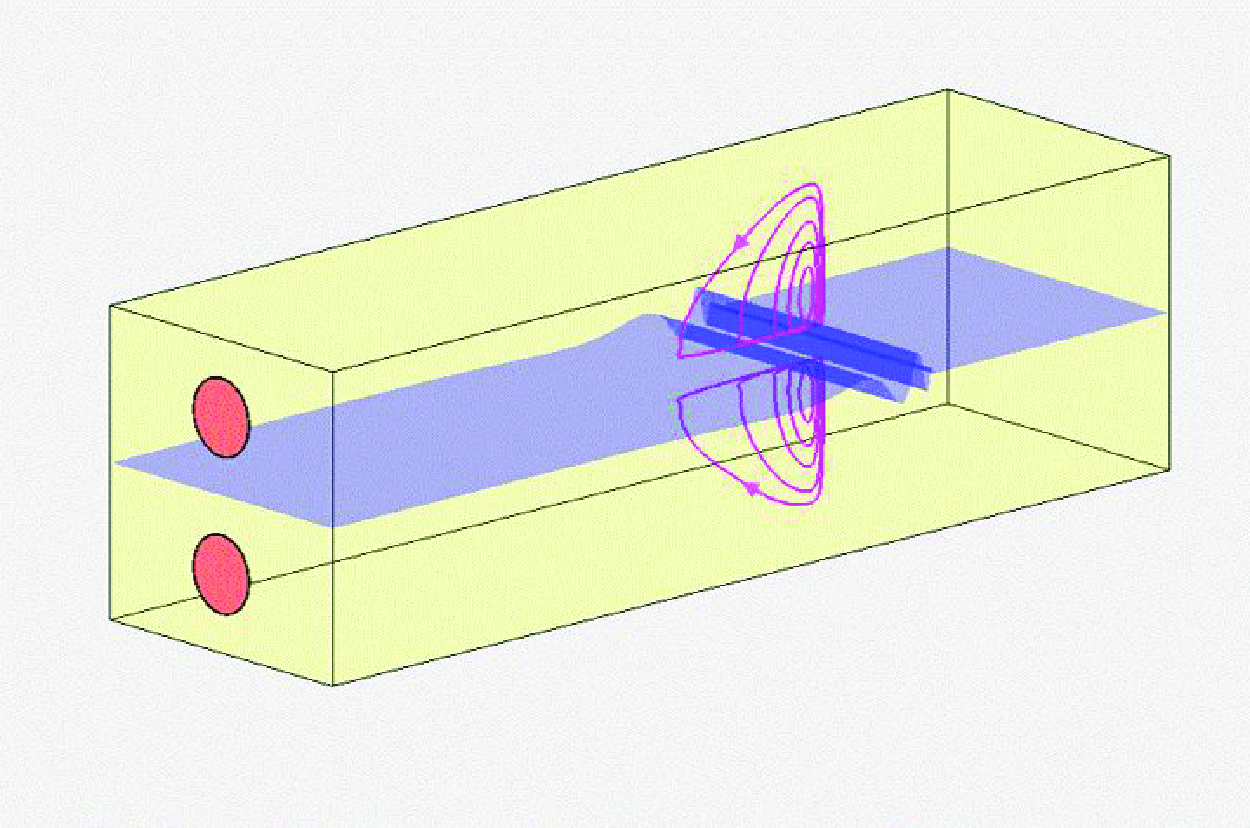
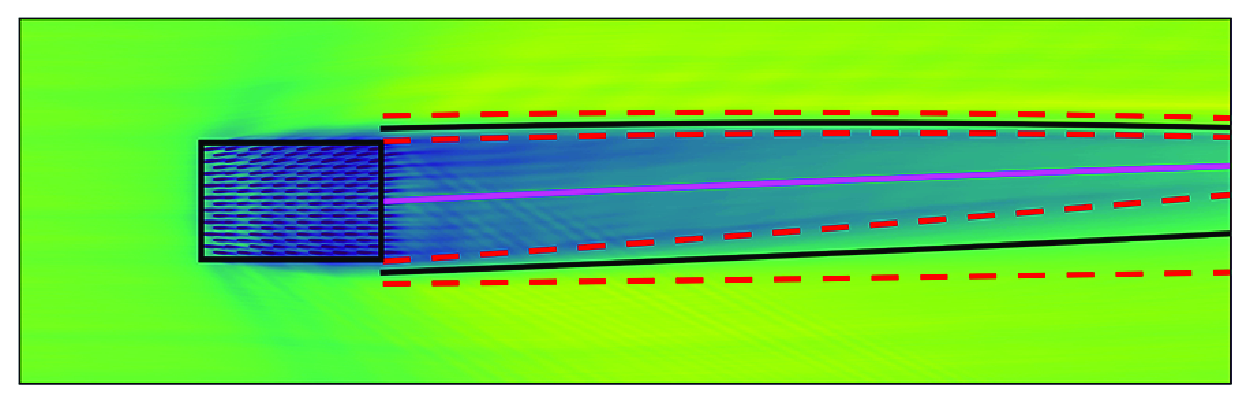
Three-dimensional wake forcing is applied to a profiled blunt trailing edge body from synthetic jet arrays distributed symmetrically on both sides of the body. The effect on the wake is experimentally studied at Reynolds numbers based on body thickness, $d$, of $2500 \leqslant Re_d=u_\infty d/\nu \leqslant 5000$ in the turbulent wake regime. The exits of the synthetic jets are rectangular slots and are oriented spanwise to the cross-flow with a uniform spacing of $2.4d$. The forcing causes spanwise variations in the separated shear layers, leading to the von Kármán vortices tilting and forming coherent streamwise vortex loops. This reorientation of the wake vorticity is associated with the attenuation of the vortex street and drag reduction, consistent with previous studies of spanwise perturbations to wakes. The effect of forcing amplitude on the drag and wake structure is examined. It is found that the mean shedding frequency is constant across the span in all cases, indicating that the forced wake has a periodic organised structure. The greatest drag reduction of approximately 25 % is achieved when the vortical structures emitted by the jets penetrate up the edges of the boundary layers of the body, which occurs at velocity ratios (defined from the mean jet exit velocity during expulsion) of about 3 when $Re_d=2500$ and about 2 when $Re_d=5000$. This study presents evidence that the forcing effectiveness is maximised when the vortex street is most tilted into the streamwise direction.
The description of the generation mechanism of impulse surface waves remains an important challenge in environmental fluid mechanics, owing to the need for a better understanding of large-scale phenomena such as landslide-generated tsunamis. In the present study, we investigated the generation phase of laboratory-scale water waves induced by the impulsive motion of a rigid piston, whose maximum velocity $U$ and total stroke $L$ are independently varied, as well as the initial liquid depth $h$. By doing so, the influence of two dimensionless numbers is studied: the Froude number $\mathrm {Fr}_p$ = $U/(gh)^{1/2}$, with $g$ the gravitational acceleration, and the relative stroke $\Lambda _p =L/h$ of the piston. During the constant acceleration phase of the vertical wall, a transient water bump forms and remains localised in the vicinity of the piston, for all investigated parameters. Experiments with a small relative acceleration $\gamma /g$, where $\gamma =U^2/L$, are well captured by a first-order potential flow theory established by Joo et al. (1990), which provides a fair estimate of the overall free surface elevation and the maximum wave amplitude reached at the contact with the piston. For large Froude numbers, however, wave breaking hinders the use of such an approach. In this case, an unsteady hydraulic jump theory is proposed, which accurately predicts the time evolution of the wave amplitude at the contact with the piston throughout the generation phase. At the end of the formation process, the dimensionless volume of the bump evolves linearly with $\Lambda _p$ and the wave aspect ratio is found to be governed, at first-order, by the relative acceleration $\gamma /g$. As the piston begins its constant deceleration, the water bump evolves into a propagating wave and several regimes such as dispersive, solitary-like and bore waves, as well as water jets are then reported and mapped in a phase diagram in the ($\mathrm {Fr}_p$, $\Lambda _p$) plane. While the transition from waves to water jets is observed if the typical acceleration of the piston is close enough to the gravitational acceleration $g$, the wave regimes are found to be mainly selected by the relative piston stroke $\Lambda _p$. On the other hand, the Froude number determines whether the generated wave breaks or not.
The Imalia polyphase polymetallic deposit, located in the Mahakoshal belt of Central India, is hosted by carbonate rocks. The major part of mineralisation at Imalia results from hydrothermal activity induced by the intrusion of quartz porphyry dykes, which also formed an alteration halo of silicate and oxide minerals during their interaction with the host lithology. The initial silicates to form were hydrothermal Ca-amphibole and a minor amount of garnet, followed by potassic phases including biotite and K-feldspar, as well as rutile, apatite, titanite, pyrite, magnetite and rare calcite and ilmenite. A subsequent, cooler pulse of hydrothermal fluid overprinted the earlier-formed silicates and was responsible for the bulk of the sulphide mineralisation at Imalia. During this transformation phase, propylitic silicates primarily consisting of chlorite and epidote, along with a modest proportion of actinolite, albite, titanite, sericite and calcite, formed, accompanied by iron-rich oxide phases including magnetite, hematite and ilmenite. These silicates mostly formed under high water-to-rock ratios with significant meteoric water influence. Geothermometric and fluid inclusion data indicate that alteration zone minerals formed at temperatures between approximately 150°C and 550°C, at pressures of around 1 kbar and depths of less than 10 km, with a mean oxygen fugacity of log fO2 -32, closely aligned with the FMQ buffer. The alteration zone minerals record the evolution of hydrothermal fluids in a predominantly brittle structural regime, characterised by episodic decompression due to fluid overpressuring and hydrofracturing, as evidenced by various types of breccias, diverse quartz veins, open space-filling textures and fluid inclusion data.
The linear stability of miscible displacement for radial source flow at infinite Péclet number in a Hele-Shaw cell is calculated theoretically. The axisymmetric self-similar flow is shown to be unstable to viscous fingering if the viscosity ratio $m$ between ambient and injected fluids exceeds $3/2$, and to be stable if $m\lt {3/2}$. If $1\lt m\lt {3/2}$, then small disturbances decay at rates between $t^{-3/4}$ and $t^{-1}$ (the exact range depending on $m$) relative to the $t^{1/2}$ radius of the axisymmetric base-state similarity solution; if $m\lt 1$, then they decay faster than $t^{-1}$. Asymptotic analysis confirms these results and gives physical insight into various features of the numerically determined relationship between the growth rate and the azimuthal wavenumber and viscosity ratio.
Wave impact on solid structures is a well-studied phenomenon, but almost exclusively for the case that the impacting liquid (e.g. water) is surrounded by a non-condensable gas (such as air). In this study we turn to wave impact in a boiling liquid, a liquid that is in thermal equilibrium with its own vapour, which is of key relevance to the transport of cryogenic liquids, such as liquified natural gas and liquid hydrogen in the near future. More specifically, we use the Atmosphere facility at MARIN, NL, to prepare water/water vapour systems at different temperatures along the vapour curve. Here, we perform wave impact experiments by generating a soliton in a flume contained within the autoclave of the facility. A bathymetry profile interacts with the soliton, leading to a breaking wave that impacts onto a vertical wall, where we measure the pressures occurring during impact by means of $100$ embedded pressure sensors. In boiling liquids, we report wave impact pressures that are up to two orders of magnitude larger than those measured in comparable water–air experiments. We trace these pressures back to the collapse of the entrapped vapour pocket, which we semi-quantitatively describe using a simplified hemicylindrical vapour bubble model, which is in good agreement with the experimental findings. Finally, this allows us to predict the relevance of our findings for the transport of cryogenic liquids in huge overseas carriers where wave impact due to sloshing is the dominant cause of hydrodynamic load of containment systems in cargo tanks.
In a quiescent medium, chemically active particles propel themselves by emitting or absorbing solutes, creating concentration gradients that induce a slip at the particle surface. This self-propulsion occurs when solute advection overcomes diffusion. However, an imposed flow field can alter these dynamics. This study explores the propulsion characteristics and the related rheological consequences of chemically active particles in an imposed uniaxial extensional flow analytically and numerically. An asymptotic solution is obtained for weak imposed flow relative to self-induced diffusiophoretic slip. Meanwhile, finite element simulations are carried out over a wide range of imposed flow strength and Péclet number. The results reveal that the interplay between solute advection, imposed flow and diffusiophoretic slip significantly affects particle propulsion and suspension rheology. While solute advection and diffusiophoretic slip tend to create asymmetric solute distributions, promoting self-propulsion, imposed extensional flow promotes symmetric distributions, hindering self-propulsion. This not only delays the start of self-propulsion but also results in an early transition from a propulsion state to a stationary state characterised by an abrupt halt at relatively lower Péclet number compared to a quiescent medium. Post the abrupt halt, a stirring effect induced by particle activity and imposed extensional flow results in an increased magnitude of stresslet, thus a sudden change in the effective viscosity of the active suspension. The effect of imposed extensional flow on active particle dynamics and suspension rheology can be described succinctly by categorising the overall dynamics into three separate regimes, determined by the Péclet number and the intensity of the extensional flow.
The acoustofluidic method holds great promise for manipulating micro-organisms. When exposed to the steady vortex structures of acoustic streaming flow, these micro-organisms exhibit intriguing dynamic behaviours, such as hydrodynamic trapping and aggregation. To uncover the mechanisms behind these behaviours, we investigate the swimming dynamics of both passive and active particles within a two-dimensional acoustic streaming flow. By employing a theoretically calculated streaming flow field, we demonstrate the existence of stable bounded orbits for particles. Additionally, we introduce rotational diffusion and examine the distribution of particles under varying flow strengths. Our findings reveal that active particles can laterally migrate across streamlines and become trapped in stable bounded orbits closer to the vortex centre, whereas passive particles are confined to movement along the streamlines. We emphasise the influence of the flow field on the distribution and trapping of active particles, identifying a flow configuration that maximises their aggregation. These insights contribute to the manipulation of microswimmers and the development of innovative biological microfluidic chips.
Recent observations have shown a fast decrease in thickness and area of Pyrenean glaciers in some cases leading to a stagnation of ice flow. However, their transition to a new paraglacial stage is not well understood. Through the combination of uncrewed aerial vehicles imagery, airborne LiDAR, ground-penetrating radar and ground temperature observations, we characterized the recent evolution of Infiernos Glacier. In 2021, this glacier had small sectors thicker than 25 m, but most of area did not exceed 10 m. The thickness losses from 2011 to 2023 reached 9 m in average, of which 5 m occurring during the period 2020–23. This trend demonstrates the significant ice melt under current climatic conditions. In the last years, the glacier has also shown a remarkable increase of debris cover extent. In these areas, the ice loss was reduced by half when compared to the thickness decrease in the entire glacier. Sub-freezing ground temperatures evidence the highly probable presence of permafrost or buried ice in the surroundings of the glacier. The clear signs of ice stagnation and the magnitude of area and thickness decrease support the main hypothesis of this work: After 2023, the Infiernos Glacier can no longer be considered a glacier and has become an ice patch.
We document the first recorded nesting attempt by a green sea-turtle (Chelonia mydas) in Pemba located in the Cabo Delgado Province of northern Mozambique – an urban area with a population of 200,529 inhabitants. This sighting expands the known nesting range of sea-turtles by 40 km south of the Quirimbas Archipelago, highlighting Pemba’s potential as a critical nesting site. In July 2021, local fishermen were observed by a tourism operator killing the turtle and selling its meat. Consequently, the absence of eggs at the presumed nesting site suggests that the turtle was intercepted before it could lay eggs. This incident highlights the threats to sea-turtles and the need for conservation while emphasising the importance of collaboration among communities, government, and researchers to protect nesting activity.
Surface migratory myctophids migrate nocturnally from the mesopelagic to the near-surface layers and are the dominant components of oceanic neuston fish assemblages. We examined the horizontal distribution and habitat conditions of juvenile surface migratory myctophids in the Kuroshio region in late winter from 2003 to 2016. In total, 9098 myctophid juveniles, including 17 species, were collected in the surface layer at night. Of these, the eight most abundant species accounted for 99.0%. They showed five distinct distribution patterns closely related to the position of the Kuroshio axis. Dasyscopelus orientalis was restricted to the inshore side of the Kuroshio axis (INK), where sea surface temperature (SST) was lowest but zooplankton biomass (ZPB), a proxy for food availability, was highest. The centre of distribution of D. asper and D. obtusirostris was in the area of the axis (KUA), where the highest SST and intermediate ZPB were observed, although they were also abundant in INK. Dasyscopelus spinosus was collected mainly in the area south of Kyushu Island adjacent to upstream of the Kuroshio. The distributions of Symbolophorus evermanni, Centrobranchus nigroocellatus, and Myctophum nitidulum were restricted to the offshore side of the axis (OFK), where intermediate SST and lowest ZPB were observed. Hygophum reinhardtii was collected abundantly in both OFK and KUA. Spatial habitat segregation of juveniles would result from differences in spawning grounds and larval and juvenile transport routes. The Kuroshio contributes to the biodiversity of myctophids along the Pacific coast of southern and central Japan by creating adjacent but distinct habitat conditions.
Monthly sampling of cephalopod at Port-en-Bessin fish market (Normandy, France) over a 30-year period, combined with commercial fishery statistics, provides essential insight into the exploitation patterns, composition and size frequencies of these resources. Port-en-Bessin cephalopod landings are shown to decrease which is consistent with the decline observed in the entire French fleet operating in the English Channel. Cuttlefish landings exhibit a bimodal length distribution which is expected for this 2-year life cycle (and two-cohort) population. Juveniles of the year are recruited from October (from 8 cm). By the end of their second year of life, cuttlefish reach their maximum size (on average about 22 cm in April–May) prior to dying following spawning. Cuttlefish average size of the second cohorts has decreased from 20 to 17 cm over the period 1996–2022. This seems to be a reduction in size rather than a change in the timing of catches. Squids are not segregated in commercial landings, and the protocol was developed to inform on the prevalence of Loligo forbesii and L. vulgaris in the catch. Both species have a 1-year life cycle with a 3-month offset (recruitment of L. forbesii occurs in June and L. vulgaris in September). Over the 30 years of data, an increase in L. vulgaris landings is observed, while L. forbesii landings have decreased. These findings, in line with climate change, consider biases such as fishermen behaviour determining landings geographical origin.
Generalised two-dimensional (2-D) fluid dynamics is characterised by a relationship between a scalar field $q$, called generalised vorticity, and the stream function $\psi$,namely $q = (-\nabla ^2)^{\frac {\alpha }{2}} \psi$. We study the transition of cascades in generalised 2-D turbulence by systematically varying the parameter $\alpha$ and investigating its influential role in determining the directionality (inverse, forward or bidirectional) of these cascades. We derive upper bounds for the dimensionless dissipation rates of generalised energy $E_G$ and enstrophy $\Omega _G$ as the Reynolds number tends to infinity. These findings corroborate numerical simulations, illustrating the inverse cascade of $E_G$ and forward cascade of $\Omega _G$ for $\alpha \gt 0$, contrasting with the reverse behaviour for $\alpha \lt 0$. The dependence of dissipation rates on system parameters reinforces these observed transitions, substantiated by spectral fluxes and energy spectra, which hint at Kolmogorov-like scalings at large scales but discrepancies at smaller scales between numerical and theoretical estimates. These discrepancies are possibly due to non-local transfers, which dominate the dynamics as we go from positive to negative values of $\alpha$. Intriguingly, the forward cascade of $E_G$ for $\alpha \lt 0$ reveals similarities to three-dimensional turbulence, notably the emergence of vortex filaments within a 2-D framework, marking a unique feature of this generalised model.
Steady-state Bloch wave systems at resonance with fixed frequencies and amplitudes are investigated using the homotopy analysis method. Nonlinear waves propagate over a stationary undulating bottom topography of infinite extent, modelled as a superposition of two waveforms. The wave systems are classified as type 1 if the primary transmitted and resonant wave components have equal energies, and type 2 if the energy distribution is unequal. Two subtypes of type 2 are identified, distinguished by their responses to frequency detuning and bottom topography: the wave steepness in subtype 1 shows monotonic variations with detuning, while in subtype 2 it exhibits a peak at a particular detuning value, indicating downward resonance that intensifies with greater wave steepness. A pair of peaks in wave steepness arises in each subtype at certain values of the angle $\theta$ between the waveforms of the bottom topography. In both subtypes, the peaks are slightly affected by the ratio $k_{{b}1}/k_{{b}2}$ of the two bottom wave vectors, and significantly affected by the propagation angle $\alpha$ of the primary transmitted wave, but remain stable under changes to other topographic parameters. As the topography amplitude and $\theta$ vary, significant additional contributions to the total energy of the wave system appear from components other than resonant and primary transmitted waves. The most pronounced effects occur with changes in $\theta$, with the additional components accounting for up to 12 % of the total energy. This study provides an enriched understanding of resonant Bloch wave systems and a basis for improving the effectiveness of wave energy converters.
Understanding the dynamics of flames at small scales opens up opportunities to enhance the performance of small-scale power generation devices, micro-reactors, fire safety devices and numerous other systems that confine combustion to micro/meso scales. The current study investigates the dynamics of laminar premixed methane–air flames in meso-scale channels. A cylindrical quartz tube, functioning as an optically accessible meso-scale combustor, is externally heated by a primary heater to facilitate the auto-ignition of the reactant mixture flowing through the tube. Experiments were conducted over a wide range of Reynolds numbers ($Re$) and equivalence ratios ($\Phi$). Apart from the previously documented observations of unsteady flames with repetitive extinction and ignition (FREI) characteristics, this study identifies an additional unsteady propagating flame (PF) regime. While FREI appeared at stoichiometric and fuel-rich conditions, PFs were observed at the equivalence ratio of $0.8$. Unlike the FREI regime, where the flame extinguishes after a characteristic travel distance, PFs continue to travel till they reach the upstream end of the combustor tube, where they extinguish upon encountering a meshed constriction. These flames are associated with a characteristic heat release rate oscillation that couples with the pressure fluctuations at frequencies close to the natural harmonic of the combustor tube. The study further investigates how variations in the wall temperature profile affect the dynamics of FREI and PF regimes. To achieve this, a secondary heater is introduced at varying distances from the primary heater, effectively imposing distinct bimodal wall heating profiles over the combustor tube. The observations and trends from the study were justified using simplified theoretical arguments based on the estimate of the mean flow temperature of the reactant mixture and a flame propagation model that accounts for wall heat losses. The novel findings from this work provide valuable insights that can significantly impact the design and development of advanced micro/meso-scale combustion systems.
The reflection of multiple incident shock waves that converge to a single point on the reflecting surface is studied in this paper. The number of the incident shocks, denoted $K$, is arbitrary. The interaction between the reflected shock of one incident shock and the other incident shocks may produce various possible configurations, such as type-I, type-II and type-IV shock interferences. The number of possible reflection configurations is shown to be an exponential function of ($K-1$) with base 2. The possibility of pre-, middle- and post-Mach reflections, which means Mach reflection occurs for the first, middle and last incident shock, is revealed through numerical simulation for $K=3$. For the particular case where the incident shocks are produced by equal variation of wedge surface deflection, the conventional von Neumann condition and detachment condition for the $k\mathrm{th}$ incident shock to have Mach reflection are derived. It is shown that the von Neumann condition for regular reflection is lowered and the detachment condition for Mach reflection is elevated as $k$ increases. The shock reflection patterns for $ K=1,2,\ldots ,10$ are obtained by numerical simulations. We observe a shock interaction train structure, where we have pre-Mach reflection followed by ($K-1$) type-I or type-II shock interferences. We also observe that the Mach stem height decreases with $K$ well above the von Neumann condition and becomes non-monotonic near the von Neumann condition.
The evolution of turbulent spots in a flat plate boundary layer is examined using time-resolved tomographic particle image velocimetry (Tomo-PIV) experiments and direct numerical simulation (DNS). The characteristics of flow structures are examined using timelines and material surfaces. Both the numerical and experimental results reveal a notable behaviour in the developmental process of turbulent spots: the development of low-speed streaks at the spanwise edges of turbulent spots, followed by the subsequent formation of hairpin vortices. The behaviour of these low-speed streaks is further investigated using timelines and material surfaces generated for a series of regions and development times. The results indicate that these low-speed streaks exhibit characteristic wave behaviour. The low-speed streaks are observed to lift up as three-dimensional (3-D) waves, with high-shear layers forming at the interface of these waves. These induced high-shear layers become unstable and evolve into vortices, which contribute to the expansion of the turbulent spot. These findings show the significant role of 3-D waves in the development of turbulent spots, supporting the hypothesis that 3-D waves serve as initiators of vortices at the bounding surface of a turbulent spot.
This perspective article takes up the challenge of articulating a political epistemology for extinction studies, centered around how both the systematic-scientific and mythopoetic traditions conceive of the idea of preservation. Political epistemology offers a solution to this for impasse because it asks the question of the social orientation or “end” of knowledge formations, thereby questioning what the larger goal of preservation might be. By focusing on the example of the thylacine, I outline one strand of what a political epistemology for contemporary justifications of preservation in the Museum might look like. Then I discuss how the mode of storytelling in extinction studies also conceives of preservation. Finally, I introduce the idea of replenishment as contrary to the preservation, focused on the cultural practices of Indigenous peoples in North East Arnhem Land, and ask whether new developments in the techno-scientific tradition will begin to turn to replenishment as well.
The greatest challenge in pressure reconstruction from the measured velocity fields is that the error of material acceleration is significantly contaminated due to error propagation. Particularly for flows with moving boundaries, accurate boundary velocities are difficult to obtain due to error propagation, and a complex boundary processing technique is needed to treat the moving boundaries. The present work proposes a machine-learning-based method to determine the pressure for incompressible flows with moving boundaries. The proposed network consists of two neural networks: one network, named the boundary network, is used to track the Lagrangian boundary points; the other physics-informed neural network, named the flow network, is adopted to approximate the flow fields. These two networks are coupled by imposing boundary conditions. We further propose a new dynamic weight strategy for the loss terms to guarantee convergence and stability. The performance of the proposed method is validated by two examples: the flow over an oscillating cylinder and the flow around a swimming fish. The proposed method can accurately determine the pressure fields and boundary motion from synthetic particle image velocimetry (PIV) flow fields. Moreover, this method can also predict the boundary and pressure at a given instant without supervised data. Finally, this method was applied to reconstruct the pressure from the two-dimensional and three-dimensional PIV velocities of the left ventricle. All of the results indicate that the proposed method can accurately reconstruct the pressure fields for flows with moving boundaries and is a novel method for surface pressure estimation.
Reflection of a rightward-moving shock over a steady oblique shock, equivalent to a shock-on-shock interaction, is typically studied with post-formed shock waves. Law, Felthun and Skews (Shock Waves, vol. 13, 2003, pp. 381–394) reported post-formed expansion fan (PFEF) reflection for second-family incident shock. Here, we show that PFEF reflection also exists for first-family incident shock. We derive the critical condition for PFEF reflection in the shock speed Mach number and incident shock angle plane. Our findings indicate PFEF emergence near type post-I region. Numerical simulations reveal that PFEF with rising incident angle can intersect the incident shock, triple point or Mach stem, echoing the Hillier (J. Fluid Mech., vol. 575, 2007, pp. 399–424) three-type classification of shock–expansion fan interactions. The complex shock reflection pattern is essentially composed of an upstream structure linked to the moving shock wave, and a downstream structure linked to the unperturbed oblique shock wave. Under the conditions investigated, the upstream structure is characterized by a Mach reflection of the incident shock over the wall, potentially featuring a triple point formed within the Mach stem. Below this triple point, there is a curved segment of the Mach stem that is close to the wall. As the inclined angle increases, the curved shock may expand and interact with the incident shock, leading to an asymmetric regular reflection, which is a phenomenon that has not been observed previously. The downstream structure is a double $\lambda$ shock structure, with the lower shock resulting from the generation of recompression shock waves.
Numerous supraglacial lakes form on the Greenland Ice Sheet (GrIS) during the summer, and accurately estimating their depth is crucial for understanding GrIS water storage. In this study, we estimate the depth of 35 representative GrIS supraglacial lakes using ICESat-2, Sentinel-2 imagery and ArcticDEM data. ICESat-2-derived lake depth is used to validate the performance of three remote sensing methods, namely empirical formula method (EFM), radiative transfer method (RTM) and depression topography method (DTM). EFM relies on ICESat-2-derived lake depth to construct empirical formulas, while RTM and DTM do not. The results show that (1) the green band EFM performs best; the DTM performs secondarily but tends to consistently underestimate depths; the green-band RTM has lower accuracy and overestimates depths, while the red-band RTM also has lower accuracy but underestimates depths. (2) Temporal changes of depression topography have limited impacts on the performance of DTM, whereas the uncertainties caused by lake shoreline height estimates should be considered. (3) The performance of RTM is significantly influenced by the spectral attenuation coefficient. We further identify the factors that affect spatiotemporal extrapolation of these methods and recommend prioritizing the use of the EFM when near-simultaneous ICESat-2 data are available; otherwise, DTM is recommended, yet an underestimation ratio should be used.