Refine search
Actions for selected content:
179468 results in Earth and Environmental Sciences

A circular plastic economy should account for all societal costs
- Part of
-
- Journal:
- Cambridge Prisms: Plastics / Volume 4 / 2026
- Published online by Cambridge University Press:
- 11 July 2025, e1
-
- Article
-
- You have access
- Open access
- HTML
- Export citation
Turbulence-resolving integral simulations for wall-bounded flows
- Part of
-
- Journal:
- Journal of Fluid Mechanics / Volume 1014 / 10 July 2025
- Published online by Cambridge University Press:
- 11 July 2025, A40
-
- Article
-
- You have access
- Open access
- HTML
- Export citation
-
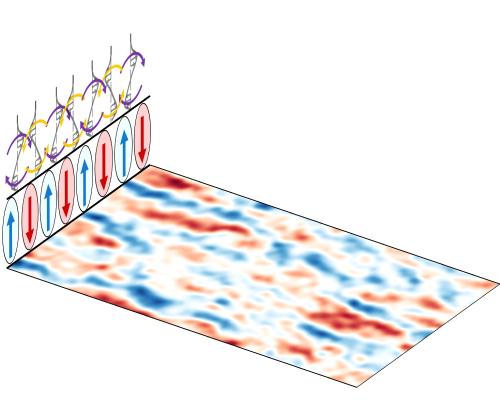
The physical fidelity of turbulence models can benefit from a partial resolution of fluctuations, but doing so often comes with an increase in computational cost. To explore this trade-off in the context of wall-bounded flows, this paper introduces a framework for turbulence-resolving integral simulations (TRIS) with the goal of efficiently resolving the largest motions using a two-dimensional, three-component representation of the flow defined by instantaneous wall-normal integrals of velocity and pressure. Self-sustaining turbulence with qualitatively realistic large-scale structures is demonstrated for TRIS on an open-channel (half-channel) flow configuration using moment-of-momentum integral equations derived from Navier–Stokes with relatively simple closure approximations. Evidence from direct numerical simulations (DNS) suggests that TRIS can theoretically resolve $35\,\%{-}40\,\%$ of the turbulent skin friction enhancement for friction Reynolds numbers between $180$ and $5200$, without a noticeable decrease or increase as a function of Reynolds number. The current implementation of TRIS can match this resolution while simulating one flow through time in ${\sim}1$ minute on a single processor, even for very large Reynolds numbers. The framework facilitates a detailed apples-to-apples comparison of predicted statistics against data from DNS. Comparisons at friction Reynolds numbers of $395$ and $590$ show that TRIS generates a relatively accurate representation of the flow, while highlighting discrepancies that demonstrate a need for improving the closure models. The present results for open-channel flow represent a proof of concept for TRIS as a new approach for wall-bounded turbulence modelling, motivating extension to more general flow configurations such as boundary layers on immersed objects.


Distribution of REE and carbon in apatite of fish debris in REE-rich, deep-sea mud from the Minami-Torishima area, southeastern Japan
-
- Journal:
- Mineralogical Magazine / Volume 90 / Issue 1 / February 2026
- Published online by Cambridge University Press:
- 11 July 2025, pp. 1-12
-
- Article
- Export citation
On the nature and distribution of mineral-forming ions: A mineral informatics approach: Hallimond Lecture
- Part of
-
- Journal:
- Mineralogical Magazine / Volume 89 / Issue 6 / December 2025
- Published online by Cambridge University Press:
- 11 July 2025, pp. 804-818
-
- Article
-
- You have access
- HTML
- Export citation
Tilting of vortex rings in the oblique collision reduces the longitudinal quadrupole and octupole modes of aerodynamic sound
-
- Journal:
- Journal of Fluid Mechanics / Volume 1015 / 25 July 2025
- Published online by Cambridge University Press:
- 11 July 2025, A1
-
- Article
- Export citation
A geometric morphometric approach to identifying recent and fossil woodrat molars with remarks on Late Pleistocene Neotoma macrotis from Rancho La Brea
-
- Journal:
- Quaternary Research / Volume 128 / November 2025
- Published online by Cambridge University Press:
- 11 July 2025, pp. 32-44
-
- Article
-
- You have access
- Open access
- HTML
- Export citation
‘Basket-weave’ textures formed during cooling of natural bornite: a HAADF STEM study
-
- Journal:
- Mineralogical Magazine / Volume 90 / Issue 1 / February 2026
- Published online by Cambridge University Press:
- 11 July 2025, pp. 93-113
-
- Article
-
- You have access
- Open access
- HTML
- Export citation
A proposed mechanism for the formation of protocell-like structures on Titan
-
- Journal:
- International Journal of Astrobiology / Volume 24 / 2025
- Published online by Cambridge University Press:
- 10 July 2025, e7
-
- Article
-
- You have access
- Open access
- HTML
- Export citation
The scientific career of Rodney M. Feldmann, 1939–2024
-
- Journal:
- Journal of Paleontology / Volume 99 / Issue 3 / May 2025
- Published online by Cambridge University Press:
- 10 July 2025, pp. 486-505
-
- Article
-
- You have access
- HTML
- Export citation
Stress resistance of halophilic Archaea from Lunenburg, Germany: implications for astrobiology
-
- Journal:
- International Journal of Astrobiology / Volume 24 / 2025
- Published online by Cambridge University Press:
- 10 July 2025, e6
-
- Article
-
- You have access
- Open access
- HTML
- Export citation
Bridging currents: an interdisciplinary source-to-sea approach is essential to align regional and national priorities with the future global plastics treaty ambitions
- Part of
-
- Journal:
- Cambridge Prisms: Plastics / Volume 3 / 2025
- Published online by Cambridge University Press:
- 10 July 2025, e22
-
- Article
-
- You have access
- Open access
- HTML
- Export citation
Icelandic intertidal fish communities and effects of knotted wrack (Ascophyllum nodosum) harvesting
-
- Journal:
- Journal of the Marine Biological Association of the United Kingdom / Volume 105 / 2025
- Published online by Cambridge University Press:
- 10 July 2025, e75
-
- Article
-
- You have access
- Open access
- HTML
- Export citation
283,821 concretions, how do you measure the Mazon Creek? Assessing the paleoenvironmental and taphonomic nature of the Braidwood and Essex assemblages
-
- Journal:
- Paleobiology / Volume 51 / Issue 3 / August 2025
- Published online by Cambridge University Press:
- 10 July 2025, pp. 488-506
-
- Article
-
- You have access
- Open access
- HTML
- Export citation
Influence of solid–liquid compositions and contact time during maturation on the properties of artificial peloids for use in pelotherapy
-
- Journal:
- Clay Minerals / Volume 60 / Issue 2 / June 2025
- Published online by Cambridge University Press:
- 10 July 2025, pp. 143-162
-
- Article
- Export citation
Horizontal force-balance calving laws: Ice shelves, marine- and land-terminating glaciers
-
- Journal:
- Journal of Glaciology / Volume 71 / 2025
- Published online by Cambridge University Press:
- 10 July 2025, e93
-
- Article
-
- You have access
- Open access
- HTML
- Export citation
-
Predicting calving in glacier models is challenging, as observations of diverse calving styles appear to contradict a universal calving law. Here, we generalize and apply the analytical Horizontal Force-Balance fracture model from ice shelves to land- and marine-terminating glaciers. We consider different combinations of “crack configurations” including surface crevasses with or without meltwater above saltwater- or meltwater-filled basal crevasses. Our generalized crevasse-depth model analytically reveals that, in the absence of meltwater, the calving criterion depends on two dimensionless variables: buttressing B and dimensionless water level λ. Using a calving regime diagram, we quantitatively demonstrate that glaciers are generally more prone to calving with reduced buttressing B and lower water level λ. For a specified set of $B, \lambda$ and crack configuration, an analytical calving law can be derived. For example, the calving law for an ice shelf, land-, or marine-terminating glacier with a dry surface crevasse above a saltwater basal crevasse reduces to a state with no buttressing (B = 0). With climate warming, glaciers are expected to become more vulnerable to calving due to meltwater-driven surface and basal crevassing. Our findings provide a framework for understanding diverse calving styles.

Scientists’ Coalition perspectives on articles of the Chair’s text
- Part of
-
- Journal:
- Cambridge Prisms: Plastics / Volume 3 / 2025
- Published online by Cambridge University Press:
- 10 July 2025, e24
-
- Article
-
- You have access
- Open access
- HTML
- Export citation
Proteomics reveal selectable markers in the threatened species Acropora palmata under seasonal temperature fluctuations
-
- Journal:
- Journal of the Marine Biological Association of the United Kingdom / Volume 105 / 2025
- Published online by Cambridge University Press:
- 10 July 2025, e76
-
- Article
- Export citation
Acoustothermal effect: mechanism and quantification of the heat source – ERRATUM
-
- Journal:
- Journal of Fluid Mechanics / Volume 1014 / 10 July 2025
- Published online by Cambridge University Press:
- 10 July 2025, E4
-
- Article
-
- You have access
- Open access
- HTML
- Export citation
Analysing the trends of research contributions and scientific collaboration networks working in Antarctic science: a look to the production of the Spanish programme honouring the memory of Andrés Barbosa
- Part of
-
- Journal:
- Antarctic Science / Volume 37 / Issue 5 / October 2025
- Published online by Cambridge University Press:
- 10 July 2025, pp. 488-500
-
- Article
-
- You have access
- Open access
- HTML
- Export citation
New record of two dragonets, Callionymus gardineri and C. omanensis (Teleostei: Callionymidae) from the Indian waters, with a description of female C. omanensis
-
- Journal:
- Journal of the Marine Biological Association of the United Kingdom / Volume 105 / 2025
- Published online by Cambridge University Press:
- 10 July 2025, e74
-
- Article
- Export citation
