Refine search
Actions for selected content:
179468 results in Earth and Environmental Sciences
Functional aspects of the headshield processes in ostracoderms
-
- Journal:
- Paleobiology / Volume 51 / Issue 2 / May 2025
- Published online by Cambridge University Press:
- 09 July 2025, pp. 310-322
-
- Article
-
- You have access
- Open access
- HTML
- Export citation

Major role and longitudinal nature of stochastic resonance in promoting chaotic states in viscoelastic channel flow with low inlet perturbations
-
- Journal:
- Journal of Fluid Mechanics / Volume 1014 / 10 July 2025
- Published online by Cambridge University Press:
- 08 July 2025, R4
-
- Article
- Export citation
-
Stochastic resonance (SR) is universal phenomenon, where noise amplifies a weak periodic signal in bistable nonlinear systems, with wide applications in biology, climate science, engineering etc., although in fluid dynamics it remains underexplored. Recently, we unexpectedly found SR above non-modal elastic instability onset in an inertialess viscoelastic channel flow, where it emerges on the top of a chaotic streamwise velocity power spectrum $E_u$ due to its interaction with white-noise spanwise velocity power spectrum $E_w$ and weak elastic waves. These three conditions necessary for SR emergence differ from those required for the classical SR emergence mentioned above. Here, we consider SR in an inertialess viscoelastic channel flow with a smoothed inlet causing order of magnitude lower noise intensity than in our former studies. Our observations reveal that SR appears at the same conditions mentioned above, where SR is found just upon the instability onset in a lower subrange of a transition regime, in contrast, here, SR persists across all flow regimes – transition, elastic turbulence and drag reduction. Furthermore, we provide experimental evidence that SR, presented by a sharp peak in $E_u$, manifests as either a standing or propagating wave in the $x$-direction, with a rather uniform amplitude of streamwise velocity fluctuations and zero propagation velocity in the $z$-direction. These findings reveal a new mechanism underpinning the transition to a chaotic channel flow of viscoelastic fluids and establish SR as a robust framework for understanding complex flow dynamics. This work opens new avenues for exploring SR in other nonlinear systems and practical applications such as mixing enhancement and flow control in industrial and biological contexts.


Including a human rights approach in the Global Plastics Treaty can ensure protection of people and the environment
- Part of
-
- Journal:
- Cambridge Prisms: Plastics / Volume 4 / 2026
- Published online by Cambridge University Press:
- 08 July 2025, e2
-
- Article
-
- You have access
- Open access
- HTML
- Export citation
Statistical treatment of dilute suspensions of electrified particles
-
- Journal:
- Journal of Fluid Mechanics / Volume 1014 / 10 July 2025
- Published online by Cambridge University Press:
- 08 July 2025, A38
-
- Article
-
- You have access
- Open access
- HTML
- Export citation
-
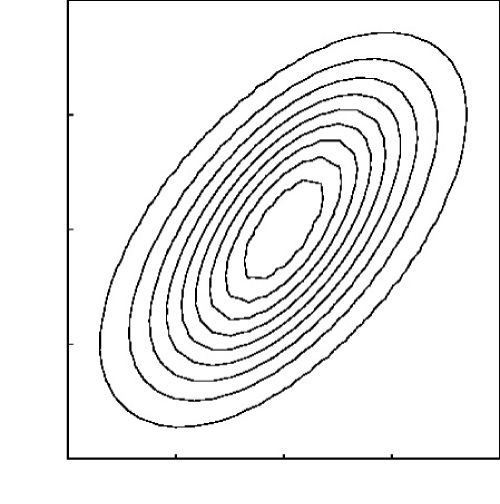
An analysis is presented of the suspensions of small, electrified particles in a gas. Two limits of interest for the electrodynamic particulate suspension technique are considered, corresponding to large and small values of the ratio $t_{coll}/t_s$ of the mean time between particle collisions to the viscous adaptation time required for the particles to reach their terminal velocities. The effect of the particle inertia can be neglected when this ratio is large, and only the distribution of particle charges at each point of the suspension needs to be computed. The way this distribution approaches an equilibrium form, determined elsewhere in the continuum regime when the mean free path of the particles is small compared with the suspension size, is described, as well as the connection between continuum regime and quasi-neutrality of the suspension. In the opposite case when $t_{coll}/t_s$ is small, the inertia of the particles plays an important role, and the joint distribution of particle charges and velocities is required. A Boltzmann equation is proposed for this distribution function, taking advantage of the fact that the charges of the particles have little effect on the redistribution of momentum and energy in the collisions. The equilibrium distribution function in the continuum regime is computed approximately, and hydrodynamic equations for the particle phase analogous to the Euler equations for a monoatomic gas are derived. The simplification of these equations when the particle inertia is negligible at the scale of the suspension is worked out.


Human traces in Arctic soils: Geoarchaeological evidence from 19th-century herders and farmers
-
- Journal:
- Polar Record / Volume 61 / 2025
- Published online by Cambridge University Press:
- 08 July 2025, e17
-
- Article
-
- You have access
- Open access
- HTML
- Export citation
Developing digital image processing methods to quantify internal and interfacial convection in the Hele-Shaw cell, with applications to the laboratory ice–ocean boundary layer
-
- Journal:
- Journal of Glaciology / Volume 71 / 2025
- Published online by Cambridge University Press:
- 07 July 2025, e86
-
- Article
-
- You have access
- Open access
- HTML
- Export citation
Delay of swept-wing transition using a surface hump
-
- Journal:
- Journal of Fluid Mechanics / Volume 1014 / 10 July 2025
- Published online by Cambridge University Press:
- 07 July 2025, A35
-
- Article
-
- You have access
- Open access
- HTML
- Export citation
Hydrodynamically beneficial school configurations in carangiform swimmers: insights from a flow-physics informed model
-
- Journal:
- Journal of Fluid Mechanics / Volume 1014 / 10 July 2025
- Published online by Cambridge University Press:
- 07 July 2025, A32
-
- Article
-
- You have access
- Open access
- HTML
- Export citation
Extending the mineralogy of U6+ (II): Barronite, a new uranyl silicate related to weeksite from Menzenschwand, Germany
-
- Journal:
- Mineralogical Magazine / Volume 89 / Issue 5 / October 2025
- Published online by Cambridge University Press:
- 07 July 2025, pp. 638-649
-
- Article
- Export citation

Flow in an electrically conducting drop due to an oscillating magnetic field
-
- Journal:
- Journal of Fluid Mechanics / Volume 1014 / 10 July 2025
- Published online by Cambridge University Press:
- 07 July 2025, A36
-
- Article
-
- You have access
- Open access
- HTML
- Export citation
-
A drop of an electrically conducting non-magnetic fluid of radius $R$, electrical conductivity $\kappa$, density $\rho _i$ and viscosity $\eta _i$ is suspended in a non-conducting medium of density $\rho _o$, viscosity $\eta _o$ and subject to an oscillating magnetic field of magnitude $H_0$ and angular frequency $\omega$. Oscillating eddy currents are induced in the drop due to Faraday’s law. The Lorentz force density, the cross product of the current density and the magnetic field, is the superposition of a steady component and an oscillating component with frequency $2 \omega$. The characteristic velocity due to the Lorentz force density is $(\mu _0 H_0^2 R/\eta _i)$ times a function of the dimensionless parameter $\beta = \sqrt {\mu _0 \kappa \omega R^2}$, the square root of the ratio of the frequency and the current relaxation rate. Here, $\mu _0$ is the magnetic permeability. The characteristic velocities for the steady and oscillatory components increase proportional to $\beta ^{4}$ for $\beta \ll 1$, and decrease proportional to $\beta ^{-1}$ for $\beta \gg 1$. The steady flow field consists of two axisymmetric eddies in the two hemispheres with flow outwards along the magnetic field axis and inwards along the equator. The flow in the drop induces a biaxial extensional flow in the surrounding medium, with compression along the magnetic axis and extension along the equatorial plane. The oscillating component of the velocity depends on $\beta$ and the Reynolds number ${Re}_\omega$ based on the frequency of oscillations. For ${Re}_\omega \gg 1$, the amplitude of the oscillatory velocity decreases proportional to ${Re}_\omega ^{-1}$ for $\beta \ll 1$, and proportional to ${Re}_\omega ^{-1/2}$ for $\beta \gg 1$.


The clayey deposit from Bomkoul (Douala, Cameroon): a case study of the geotechnical appraisal and assessment of the characteristics of firing bricks
-
- Journal:
- Clay Minerals / Volume 60 / Issue 2 / June 2025
- Published online by Cambridge University Press:
- 07 July 2025, pp. 113-126
-
- Article
-
- You have access
- Open access
- HTML
- Export citation

Quantum implicit representation of vortex filaments in turbulence
-
- Journal:
- Journal of Fluid Mechanics / Volume 1014 / 10 July 2025
- Published online by Cambridge University Press:
- 07 July 2025, A31
-
- Article
- Export citation
Comparing GPR with ice thickness and thermal models: Insights from two polythermal glaciers in West Greenland
-
- Journal:
- Journal of Glaciology / Volume 71 / 2025
- Published online by Cambridge University Press:
- 07 July 2025, e97
-
- Article
-
- You have access
- Open access
- HTML
- Export citation
Direct numerical simulations of turbulent Rayleigh–Bénard convection with polymer additives
-
- Journal:
- Journal of Fluid Mechanics / Volume 1014 / 10 July 2025
- Published online by Cambridge University Press:
- 07 July 2025, A22
-
- Article
-
- You have access
- Open access
- HTML
- Export citation
-
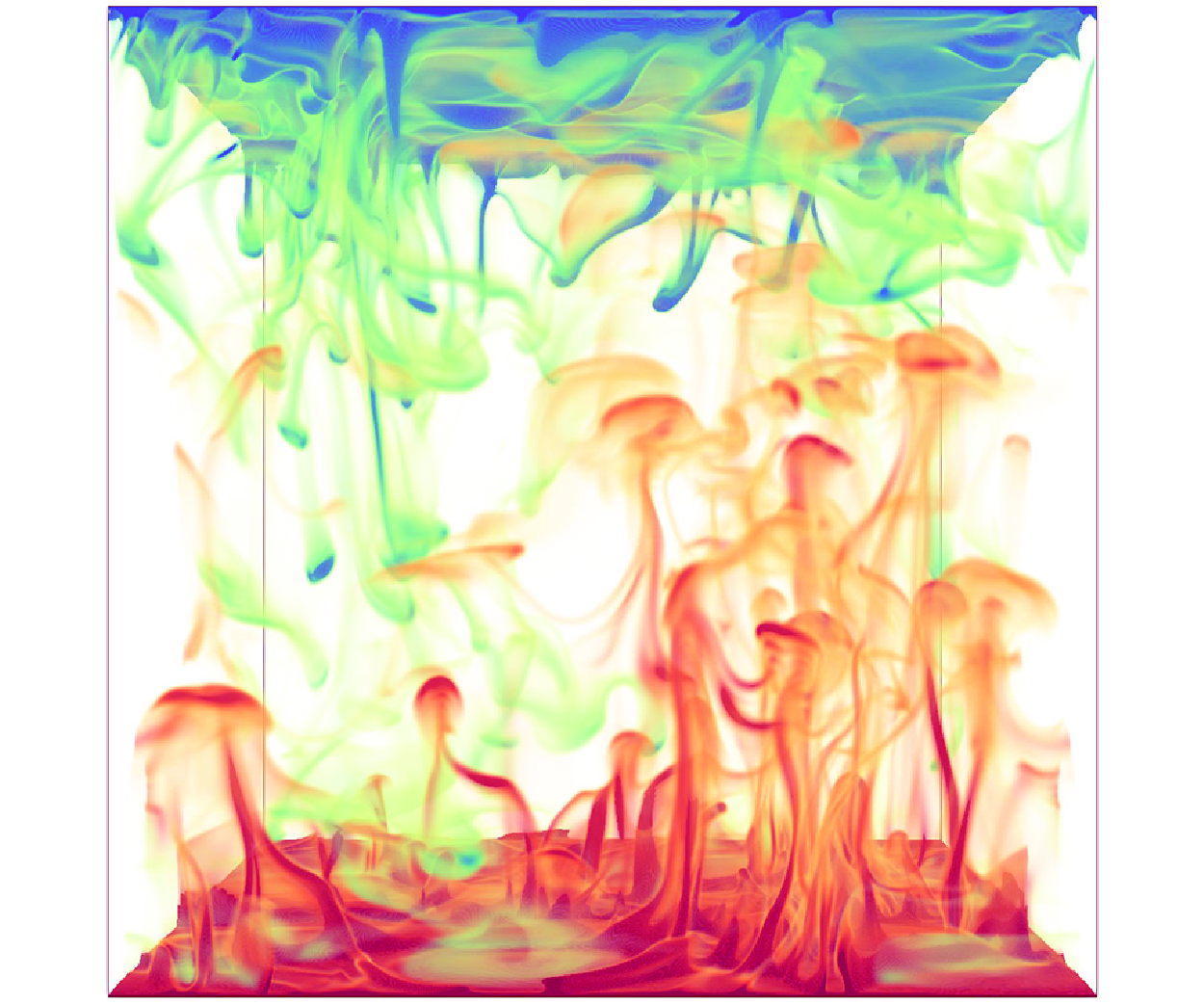
We present results of three-dimensional direct numerical simulations of turbulent Rayleigh–Bénard convection of dilute polymeric solutions for Rayleigh number ( $Ra$) ranging from $10^6$ to $ 10^{10}$, and Prandtl number $Pr=4.3$. The viscoelastic flow is simulated by solving the incompressible Navier–Stokes equations under the Boussinesq approximation coupled with the finitely extensible nonlinear elastic Peterlin constitutive model. The Weissenberg number ( $Wi$) is either $Wi=5$ or $Wi=10$, with the maximum chain extensibility parameter $L=50$, corresponding to moderate fluid elasticity. Our results demonstrate that both heat transport and momentum transport are reduced by the presence of polymer additives in the studied parameter range. Remarkably, the specific parameters used in the current numerical study give similar heat transfer reduction values as observed in experiments. We demonstrate that polymers have different effects in different regions of the flow. The presence of polymers stabilises the boundary layer, which is found to be the primary cause of the overall heat transfer reduction. In the bulk region, the presence of polymers slows down the flow by increasing the effective viscosity, enhances the coherency of thermal plumes, and suppresses the small-scale turbulent fluctuations. For small $Ra$, the heat transfer reduction in the bulk region is associated with plume velocity reduction, while for larger $Ra$, it is caused by the competing effects of suppressed turbulent fluctuations and enhanced plume coherency.



Optimal rigid brush for fluid capture
-
- Journal:
- Journal of Fluid Mechanics / Volume 1014 / 10 July 2025
- Published online by Cambridge University Press:
- 07 July 2025, A29
-
- Article
- Export citation

Elliptic liquid jets in a supersonic cross-flow
-
- Journal:
- Journal of Fluid Mechanics / Volume 1014 / 10 July 2025
- Published online by Cambridge University Press:
- 07 July 2025, A34
-
- Article
-
- You have access
- Open access
- HTML
- Export citation
-
In the present work, we experimentally investigate the transverse injection of elliptic liquid jets into a supersonic cross-flow ( $M_\infty$ = 2.5). The primary focus is to understand the effect of injection orifice aspect ratio ( $\textit{AR}$ = spanwise/streamwise dimension), on the liquid jet breakup mechanism, the flow field around the liquid jet and the resulting droplet sizes formed downstream, for three $\textit{AR}$ cases ( $\textit{AR}$ = 0.3, 1, 3.3). We find that the $\textit{AR}$ = 0.3 case has large unsteadiness in the spray core due to relatively large wavelength Rayleigh–Taylor (RT) waves formed on the liquid jet surface. However, the primary jet breakup occurs through Kelvin–Helmholtz (KH) instabilities formed on the large lateral surfaces, as in coaxial liquid jet breakup. This leads to a higher Sauter mean diameter (SMD) of the droplets in the spray core with a wider range of droplet sizes compared with the circular case ( $\textit{AR}$ = 1.0). However, in the case of $\textit{AR}$ = 3.3, the RT waves are more intense and of smaller wavelength due to the large drag on the liquid jet, which results in a direct catastrophic breakup of the liquid jet by the RT waves. This results in a relatively steady liquid jet and shock structure with the formation of a fine spray and smaller droplets in the spray core than for the $\textit{AR}=1.0$ case. The study shows the importance of the orifice $\textit{AR}$ on the flow around, and the spray downstream of, the liquid jet injection into supersonic cross-flow.


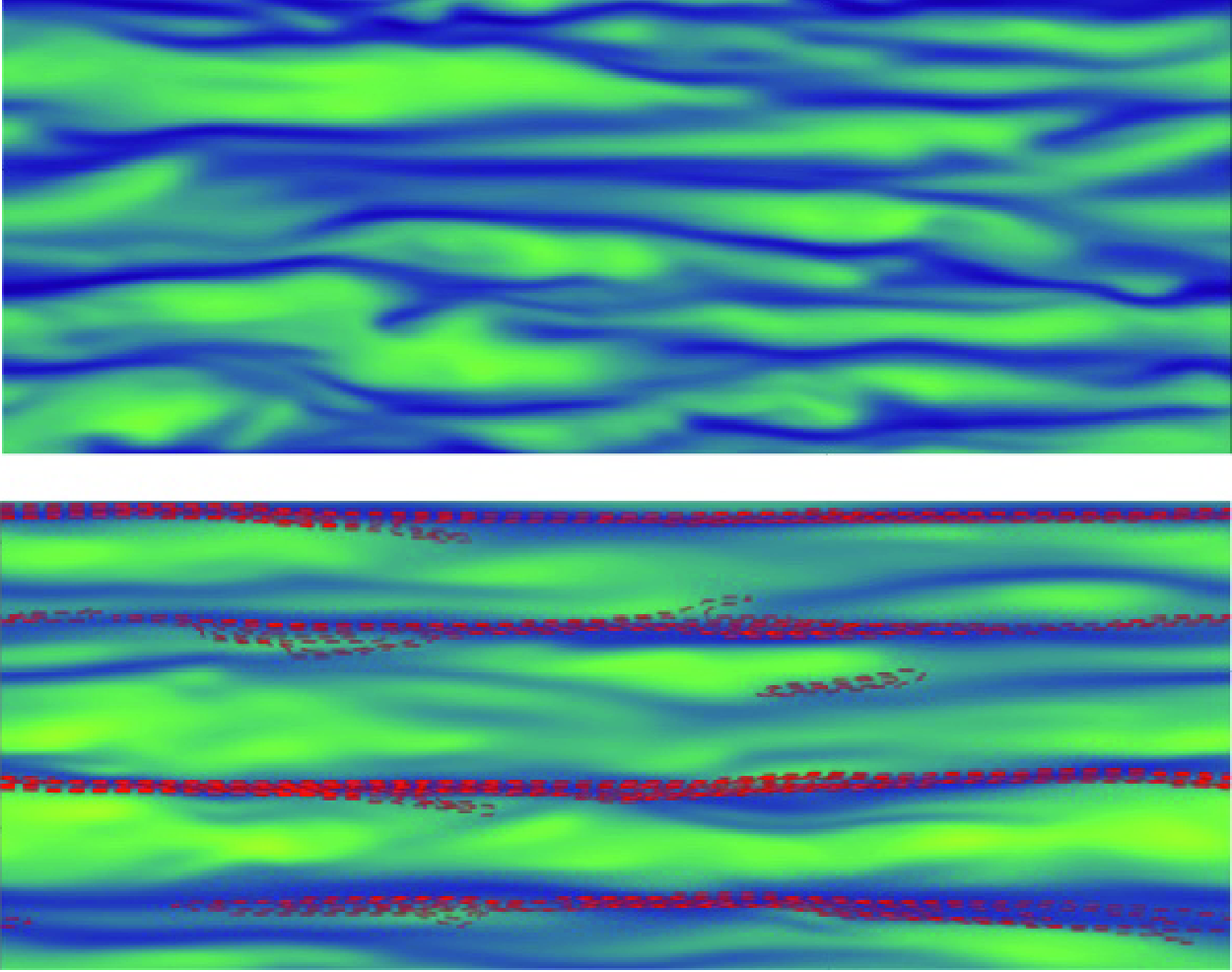
Direct numerical simulation of particle clustering and turbulence modulation: an Eulerian approach
-
- Journal:
- Journal of Fluid Mechanics / Volume 1014 / 10 July 2025
- Published online by Cambridge University Press:
- 07 July 2025, A37
-
- Article
-
- You have access
- Open access
- HTML
- Export citation
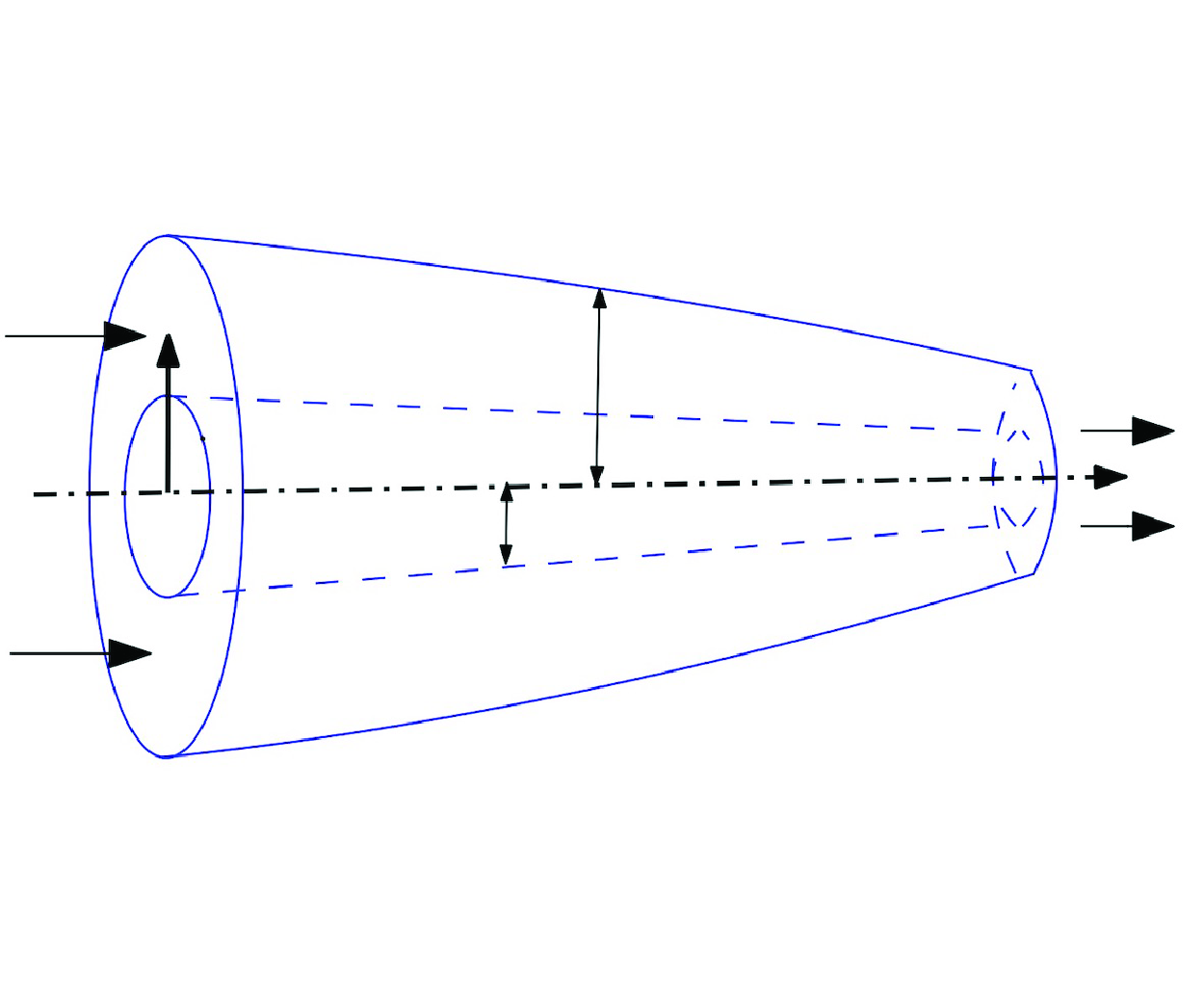
Drawing of weakly viscoelastic fluid tubes
-
- Journal:
- Journal of Fluid Mechanics / Volume 1014 / 10 July 2025
- Published online by Cambridge University Press:
- 07 July 2025, A27
-
- Article
-
- You have access
- Open access
- HTML
- Export citation
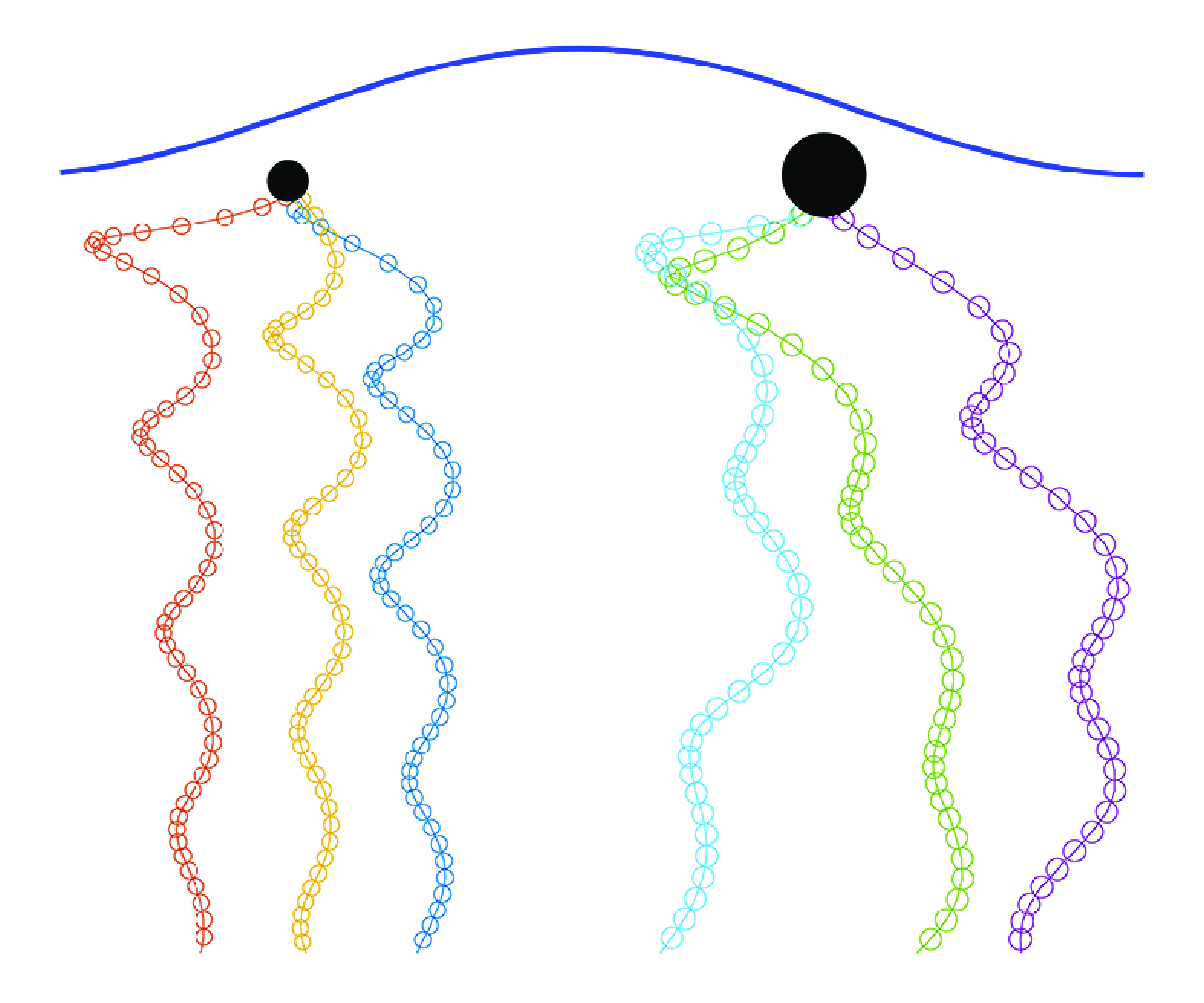
Experimental investigation of inertial spheres settling in surface gravity waves
-
- Journal:
- Journal of Fluid Mechanics / Volume 1014 / 10 July 2025
- Published online by Cambridge University Press:
- 04 July 2025, A33
-
- Article
-
- You have access
- Open access
- HTML
- Export citation
INC-5.2 presents a critical opportunity to protect the health of current and future generations
- Part of
-
- Journal:
- Cambridge Prisms: Plastics / Volume 3 / 2025
- Published online by Cambridge University Press:
- 04 July 2025, e34
-
- Article
-
- You have access
- Open access
- HTML
- Export citation
