Refine search
Actions for selected content:
212620 results in Engineering

A method for evaluating relations of turbulent normal stresses by experimental data over a wide range of Reynolds numbers
-
- Journal:
- Journal of Fluid Mechanics / Volume 1016 / 10 August 2025
- Published online by Cambridge University Press:
- 30 July 2025, A24
-
- Article
-
- You have access
- Open access
- HTML
- Export citation
-
Recently, Nagib et al. (Phys. Fluids, vol. 36, no. 7, 2024, 075145) used indicator functions of streamwise normal stress profiles to identify the valid wall-distance and Reynolds number ranges for two models in direct numerical sumulation (DNS) of channel and pipe flows. Since such functions are challenging to construct from experimental data, we propose a simpler, more robust method better suited to experiments. Applied to the two leading models – logarithmic and power-law – for normal stresses in the ‘fitting region’ of wall-bounded flows, this method is tested on prominent experimental data sets in zero-pressure-gradient (ZPG) boundary layers and pipe flows across a wide Reynolds number range ( $Re_\tau$). Valid regions for the models appear only for $Re_\tau \gtrapprox 10{\,}000$, with a lower bound $y^+_{in} \sim (Re_\tau )^{0.5}$ and $y^+_{in} \gtrapprox 400$. The upper bound is a fixed fraction of the boundary layer thickness or pipe radius, independent of $Re_\tau$. The power-law model is found to hold over a broader range, up to $Y \approx 0.4$ in ZPG and $Y \approx 0.5$ in pipe flows, compared with the logarithmic trend, which is formulated to be coincident with the classical logarithmic region for the mean flow ( $Y \lessapprox 0.15$). A slightly higher exponent ( $0.28$) than that of Chen & Sreenivasan (J. Fluid Mech. vol. 933, 2022, A20; J. Fluid Mech. vol. 976, 2023, A21) extends the power-law model’s validity and correcting for outer intermittency in ZPG flows further broadens it. Projections to the near-wall region of both models yield nearly identical predictions of near-wall peak stress across the highest available $Re_\tau$. These findings, alongside results from Monkewitz & Nagib (J. Fluid Mech. vol. 967, 2023, A15) and Baxerras et al. (J. Fluid Mech. vol. 987, 2024, R8), highlight the importance of nonlinear eddy growth and residual viscous effects in wall-bounded flow modelling, informing potential refinements to the logarithmic model, such as those proposed by Deshpande et al. (J. Fluid Mech. vol. 914, 2021, A5).


Single-mode Rayleigh–Taylor instability in time-dependent rarefaction-driven flows
-
- Journal:
- Journal of Fluid Mechanics / Volume 1016 / 10 August 2025
- Published online by Cambridge University Press:
- 30 July 2025, A27
-
- Article
- Export citation

Predicting internal boundary layer growth following a roughness change in thermally neutral and stable boundary layers
-
- Journal:
- Journal of Fluid Mechanics / Volume 1016 / 10 August 2025
- Published online by Cambridge University Press:
- 30 July 2025, R4
-
- Article
-
- You have access
- Open access
- HTML
- Export citation
-
This study uses the diffusion analogy (Miyake, Sci. Rep., 5R-6, 1965, Univ. of Washington, Seattle, USA) to predict the full growth behaviour of internal boundary layers (IBLs) induced by a roughness change for neutrally – and especially stably – stratified boundary layers with finite thickness. The physics of the diffusion analogy shows that the streamwise variation of the IBL thickness is dictated by $\sigma _w/U$ at the interface, where $\sigma _w$ and $U$ represent wall-normal Reynolds stress and mean streamwise velocity, respectively. The existing variants of the model, summarised by Savelyev & Taylor (2005, Boundary-Layer Meteorol., vol. 115, pp. 1–25), are tailored to IBLs confined within the constant shear stress layer. To extend the applicability of the model to the outer region, we investigate the relation between $\sigma _w/U$ and $U/U_\infty$ in the outer region across varying stratification, where $U_\infty$ is the free-stream velocity. Our analysis reveals that wind tunnel data from a number of facilities collapse onto a master curve when $\sigma _w/U$ is premultiplied by a height-independent parameter, which is a function of the ratio of Monin–Obukhov length to the boundary layer thickness. The scaled $\sigma _w/U$ decreases inversely with $U/U_\infty$ in the surface layer, transitioning to a linear decrease as $U/U_\infty$ increases. The new model, which integrates these findings, along with the effects of streamline displacement and acceleration, captures the complete characteristics of IBLs as they develop within turbulent boundary layers of finite thickness.


Scale invariance of intermittency in LES turbulence
-
- Journal:
- Journal of Fluid Mechanics / Volume 1016 / 10 August 2025
- Published online by Cambridge University Press:
- 30 July 2025, R5
-
- Article
- Export citation

Low-dimensional modelling of viscous fluids in porous media over curvilinear surfaces
-
- Journal:
- Journal of Fluid Mechanics / Volume 1016 / 10 August 2025
- Published online by Cambridge University Press:
- 30 July 2025, A16
-
- Article
-
- You have access
- Open access
- HTML
- Export citation

Transient growth and nonlinear breakdown of wavelet-based resolvent modes in turbulent channel flow
-
- Journal:
- Journal of Fluid Mechanics / Volume 1016 / 10 August 2025
- Published online by Cambridge University Press:
- 30 July 2025, A19
-
- Article
- Export citation

Breakup of viscous liquid bridges on solid surfaces
-
- Journal:
- Journal of Fluid Mechanics / Volume 1016 / 10 August 2025
- Published online by Cambridge University Press:
- 30 July 2025, A22
-
- Article
-
- You have access
- Open access
- HTML
- Export citation

A model spectrum for turbulent wall-bounded flow
-
- Journal:
- Journal of Fluid Mechanics / Volume 1016 / 10 August 2025
- Published online by Cambridge University Press:
- 30 July 2025, A23
-
- Article
-
- You have access
- Open access
- HTML
- Export citation
-
A model is proposed for the one-dimensional spectrum and streamwise Reynolds stress in pipe flow for arbitrarily large Reynolds numbers. Constructed in wavenumber space, the model comprises four principal contributions to the spectrum: streaks, large-scale motions, very-large-scale motions and incoherent turbulence. It accounts for the broad and overlapping spectral content of these contributions from different eddy types. The model reproduces well the broad structure of the premultiplied one-dimensional spectrum of the streamwise velocity, although the bimodal shape that has been observed at certain wall-normal locations, and the $-5/3$ slope of the inertial subrange, are not captured effectively because of the simplifications made within the model. Regardless, the Reynolds stress distribution is well reproduced, even within the near-wall region, including key features of wall-bounded flows such as the Reynolds number dependence of the inner peak, the formation of a logarithmic region, and the formation of an outer peak. These findings suggest that many of these features arise from the overlap of energy content produced by both inner- and outer-scaled eddy structures combined with the viscous-scaled influence of the wall. The model is also used to compare with canonical turbulent boundary layer and channel flows, and despite some differences being apparent, we speculate that with only minor modifications to its coefficients, the model can be adapted to these flows as well.


Evolution and instability of the tip vortices behind a yawed wind turbine
-
- Journal:
- Journal of Fluid Mechanics / Volume 1016 / 10 August 2025
- Published online by Cambridge University Press:
- 30 July 2025, A20
-
- Article
- Export citation

Effect of transversely variable thickness of an ice plate on periodic hydroelastic waves propagating in a frozen channel
-
- Journal:
- Journal of Fluid Mechanics / Volume 1016 / 10 August 2025
- Published online by Cambridge University Press:
- 30 July 2025, A17
-
- Article
- Export citation

Vortex-induced vibration of a streamwise and transversely rotating sphere
-
- Journal:
- Journal of Fluid Mechanics / Volume 1016 / 10 August 2025
- Published online by Cambridge University Press:
- 30 July 2025, A18
-
- Article
- Export citation
-
We investigate the effect of streamwise and transverse rotation on the wake behind an elastically mounted sphere. Simulations are performed at a Reynolds number $Re=500$ over a range of reduced velocity $2\le U^{\ast }\le 12$, considering a low and high rotational speed (0.2 and 1), keeping the mass ratio $m^{\ast }=2$. Streamwise rotation yields a structural response akin to the non-rotating case, while transverse rotation triggers induced vibration at lower $U^{\ast }$ and sustains it across a wider range. Like the non-rotating case, the streamwise rotating sphere exhibits synchronous, high-amplitude vibration across the entire $U^\ast$ range, whereas for low transverse rotation, it is confined to $5\le U^{\ast }\le 6$. Cross-stream displacement of the sphere remains unaffected by streamwise rotation with increasing $U^{\ast }$. In contrast, it monotonically increases due to transverse rotation, driven by the Magnus force, as supported by our theoretical and numerical estimations. While the spiral shedding mode dominates at $\Omega _{x}=0.2$, twisted hairpin and twisted spiral modes emerge as the rotation rate is increased. On the other hand, we observe the hairpin (HP) mode, as seen in the non-rotating case, for low transverse rotation. The HP mode gives rise to the ring vortical mode at the far wake, and with an increase in $U^\ast$, the wake shows small-scale stretched threads and reconnected bridgelets. Wake fluctuations increase with a streamwise rotation that saturates at higher $U^{\ast }$ during synchronisation, while desynchronisation at dimensionless transverse rotation rate $\Omega _{z}=1$ induces intermittent low-amplitude vibration via the Magnus effect. Space–time reconstruction at the near wake shows an undisturbed helical vortex core at $\Omega _{x}=0.2$ and $U^{\ast }=5$, which bifurcates at $\Omega _{x}=1$ owing to the centrifugal-induced distortion. At $\Omega _{x}=1$ and $U^{\ast }=5$, the phase difference between $(y, C_{y})$ and $(z, C_{z})$ exhibits in-phase synchrony with occasional phase slips. The wake vortex remains unaffected by the transverse rotation of the sphere; however, a streamwise rotating sphere couples the wake, leading to a rotational lock-in. The wake rotation shifts from anti-clockwise to clockwise sense earlier (in $U^\ast$) at a lower rotation rate. The reduced velocity is seen to have a favourable effect on the transfer of the sphere’s rotational inertia onto the wake as the measured penetration depth increases with $U^{\ast }$. Insights from the present research will aid in understanding complex flow interactions in rotational systems, improving efficiency, stability and control in modern engineering applications.


Performance characterization of a novel semi-active exoskeleton for overhead work
-
- Journal:
- Wearable Technologies / Volume 6 / 2025
- Published online by Cambridge University Press:
- 30 July 2025, e36
-
- Article
-
- You have access
- Open access
- HTML
- Export citation

A computational framework for simulating suspensions of phoretic particles
-
- Journal:
- Journal of Fluid Mechanics / Volume 1016 / 10 August 2025
- Published online by Cambridge University Press:
- 30 July 2025, A25
-
- Article
- Export citation

Transition regimes of gravity current: from salinity-driven to particle-driven
-
- Journal:
- Journal of Fluid Mechanics / Volume 1016 / 10 August 2025
- Published online by Cambridge University Press:
- 30 July 2025, A21
-
- Article
- Export citation

Revisiting Townsend’s spatial energy-density function
-
- Journal:
- Journal of Fluid Mechanics / Volume 1016 / 10 August 2025
- Published online by Cambridge University Press:
- 30 July 2025, A12
-
- Article
-
- You have access
- Open access
- HTML
- Export citation
-
Fourier analysis is the standard tool of choice for quantifying the distribution of kinetic energy amongst the eddies in a turbulent flow. The resulting spectral energy-density function is the well-known energy spectrum. And yet, because eddies are distinct from waves, alternative approaches to finding energy-density functions have long been sought. Townsend (1976) outlined a promising approach to finding a spatial energy-density function, $V\!(r)$, where $r$ is the eddy size. Notably, this approach led to two distinct and mutually inconsistent formulations of $V\!(r)$ in homogeneous, isotropic turbulence. We revisit Townsend’s proposal and derive the corresponding three-dimensional $V\!(r)$ as well as introduce its one-dimensional variants (which, to our knowledge, have not been explicitly discussed before). By training our focus on the associated dimensionality of the function, we resolve the discrepancies between the previous formulations. Additionally, we generalise our analysis to include anisotropic flows. Finally, by means of concrete examples, we illustrate how one-dimensional spatial energy-density functions are useful for analysing empirical data. Some notable findings include new insights into the $k_1^{-1}$ scaling (where $k_1$ is the streamwise wavenumber) and a possible resolution of the enigmatic sizes of organised motions at large scales.


Shock interactions on a V-shaped cowl lip at supersonic and hypersonic speeds
-
- Journal:
- Journal of Fluid Mechanics / Volume 1016 / 10 August 2025
- Published online by Cambridge University Press:
- 30 July 2025, A15
-
- Article
- Export citation
-
Shock interactions on a V-shaped blunt leading edge (VBLE) that are commonly encountered at the cowl lip of an inward-turning inlet are investigated at freestream Mach numbers ( $ M_\infty$) 3–6. The swept blunt leading edges of the VBLE generate a pair of detached shocks with varying shapes due to the changes in $ M_\infty$ and $L/r$ (i.e. the ratio of the leading-edge length $L$ to the leading-edge blunt radius $r$), which causes intriguing shock interactions at the crotch of the VBLE. Three subtypes of regular reflection (RR) and a Mach reflection (MR) are produced successively with increasing $ M_\infty$ for a given $L/r$, which appear in the opposite order to those with increasing $L/r$ for a given $ M_\infty$. These shock interactions identified in numerical simulations are verified in supersonic and hypersonic wind tunnel experiments. It is demonstrated that the relative position of the shocks is crucial in determining the transitions of shock interactions by varying either $L/r$ or $ M_\infty$. Transition criteria between subtypes of RR and from RR to MR are theoretically established in the parameter space $(M_\infty,L/r)$ by analysing the shock structures, showing good agreement with the numerical and experimental results. Interactions between either immature or fully developed detached shocks are embedded in these criteria. Specifically, the transition criteria asymptotically approach the corresponding critical $ M_\infty$ when $L/r$ is sufficiently large. These transition criteria provide guidelines for improving the design of the cowl lip of an inward-turning inlet in supersonic and hypersonic regimes.


Characterizing turbulent boundary layer response and recovery to buffer region spanwise blowing
-
- Journal:
- Journal of Fluid Mechanics / Volume 1016 / 10 August 2025
- Published online by Cambridge University Press:
- 30 July 2025, A26
-
- Article
-
- You have access
- Open access
- HTML
- Export citation
-
Experiments were performed that (i) document the effect of the steady spanwise buffer layer blowing on the mean characteristics of the turbulent boundary layer for a range of momentum thickness Reynolds numbers from 4760 to 10 386, and (ii) document the effect of the buffer layer blowing on the unsteady characteristics and coherent vorticity in a boundary layer designed to provide sufficiently high spatial resolution. The spanwise buffer layer blowing of the order of $u_{\tau }$ is produced by a surface array of pulsating direct current (pulsed-DC) plasma actuators. This was found to substantially reduce the wall shear stress that was directly measured with a floating element coupled with a force sensor. The direct wall shear measurements agreed with values derived using the Clauser method to within $\pm 0.85$ %. The degree to which the buffer layer blowing affected $\tau _w$ was found to primarily depend on the inner variable spanwise spacing between the pulsed-DC actuator electrodes, i.e. ‘blowing sites’. Utilizing pairs of $[u,v]$ and $[u,w]$ hot-wire sensors, the latter experiments correlated significant reductions in the $\omega _y$ and $\omega _x$ vorticity components that resulted from the buffer layer blowing and translated into lower Reynolds stresses and turbulence production. The time scale to which these observed changes in the boundary layer characteristics would return to the baseline condition was subsequently documented. This revealed a recovery length of $x^+ \approx 86\,000$ that translated to a streamwise fetch of $x \approx 66\delta$. Finally, a comparison with the recent work by Cheng et al. (2021, J. Fluid Mech. vol. 918, A24) and Wei & Zhou (2024 in TSFP13, June 25–28, 2024) that followed our experimental approach to achieve comparable wall shear stress (drag) reductions has led to a new scaling based on the baseline boundary layer $\textit{Re}_{\tau }$ and buffer layer blowing velocity.


Electrokinetic versus leaky-dielectric modelling of electrosprays operating in the cone-jet mode
-
- Journal:
- Journal of Fluid Mechanics / Volume 1016 / 10 August 2025
- Published online by Cambridge University Press:
- 30 July 2025, A14
-
- Article
-
- You have access
- Open access
- HTML
- Export citation
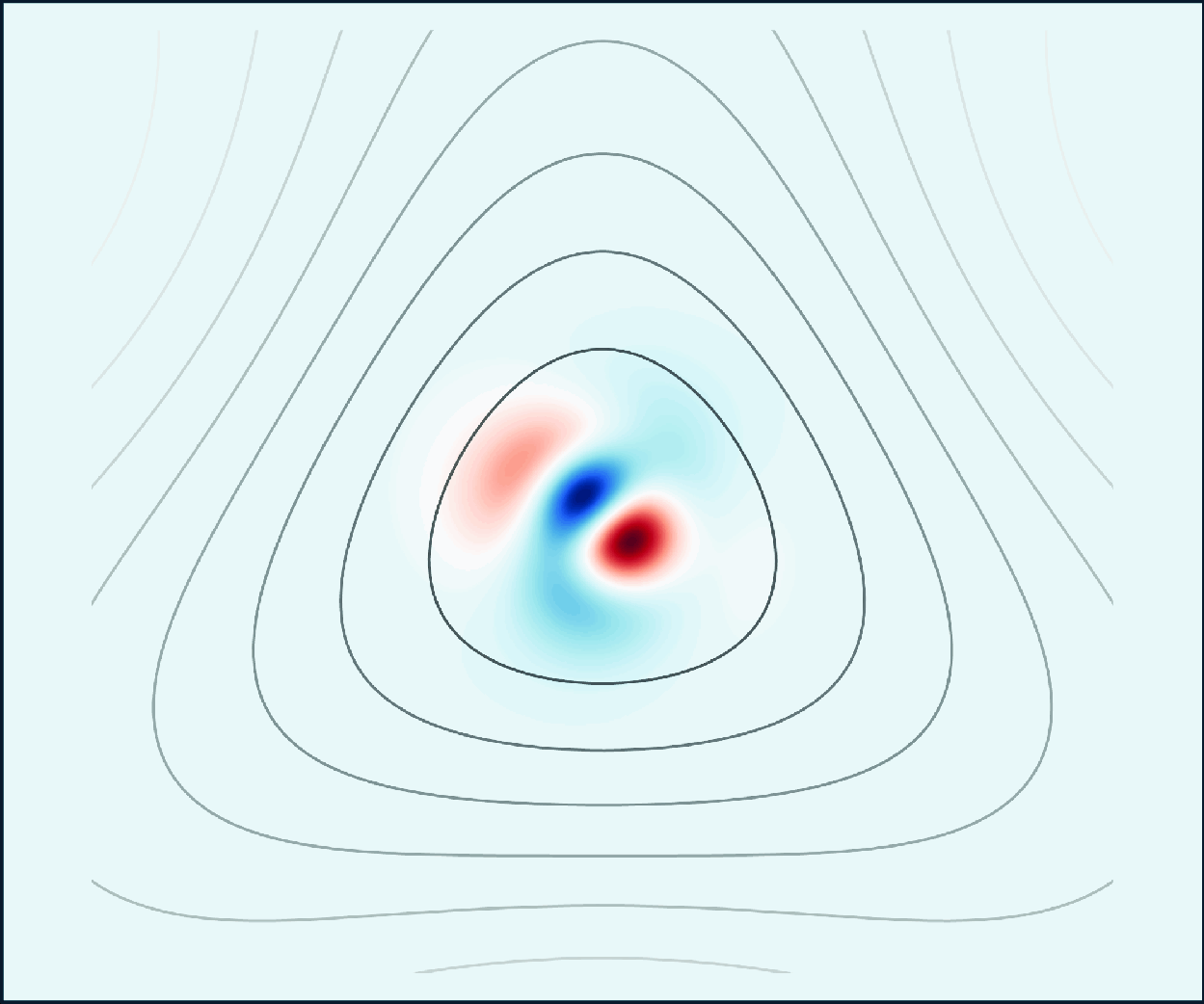
Triangular instability of a strained Lamb–Oseen vortex
-
- Journal:
- Journal of Fluid Mechanics / Volume 1016 / 10 August 2025
- Published online by Cambridge University Press:
- 29 July 2025, A9
-
- Article
-
- You have access
- Open access
- HTML
- Export citation
-
In this study, we demonstrate, for the first time, the existence of a short-wave instability in a Lamb–Oseen vortex subjected to a triangular strain field generated by three satellite vortices, which we term the triangular instability. We identify this instability by numerically integrating the linearised Navier–Stokes equations around a quasi-steady base flow to capture the most unstable mode and validate it by comparing results with theoretical predictions. We evaluate this instability by calculating the growth rates associated with the parametric resonant coupling of two Kelvin waves with the triangular strain field in the limit of small strain rate and large Reynolds number. Our analysis reveals that resonance occurs only for combinations of the azimuthal wavenumbers $m = 1$ and $m = - 2$ (or their symmetric counterparts with opposite signs). We observe several unstable modes with positive growth rates for a moderate viscous Reynolds number $10^4$ and straining parameter value $\epsilon = 0.008$, defined as the cube of the ratio of the core size to the distance from the satellite vortices. The most unstable mode, dominant at typically high Reynolds numbers, has $k \approx 5.18/a$ and $\omega \approx - 0.312\Omega$ (where $a$ and $\Omega$ denote the core size and central angular velocity). It exhibits negligible critical layer damping and remains the most unstable mode over a wide range of ${Re}$ and $\epsilon$. At lower Reynolds numbers, another mode with $k \approx 1.76/a$ and $\omega \approx - 0.407\Omega$, despite significant critical layer damping, becomes the most unstable.


A machine learning analysis of the impact of helideck surface conditions on helicopter safety
-
- Journal:
- The Aeronautical Journal / Volume 129 / Issue 1341 / November 2025
- Published online by Cambridge University Press:
- 29 July 2025, pp. 2969-2984
-
- Article
- Export citation
