To save content items to your account,
please confirm that you agree to abide by our usage policies.
If this is the first time you use this feature, you will be asked to authorise Cambridge Core to connect with your account.
Find out more about saving content to .
To save content items to your Kindle, first ensure no-reply@cambridge.org
is added to your Approved Personal Document E-mail List under your Personal Document Settings
on the Manage Your Content and Devices page of your Amazon account. Then enter the ‘name’ part
of your Kindle email address below.
Find out more about saving to your Kindle.
Note you can select to save to either the @free.kindle.com or @kindle.com variations.
‘@free.kindle.com’ emails are free but can only be saved to your device when it is connected to wi-fi.
‘@kindle.com’ emails can be delivered even when you are not connected to wi-fi, but note that service fees apply.
A broadband magnetoelectric energy harvester, consisting of Fe1−xGax (Galfenol) as the magnetostrictor and a relaxor ferroelectric single crystal as the piezoelectric, has been designed and optimized. Finite element analysis (FEA) has been employed to show that either a linear displacement or a 180° rotation of a magnet is sufficient to achieve maximum stroke from the Galfenol rod, which induces a rhombohedral to orthorhombic phase transition in Pb(In1/2Nb1/2)O3–Pb(Mg1/3Nb2/3)O3–PbTiO3 that produces a large jump in voltage. A rotational design based on a pendulum with an unbalanced mass was fabricated and used to confirm the validity of our FEA model.
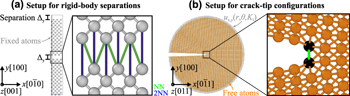
In fracture mechanics, established methods exist to model the stability of a crack tip or the kinetics of crack growth on both the atomic and the macroscopic scale. However, approaches to bridge the two scales still face the challenge in terms of directly converting the atomic forces at which bonds break into meaningful continuum mechanical failure stresses. Here we use two atomistic methods to investigate cleavage fracture of brittle materials: (i) we analyze the forces in front of a sharp crack and (ii) we study the bond breaking process during rigid body separation of half crystals without elastic relaxation. The comparison demonstrates the ability of the latter scheme, which is often used in ab initio density functional theory calculations, to model the bonding situation at a crack tip. Furthermore, we confirm the applicability of linear elastic fracture mechanics in the nanometer range close to crack tips in brittle materials. Based on these observations, a fracture mechanics model is developed to scale the critical atomic forces for bond breaking into relevant continuum mechanical quantities in the form of an atomistically informed scale-sensitive traction separation law. Such failure criteria can then be applied to describe fracture processes on larger length scales, e.g., in cohesive zone models or extended finite element models.
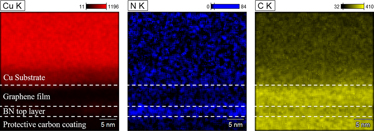
In this study, we have successfully grown hBN/graphene heterostructures on copper thin films using chemical vapor deposition in a single process. The first and most surprising result is that graphene grows underneath hBN and adjacent to the Cu film even though it is deposited second. This was determined from cross-sectional TEM analysis and XPS depth profiling, which chemically identified the relative positions of hBN and graphene. The effect of various growth conditions on graphene/hBN heterostructures was also studied. It was found that a pressure of 200 torr and a hydrogen flow rate of 200 sccm (∼1 H2/N2) yielded the highest quality of graphene, with full surface coverage occurring after a growth time of 120 min. The resulting graphene films were found to be approximately 6–8 layers thick. The grain size of the nanocrystalline graphene was found to be 15–50 nm varying based on growth conditions.
In this work, the guest Li+ conduction properties in NaBr–LiBH4 system were investigated. It was suggested that the guest Li+ ions occupy the Na+ sites and BH4− ions substitute the Br− ions in NaBr. The dominant Li+ conduction in NaBr–LiBH4 system was demonstrated by the combination of electrochemical measurements and time-of-flight secondary ion mass spectrometry. The guest Li+ ion conductivity of 15NaBr·LiBH4 was measured to be 1 × 10⁻⁷ S/cm at 313 K. The present results indicate that the guest Li+ conductors are not restricted to the previous reported iodides (NaI, KI), but other Li-free compounds have the possibility to become the candidates for the guest Li+ ion conductors.
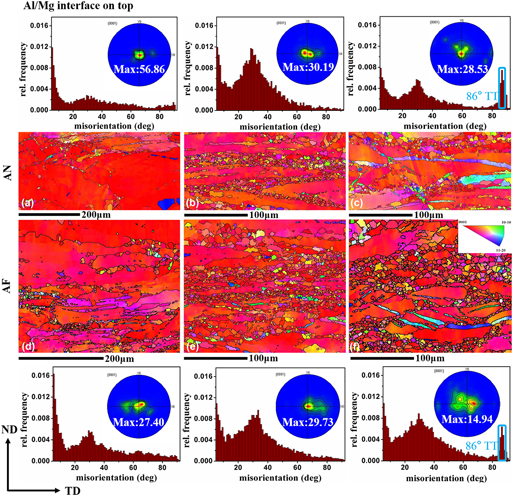
Ti/Al/Mg/Al/Ti laminates were fabricated by hot rolling at 450 °C with various rolling reductions, and the relationship between the mechanical properties and microstructures was investigated in detail. Both Al–Mg and Ti–Al interfaces are well bonded without pore, crack, and intermetallics. Mg layer of 50% rolling reduction has the most dynamic recrystallized (DRXed) grains around the deformation bands, and tensile twins appear in Mg layer when the rolling reduction increases to 60%. Large numbers of twins are formed to absorb the further strain as reduction increases. Ti layer shows equiaxed grains, which are not sensitive to thickness strain. Mg layers of laminates with various rolling reductions all exhibit typical (0002) basal texture. Fifty-percent rolling reduction has the largest ultimate tensile strength of 337.8 MPa, which is mainly owing to grain refinement caused by the extensive DRX. The differences of elongation among the three samples with different rolling reductions are small.
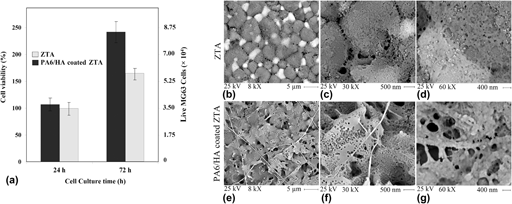
In this study, the bioactivity and cytocompatibility of electrospun polyamide 6 (PA6)/hydroxyapatite (HA) coating on zirconia-toughened alumina (ZTA) were investigated. Adjusting the PA6/HA ratio to 1.15 (w/w) had a significant role in achieving an appropriate fibrous coating with an average diameter of 120 ± 10 nm and surface porosity of 64.3%. The surface of bare and coated samples was hydrophilic, which promoted bone regeneration. The adhesion test of the PA6/HA mat demonstrated that a cohesive coating was formed on the ZTA via electrospinning. The in vitro bioactivity test of the PA6/HA coating in simulated body fluid (SBF) corroborated the formation of a nanostructured bonelike apatite phase. Cytocompatibility of the samples was evaluated through in vitro osteosarcoma-like cell (MG63) culture assays. The cytotoxicity study showed that the electrospun PA6/HA coating significantly improved cell attachment and spreading. The development of such bioactive, biomedical coatings opens new avenues for bone tissue engineering applications.
Chitosan is an important cationic biopolymer widely used in various biomedical applications such as wound care, drug delivery, biomaterial scaffolds, and tissue engineering. In this work, hollow silica sphere (HSS) nanoparticles with an average size of 400–450 nm (via TEM) were synthesized by sol–gel process and were epoxidized using epichlorohydrin. Then, chitosan was chemically bound to the epoxidized HSS to form a bionanocomposite, HSS-epoxy-CHI-X where X represents the percentage of chitosan in the sample. BET analysis showed that pure HSS has a specific surface area (Ass) of around 4.8 m2/g and adsorption average pore diameter of 10.18 nm. Bionanocomposites were characterized by FT-IR spectroscopy to confirm the bonding of chitosan on HSS nanoparticles. X-ray diffraction studies demonstrated that the amorphous character of the materials improved with the HSS content. Thermogravimetric analysis illustrated that at low temperatures, the thermal stability of bionanocomposites was higher than that of the sample with no chitosan in it. Scanning electron microscopic analysis results confirmed the homogenous distribution of HSS in the bionanocomposites. Considering the biological activity of chitosan and absorption characteristics of HSS, newly developed HSS-epoxy-CHI-X bionanocomposites were tested for wound healing by in vitro scratch assay using NIH 3T3 fibroblast cells. Among the bionanocomposites analyzed, HSS-epoxy-CHI-60 exhibited better performance where about 90% wound closure was observed for this sample after 21 h of exposure.
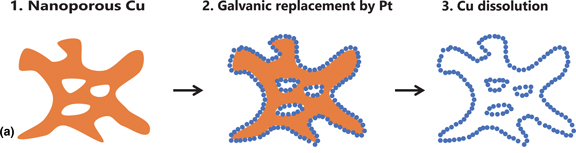
Bimodal nanoporous platinum (BNP-Pt) is synthesized by using a sacrificial nanoporous copper (NP-Cu) support for oxygen-reduction-reaction (ORR) catalysts in fuel cells. The specific ORR catalytic activity of BNP-Pt increases by the dissolution and removal of supporting NP-Cu, suggesting that the BNP structure improves the intrinsic catalytic properties of platinum. The lattice contraction of BNP-Pt containing residual copper even after NP-Cu removal is milder than predicted by Vegard's law. The BNP structure governs the intrinsic catalytic activity of the platinum by relaxing the lattice contraction and by alloying with copper and/or misfit strain at the Pt/Cu interface.
The effect of SiCp on the aging behavior of the extruded SiCp/AZ91 composite fabricated by stir casting was investigated in detail. The necklace-type distribution of the particles in the cast SiCp/AZ91 composite was destroyed, and the extrusion bands consisting of SiCp and small dynamic recrystallized grains formed aligning along the extrusion direction. Addition of SiCp could accelerate the aging kinetics of the AZ91 matrix because of the overlapped particle plastic zone. The improved particle distribution and refined grains caused by the recrystallization could affect the aging behavior of the SiCp/AZ91 composite. The Mg17A112 discontinuous precipitates preferred to nucleate at the SiC/Mg interfaces and the grain boundaries within the extrusion bands and then expanded into the particle-free region. Moreover, the promoted discontinuous precipitates would suppress the continuous intragranular precipitates with respect to the unreinforced AZ91 alloy.
The crystal structure of hydroxyzine dihydrochloride has been solved and refined using synchrotron X-ray powder diffraction data, and optimized using density functional techniques. Hydroxyzine dihydrochloride crystallizes in space group P21 (#4) with a = 11.48735(10), b = 7.41792(7), c = 14.99234(15) Å, β = 110.4383(10)°, V = 1197.107(13) Å3, and Z = 2. The hydroxyl-containing side chain of the cation is disordered over two conformations, with ~70/30% occupancy. The crystal structure consists of alternating polar (which includes the cation-anion interactions and hydrogen bonds) and nonpolar layers parallel to the ab-plane. The crystal structure is dominated by hydrogen bonds. Each of the protonated nitrogen atoms forms a very strong hydrogen bond to one of the chloride anions. The hydroxyl group forms a strong hydrogen bond to one of the chloride anions in both conformations, and there are subtle differences in the hydrogen bonding patterns between the conformations. The powder pattern is included in the Powder Diffraction File™ as entry 00-066-1603.
The crystal structure of minocycline hydrochloride dihydrate has been solved and refined using synchrotron X-ray powder diffraction data, and optimized using density functional techniques. Minocycline hydrochloride dihydrate crystallizes in space group P212121 (#19) with a = 7.40772(1), b = 14.44924(3), c = 22.33329(4) Å, V = 2390.465(12) Å3, and Z = 4. The minocycline cation is a zwitterion: both dimethylamino groups are protonated and one hydroxyl group is ionized. A potential ambiguity in the orientation of the amide group was resolved by considering Rietveld refinement residuals and displacement coefficients, as well as DFT energies. The crystal structure is dominated by hydrogen bonds. Both water molecules and a hydroxyl group act as donors to the chloride anion. Both protonated dimethyl amine groups act as donors to the ionized hydroxyl group. Several intramolecular O–H···O hydrogen groups help determine the conformation of the cation. The powder pattern is included in the Powder Diffraction File™ as entry 00-066-1606.
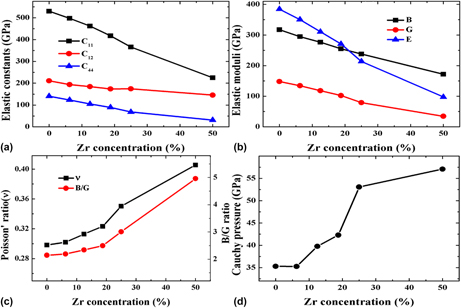
The effect of zirconium alloying on the crystal structures and mechanical properties of binary tungsten–zirconium alloys is investigated in this study using the first-principles method. Firstly, we investigate the cell volumes, lattice constants, and formation energies of binary W1−xZrx (x = 0, 0.0625, 0.125, 0.1875, 0.25, and 0.5) alloys. It is shown that binary tungsten–zirconium alloys maintain BCC structures. When the concentration of zirconium atoms is lower than 12.5%, the structures of binary tungsten–zirconium alloys can be thermodynamically stable. The elastic constants of binary tungsten–zirconium alloys are calculated based on the optimized atomic lattice. Then, the elastic modulus and other mechanical parameters are deduced according to the relevant formulas. It is shown that the mechanical strength of binary tungsten–zirconium alloy decreases with an increasing concentration of zirconium atoms, which is lower than the mechanical strength of pure tungsten metal. However, the mechanical strength of binary tungsten–zirconium alloys is higher than that of pure zirconium metal. In addition, zirconium alloying can be effective in improving the ductility of pure tungsten metal.