To save content items to your account,
please confirm that you agree to abide by our usage policies.
If this is the first time you use this feature, you will be asked to authorise Cambridge Core to connect with your account.
Find out more about saving content to .
To save content items to your Kindle, first ensure no-reply@cambridge.org
is added to your Approved Personal Document E-mail List under your Personal Document Settings
on the Manage Your Content and Devices page of your Amazon account. Then enter the ‘name’ part
of your Kindle email address below.
Find out more about saving to your Kindle.
Note you can select to save to either the @free.kindle.com or @kindle.com variations.
‘@free.kindle.com’ emails are free but can only be saved to your device when it is connected to wi-fi.
‘@kindle.com’ emails can be delivered even when you are not connected to wi-fi, but note that service fees apply.
Resistance switching random-access memory (ReRAM), with the ability to repeatedly modulate electrical resistance, has been highlighted as a feasible high-density memory with the potential to replace negative-AND flash memory. Such resistance modulation usually involves ion migration and filament formation, which usually lead to relatively low device reliability and yield. Resistance switching can also come from an entirely electronic origin, as in nanometallic memory, by electron trapping and detrapping. Recent research has revealed additional merits of its mechanism, which entails smart, atomic-sized floating gates that can be easily engineered in amorphous Si, oxides, and nitrides. This article addresses the basic ideas of nanometallic ReRAM, which may also be a contender for analogue computing and non-von Neumann-type computation.
Dynamic random-access memory (DRAM) is the main memory in most current computers. The excellent scalability of DRAM has significantly contributed to the development of modern computers. However, DRAM technology now faces critical challenges associated with further scaling toward the ∼10-nm technology node. This scaling will likely end soon because of the inherent limitations of charge-based memory. Much effort has been dedicated to delaying this. Novel cell architectures have been designed to reduce the cell area, and new materials and process technologies have been extensively investigated, especially for dielectrics and electrodes related to charge storage. In this article, the current issues, recent progress in and the future of DRAM materials, and fabrication technologies are discussed.
It is curious that first-principles quantum simulations for establishing the electronic structure and bonding patterns of molecules and materials are conducted using fields, yet the standard theoretical approach to understanding their thermal behavior, phase transitions, and self-assembly on larger length- and time scales relies on classical force fields acting on particle degrees of freedom. This article discusses how equilibrium models of classical particle assemblies can be exactly reframed as statistical field theories, and how these theories can be numerically simulated. Today, such field-theoretic simulations have emerged as a highly efficient way to study phase transitions and self-assembly behavior in broad classes of soft materials, including block polymers, polyelectrolyte complexes, and polymeric emulsions.
In this study, we report the characterization of a 304L stainless steel cylindrical projectile produced by additive manufacturing. The projectile was compressively deformed using a Taylor Anvil Gas Gun, leading to a huge strain gradient along the axis of the deformed cylinder. Spatially resolved neutron diffraction measurements on the HIgh Pressure Preferred Orientation time-of-flight diffractometer (HIPPO) and Spectrometer for Materials Research at Temperature and Stress diffractometer (SMARTS) beamlines at the Los Alamos Neutron Science CEnter (LANSCE) with Rietveld and single-peak analysis were used to quantitatively evaluate the volume fractions of the α, γ, and ε phases as well as residual strain and texture. The texture of the γ phase is consistent with uniaxial compression, while the α texture can be explained by the Kurdjumov–Sachs relationship from the γ texture after deformation. This indicates that the material first deformed in the γ phase and subsequently transformed at larger strains. The ε phase was only found in volumes close to the undeformed material with a texture connected to the γ texture by the Shoji–Nishiyama orientation relationship. This allows us to conclude that the ε phase occurs as an intermediate phase at lower strain, and is superseded by the α phase when strain increases further. We found a proportionality between the root-mean-squared microstrain of the γ phase, dominated by the dislocation density, with the α volume fraction, consistent with strain-induced martensite α formation. Knowledge of the sample volume with the ε phase from the neutron diffraction analysis allowed us to identify the ε phase by electron back scatter diffraction analysis, complementing the neutron diffraction analysis with characterization on the grain level.
A two-dimensional (2D) diffraction pattern is an image representing the diffraction intensity distribution over the detected area. For data evaluations of various materials characterization, such as phase identification, stress, texture, and crystal size, this distribution is further converted into the intensity distribution over 2θ or γ angles. For many applications, especially phase analysis and structure refinement, it is crucial for the two-dimensional (2D) pattern to have a large 2θ range sufficient to cover as many diffraction rings as necessary. The 2θ range covered by a 2D detector is determined by the size of the detector active area and the detector distance from the sample. In order to expand the 2θ coverage with a given 2D detector, one may collect several 2D frames at various swing angles and then merge the multiple frames, or scan the 2D detector over the desired 2θ range during the data collection. This paper introduces the geometry and algorithms to produce accurate 2D diffraction patterns with expanded 2θ coverages from multiple images or scanned images.
Perovskites solar cells have reached impressive efficiencies (22%) in recent years. Because certain environmental concerns are raised by the use of lead halides, there is an interest to seek out lead-free alternatives, featuring bismuth or antimony. Alongside, one of the major drawbacks displayed by MAPbI3 is their low stability at ambient conditions. In this work, (RP4)xBiyIz were synthesized, using different types of tetra-alkylphosphoniums (R4PI) were R = ethyl, butyl, hexyl, and octyl, to assess their stability. Afterwards, they were characterized to study their morphology and crystal structure, as well as their optical properties.
Evolving from the oblique-angle deposition method used industrially for the deposition of thin films, the conformal-evaporated-film-by-rotation (CEFR) technique has been successfully applied to replicate surfaces of biologic origin. The CEFR technique is the first step of the Nano4Bio technique, an industrially scalable bioreplication process, the other three steps being electroforming, plasma ashing, and either stamping or casting. These techniques have found optical applications in diverse fields, including forensic science, pest control, and light sources.
We present a method for measuring the shear complex modulus of hydrogels by oscillatory nanoindentation, with unprecedented attention to procedure and uncertainty analysis. The method is verified by testing a typical low-molecular-weight gelator formed from the controlled hydrolysis of glucono-δ-lactone. Nanoindentation results are compared with those obtained by rheometry using both vane-in-cup and parallel-plate fixtures. At 10 Hz, the properties measured by oscillatory nanoindentation were G′ = 38.1 ± 2.8 kPa, tan δ = 0.22 ± 0.02. At the same frequency, the properties measured by rheometry were G′ = 15.3 ± 2.9 kPa, tan δ = 0.11 ± 0.016 (vane-in-cup) and G′ = 7.9 ± 1.1 kPa, tan δ = 0.05 ± 0.004 (parallel-plate). The larger shear modulus measured by nanoindentation is due to the scale of testing. Whereas rheometry characterizes the bulk material response, nanoindentation probes the fibrous network of the gel. The procedure and analysis presented here are valuable for nanoindentation testing of other compliant materials such as hydrogels, soft biological tissue, and food products.
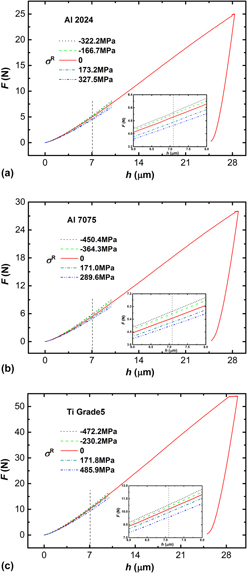
For instrumented spherical indentation, the presence of equibiaxial residual stress in a material will lead the indentation load–depth curve to shift upward or downward. The load differences between the stressed and stress-free curves were used to estimate the equibiaxial residual stress. Using dimensional analysis and finite element simulations, the equibiaxial residual stress was related to the elastic–plastic parameters and the relative load difference at a fixed normalized indentation depth (h/R = 0.1). Based on these expressions, and together with the method for determining elastic–plastic parameters established in our previous work, an integrated method was proposed to estimate the equibiaxial residual stress and elastic–plastic parameters of metals simultaneously via instrumented spherical indentation. This method avoids preknowledge of the yield strength and measuring the contact area. Applications were illustrated on Al 2024, Al 7075, and Ti Grade 5 with introduced stresses. By comparing the results determined by this integrated method with the reference values, the maximum relative error is generally within ±10% for the yield strength, within ±15% for the elastic modulus, and within ±20% for the equibiaxial residual stress.
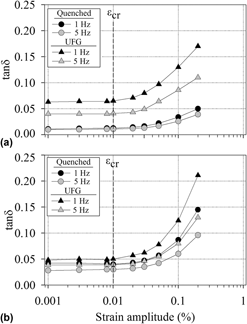
The effects of grain refinement and phase composition on superplasticity and damping capacity of eutectic Zn–5Al and eutectoid Zn–22Al alloys were investigated. For grain refinement, equal-channel angular pressing (ECAP) was applied to these alloys. ECAP completely eliminated the as-cast lamellar microstructures of both alloys and resulted in ultrafine-grained structures along with room temperature superplasticity. Furthermore, these microstructural changes with ECAP increased the damping capacity of both alloys in the dynamic hysteresis region, where damping arises from viscous sliding of phase/grain boundaries. Dynamic recrystallization at the surface and thermally activated viscous motion of grain/phase boundaries at the subsurface of the samples of both alloys were proposed as the damping mechanisms in the region where the alloys showed combined aspects of static/dynamic hysteresis damping behavior. Although the grain size is larger in Zn–5Al compared to Zn–22Al, it showed higher damping capacity due to the different sliding characteristics of its phase boundaries.
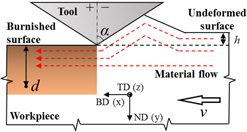
In the present study, gradient microstructure and texture development in wedge-based severe plastic burnishing of oxygen-free high conductivity copper was investigated. Microstructural response and evolution of crystallographic texture in severe surface plastic deformation was shown to be controllable in terms of both magnitude and gradient through control of the incident wedge angle and burnishing parameters. Equiaxed ultra-fined grains and micro/nanoscale elongated grains were produced in the subsurface region, which is indicative of dynamic recrystallization at large strains in the subsurface. Subsurface regions exhibited a significant fraction of shear texture components along the 〈110〉 partial fibers. Texture evolution simulated using the visco-plastic self-consistent framework revealed variations in strain level controlling different mechanisms for rotation of these partial fibers from their ideal orientation. Controllability of subsurface properties and microstructure for such materials is briefly discussed. These results allude to fundamental limits in material processing by severe shear using scalable deformation configurations.
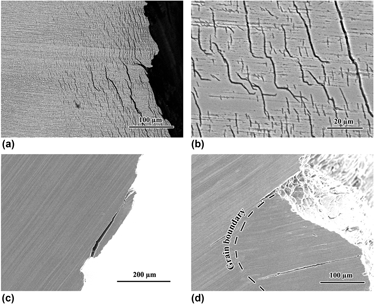
Ti–47Al samples with a diameter of 18 mm are obtained by electromagnetic confinement and directional solidification at different growth velocities. Controlled by a Ti–43Al–3Si seed, the α grains are aligned well and the parallel lamellar microstructure is obtained at the growth velocity of 10 μm/s. With the growth velocity increases to 25 and 50 μm/s, although the lamellar microstructures are still aligned well in the initial transition stage, the lamellar alignment fails due to the nucleation and growth of new β and α grains and then the inclined and perpendicular lamellar microstructures form eventually. The room temperature tensile properties of the different lamellar microstructures are measured and the results show that the desired lamellar microstructure has a tensile strength of 693 MPa and an elongation of 10.0% simultaneously. They are the maximum values that have been reported in binary γ-TiAl alloys so far and are far higher than those of the other two types of lamellar microstructures. The fracture behaviors of the lamellar microstructures are checked by scanning electron microscopy and transmission electron microscopy. Two models are used to illustrate the fracture mechanism of the different lamellar structures.