To save content items to your account,
please confirm that you agree to abide by our usage policies.
If this is the first time you use this feature, you will be asked to authorise Cambridge Core to connect with your account.
Find out more about saving content to .
To save content items to your Kindle, first ensure no-reply@cambridge.org
is added to your Approved Personal Document E-mail List under your Personal Document Settings
on the Manage Your Content and Devices page of your Amazon account. Then enter the ‘name’ part
of your Kindle email address below.
Find out more about saving to your Kindle.
Note you can select to save to either the @free.kindle.com or @kindle.com variations.
‘@free.kindle.com’ emails are free but can only be saved to your device when it is connected to wi-fi.
‘@kindle.com’ emails can be delivered even when you are not connected to wi-fi, but note that service fees apply.
The electrochemical catalytic effects of the NiO islands and layer on n-type GaN were investigated. The NiO islands covered some parts of the GaN surface and were seen to improve photoanodic current and prevent photoanodic corrosion. However, the NiO layer was found to worsen the photoanodic current. Hole transportation is thought to occur from the GaN valence band edge to the NiO valence band edge in their surface plane direction due to the band alignment. In addition, the electron capture for water oxidation is expected to be the valence band edge of the NiO instead of the intermediate state.
Amine-based plasma polymer thin films (NH2-PPTFs) are favorable due to their potential ability for binding a variety of biomolecules, especially in biotechnologic studies. In this context, to understand the effect of different amine sources on quartz tuning forks’ (QTF) surface functionalization and isolation, we prepared PPTFs by single-step plasma polymerization process. The amino-group concentration of PPTF's was proportionally increased by increasing discharge powers, whereas not affected from exposure time. It was observed that the resistivity increased with the increasing molecular weight of the precursor. In conclusion, NH2-PPTF-modified QTFs present as a great candidate for future biotechnologic applications.
The strength of materials exhibits size effects at sample dimensions <1 mm. In the literature, two trends are identified in the length scale spectrum: smaller is stronger at <10 µm; larger is stronger at >500 µm. The dimension at which the transition between these two trends occurs remained unclear. We study this mesoscopic scale (20–400 µm) by examining the compression response of ring and pillar-shaped Al specimens. Integrating present results with literature data, we provide Al's compression response in a “master curve” fashion. We demonstrate the inadequacies of the classical surface layer model, and suggest directions for future studies.
A thermoresponsive large-area plasmonic architecture, made from randomly distributed gold nanoparticles (GNPs) located at the substrate interface of a cholesteric liquid crystal (CLC) cell, is fabricated and thoroughly characterized. A photo-thermal heating effect due to the localized plasmonic resonance (LPR) mechanism is generated by pumping the GNP array with a resonant light beam. The photo-induced heat, propagating through the CLC layer, induces a gradual phase transition from the cholesteric to isotropic phase. Both the plasmonic and photonic properties of the system as both the selective reflection properties and frequency of the LPR are modulated.
We provide insights pertaining the dependence of undercooling in the formation of graphite, nanodiamonds, and Q-carbon nanocomposites by nanosecond laser melting of diamond-like carbon (DLC). The DLC films are melted rapidly in a super-undercooled state and subsequently quenched to room temperature. Substrates exhibiting different thermal properties—silicon and sapphire, are used to demonstrate that substrates with lower thermal conductivity trap heat flow, inducing larger undercooling, both experimentally and theoretically via finite element simulations. The increased undercooling facilitates the formation of Q-carbon. The Q-carbon is used as nucleation seeds for diamond growth via laser remelting and hot-filament chemical vapor deposition.
Focused electron beam-induced deposition (FEBID) is capable of producing metal-containing nanostructures with lateral resolution on the sub-nanometer scale. Practical application of this nanofabrication technique has been hindered by ligand-derived contamination from precursors developed for thermal deposition methods. Mechanistic insight into FEBID through surface science studies and gas-phase electron–molecule interactions has begun to enable the design of custom FEBID precursors. These studies have shown that precursors designed to decompose under electron irradiation can produce high-purity FEBID deposits. Herein, we highlight the progress in FEBID precursor development with several examples that incorporate this mechanism-based design approach.
We have studied the effect of hydrostatic pressure on the confined exciton in a spherical core–shell quantum dot. Using a simple variational approach under the framework of effective mass approximation, we have computed the excitonic binding energy as a function of the shell thickness under the applied hydrostatic pressure. Our results show that the ground state binding energy of exciton depends greatly on the shell thickness, which tends to the two-dimensional limit of 4RX, when the ratio a/b tends to unity. The numerical calculations also suggest that the applied hydrostatic pressure favors the attraction between electrons and holes so the excitonic binding energy increases when pressure increases.
We report on the low-temperature electrical characterization of bilayer MoS2 treated with increasing dose of oxygen:argon (1:3) plasma. We characterize the effective Schottky barrier heights as a function of plasma exposure time and observe a significant barrier lowering, with no accompanying p-type conduction in the negative bias region. Furthermore, we observe a crossover in the temperature-dependent conduction regimes below 181 K due to the plasma exposure. The Efros–Shklovskii (ES) hopping regime is seen to transform upon plasma exposure to a mixed ES/thermally-activated regime at high temperatures, and to a strongly short-range Arrhenius regime at low temperatures. We attribute the observed crossovers to a critical defect density created by the surface reaction with the plasma.
We report the synthesis and photovoltaic characterization of four novel polymers based on poly({4,8-bis[(2-ethylhexyl)oxy]benzo[1,2-b:4,5-b′]dithiophene-2,6-diyl}{3-fluoro-2-[(2-ethylhexyl)carbonyl]thieno[3,4-b]thiophenediyl}) (PTB7) incorporating various numbers of photocrosslinkable n-octyl chloride sidechains (PTB-Cl). These polymers showed similar optoelectronic properties to PTB7 and readily cross-linked in the form of thin films after deep-UV exposure. Photolithography with micrometer-scale patterning is demonstrated. PTB-Cls exhibit similar PV performances to PTB7 and lightly cross-linked PTB-Cls showed stable high photoconversion efficiencies after prolonged thermal treatment. However, it is found that a high-degree cross-linking is needed to prevent the formation of PCBM crystallites at high annealing temperatures even though the PV performance is stabilized with a much lower degree of cross-linking. This implies that the complete prevention of PCBM crystallite formation is not necessary to affect the stabilization of PV devices against excessive heat.
An Al–3% B master alloy has been subjected to equal channel angular pressing (ECAP). The grain refining performance and fading resistance of an Al–3% B master alloy on a commercial purity Al (CPA) have been evaluated. The effect of the number of ECAP passes on the size and the distribution of the AlB2 particles, the grain size of CPA ingots with and without adding the Al–3% B master alloy subjected to ECAP have been investigated. The mean size of AlB2 particles was significantly reduced from ∼34 to ∼12 μm after four ECAP passes. Fine blocky AlB2 particles were uniformly distributed in the Al matrix. It has been revealed that when it was inoculated by the Al–B master alloy subjected to ECAP, the grain size of α-Al was decreased from ∼1200 to ∼180 μm after four ECAP passes, beyond that, the grain size tends to be saturated. It has been proved that grain refinement efficiency and fading resistance of the Al–3% B master alloy subjected to ECAP in CPA ingots was enhanced.
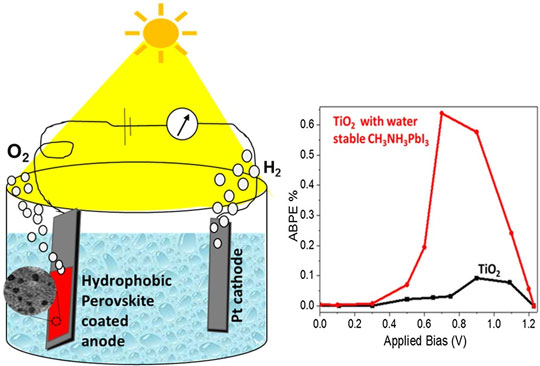
To evaluate whether the photocatalysis efficiency of titanium oxide (TiO2) increases under the shading of carbon aerogel (CA), super black CA/TiO2 composite sheets were directly fabricated by physical mixing of CA, TiO2 powder, and binder. It was found that the photocatalysis efficiency of composite sheets were higher than that of pure TiO2 sheet. We attribute this phenomenon to the hot electrons coupling between CA and TiO2. Besides the direct light absorption of TiO2, the hot electrons generating and indirect energy transfer from CA to TiO2 may enhance the photocatalysis efficiency of TiO2.
The present work focuses on the radiation-modification of chitosan (CS) with N,N-dimethylacrylamide (DMAAm) presented as three different architectures: comb-type grafting hydrogels (net-CS)-g-DMAAm, interpenetrating networks of CS and DMAAm (net-CS)-inter-(net-DMAAm), and semi-interpenetrating networks (net-DMAAm)-inter-CS. The syntheses of different polymeric architectures were realized by gamma irradiation by a 60Co source. The optimum conditions for the syntheses of the three systems were at a dose of 6 kGy. Only the comb-type system presented a well-defined critical pH. All the hydrogels showed porous and interconnected structures according to scanning electronic microscopy. These different architectures could be used as three-dimensional cell culture scaffolding.
The emerging planar subwavelength microlens has attracted wide attention recently. There exists a trade-off in the selection of phase shifter materials for the lens designed with linearly polarized incidence. In this work, we have discovered that it is possible to utilize tapered nanostructure to increase the transmission of phase shifters built with high refractive index materials. A typical grating microlens is demonstrated to examine the effectiveness of taper-enhancement effect—the focus efficiency is increased from 9% to 28% with the properly designed tapered sidewall. Our work will provide a novel method to enhance performance using high refractive index materials in the emerging microlens field.
The helium ion microscope (HeIM) holds immense promise for nano-engineering and imaging with scope for in-situ chemical analysis. Here we will examine the potential of secondary electron hyperspectral imaging (SEHI) as a new route to exploring chemical variations in both two and three dimensions. We present a range of early applications in the context of image interpretation in wider materials science and process control in ion beam-based nano-engineering. Necessary steps for SEHI in the HeIM to evolve into a reliable technique which can be fully embedded into nano-engineering workflows are considered.
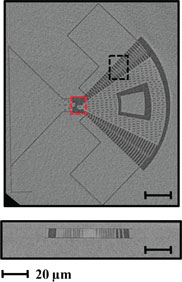
This study presents in situ detection of Zn2+ using a novel two-step square-wave anodic stripping voltammetry (SWASV)-based needle-type microsensor for citrus plant applications. A double-barrel bismuth/platinum (Bi/Pt) microelectrode was fabricated with a solid metal tip (~110 µm), which was durable enough to penetrate the thick skin of the citrus leaves and sensitive enough to detect ppb changes in Zn2+ concentration using SWASV. The microelectrode tip size was also determined to reduce mass transport limitation and improve limit of detection. Overall, the developed Bi/Pt microelectrode successfully measured Zn2+ concentrations within the vascular bundle of citrus plants.
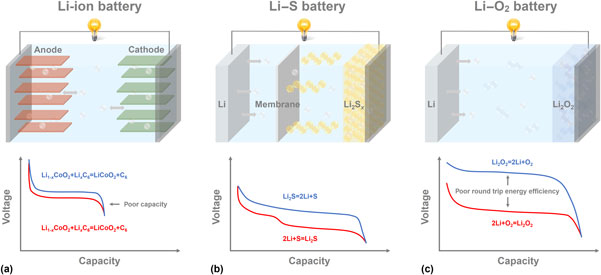
Binder-free three-dimensional Co3O4 electrodes are fabricated by an economical and scalable one-step flame combustion method, namely Reactive Spray Deposition Technology. The electrodes are composed of porous nanostructured Co3O4 uniformly distributed throughout the conductive substrate. In the absence of any further optimization on the processing conditions, the as-synthesized electrodes demonstrate high capacitance of 567 F g−1 at 1.5 A g−1, excellent rate capability, and stable cycling performance with a capacity retention ratio of 96.7% after 1000 charge/discharge cycles from the three-electrode half-cell testing. This study presents the pathway to a significantly simplified manufacturing process of three-dimensional electrodes with the desirable porous nanostructure.
Porphyrins are photosensitisers used in photodynamic therapy (PDT) due to their tumor localization and in situ singlet oxygen generation. However, their limited absorption, insolubility, and aggregation in an aqueous medium limited their effective application in PDT. To overcome these limitations, we herein, report a large-scale aqueous synthesis of CuInS2/ZnS ternary quantum dots, and its conjugation to 5, 10, 15, 20-meso(4-hydroxyphenyl) porphyrin. The singlet oxygen generation of this highly aqueous soluble novel conjugate shows its potential for PDT applications.
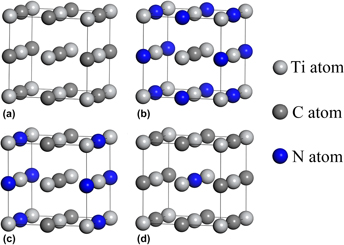
The TiCxN1−x(001)/TiC(001) interface was studied by the first-principles method to provide the theoretical basis for developing TiCxN1−x/TiC coatings. The partial density of state (PDOS), charge density, charge density difference, and Mulliken population analysis were utilized to investigate the bonding nature and the electronic characteristic of the TiC0.25N0.75/TiC interface. The corresponding results indicate that the bonding nature at the interface is ionic and covalent characteristics, which also exist in bulk materials. The extreme similarity of PDOS among interfacial C, N, and Ti atoms and their bulk counterparts reveals that the electronic structure transition at the interface is smooth. The results of Mulliken population analysis and plots of charge density and charge density difference demonstrate that the charge increased for C in the TiC side is less than that for N in the TiC0.25N0.75 side, which reveals that the ionic bond in TiC0.25N0.75 is stronger than that in TiC. Therefore, TiC0.25N0.75 coating can be an alternative choice to combine with TiC coating in the actual production process of multilayer coatings.
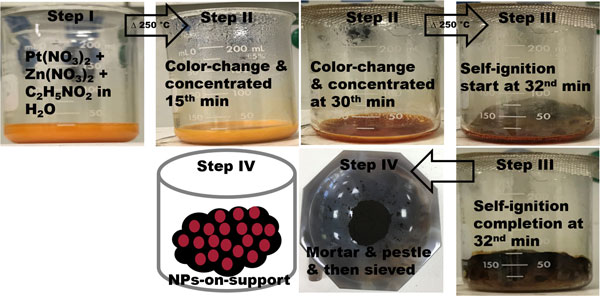
This work focuses on the syntheses of Zn-enriched PtZn nanoparticle electrocatalysts by solution combustion for ethanol oxidation reaction (EOR). Analytical techniques of x-ray diffraction, transmission electron microscopy (TEM), scanning electron microscopy, TEM/scanning TEM-energy dispersive x-ray spectroscopy, and x-ray photoelectron spectroscopy are used for the characterization of electrocatalysts. Cyclic voltammetry and chronoamperometry are applied for the electrocatalysis of C2H5OH and stability test in an alkaline medium, respectively. Electrochemical data show that PtZn/C has improved electrocatalytic activity by ~2.3 times compared with commercial Pt/C, in addition to having earlier onset potential and better stability for EOR. The variation of fuel amount in the synthesis has affected crystallite sizes, electronic, and electrochemical properties in electrocatalysts.
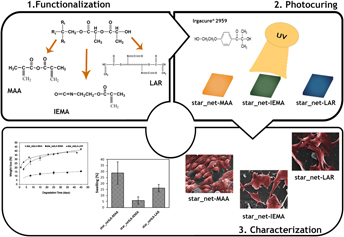
Direct polycondensation of L-lactic acid with a comonomer allows tailoring the properties of the product from the very first step. The viscous L-lactic acid co-oligomers with star-shaped architectures obtained were modified with three different acrylate monomers. Regardless the functionalization agent, UV curing was fast and all materials were cell compatible and promoted cell adhesion. The physical properties of the three star-shaped films exhibited a consistent trend as swelling capacity, hydrolytic instability, and gel content decreased simultaneously. A higher network density increased crosslinking degree and gel content among the films with an isocyanate group. The methacrylic end group functionalized material, lowest molecular weight, consistently exhibited the higher hydrolytic instability. Comparison of physical properties of these films with the corresponding linear materials reported previously confirmed the influence of precursor molecular architecture on the final material. The methodology developed herein is prone to scale-up and lead to the industrial production of new bioadhesives.