To save content items to your account,
please confirm that you agree to abide by our usage policies.
If this is the first time you use this feature, you will be asked to authorise Cambridge Core to connect with your account.
Find out more about saving content to .
To save content items to your Kindle, first ensure no-reply@cambridge.org
is added to your Approved Personal Document E-mail List under your Personal Document Settings
on the Manage Your Content and Devices page of your Amazon account. Then enter the ‘name’ part
of your Kindle email address below.
Find out more about saving to your Kindle.
Note you can select to save to either the @free.kindle.com or @kindle.com variations.
‘@free.kindle.com’ emails are free but can only be saved to your device when it is connected to wi-fi.
‘@kindle.com’ emails can be delivered even when you are not connected to wi-fi, but note that service fees apply.
Kinetic Monte Carlo (KMC) models of complex materials and biomolecules are increasingly being constructed using molecular dynamics (MD). A KMC model contains a catalog of states and kinetic pathways, which enables study of the dynamics. The completeness of the catalog is crucial to the model accuracy and is linked to the quality of the MD data used for model construction. Therefore, quantifying the uncertainty due to missing states and pathways is important. A review on computational procedures available for on-the-fly KMC model construction using MD, uncertainty measurement, and algorithms for guiding further MD sampling in an accelerated manner is presented.
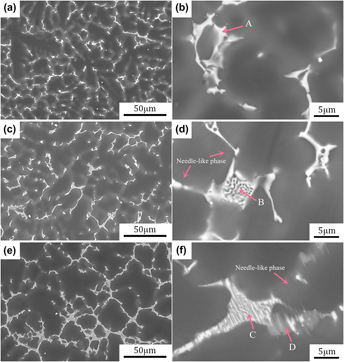
Eutectic Al–13% Si alloys are widely used in automotive components, such as pistons and cylinder heads. Recently, the demand on the performance of piston alloys at high temperature is greatly increased to enhance the engine efficiency and to reduce exhaust emission. In the present work, Mn was added to strengthen the aluminum matrix via the formation of thermally stable dispersoids. The evolution of dispersoids during heat treatment and their influence on elevated-temperature properties were studied. The results showed that the as-cast microstructures in the experimental alloys without/with Mn addition were similar, which were composed of eutectic Si, primary Mg2Si, Al–Fe–Ni, Al–Cu–Ni, and π-Al–Mg–Fe–Si intermetallic phases. In the alloy with Mn addition, a number of α-Al(Mn,Fe)Si dispersoids started to form after a heat treatment at 425 °C for 24 h and reached the peak condition at 500 °C for 6 h, resulting in a remarkable increase of the microhardness at room temperature and the improvement in the yield strength and creep resistance at 300 °C. As a complementary strengthening mechanism, the dispersoid strengthening in the aluminum matrix provides a novel approach to improve the elevated-temperature properties of Al–Si piston alloys.
In this study, a facile room-temperature solution method is developed for the preparation of zinc oxide@graphene oxide (ZnO@GO) nanocomposites. Unlike the general process to obtain crystallized materials by heating, the room temperature we used can generate fine ZnO@GO nanocomposites with ultra-small ZnO nanocrystal (∼8 nm) and high weight content (∼84%). The obtained ZnO@GO nanocomposite was thoroughly characterized by various physicochemical techniques such as scanning electron microscopy, high-resolution transmission electron microscopy, X-ray diffraction, Raman spectroscopy, and X-ray photoelectron spectroscopy, indicating well-dispersed ZnO on the GO layer and strong interaction between the each other. As an anode material for lithium-ion batteries, ZnO@GO exhibits high specific reversible capacity and excellent cycling performance, which can be ascribed to the role of GO in preventing the agglomeration of the ZnO nanoparticles by creating the decorated nanoscale composite during the electrochemical process.
To obtain a fine-grained Mg matrix, the (submicron + micron) bimodal size SiC particle reinforced AZ91 (SiCp/AZ91) composite was subjected to forging followed by the extrusion process first. Then, the fine-grained bimodal size SiCp/AZ91 composite was compressed at 270–370 °C with 0.1–0.001 s−1. The result indicated that the refinement of the Mg matrix contributed to its deteriorated strength at high temperature. However, the grain size is not the only factor influencing flow stress but the SiCp also plays an important role. The effect of SiCp on the fine grained Mg matrix depends on grain size and dislocation density, both of which strongly depend on temperature and strain rate. As compared with the fine grained Mg matrix reinforced by single size SiCp, the one with bimodal size SiCp unusually exhibit lower flow stress during hot compression. The calculated activation energy of the bimodal size SiCp/AZ91 composite is higher than the micron SiCp/AZ91 composite; however, nearly the same as the submicron SiCp/AZ91 composite, and the deformation of which was thought to be controlled by ∼1 vol% submicron SiCp.
In this study, based on the collection process, three-dimensional aligned fiber scaffolds from gelatin and zein protein were manufactured using Forcespinning®. The homogeneous blending of gelatin:zein (1:4) showed improved tensile and good hydrophobic properties (water contact angle of 115 °C). Cell viability, adhesion, proliferation, and drug release were measured. The cell viability was studied with human fibroblasts and a low cytotoxic effect was observed. Berberine drug release was measured and sustained release rate was observed over 15 days. The morphologic features, prolonged drug release, and cytotoxicity results suggest that these fibers could be appropriate for drug delivery and tissue engineering applications.
The goal of this study is to examine whether participation in high school research apprenticeships increases pursuit of degrees and careers in science, and to explore other apprenticeship benefits. Students who participated in a research apprenticeship were surveyed about its influence on their undergraduate, graduate, and professional decisions. A control group who attended the same high schools, had similar grade point averages, and graduated with the apprenticeship participants was also surveyed. It was found that a significantly higher fraction of the apprenticeship group majored in Science, Math, Engineering, and Technology (STEM) fields, pursued careers in STEM disciplines, and found the experience to strategically influence their job performance.
This work presents a study of the region of nanoparticle growth in an atmospheric pressure carbon arc. The nanoparticles are detected using the planar laser-induced incandescence technique. The measurements revealed large clouds of nanoparticles in the arc periphery bordering the region with a high density of diatomic carbon molecules. Two-dimensional computational fluid dynamic simulations of the arc combined with thermodynamic modeling show that this is due to the interplay of the condensation of carbon molecular species and the convection flow pattern. These results show that the nanoparticles are formed in the colder, peripheral regions of the arc and describe the parameters necessary for coagulation.
Boron carbide (B4C) is an attractive material for numerous applications including vehicle armor, cutting tools, blasting nozzles, and abrasive powder, owing to its extreme hardness, high melting point, high Young’s modulus, and excellent thermoelectric properties. However, the application of B4C is limited by the high-temperature synthesis process. The present work aims to explore a low-temperature manufacturing process for synthesizing B4C with a small amount of free carbon. Poly(resorcinol borate) with an aromatic structure and high char yield was chosen as the aromatic polymeric precursor. A combination of Fourier transform infrared spectroscopy, X-ray photoelectron spectroscopy, X-ray diffraction, scanning electron microscopy, transmission electron microscopy and Raman spectroscopy was performed to investigate the influences of the reaction temperature and holding time on the changes in the precursor microstructure. The results indicate that the rod-like structure of crystalline B4C is successfully synthesized at 600 °C, and the free carbon can be reduced to about 0.8 wt% in the final product. This is because the pyrolysis temperature controlled the carbon content of the B4C, which led to an enlarged contact domain between B2O3 and carbon, and a relatively low-temperature synthesis of B4C.
Boron nitride nanotubes (BNNTs) have been utilized to strengthen various engineering materials especially metal matrix composites thanks to their extraordinary high tensile strength, elastic modulus, and failure strain. In this paper, single- and multi-walled BNNTs were therefore used to combine with aluminum (Al) metal matrix. Mechanical characteristics and deformation mechanism of nanocomposites reinforced with long (continuous) and short (discontinuous) BNNTs were then investigated for different loadings including uniaxial tension and compression and different boundary conditions based on molecular dynamics simulations. It was found that long BNNTs remarkably improved tensile mechanical properties of the matrix and effectively enhanced elastic modulus and strength of the nanocomposites by 82% and 79.4%, respectively. They could provide effective barriers to propagation path of dislocations formed inside the matrix. Diameter and wall number of the reinforcement did not leave considerable impacts on the nanocomposite behavior while its atomic fraction remarkably influenced the material response.
A hypoeutectic CoCrFeNiNbχ system was synthesized to investigate the effect of Nb content on the thermal stability, mechanical properties, and corrosion behaviors. The hypoeutectic CoCrFeNiNbχ alloy, which contained the Laves phase, possessed two-phase eutectic structures. The elevated temperature may have an impact on the stability of the Laves phase. Nanoindentation measurements showed that the Laves phase is much harder than the FCC phase, which could be confirmed by the shallower maximum penetration depth in the typical P–h curve. Furthermore, the plasticity of the Laves phase was characterized by nanoindentation measurements. Compared with the FCC phase, the activation energy of dislocation nucleation in the Laves phase is much higher due to the large atomic size difference and the phase difference. Corrosion and passivation behaviors of CoCrFeNiNbχ were investigated in 3.5% NaCl solution. All the alloys exhibited spontaneous passivity and low current densities in 3.5% NaCl solution. Furthermore, the corrosion potential increased with the increasing Nb content, which indicated that the corrosion resistance enhanced with a higher Nb content.
The wetting of Cu–19Ni–5Al alloy on Ni-coated WC–8Co substrates with different coating thicknesses was investigated, and the brazing of Ni-coated WC–8Co to SAE1045 steel was performed by using the Cu–19Ni–5Al alloy as the filler metal. All the Cu–19Ni–5Al/Ni-coated WC–8Co systems present excellent wettability with a final contact angle of ∼10°. The thicknesses of the β + γ phase enriched with Co, Ni, and Al at the two joint interfaces increase and decrease with the Ni coating thickness, brazing temperature, and holding time increasing, respectively. The joint shear strength increases first and then decreases with the increase of Ni coating thickness, brazing temperature, or holding time. The maximum joint shear strength of ∼328 MPa is obtained while Ni plating for 90 min and brazing at 1210 °C × 5 min.
The protective effect of poly(methylmethacrylate) (PMMA) cover layers against the degradation of π-conjugated polymers by ozone and photo-oxidation, respectively, has been investigated by UV/Vis spectroscopy. The PMMA films were cast from solution at thicknesses between 20 and 100 nm on top of films of poly(3-hexylthiophene) and poly[2-methoxy-5-(3′,7′-dimethyloctyloxy)-1,4-phenylenevinylene]. PMMA layers of more than 65 nm in thickness reduce the oxidation rate of the π-conjugated polymers under 15 ppm of ozone in the dark by more than three orders of magnitude, whereas photo-oxidation rates under dry and humid air remain unaffected. The PMMA cover layers are hardly affected by ambient ozone over thousands of hours. Calculations of ozone and oxygen fluxes through the PMMA films reveal that ozonation rates are limited by the diffusion of ozone, whereas photo-oxidation rates are not limited by the diffusion of oxygen, due to the much larger pressure gradient of the latter.
Surface modification by the bioactive material is a potential way to overcome the poor osseoconductivity of titanium (Ti)-based implants. A continuous wave laser source was used to deposit strontium titanate (SrTiO3)-reinforced Ti coating on the Ti substrate using the laser engineered net shaping (LENS™) process. The maximum of 10 wt% SrTiO3 could be incorporated into Ti using laser without cracking of the deposit. This study investigated the constituent phases, microstructure, compositional analysis, wettability, and electrochemical behavior of the composite coatings. XRD and EDX analyses confirmed the presence of the SrTiO3 phase in the coatings. The composite coatings also exhibited superior mechanical properties, corrosion resistance, and bioactivity compared to that of commercially pure Ti. In vitro ion release study confirmed the sustain release of Sr2+ from the composite coatings. In summary, the excellent mechanical bonding with the substrate and high in vitro bioactivity make these SrTiO3-incorporated composite coatings as a potential material to enhance osseoconductivity of Ti-based orthopedic implants.
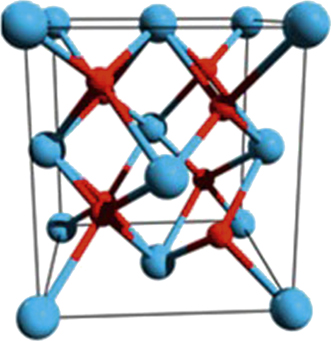
Uniformly dispersed ultra-small hollow Co9S8 nanoparticles (<10 nm) (H-Co9S8@C) and solid Co9S8 nanoparticles (S-Co9S8@C) in porous carbon were fabricated separately by solvothermal and sulfur powder sulphurisation using Co-MOF-74 as the template. Owing to significant structural stability and uniform hollow structure of carbon-encapsulated Co9S8, the as-prepared H-Co9S8@C exhibited excellent lithium ion storage performance as an anode material. Worked in the voltage of 0.01–3.0 V, H-Co9S8@C revealed outstanding rate capability (850, 670, 613, 552, 457, and 347 mA h/g at 0.1, 0.2, 0.5, 1, 2, and 3 A/g, respectively), and high reversible capacity (after 250 cycles with a remained capacity of 900.5 mA h/g). Compared with S-Co9S8@C, over 50 cycles, the discharge specific capacity of H-Co9S8@C was still maintained at 655 mA h/g at a current density of 0.5 A/g, whereas the capacity of S-Co9S8@C declined rapidly to 160.4 mA h/g. The results showed that superior capacity, excellent rate performance, and highly stable cycle performance depended mainly on the hollow characteristic of Co9S8.
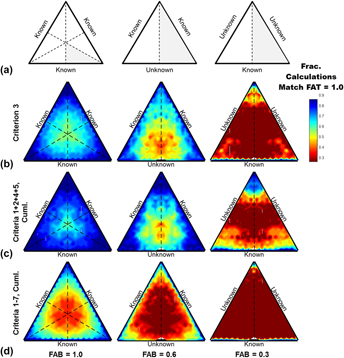
CALPHAD databases have traditionally been developed for investigation of single-principal component alloys. With the advent of batch processing capability, engineering teams have proposed using these models to systematically explore compositional space for multiprincipal element systems. However, the uncertainty of phase equilibria predictions outside of traditional compositional bounds has yet to be evaluated. This study assesses the current capabilities of commercially available CALPHAD databases to predict phase equilibria within ternary phase space as a function of the number of full binary system descriptions contained within the thermodynamic databases, the spatial location in compositional space relative to subsystem descriptions, and the specific database used. A strong correlation was observed between the fraction of subsystem descriptions available for the free energy calculation and the accuracy of phase predictions in undefined ternary space. The accuracy of equilibria predictions degraded with increased compositional extrapolation from defined subsystems.
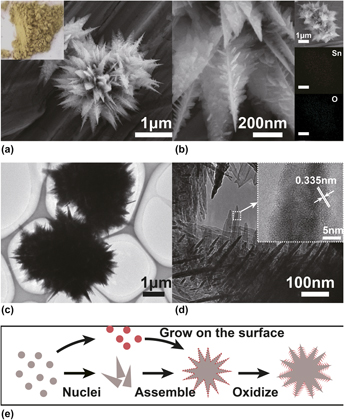
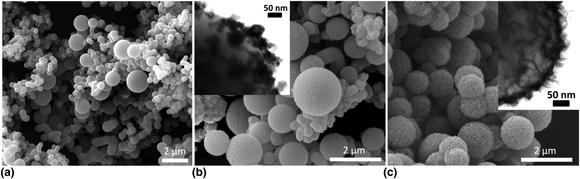
Unique SnO2 monoflowers with an aloe-like morphology were successfully synthesized via a one-step hydrothermal method. The structural, chemical, and physical characteristics were investigated. The results exhibited that the as-prepared sample was assembled by triangle rutile SnO2 nanoslices with rough surfaces. A possible crystal growth and nanostructure assembling mechanism was proposed. The Raman peaks in 171, 235, and 211 cm−1 proved that a large amount of oxygen defects existed inside the sample, which might narrow the band gap from 3.6 eV of pure SnO2 to 2.7 eV of the sample. The sensor fabricated by aloe-like SnO2 nanostructures exhibited an excellent response and selectivity to ethanol. The developed sensor can detect ethanol as low as 10 ppm at 360 °C. The prepared aloe-like SnO2 microflower sensor exhibited a gas sensing response of about 7.46 when exposed to 100 ppm of ethanol gas at 360 °C, which was probably related to more numerous defects and thinner structure of aloe-like SnO2.
The microstructure evolution and mechanical properties of Mg–10Gd–3Y–xZn–0.6Zr (x = 0.5, 1, and 1.5 wt%) alloys in the as-cast, solution-treated, and peak-aged conditions have been investigated systematically. The results indicate that the microstructure of the as-cast alloy with 0.5% Zn consists of α-Mg, (Mg,Zn)3RE and Mg24(RE,Zn)5 phases, while the alloy with 1.0 and 1.5% Zn consists of α-Mg, (Mg,Zn)3RE and some stacking faults. Moreover, 18R-LPSO phases are observed in the as-cast alloy with 1.5% Zn. The formation of LPSO phases involves not only stacking sequence ordered but also chemical composition ordered. After solution treatment, the Mg24(RE,Zn)5, (Mg,Zn)3RE, stacking faults, and 18R-LPSO phases transform into 14H-LPSO phases. The 14H-LPSO phase plays an important role in the improvement of mechanical properties, especially for the ductility. The β′ phase with a bco structure precipitates in the peak-aged alloys results in precipitation hardening, significantly improving the tensile strength, but it leads to poor ductility.
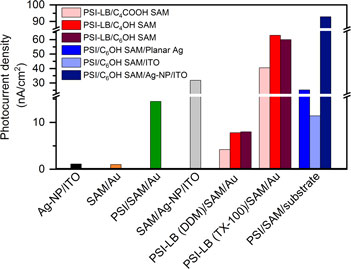
Rational design of bio-hybrid photovoltaic and/or optoelectronic devices requires systematic electrochemical characterizations of photosystem I (PSI), the photosynthetic membrane protein, assembled onto tailored biotic–abiotic interfaces. This work communicates our research findings on the role of PSI microenvironment alterations at organic/inorganic interfaces, via biomimetic lipid membrane confinements and plasmonic coupling with Ag nano-pyramid structures, in tuning the photoactivated charge separation and photocurrent generations from surface-assembled PSI. The observed photocurrent enhancements and the associated mechanistic insights from this study will facilitate the future design of tailored interfaces that can optimally tune the photoactivity and photostability of PSI in solid-state bioelectronics.
Three different hydrothermally grown carbonaceous materials and their molybdenum chalcogenides derived from glucose (HTC, HTC–MoO2, HTC–MoS2) were investigated to evaluate their potential as Li-ion battery anodes. All tested materials exhibited good cycling performance at a current density of 100 mA/g and showed high coulombic efficiency, >98%, after the 50th cycle. Reversible charge capacities of HTC, HTC–MoO2, and HTC–MoS2 were 296, 266, and 484 mAh/g, respectively, after 50 successive cycles. This study demonstrated that the HTC–MoS2 showed the highest reversible charge capacity which promises to be a good candidate for an environmentally friendly anode material for Li-ion batteries.
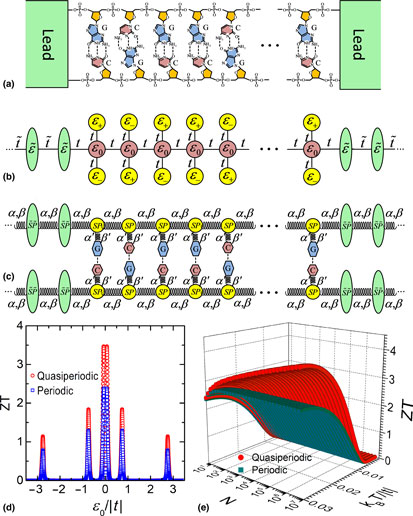
Atomic clusters attached to a low-dimensional system, called Fano defects, produce rich wave interferences. In this work, we analytically found an enhanced thermoelectric figure-of-merit (ZT) in periodic atomic chains with Fano defects, compared with those without such defects. We further study self-assembled DNA-like systems with periodic and quasiperiodically placed Fano defects by using a real-space renormalization method developed for the Kubo–Greenwood formula, in which tight-binding and Born models are respectively used for the electric and lattice thermal conductivities. The results reveal that the quasiperiodicity could be another ZT-improving factor, whose long-range disorder inhibits low-frequency acoustic phonons insensitive to local defects.