To save content items to your account,
please confirm that you agree to abide by our usage policies.
If this is the first time you use this feature, you will be asked to authorise Cambridge Core to connect with your account.
Find out more about saving content to .
To save content items to your Kindle, first ensure no-reply@cambridge.org
is added to your Approved Personal Document E-mail List under your Personal Document Settings
on the Manage Your Content and Devices page of your Amazon account. Then enter the ‘name’ part
of your Kindle email address below.
Find out more about saving to your Kindle.
Note you can select to save to either the @free.kindle.com or @kindle.com variations.
‘@free.kindle.com’ emails are free but can only be saved to your device when it is connected to wi-fi.
‘@kindle.com’ emails can be delivered even when you are not connected to wi-fi, but note that service fees apply.
Optical isolators, devices that only allow unidirectional light propagation, constitute an essential building block for photonic integrated circuits. For near-infrared communications wavelengths, most current isolator designs rely on the incorporation of magneto-optical (MO) materials to break time-reversal symmetry, such as iron garnets or magnetically substituted semiconductors. MO garnets form the backbone of traditional bulk isolators, but suffer from large lattice and thermal mismatch with common semiconductor substrates, which has significantly impeded their integration into on-chip optical isolators. Materials innovations over the past few years have overcome these barriers and enabled monolithic deposition of MO oxide thin films on silicon using techniques such as pulsed laser deposition and magnetron sputtering. On-chip optical isolator devices with polarization diversity in the telecommunication band have been demonstrated based on these materials. This article reviews the latest technological breakthroughs in MO oxide material growth as well as device design and integration strategies toward practical implementation of on-chip optical isolation.
In this work, morphology, viability, and metabolism of the amniotic mesenchymal stem cells conditioned with different citric acid (CA)/media ratios were investigated using rhodamine-phalloidin/4′,6-diamidino-2-phenylindole staining, live/dead assay, proliferating cell nuclear antigen, and terminal deoxynucleotidyl transferase dUTP nick end labeling (TUNEL assay). The cells cultured in 25:75 CA/media displayed well spread actin filaments with a prominent nucleus and evidenced optimum viability. The gelation kinetics of chitosan solution in CA/media (25:75) was monitored via dynamic time sweep analysis on a rheometer. The chemical cross-linking of chitosan with CA was confirmed by nuclear magnetic resonance studies. Subsequently, chitosan solution was extruded in CA/media bath containing cells under benign conditions to form cell-laden fibers (living fibers). The prelabeled cells imaged immediately after fiber formation confirmed the attachment of the cells on the fibers. This approach has several advantages including instantaneous gelation, tunable mechanical properties, and adjustable biodegradability that can provide a platform technology for creating viable three dimensional (3D) building blocks for tissue engineering applications.
Metal–resin interpenetrating phase composites (IPCs) have been produced by spontaneously infiltrating unsaturated polyester resin into porous stainless steel fibrous preforms under vacuum conditions. The compressive behaviors of the IPCs were investigated and the fractures were examined. The compressive strength and elastic modulus increase with increasing fiber fraction. The structures, compressive behaviors, and energy absorption capacities of the IPCs exhibit anisotropy. A higher compressive strength, lower elastic modulus, and lower energy absorption efficiency are observed in the through-thickness direction. The energy absorption efficiency slightly decreases with increasing fiber fraction in a certain range rather than monotonically increasing or decreasing. The energy absorption efficiency in the in-plane direction is superior to that in the through-thickness direction. Finer fibers improve the strength and elastic modulus but have little influence on the energy absorption efficiency. Resin collapse, fiber necking, and debonding are the main failure types observed in the composites.
The use of the advanced manufacturing technique of strain annealing for nanocomposite magnetic ribbons enables control of relative permeabilities and spatially dependent permeability profiles. Tuned permeability profiles enable enhanced control of the magnetic flux throughout magnetic cores, including the concentration or dispersion of the magnetic flux over specific regions. Due to the correlation between local core losses and temperature rises with the local magnetic flux, these profiles can be tuned at the component level for improved losses and reduced steady-state temperatures. We present analytical models for a number of assumed permeability profiles. This work shows significant reductions in the peak temperature rise with overall core losses impacted to a lesser extent. Controlled strain annealing profiles can also adjust the location of hotspots within a component for optimal cooling schemes. As a result, magnetic designs can have improved performance for a range of potential operating conditions.
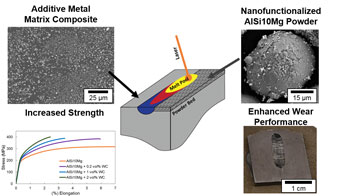
The powder-bed laser additive manufacturing (AM) process is widely used in the fabrication of three-dimensional metallic parts with intricate structures, where kinetically controlled diffusion and microstructure ripening can be hindered by fast melting and rapid solidification. Therefore, the microstructure and physical properties of parts made by this process will be significantly different from their counterparts produced by conventional methods. This work investigates the microstructure evolution for an AM fabricated AlSi10Mg part from its nonequilibrium state toward equilibrium state. Special attention is placed on silicon dissolution, precipitate formation, collapsing of a divorced eutectic cellular structure, and microstructure ripening in the thermal annealing process. These events alter the size, morphology, length scale, and distribution of the beta silicon phase in the primary aluminum, and changes associated with elastic properties and microhardness are reported. The relationship between residual stress and silicon dissolution due to changes in lattice spacing is also investigated and discussed.
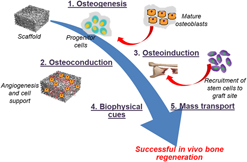
Wollastonite (CaSiO3)–diopside (CaMgSi2O6) glass-ceramic scaffolds have been successfully fabricated using two different additive manufacturing techniques: powder-based 3D printing (3DP) and digital light processing (DLP), coupled with the sinter-crystallization of glass powders with two different compositions. The adopted manufacturing process depended on the balance between viscous flow sintering and crystallization of the glass particles, in turn influenced by the powder size and the sensitivity of CaO–MgO–SiO2 glasses to surface nucleation. 3DP used coarser glass powders and was more appropriate for low temperature firing (800–900 °C), leading to samples with limited crystallization. On the contrary, DLP used finer glass powders, leading to highly crystallized glass-ceramic samples. Despite the differences in manufacturing technology and crystallization, all samples featured very good strength-to-density ratios, which benefit their use for bone tissue engineering applications. The bioactivity of 3D-printed glass-ceramics after immersion in simulated body fluid and the similarities, in terms of ionic releases and hydroxyapatite formation with already validated bioactive glass-ceramics, were preliminarily assessed.
Physical Metallurgy elucidates the microstructure, transformation and properties of metallic materials by means of solid state physics and chemical thermodynamics. Experimental methods of physical metallurgy are also treated.This third edition includes new sections on the permeation of hydrogen in metals, the Landau theory of martensitic transformation, and order hardening and plasticity of intermetallics. Numerous other sections have been brought up to date in the light of new developments (e.g. scanning tunnelling microscopy, CALPHAD-method, diffusion in glasses, DIGM, recrystallisation). New artwork and references have also been added.Professor Haasen's clear and concise coverage of a remarkably wide range of topics will appeal both to physics students at the threshold of their metallurgical careers, and to metallurgists who are interested in the physical foundation of their field.
The field of matter transport is central to understanding the processing of materials and their subsequent mechanical properties. While thermodynamics determines the final state of a material system, it is the kinetics of mass transport that governs how it gets there. This book, first published in 2000, gives a solid grounding in the principles of matter transport and their application to a range of engineering problems. The author develops a unified treatment of mass transport applicable to both solids and liquids. Traditionally matter transport in fluids is considered as an extension of heat transfer and can appear to have little relationship to diffusion in solids. This unified approach clearly makes the connection between these important fields. This book is aimed at advanced undergraduate and beginning graduate students of materials science and engineering and related disciplines. It contains numerous worked examples and unsolved problems. The material can be covered in a one semester course.
This groundbreaking single-authored textbook equips students with everything they need to know to truly understand the hugely topical field of biomaterials science, including essential background on the clinical necessity of biomaterials, relevant concepts in biology and materials science, comprehensive and up-to-date coverage of all existing clinical and experimental biomaterials, and the fundamental principles of biocompatibility. It features extensive case studies interweaved with theory, from a wide range of clinical disciplines, equipping students with a practical understanding of the phenomena and mechanisms of biomaterials performance; a whole chapter dedicated to the biomaterials industry itself, including guidance on regulations, standards and guidelines, litigation, and ethical issues to prepare students for industry; informative glossaries of key terms, engaging end-of-chapter exercises and up-to-date lists of recommended reading. Drawing on the author's forty years' experience in biomaterials, this is an indispensable resource for students studying these lifesaving technological advances.
This textbook provides students with a complete working knowledge of the properties of imperfections in crystalline solids. Readers will learn how to apply the fundamental principles of mechanics and thermodynamics to defect properties in materials science, gaining all the knowledge and tools needed to put this into practice in their own research. Beginning with an introduction to defects and a brief review of basic elasticity theory and statistical thermodynamics, the authors go on to guide the reader in a step-by-step way through point, line, and planar defects, with an emphasis on their structural, thermodynamic, and kinetic properties. Numerous end-of-chapter exercises enable students to put their knowledge into practice, and with solutions for instructors and MATLAB® programs available online, this is an essential text for advanced undergraduate and introductory graduate courses in crystal defects, as well as being ideal for self-study.
In this work, the deformation mechanisms underlying the room temperature deformation of the pseudomorphic body centered cubic (BCC) Mg phase in Mg/Nb nanolayered composites are studied. Nanolayered composites comprised of 50% volume fraction of Mg and Nb were synthesized using physical vapor deposition with the individual layer thicknesses h of 5, 6.7, and 50 nm. At the lower layer thicknesses of h = 5 and 6.7 nm, Mg has undergone a phase transition from HCP to BCC such that it formed a coherent interface with the adjoining Nb phase. Micropillar compression testing normal and parallel to the interface plane shows that the BCC Mg nanolayered composite is much stronger and can sustain higher strains to failure than the HCP Mg nanolayered composite. A crystal plasticity model incorporating confined layer slip is presented and applied to link the observed anisotropy and hardening in the deformation response to the underlying slip mechanisms.
We present a fast method to prepare hybrid materials of polyaniline (PAni) with carbon nanotubes (CNTs, both undoped and nitrogen-doped) by ball milling without solvents or strong oxidants. PAni forms nanoparticles, attached to CNTs in a nanocomposite structure, with the nanotubes well dispersed among the polymer. This is achieved with only a few minutes of ball milling. Raman spectroscopy confirms that PAni was synthesized in its conductive state and suggests a good CNT–PAni interaction, particularly with nitrogen-doped CNTs. We found that water increased polymer yield, which we optimized, together with the nanocomposite conductivity, as function of amount of water and of oxidant (FeCl3). The nanocomposite conductivity is four orders of magnitude higher than that of PAni, for both types of nanotubes. Scanning electron microscopy and X-ray diffraction both show negligible damage to the CNT during this mechanosynthesis procedure, while dry milling and milling CNT in water without aniline does damage nanotubes, indicating that the reaction absorbs most of the mechanical energy.
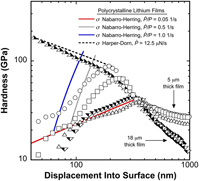
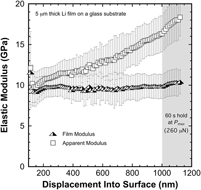
Nanoindentation experiments performed in 5 and 18 μm thick vapor deposited polycrystalline lithium films at 31 °C reveal the mean pressure lithium can support is strongly dependent on length scale and strain rate. At the smallest length scales (indentation depths of 40 nm), the mean pressure lithium can support increases from ∼23 to 175 MPa as the indentation strain rate increases from 0.195 to 1.364 s−1. Furthermore, these pressures are ∼46–350 times higher than the nominal yield strength of bulk polycrystalline lithium. The length scale and strain rate dependent hardness is rationalized using slightly modified forms of the Nabarro–Herring and Harper–Dorn creep mechanisms. Load–displacement curves suggest a stress and length-scale dependent transition from diffusion to dislocation-mediated flow. Collectively, these experimental observations shed significant new light on the mechanical behavior of lithium at the length scale of defects existing at the lithium/solid electrolyte interface.
Mastery of strengthening strategies to achieve high-capacity anodes for lithium-ion batteries can shed light on understanding the nature of diffusion-induced stress and offer an approach to use submicro-sized materials with an ultrahigh capacity for large-scale batteries. Here, we report solute strengthening in a series of silicon (Si)–germanium (Ge) alloys. When the larger solute atom (Ge) is added to the solvent atoms (Si), a compressive stress is generated in the vicinity of Ge atoms. This local stress field interacts with resident dislocations and subsequently impedes their motion to increase the yield stress in the alloys. The addition of Ge into Si substantially improves the capacity retention, particularly in Si0.50Ge0.50, aligning with literature reports that the Si/Ge alloy showed a maximum yield stress in Si0.50Ge0.50. In situ X-ray diffraction studies on the Si0.50Ge0.50 electrode show that the phase change undergoes three subsequent steps during the lithiation process: removal of surface oxide layer, formation of cluster-size Lix(Si,Ge), and formation of crystalline Li15(Si,Ge)4. Furthermore, the lithiation process starts from higher index facets, i.e., (220) and (311), then through the low index facet (111), suggesting the orientation-dependence of the lithiation process in the Si0.50Ge0.50 electrode.
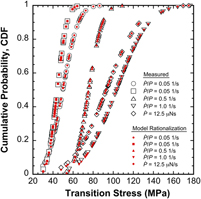
Nanoindentation experiments performed in high-purity vapor deposited lithium films at 31 °C reveal a strain rate and length scale dependence in the stress at which pop-in type events signal an abrupt transition from diffusion to dislocation-mediated flow. The stress level at which the transition to dislocation-mediated flow occurs varies with the strain rate and ranges from 88 to 208 times larger than the nominal yield strength of bulk, polycrystalline lithium. Variation in the indentation strain rate reveals the relationship between the stress required to initiate the transition and the length scale at which the transition occurs follows the power-law relation, hardness × depth1.17 = 1.545 N/m0.83, where the magnitude of the exponent and constant reflect the defect structure of the film. A rationalization of the transition is provided through direct comparisons between the measured cumulative distribution function (CDF) and the CDF hypothesized for the activation of a Frank–Read source.
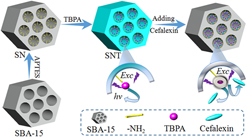
A novel luminogen-functionalized SBA-15, denoted as SNT, was developed by incorporating tris(4-bromophenyl)amine (TBPA) into SBA-15 via a “fixation-induced emission” strategy. The emission of TBPA on the matrix of SBA-15 was greatly enhanced, making the SNT possible as a fluorescence sensor. Cefalexin, a typical antibiotic, was chosen as the model analyte to be assayed and sensitive detection performance was achieved. This is the first time for cefalexin to be detected by a fluorescent method. Moreover, the SNT can be recycled by simply washing with proper solvents then used for next detection. This work provides a strategy to greatly improve the emission characteristics of fluorophores, even if a mediocre small fluorophore. It can be extended to design practical fluorescent sensors with high performance and recyclability by this strategy.
Ga2−xFexO3 (GFO) bulks with x from 0.7 to 1.3 have been fabricated using the classic solid-state route. The structural, optical, and magnetic properties have been investigated systematically. X-ray diffraction spectra and FULLPROF profile fitting indicate that GFO bulks belong to the orthorhombic structure with the space group Pc21n. Phase separation appears at the Fe content of x = 1.3. The optical bandgap decreases almost linearly with the increase of iron content, which means that the bandgap of GFO bulks can be controlled by adjusting the Fe content in the samples. The magnetic property measurements suggest that GFO is ferromagnetic, and the magnetic properties are enhanced compared with other reported works, exhibiting the application in ferromagnetic semiconductors devices.