To save content items to your account,
please confirm that you agree to abide by our usage policies.
If this is the first time you use this feature, you will be asked to authorise Cambridge Core to connect with your account.
Find out more about saving content to .
To save content items to your Kindle, first ensure no-reply@cambridge.org
is added to your Approved Personal Document E-mail List under your Personal Document Settings
on the Manage Your Content and Devices page of your Amazon account. Then enter the ‘name’ part
of your Kindle email address below.
Find out more about saving to your Kindle.
Note you can select to save to either the @free.kindle.com or @kindle.com variations.
‘@free.kindle.com’ emails are free but can only be saved to your device when it is connected to wi-fi.
‘@kindle.com’ emails can be delivered even when you are not connected to wi-fi, but note that service fees apply.
As a new functional composite material, functionally graded shape memory alloy (FG-SMA) holds particular properties of both functionally graded materials and shape memory alloys. By bringing in a new concept of conical surface assumption, considering the axial deformation, a macroconstitutive model which can describe the thermal mechanical properties of a FG-SMA cylinder subjected to pressure and graded temperature loads is established in this work. Furthermore, a new layered finite element model (FEM) which can avoid the direct assumption of the macroproperties of the FG-SMA cylinder is provided. The theoretical results display a good agreement with the FEM results, which indicates that both the macroconstitutive model and the FEM provided here are valid. The obtained results show that the stress in the cylinder distributes complexly, and it decreases remarkably as a result of the martensite transformation. This research can provide a base for the design and in-depth investigation of FG-SMA materials.
A great challenge in the field of neurocomputing is to mimic the brain behavior by implementing artificial synapses and neurons directly in hardware. This work shows that a Leaky Integrate and Fire (LIF) artificial neuron can be realized with a two-terminal device made of Mott insulator thin films. Polycrystalline thin films of the well-known Mott insulator oxide (V0.95Cr0.05)2O3 were deposited by magnetron sputtering and patterned with micron-scale TiN electrodes. These devices exhibit a volatile resistive switching and a remarkable LIF behavior under a train of pulses suggesting that LIF artificial neurons may be realized from (V0.95Cr0.05)2O3 thin films.
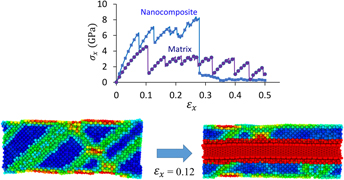
Significant reductions recently seen in the size of wide-bandgap power electronics have not been accompanied by a relative decrease in the size of the corresponding magnetic components. To achieve this, a new generation of materials with high magnetic saturation and permeability are needed. Here, we develop gram-scale syntheses of superparamagnetic Fe/FexOy core–shell nanoparticles and incorporate them as the magnetic component in a strongly magnetic nanocomposite. Nanocomposites are typically formed by the organization of nanoparticles within a polymeric matrix. However, this approach can lead to high organic fractions and phase separation; reducing the performance of the resulting material. Here, we form aminated nanoparticles that are then cross-linked using epoxy chemistry. The result is a magnetic nanoparticle component that is covalently linked and well separated. By using this ‘matrix-free’ approach, we can substantially increase the magnetic nanoparticle fraction, while still maintaining good separation, leading to a superparamagnetic nanocomposite with strong magnetic properties.
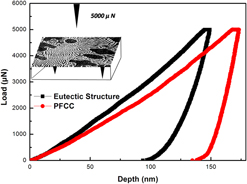
To prepare high quality large solidified Al2O3/ZrO2 eutectic ceramic, the preparation processing of the presintered ceramic as a feed rod was investigated via experiments; some parameters of the induction heating zone process were optimized via numerical modeling; an Al2O3/ZrO2 eutectic ceramic rod with a diameter 10 mm was prepared. The results show that increasing the sintering temperature could increase the presintered ceramic’s bulk density, while increasing sintering time had little effect. And the bulk density increased first and then decreased with the molding pressure increase. And the saucer coil obtained a higher temperature gradient than the tubbiness coil for a fixed crucible wall maximum temperature, and the coil turn’s increase could increase the melting zone height in the induction zone melting process. In the directionally solidified Al2O3/ZrO2 eutectic ceramics, Al2O3 phase is the matrix phase, and the ZrO2 phase embedded in the Al2O3 phase mostly with the rod shape, and little with lamellar. The hardness of directionally solidified eutectic ceramics reaches 16.17 GPa and the fracture toughness reaches 4.76 MPa m1/2, which are 1.7 times and 1.5 times of the presintered eutectic ceramic, respectively.
This work aims at providing guidance through systematic experimental characterization for the design of 3D-printed scaffolds for potential orthopedic applications, focusing on fused deposition modeling with a composite of clinically available polycaprolactone (PCL) and β-tricalcium phosphate (β-TCP). First, we studied the effect of the chemical composition (0–60% β-TCP/PCL) on the scaffold’s properties. We showed that surface roughness and contact angle were, respectively, proportional and inversely proportional to the amount of β-TCP and that degradation rate increased with the amount of ceramic. Biologically, the addition of β-TCP enhanced proliferation and osteogenic differentiation of C3H10. Second, we systematically investigated the effect of the composition and the porosity on the 3D-printed scaffold mechanical properties. Both an increasing amount of β-TCP and a decreasing porosity augmented the apparent Young’s modulus of the 3D-printed scaffolds. Third, as a proof of concept, a novel multimaterial biomimetic implant was designed and fabricated for potential disc replacement.
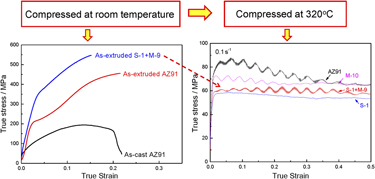
AZ91 magnesium plates with a thickness of 6 mm were subjected to one- and two-pass friction stir processing (FSP). Microstructures and mechanical properties of the experimental materials were investigated. The results show that FSP can significantly refine the microstructures of magnesium alloys, and two-pass FSP can prepare slightly finer grains in comparison with one-pass FSP. Some coarse β-Mg17Al12 phases existed in the first pass FSP break and dissolve into the matrix under the action of the second pass FSP. Microhardness distribution of the two-pass FSP AZ91 alloy exhibits no too much difference with that of the one-pass FSP AZ91 alloy. Due to further finer microstructures, the tensile properties of the two-pass FSP alloy are slightly higher than those of the one-pass FSP alloy. Both FSP AZ91 alloys show typical ductile fracture characteristics, while the dimples on the two-pass FSP specimen are much deeper and increase in quantity.
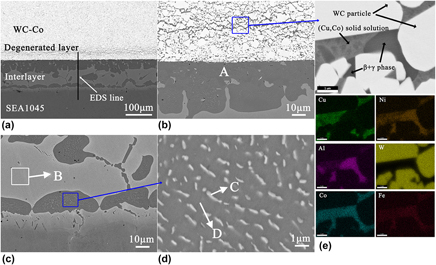
The effect of aging time on the corrosion behavior of 6005 Al alloys has been investigated in aerated 3.5% NaCl aqueous solution. The corrosion resistance of the alloy with different aging times is analyzed by measuring potentiodynamic polarization, electrochemical impedance spectroscopy. The surface morphology is examined by scanning electron microscopy. The results demonstrated that the corrosion resistance of the alloy in the peak-aged condition is worse than the other conditions. Accordingly, corrosion rate and the corrosion current density of the alloy reach its maximum value. An Fe-rich phase is identified as the β-Al4.5FeSi phase by atomic-resolution high angle annular dark field scanning transmission electron microscopy and energy dispersive X-ray spectroscopy mapping analyses. The β-Al4.5FeSi is wrapped slowly by the precipitates of Mg2Si from the process of the peak-aged condition to the over-aged condition. It is hypothesized that the change of corrosion behavior of the alloy may be attributed to the β-Al4.5FeSi wrapped slowly by the precipitates of Mg2Si.
Previously known to form only under high pressure synthetic conditions, here we report that the T′-type 214-structure cuprate based on the rare earth atom Tb is stabilized for ambient pressure synthesis through partial substitution of Pd for Cu. The new material is obtained in purest form for mixtures of nominal composition Tb1.96Cu0.8Pd0.2O4. The refined formula, in orthorhombic space group Pbca, with a = 5.5117(1) Å, b = 5.5088(1) Å, and c = 11.8818(1) Å, is Tb2Cu0.83Pd0.17O4. An incommensurate structural modulation is seen along the a axis by electron diffraction and high resolution imaging. Magnetic susceptibility measurements reveal long-range antiferromagnetic ordering at 7.9 K, with a less pronounced feature at 95 K; a magnetic moment reorientation transition is observed to onset at a field of approximately 1.1 T at 3 K. The material is an n-type semiconductor.
Metal–insulator–metal (MIM) resonant absorbers comprise a conducting ground plane, a thin dielectric, and thin separated metal top-surface structures. The dielectric SiO2 strongly absorbs near 9 µm wavelength and has correspondingly strong long-wave-infrared (LWIR) dispersion for the refractive index. This dispersion results in multiple absorption resonances spanning the LWIR, which can enhance broad-band sensitivity for LWIR bolometers. Similar considerations apply to silicon nitride Si3N4. TiO2 and AlN have comparatively low dispersion and give simple single LWIR resonances. These dispersion-dependent features for infrared MIM devices are demonstrated by experiment, electrodynamic simulation, and an analytic model based on standing waves.
Engineering Chemistry discusses the fundamental theoretical concepts of chemistry and links them with their engineering applications. The book is designed as an introductory course for undergraduate students in all branches of engineering. Employing an easy-to-understand approach, it elaborates on the fundamental concepts and their applications, and includes scores of illustrations and learning exercises to facilitate comprehension. Starting with areas of common interest, such as fuels, water, corrosion and phase rule, followed by chapters on engineering materials, polymers and lubricants, the book then covers a range of important subjects, such as structure and bonding, solid state, liquid crystal, chemical kinetics, surface chemistry, thermodynamics, electrochemistry, spectroscopy, photochemistry, the basics of organic chemistry and organometallic compounds. It also covers the applications of several important topics in detail, including nanomaterials, green chemistry, NMR spectroscopy and biotechnology.
We studied the effect of annealing on magnetic properties and structure of Heusler-type NiMnGa glass-covered microwires with a metallic nucleus diameter of about 22 μm prepared using the Taylor–Ulitovsky method. The as-prepared NiMnGa glass-covered microwires do not present ferromagnetic order at room temperature. Magnetization curves of the as-prepared samples do not present either saturation or coercivity at temperatures above 5 K. After annealing of the microwires, a ferromagnetic ordering is obtained with a Curie temperature of about 300 K which is beneficial for magnetic solid state refrigeration. The hysteresis observed on temperature dependence of magnetization in annealed samples and magnetic softening at about 260 K has been interpreted as the first-order phase transformation. Observed changes have been discussed considering internal stress relaxation after annealing, nanocrystalline structure of the as-prepared and annealed samples, recrystallization process and magnetic ordering of phases identified in the as-prepared sample and appearing under recrystallization. Existence of insulating and flexible glass-coating is beneficial for improvement of mechanical properties but the glass coating considerably affects magnetic properties of NiMnGa microwires. Therefore special attention must be paid to annealing conditions for realization of martensitic transformation.
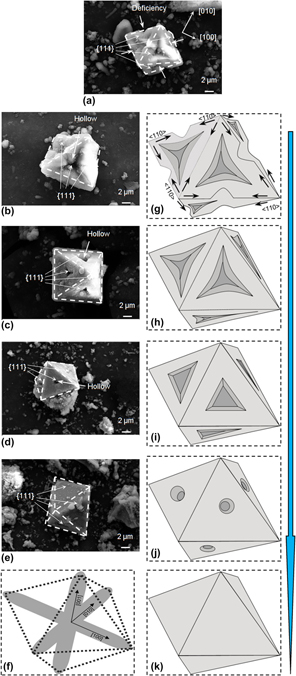
In this paper, the morphology transition and the growth process of the primary Mg2Si in the Al–Mg2Si in situ composites were three-dimensionally investigated by observing the extracted Mg2Si particles. The primary Mg2Si transforms from perfect octahedron to truncated octahedron with increasing cooling rate. Combining with the crystal morphologies obtained at different growth stages, the growth mechanism of octahedral Mg2Si was discussed. In the early growth stage of the octahedral Mg2Si, the secondary branches preferentially grow on the advancing tips of the first branches. Then, the hollows in the {111} faces shrink gradually and the octahedral Mg2Si forms finally. With the increase of Mg2Si content, dendritic Mg2Si phases were observed and the truncated octahedron Mg2Si connect mutually to form the complicated morphology at low cooling rate. The high cooling rate transforms the morphology of the Mg2Si crystal. The growth rates of the 〈100〉 and 〈111〉 axes can be manipulated by adjusting the cooling rates, which are responsible for the evolution of the Mg2Si crystals.
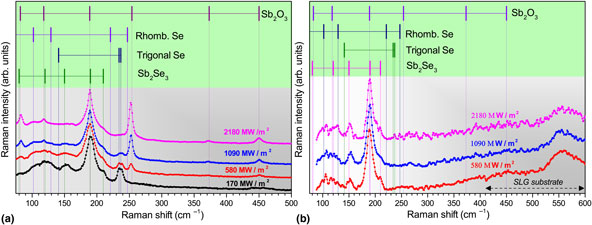
Robust evidences are presented showing that the Raman mode around 250 cm−1 in the Sb2Se3 thin films does not belong to this binary compound. The laser power density dependence of the Raman spectrum revealed the formation of Sb2O3 for high values of laser intensity power density excitation under normal atmospheric conditions. To complement this study, the Sb2Se3 films were characterized by x-ray diffraction during in situ annealing. Both these measurements showed that the Sb2Se3 compound can be replaced by Sb2O3. A heat-assisted chemical process explains these findings. Furthermore, Raman conditions required to perform precise measurements are described.
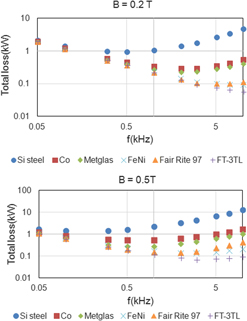
We review the materials paradigm for metal amorphous nanocomposite (MANC) soft magnetic materials to showcase in solid state transformers (SSTs). We report 2D finite element analysis (FEA) of 3-phase SSTs operating at 50 Hz–10 kHz frequencies. We benchmark materials in designs to control high frequency losses and achieve higher power densities. FEA models are solved in the time domain for line frequencies of 50 Hz–10 kHz and 100 KW output power for the first 4 cycles. Transformer topologies are coupled to a power analysis using a Steinmetz parameterization of magnetic losses capturing induction and field scaling for transformer grade Si steel as compared to Metglas, Ferrite, FINEMET, Co- and FeNi-based MANCs. Recently discovered FeNi-based MANCs allow smaller transformers at equivalent power as compared to Si steel, Metglas, and Co-based MANCs. Fe-rich and non-Co containing MANCs also offer economies based on lower raw materials costs compared with Co-based MANCs.
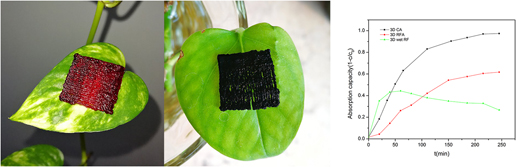
We designed a resorcinol-formaldehyde (RF) sol–gel ink for direct ink writing of the microlattices. To improve the formability, the fresh microlattices were strengthened by surface catalysis with HCl atmosphere. After supercritical drying and carbonization, the sample’s specific surface area was 631 m2/g and the average pore size was 3.81 nm. Both RF aerogel and carbonized RF aerogel samples had millimeter-scale pore, micron-scale pore, and nanoscale skeleton. The pore and skeleton could provide high surface area and diffusion channels, which were beneficial to the adsorption performances. The carbonized RF aerogel sample fully adsorbed Dulbecco’s modified eagle medium in 250 min, which exhibited a good capacity of quick adsorption and indicated the potential application for cell supports.
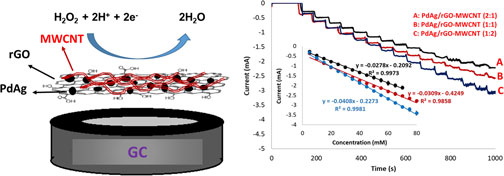
High-performance electrochemical hydrogen peroxide (H2O2) sensors based on PdAg nanoparticle-decorated reduced graphene oxide (rGO) and multi-walled carbon nanotube (MWCNT) hybrids were developed. The nanostructures were characterized using transmission electron microscopy, scanning electron microscopy, energy-dispersive spectroscopy, thermogravimetric analysis, Fourier transform spectroscopy, and x-ray diffraction techniques. It was found that introduction of MWCNT in the catalyst layer improved the sensitivity and widened the linear range. Sensitivities of 393.2, 437.1, and 576.6 µA/mM/cm2 were obtained for PdAg/rGO–MWCNT (2:1), PdAg/rGO–MWCNT (1:1), and PdAg/rGO–MWCNT (1:2), respectively. Furthermore, hierarchical structure of rGO–MWCNT nanohybrids enabled the detection of H2O2 up to 80 mM.
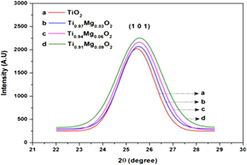
Pure and magnesium-doped TiO2 nanoparticles (NPs) of three different concentrations (3, 6, and 9 mol%) were synthesized by a simple, cost effective solvothermal microwave irradiation method and characterized by XRD, EDAX, transmission electron microscopy (TEM), and UV-Vis diffuse reflection spectroscopy. X-ray diffraction studies performed on synthesized NPs have shown that the anatase phase is preserved after doping and the dopant does not change the crystalline phase (anatase) of the parent material (TiO2). TEM results revealed that the particle size was significantly reduced with increasing dopant concentration and are spherical in shape. For the J–V measurements, the devices were subjected to the simulated sun light of 100 mW/cm2 irradiation with a working electrode area of 0.25 cm2 (0.5 × 0.5 cm). The results show that the dye-sensitized solar cell based on a 3 mol% Mg-doped TiO2 electrode achieved a photoelectrical conversion efficiency of 7.36% which is perceptibly increased by 17.6% than undoped TiO2 (6.26%).