To save content items to your account,
please confirm that you agree to abide by our usage policies.
If this is the first time you use this feature, you will be asked to authorise Cambridge Core to connect with your account.
Find out more about saving content to .
To save content items to your Kindle, first ensure no-reply@cambridge.org
is added to your Approved Personal Document E-mail List under your Personal Document Settings
on the Manage Your Content and Devices page of your Amazon account. Then enter the ‘name’ part
of your Kindle email address below.
Find out more about saving to your Kindle.
Note you can select to save to either the @free.kindle.com or @kindle.com variations.
‘@free.kindle.com’ emails are free but can only be saved to your device when it is connected to wi-fi.
‘@kindle.com’ emails can be delivered even when you are not connected to wi-fi, but note that service fees apply.
Several methods can be used to obtain, from powder diffraction patterns, crystallite size and lattice strain of polycrystalline samples. Some examples are the Scherrer equation, Williamson–Hall plots, Warren/Averbach Fourier decomposition, Whole Powder Pattern Modeling, and Debye function analysis. To apply some of these methods, it is necessary to remove the contribution of the instrument to the widths of the diffraction peaks. Nowadays, one of the main samples used for this purpose is the LaB6 SRM660b commercialized by the National Institute of Standard Technology; the width of the diffraction peak of this sample is caused only by the instrumental apparatus. However, this sample can be expensive for researchers in developing countries. In this work, the authors present a simple route to obtain micron-sized polycrystalline CeO2 that have a full width at half maximum comparable with the SRM660b and therefore it can be used to remove instrumental broadening.
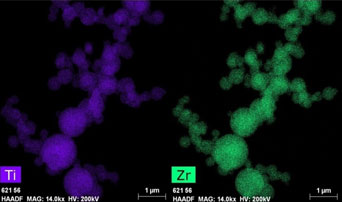
In this study, the formation solid solutions of titanium dioxide- zirconium dioxide (TiO2-ZrO2) system with the supercritical fluid method is described. The particles of solid solutions in the TiO2-ZrO2 system are spherical and form agglomerates, they are amorphous and have a size from 90 to 850 nm. The X-ray patterns of samples calcined above the temperatures of crystallization (450 °C) and phase transition (750 °C) demonstrate the decomposition of the solid solutions above the crystallization temperature and formation of phases in accordance with phase ratios in the TiO2-ZrO2 system at these temperatures. The formation solid solutions of the starting materials are observed in all region of concentrations.
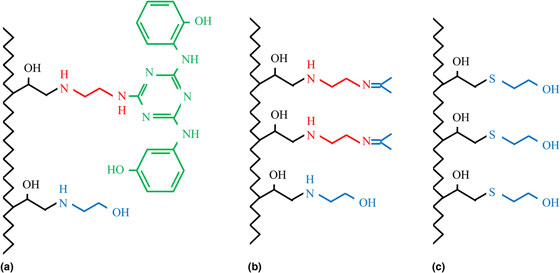
The preparation, screening, and characterization of affinity membranes require a deep knowledge of the behavior of all components of the affinity material. Several studies report the effect of different spacers in combination with the ligand molecule, but the effect of the spacer arm “per se” is generally disregarded. The effect of the spacer 1,2-diaminoethane on non-specific protein adsorption was recently investigated and the results were compared with the ones obtained with A2P affinity membranes. The results show that this spacer has indeed an important effect and that similar specific studies need to be performed for every spacer molecule.
Regions of deformation resulting from nanoindentation testing of nanoporous gold (np-Au) are characterized by cross-sectional imaging of the ligament structure directly beneath the surface, after lift-out using focused ion beam techniques. Permanent deformation of the porous structure was not exclusively confined to the region directly in contact with the indenter but extended much deeper into the sample. Implications of these observations with respect to previous measurements of the mechanical properties of np-Au are discussed. The conclusions provide initial insight into the deformation behavior of np structures during nanoindentation, as well as a basis for extending this technique to other np metals.
The crystal structure of methylprednisolone acetate form II, C24H32O6, has been solved and refined using synchrotron X-ray powder diffraction data, and optimized using density functional techniques. Methylprednisolone acetate crystallizes in space group P212121 (#19) with a = 8.17608(2), b = 9.67944(3), c = 26.35176(6) Å, V = 2085.474(6) Å3, and Z = 4. Both hydroxyl groups act as hydrogen bond donors, resulting in a two-dimensional hydrogen bond network in the ab plane. C–H⋯O hydrogen bonds also contribute to the crystal energy. The powder pattern is included in the Powder Diffraction File™ as entry 00-065-1412.
The indentation response of a 3D noninterlaced composite comprising three sets of orthogonal carbon-fibre tows in an epoxy matrix is investigated. The 3D composites have a near isotropic and ductile indentation response. The deformation mode includes the formation of multiple kinks in the tows aligned with the indentation direction and shearing of the orthogonally oriented tows. Finite element (FE) calculations are also reported wherein tows in one direction are explicitly modeled with the other two sets of orthogonal tows and the matrix pockets treated as an effective homogenous medium. The calculations capture the indentation response in the direction of the explicitly modeled tows with excellent fidelity but under-predict the indentation strength in the other directions. In contrast to anisotropic and brittle laminated composites, 3D noninterlaced composites have a near isotropic and ductile indentation response making them strong candidates for application as materials to resist impact loading.
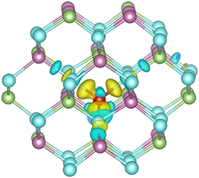
We present an ab initio study of dopant–dopant interactions in beryllium-doped InGaAs. We consider defect formation energies of various interstitial and substitutional defects and their combinations. We find that all substitutional–substitutional interactions could be neglected. On the other hand, interactions involving an interstitial defect are significant. Specially, interstitial Be is stabilized by about 0.9/1.0 eV in the presence of one/two BeGa substitutionals. Ga interstitial is also substantially stabilized by Be substitutionals. Two Be interstitials can form a metastable Be–Be–Ga complex with a dissociation energy of 0.26 eV/Be. Therefore, interstitial defects and defect–defect interactions should be considered in accurate models of Be-doped InGaAs. We suggest that In and Ga should be treated as separate atoms and not lumped into a single effective group III element, as has been done before. We identified dopant-centred states which indicate the presence of other charge states at finite temperatures, specifically, the presence of Beint+1 (as opposed to Beint+2 at 0 K).
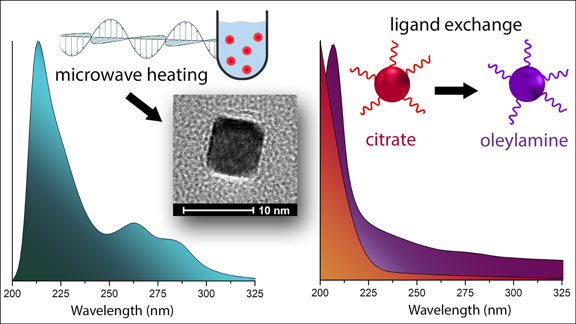
We have developed a novel, facile, and reproducible synthesis of highly crystalline oleylamine-capped colloidal platinum nanocubes by microwave (MW) heating. Use of MW heating decreases reaction times, eliminates the need for dangerous reagents [e.g., Fe(CO)5], and gives efficient production of monodispersed 8 nm Pt nanocubes [MW-nanoparticles (NPs)]. We also present a study of the optical properties of these NPs, which to our knowledge has not been previously reported. Absorbance spectra of the MW-NPs show a distinct localized surface plasmon resonance band at 213 nm. This observation could be significant for developments in plasmonic photocatalysis and advanced catalytic materials.
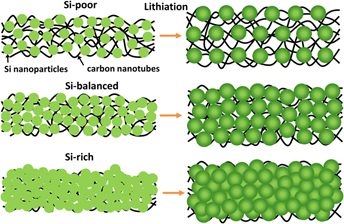
Si nanoparticles and multi-walled carbon nanotubes (MWNTs) were combined using the simple, inexpensive, and scalable approach involving ultrasonication and positive-pressure filtration to generate binder-free freestanding flexible Si–MWNT (Si–MW) composite paper anodes for Li-ion batteries. Through controlling the Si/carbon nanotube (CNT) weight ratio, the composite with 3:2 Si/CNT ratio exhibited the optimal balance between the high capacity of SiNPs and high conductivity and structural stabilization quality of MWNTs, leading to high rate capability as well as specific capacity and cyclability surpassing the conventional slurry-cast SiNP electrode using binder and current collector and other complicated freestanding Si/carbon composite designs. After 100 cycles, our electrode retained a capacity of 1170 mA h/g at 100 mA/g and 750 mA h/g at 500 mA/g. Moreover, a different electrolyte composition enabled a reversible capacity of 1300 mA h/g at 100 mA/g after 100 cycles. The freestanding feature of our electrodes is promising for enhanced energy density of Li-ion cells.
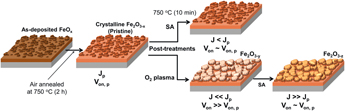
Hematite films deposited by plasma-enhanced chemical vapor deposition of iron pentacarbonyl [Fe(CO)5] in an oxygen plasma were modified by postdeposition (i) oxygen plasma treatment and (ii) short annealing treatments to reduce the defects and to modify the (sub)surface states and consequently the photoelectrochemical properties. The oxygen plasma treatment resulted in the increase of particle size and augmented surface roughening by densification of grains. Moreover, it induced saturated surface states with reactive oxygen species (O−, OH−), evident in the X-ray photoelectron spectroscopy (XPS). Under standard illumination (1.5 AM; 100 mW/cm2; 150 W xenon lamp), when compared to the pristine hematite coating (0.696 mA/cm2 at 1.23 V versus RHE and 0.74 Vonset) the oxygen plasma-treated films showed severe deterioration in photocurrent density of 0.035 mA/cm2 and an anodic shift in the onset potential (1.10 Vonset) due to oxygen rich surface. In a second set of experiments, the oxygen plasma-treated hematite films were briefly annealed (10 min at 750 °C) and the signals of Fe 2p and O 1s recovered to higher binding energies, indicating the formation of oxygen vacancies. In addition, a superior photocurrent density value of max. 1.306 mA/cm2 at 1.23 V versus RHE to that of the pristine hematite photoanode with 0.74 Vonset was obtained. Transient absorption spectroscopy further elucidated that the oxygen plasma-induced electron trap states acting as recombination centers that are unfavorable for photoelectrochemical activity. The alteration in Fe:O stoichiometry and thus photocurrent density are corroborated by determination of water oxidation rates in annealed (7.1 s−1) and oxygen plasma treated (2.5 s−1) samples.
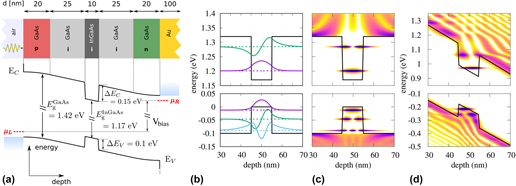
The implementation of a wide range of high-efficiency solar cell concepts is based on nanostructures with configuration-tunable optoelectronic properties. On the other hand, effective nano-optical light-trapping concepts enable the use of ultra-thin absorber architectures. In both cases, the local density of electronic and optical states deviates strongly from that of a homogeneous bulk material. At the same time, nonlocal and coherent phenomena like tunneling or ballistic transport become increasingly relevant. As a consequence, the semiclassical, diffusive bulk picture may no longer be appropriate to describe the physics of such devices. In this review, we provide a quantum-kinetic perspective on photovoltaic device operation that reaches beyond the limits of the standard simulation models for bulk solar cells. Deviations from bulk physics are assessed in ultra-thin film and nanostructure-based solar cell architectures by comparing predictions of semiclassical models with those of a more fundamental description based on nonequilibrium quantum statistical mechanics.
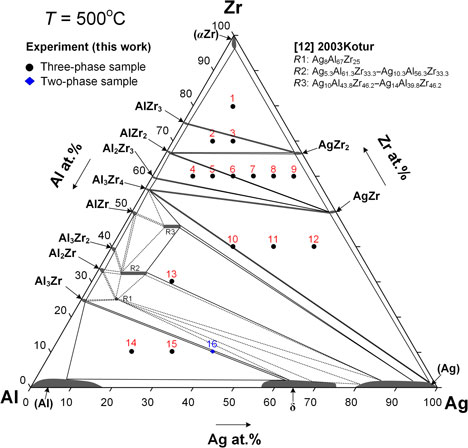
Forty-eight different Ag–Al–Zr ternary alloys were prepared in various compositions to determine the metallic glass region in the Ag–Al–Zr ternary system. Experimental results indicated that the metallic glass region in the Ag–Al–Zr ternary system is Ag20–30Al10–30Zr50–60. The Ag20Al30Zr50 and Ag30Al20Zr50 alloys are supposed to have the best glass-forming ability in the Ag–Al–Zr ternary system. The phase equilibria of the Ag–Al–Zr ternary system at 773 K (500 °C) were investigated and compared with the metallic glass region results in the Ag–Al–Zr ternary system. Ternary isothermal sections of the Ag–Al–Zr system at 773 K (500 °C) were established and two ternary intermetallic phases were observed in this isothermal section.
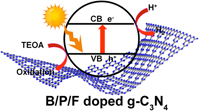
Graphitic carbon nitride (g-C3N4) is considered as a promising heterogeneous catalyst for photocatalytic H2 evolution from water under visible light illustration, and its photocatalytic performance could be controlled through its texture and optical/electronic properties. Herein, we present a facile one-step heating method for the synthesis of B/P/F doped g-C3N4 photocatalysts (BCN, PCN, and FCN). The prepared photocatalysts were characterized by XRD, SEM, UV-vis absorption, FTIR, BET, XPS, PL, and photocurrent measurement. The results show that the B/P/F doping increased the interplanar stacking distance of g-C3N4, enlarged the optical absorption range, and improved the photocatalytic activity of H2 evolution. FCN exhibits the highest photocatalytic activity, followed by BCN, and PCN that has the lowest performance. This work studies the doping effects of the nonmetal elements on the photocatalytic activities, the electronic structures as well as the band gaps of g-C3N4, to provide a feasible modification pathway to design and synthesize highly efficient photocatalysts.
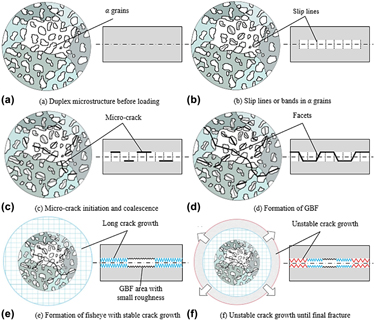
The crack initiation and early growth behaviors of a TC4 titanium alloy under high cycle fatigue and very high cycle fatigue were experimentally investigated. The results show that it exhibits the duplex S–N curve characteristics associated with surface and interior failures at a stress ratio of 0.1, while it represents the similar S–N curve characteristics only related to surface failure at a stress ratio of −1. The interior failure is accompanied with the occurrence of facets, granular bright facets (GBFs), and fisheye. Slip-like patterns are observable on the facets easily formed under positive stress ratio. The interior failure process is characterized as (i) occurrence of slip lines on partial α grains under cyclic loading, (ii) initiation and growth of microcracks within some α grains, (iii) coalescence of microcracks and formation of GBF, (iv) stable long crack growth within fisheye, (v) unstable crack growth outside fisheye, and (vi) final momentary fracture.
Structural hierarchy is ubiquitous in nature and quite important for optimizing the properties of functional materials. Carbon nanomaterials, owing to their unique and tunable physical and chemical properties, have been regarded as promising candidates for various energy storage systems. Constructing hierarchically structured carbon nanomaterials (HSCNs) can boost electrochemical performance of nanocarbons. Therefore, HSCNs have attracted tremendous research attentions in recent years. In this review, we summarized the recent progress in hierarchical structure design of carbon nanomaterials and their potential applications in different energy storage technologies. First we give a brief introduction about carbon nanomaterials and the hierarchical structure merits. Subsequently, recent research works on hierarchical structure design of carbon nanomaterials was summarized and classified according to applications in lithium-ion batteries, sodium-ion batteries, supercapacitors and lithium–sulfur batteries, respectively. In addition, the challenges of HSCNs in different applications were also concluded and reviewed. At last, design principles of HSCNs were summarized and future development trends were prospected.
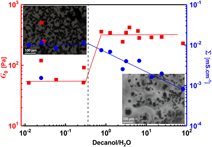
In an attempt to introduce a novel approach to formulate carbon black (ketjen black) suspension with enhanced colloidal stability, improved flowability, and higher conductivity, ketjen black was dispersed in microemulsion systems composed of a non-ionic surfactant (Triton X100), decanol, and water. Rheo-electric and rheo-microscopy proved to be very powerful techniques that are able to elucidate the microstructure evolution with the composition and under shear flow. Interestingly, the carbon black slurries at low decanol/water ratio are weak gels (flowable) with higher electrical conductivity than those at higher ratio, which shows strong-gel viscoelastic response. In addition, the slurries show recoverable electrical behavior under shear flow in tandem with the viscosity trend. It is likely that the oil-in-water microemulsion enhances slurries’ stability without affecting the percolating network of carbon black. On the other hand, the oil-in-water analogous and bilayer structure of the lamellar phase makes the slurries less conductive as a consequence of losing the network percolation.