Refine search
Actions for selected content:
106117 results in Materials Science
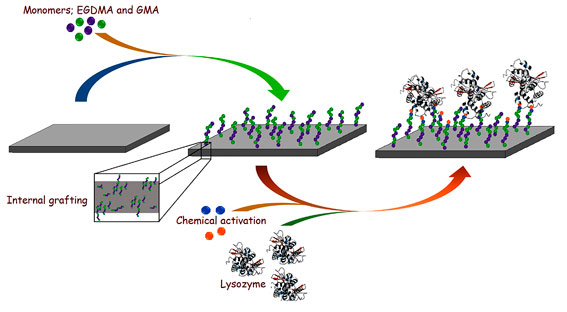
Covalent immobilization of lysozyme in silicone rubber modified by easy chemical grafting
-
- Journal:
- MRS Communications / Volume 7 / Issue 4 / December 2017
- Published online by Cambridge University Press:
- 16 October 2017, pp. 904-912
- Print publication:
- December 2017
-
- Article
- Export citation
JMR volume 32 issue 19 Cover and Front matter
-
- Journal:
- Journal of Materials Research / Volume 32 / Issue 19 / 16 October 2017
- Published online by Cambridge University Press:
- 12 October 2017, pp. f1-f5
- Print publication:
- 16 October 2017
-
- Article
-
- You have access
- Export citation
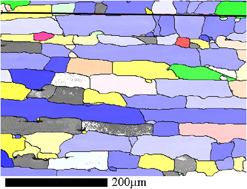
Static recrystallization and grain growth of accumulative roll bonded aluminum laminates
-
- Journal:
- Journal of Materials Research / Volume 32 / Issue 24 / 28 December 2017
- Published online by Cambridge University Press:
- 12 October 2017, pp. 4503-4513
- Print publication:
- 28 December 2017
-
- Article
- Export citation

Hot deformation behavior and microstructural evolution of Nb–V–Ti microalloyed ultra-high strength steel
-
- Journal:
- Journal of Materials Research / Volume 32 / Issue 19 / 16 October 2017
- Published online by Cambridge University Press:
- 12 October 2017, pp. 3777-3787
- Print publication:
- 16 October 2017
-
- Article
- Export citation

Computational modeling of high-entropy alloys: Structures, thermodynamics and elasticity
-
- Journal:
- Journal of Materials Research / Volume 32 / Issue 19 / 16 October 2017
- Published online by Cambridge University Press:
- 12 October 2017, pp. 3627-3641
- Print publication:
- 16 October 2017
-
- Article
- Export citation
JMR volume 32 issue 19 Cover and Back matter
-
- Journal:
- Journal of Materials Research / Volume 32 / Issue 19 / 16 October 2017
- Published online by Cambridge University Press:
- 12 October 2017, pp. b1-b2
- Print publication:
- 16 October 2017
-
- Article
-
- You have access
- Export citation
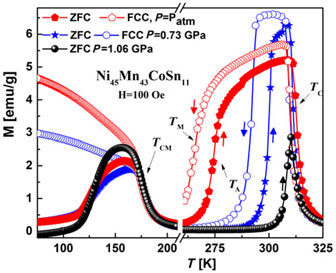
The effects of hydrostatic pressure on the martensitic transition, magnetic, and magnetocaloric effects of Ni45Mn43CoSn11
-
- Journal:
- MRS Communications / Volume 7 / Issue 4 / December 2017
- Published online by Cambridge University Press:
- 11 October 2017, pp. 885-890
- Print publication:
- December 2017
-
- Article
- Export citation
Improvement of notch fatigue properties of ultra-high CM400 maraging steel through shot peening – CORRIGENDUM
-
- Journal:
- Journal of Materials Research / Volume 32 / Issue 22 / 28 November 2017
- Published online by Cambridge University Press:
- 11 October 2017, p. 4272
- Print publication:
- 28 November 2017
-
- Article
-
- You have access
- HTML
- Export citation
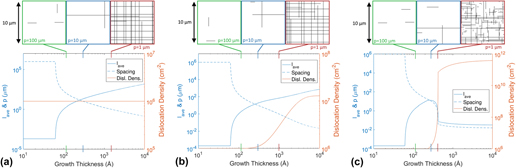
Distributions of kinetic pathways in strain relaxation of heteroepitaxial films
-
- Journal:
- Journal of Materials Research / Volume 32 / Issue 21 / 14 November 2017
- Published online by Cambridge University Press:
- 11 October 2017, pp. 3977-3991
- Print publication:
- 14 November 2017
-
- Article
- Export citation
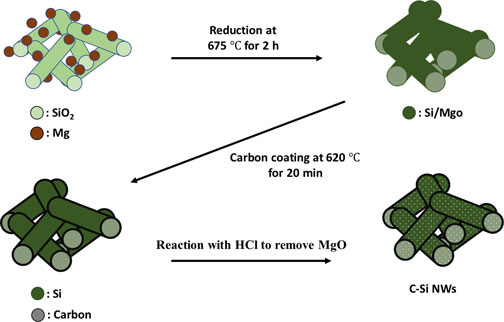
Electrode architecture of carbon-coated silicon nanowires through magnesiothermic reduction for lithium-ion batteries
-
- Journal:
- MRS Communications / Volume 7 / Issue 4 / December 2017
- Published online by Cambridge University Press:
- 09 October 2017, pp. 867-872
- Print publication:
- December 2017
-
- Article
- Export citation
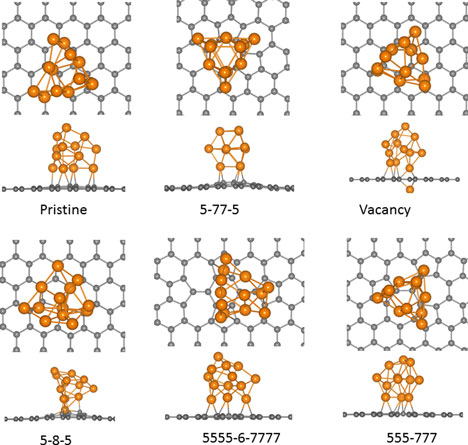
Stable Pt clusters anchored to monovacancies on graphene sheets
-
- Journal:
- MRS Communications / Volume 7 / Issue 4 / December 2017
- Published online by Cambridge University Press:
- 09 October 2017, pp. 891-895
- Print publication:
- December 2017
-
- Article
- Export citation
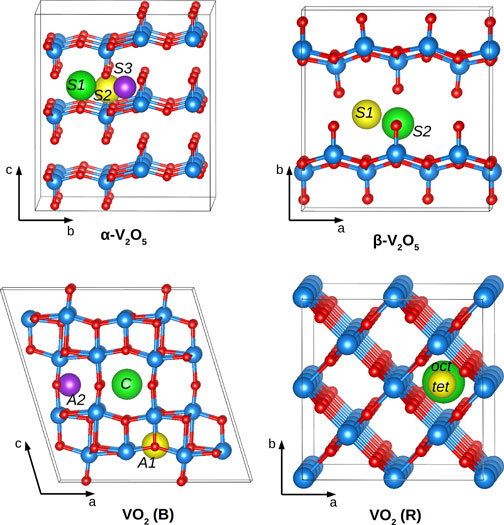
A first-principles study of potassium insertion in crystalline vanadium oxide phases as possible potassium-ion battery cathode materials
-
- Journal:
- MRS Communications / Volume 7 / Issue 4 / December 2017
- Published online by Cambridge University Press:
- 09 October 2017, pp. 819-825
- Print publication:
- December 2017
-
- Article
- Export citation
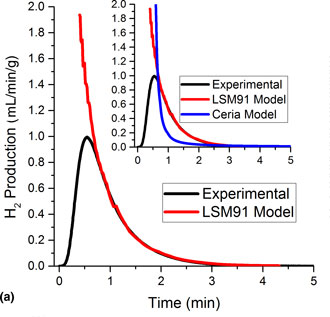
Impact of enhanced oxide reducibility on rates of solar-driven thermochemical fuel production
-
- Journal:
- MRS Communications / Volume 7 / Issue 4 / December 2017
- Published online by Cambridge University Press:
- 09 October 2017, pp. 873-878
- Print publication:
- December 2017
-
- Article
- Export citation
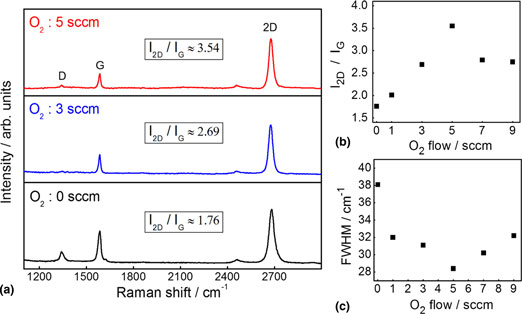
Effect of intermittent oxygen exposure on chemical vapor deposition of graphene
-
- Journal:
- MRS Communications / Volume 7 / Issue 4 / December 2017
- Published online by Cambridge University Press:
- 09 October 2017, pp. 826-831
- Print publication:
- December 2017
-
- Article
- Export citation
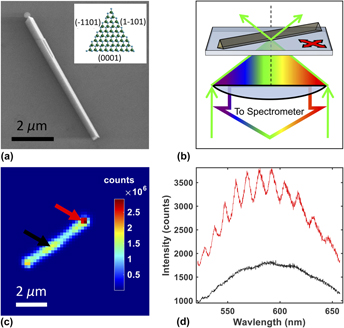
Investigating surface effects of GaN nanowires using confocal microscopy at below-band gap excitation
-
- Journal:
- Journal of Materials Research / Volume 32 / Issue 21 / 14 November 2017
- Published online by Cambridge University Press:
- 09 October 2017, pp. 4076-4086
- Print publication:
- 14 November 2017
-
- Article
- Export citation
-
We analyze the microscopic origins of subgap photoexcitations of individual gallium nitride (GaN) triangular cross-section nanowires (NWs), which are highly photoactive over a broadband spectral range. Using confocal hyperspectral photoluminescence (PL) microscopy, mid-gap states on the NWs were excited using subgap illumination, resulting in two distinct PL spectra corresponding to the polar (0001) and the semipolar $\left( {\bar 1101} \right)$ / $\left( {1\bar 101} \right)$ surfaces. Emission spectra are well represented by Gaussian functions with fitted centers of 1.99 ± 0.01 eV and 2.26 ± 0.01 eV, respectively. PL collected from the end facets exhibits interference fringes and a relative blue shift. Furthermore, the PL spectrum shifts strongly to the blue when the excitation intensity is increased. These observations are consistent with a qualitative model in which the PL results from excitation into a broad manifold of surface-associated states which are rapidly populated at a high excitation intensity and can couple to etalon modes via longitudinal photon emission.


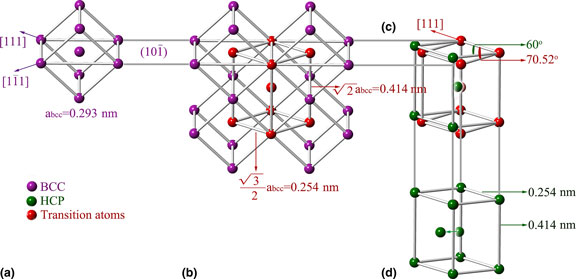
Formation of a hexagonal closed-packed phase in Al0.5CoCrFeNi high entropy alloy
-
- Journal:
- MRS Communications / Volume 7 / Issue 4 / December 2017
- Published online by Cambridge University Press:
- 09 October 2017, pp. 879-884
- Print publication:
- December 2017
-
- Article
- Export citation
Quantum materials: Where many paths meet
-
- Journal:
- MRS Bulletin / Volume 42 / Issue 10 / October 2017
- Published online by Cambridge University Press:
- 10 October 2017, pp. 698-705
- Print publication:
- October 2017
-
- Article
-
- You have access
- HTML
- Export citation
Babak Anasori: Research assistant professor and microscopic photographer
-
- Journal:
- MRS Bulletin / Volume 42 / Issue 10 / October 2017
- Published online by Cambridge University Press:
- 10 October 2017, p. 757
- Print publication:
- October 2017
-
- Article
-
- You have access
- HTML
- Export citation

Impact of pressure on the structure of glass and its material properties
-
- Journal:
- MRS Bulletin / Volume 42 / Issue 10 / October 2017
- Published online by Cambridge University Press:
- 10 October 2017, pp. 734-737
- Print publication:
- October 2017
-
- Article
- Export citation

Chemistry at high pressure: Tuning functional materials properties
-
- Journal:
- MRS Bulletin / Volume 42 / Issue 10 / October 2017
- Published online by Cambridge University Press:
- 10 October 2017, pp. 718-723
- Print publication:
- October 2017
-
- Article
- Export citation
