Refine search
Actions for selected content:
106117 results in Materials Science
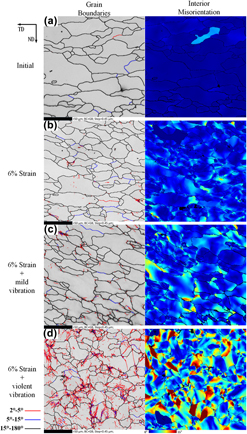
Mechanical behavior and microstructure of low-carbon steel undergoing low-frequency vibration-assisted tensile deformation
-
- Journal:
- Journal of Materials Research / Volume 32 / Issue 20 / 27 October 2017
- Published online by Cambridge University Press:
- 20 September 2017, pp. 3885-3893
- Print publication:
- 27 October 2017
-
- Article
- Export citation
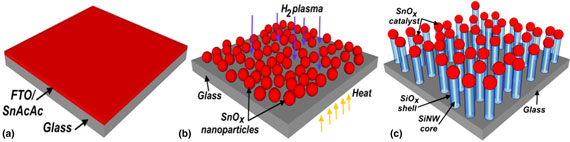
Birth of silicon nanowires covered with protective insulating blanket
-
- Journal:
- MRS Communications / Volume 7 / Issue 4 / December 2017
- Published online by Cambridge University Press:
- 20 September 2017, pp. 854-861
- Print publication:
- December 2017
-
- Article
- Export citation

Enhanced power conversion efficiency of dye-sensitized solar cells with samarium doped TiO2 photoanodes
-
- Journal:
- Journal of Materials Research / Volume 32 / Issue 18 / 28 September 2017
- Published online by Cambridge University Press:
- 20 September 2017, pp. 3469-3476
- Print publication:
- 28 September 2017
-
- Article
- Export citation
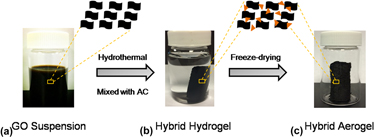
Multi-scale porous graphene/activated carbon aerogel enables lightweight carbonaceous catalysts for oxygen reduction reaction
-
- Journal:
- Journal of Materials Research / Volume 33 / Issue 9 / 14 May 2018
- Published online by Cambridge University Press:
- 20 September 2017, pp. 1247-1257
- Print publication:
- 14 May 2018
-
- Article
- Export citation
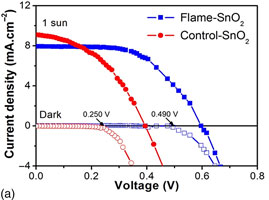
Rapid and scalable synthesis of crystalline tin oxide nanoparticles with superior photovoltaic properties by flame oxidation
-
- Journal:
- MRS Communications / Volume 7 / Issue 4 / December 2017
- Published online by Cambridge University Press:
- 19 September 2017, pp. 862-866
- Print publication:
- December 2017
-
- Article
- Export citation
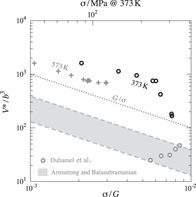
In situ study of thermally activated flow and dynamic restoration of ultrafine-grained pure Cu at 373 K
-
- Journal:
- Journal of Materials Research / Volume 32 / Issue 24 / 28 December 2017
- Published online by Cambridge University Press:
- 18 September 2017, pp. 4514-4521
- Print publication:
- 28 December 2017
-
- Article
- Export citation
-
Pure Cu was made ultrafine-grained by equal channel angular pressing on route BC at ambient temperatures and deformed in situ in a scanning electron microscope at the elevated temperature of 373 K and at a constant total strain rate of 10−4 s−1. Deformation was repetitively stopped to take micrographs of the grain structure on the same area of observation, revealing limited activity of discontinuous dynamic recrystallization. During the stops of deformation, the flow stress was relaxing. The relaxation of stress as function of time was used to determine the rate of inelastic deformation as a function of stress, from which the activation volume ${V^ * }$ of the thermally activated flow was derived. It is found that the normalized values of ${V^ * }$ were lying in the same order generally found for coarse-grained pure materials. This seems to be in conflict with the literature. However, the conflict is resolved by noting that the literature results refer to quasistationary deformation with the concurrent dynamic recovery in contrast to the present results obtained at a virtually constant microstructure. The interpretation of the two kinds of activation volumes for thermally activated flow is discussed.


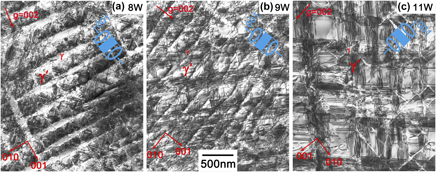
Microstructure evolution in L12 hardened Co-base superalloys during creep
-
- Journal:
- Journal of Materials Research / Volume 32 / Issue 24 / 28 December 2017
- Published online by Cambridge University Press:
- 18 September 2017, pp. 4522-4530
- Print publication:
- 28 December 2017
-
- Article
- Export citation
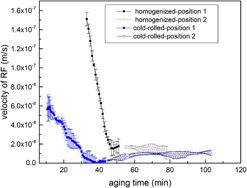
Investigation of discontinuous precipitation upon age-hardening of invar-based Sn alloy
-
- Journal:
- Journal of Materials Research / Volume 32 / Issue 20 / 27 October 2017
- Published online by Cambridge University Press:
- 18 September 2017, pp. 3842-3853
- Print publication:
- 27 October 2017
-
- Article
- Export citation
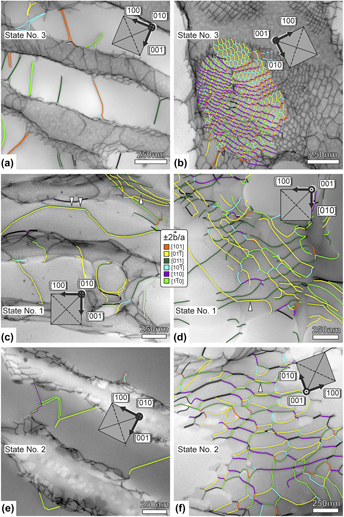
Transmission electron microscopy study of the microstructural evolution during high-temperature and low-stress (011) [11] shear creep deformation of the superalloy single crystal LEK 94
-
- Journal:
- Journal of Materials Research / Volume 32 / Issue 24 / 28 December 2017
- Published online by Cambridge University Press:
- 15 September 2017, pp. 4491-4502
- Print publication:
- 28 December 2017
-
- Article
- Export citation
-
The present work describes the shear creep behavior of the superalloy LEK 94 at temperatures between 980 and 1050 °C and shear stresses between 50 and 140 MPa for loading on the macroscopic crystallographic shear system (MCSS) (011) $\left[ {01\bar 1} \right]$ . The strain rate versus strain curves show short primary and extended secondary creep regimes. We find an apparent activation energy for creep of Q app = 466 kJ/mol and a Norton-law stress exponent of n = 6. With scanning transmission electron microscopy, we characterize three material states that differ in temperature, applied stress, and accumulated strain/time. Rafting develops perpendicular to the maximum principal stress direction, γ channels fill with dislocations, superdislocations cut γ′ particles, and dislocation networks form at γ/γ′ interfaces. Our findings are in agreement with previous results for high-temperature and low-stress [001] and [110] tensile creep testing, and for shear creep testing of the superalloys CMSX-4 and CMSX-6 on the MCSSs (111) $\left[ {01\bar 1} \right]$ and (001)[100]. The parameters that characterize the evolving γ/γ′ microstructure and the evolving dislocation substructures depend on creep temperature, stress, strain, and time.


Introduction
-
- Journal:
- Journal of Materials Research / Volume 32 / Issue 17 / 14 September 2017
- Published online by Cambridge University Press:
- 14 September 2017, pp. 3203-3204
- Print publication:
- 14 September 2017
-
- Article
- Export citation
JMR volume 32 issue 17 Cover and Front matter
-
- Journal:
- Journal of Materials Research / Volume 32 / Issue 17 / 14 September 2017
- Published online by Cambridge University Press:
- 14 September 2017, pp. f1-f5
- Print publication:
- 14 September 2017
-
- Article
-
- You have access
- Export citation
JMR volume 32 issue 17 Cover and Back matter
-
- Journal:
- Journal of Materials Research / Volume 32 / Issue 17 / 14 September 2017
- Published online by Cambridge University Press:
- 14 September 2017, pp. b1-b3
- Print publication:
- 14 September 2017
-
- Article
-
- You have access
- Export citation
Uranyl peroxide nanoclusters at high-pressure – CORRIGENDUM
-
- Journal:
- Journal of Materials Research / Volume 32 / Issue 19 / 16 October 2017
- Published online by Cambridge University Press:
- 12 September 2017, p. 3788
- Print publication:
- 16 October 2017
-
- Article
-
- You have access
- HTML
- Export citation
Effect of Zn content on interfacial reactions of Ni/Sn–xZn/Ni joints under temperature gradient – ERRATUM
-
- Journal:
- Journal of Materials Research / Volume 32 / Issue 18 / 28 September 2017
- Published online by Cambridge University Press:
- 12 September 2017, p. 3616
- Print publication:
- 28 September 2017
-
- Article
-
- You have access
- HTML
- Export citation
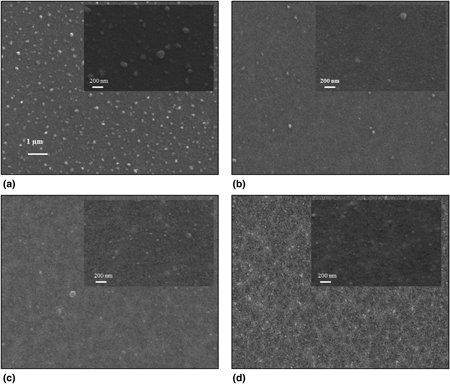
Dewetting of Co thin films obtained by atomic layer deposition due to the thermal reduction process
-
- Journal:
- MRS Communications / Volume 7 / Issue 4 / December 2017
- Published online by Cambridge University Press:
- 11 September 2017, pp. 848-853
- Print publication:
- December 2017
-
- Article
- Export citation

Equal channel angular pressing with rotating shear plane to produce hybrid materials with helical architecture of constituents
-
- Journal:
- Journal of Materials Research / Volume 32 / Issue 24 / 28 December 2017
- Published online by Cambridge University Press:
- 11 September 2017, pp. 4483-4490
- Print publication:
- 28 December 2017
-
- Article
- Export citation
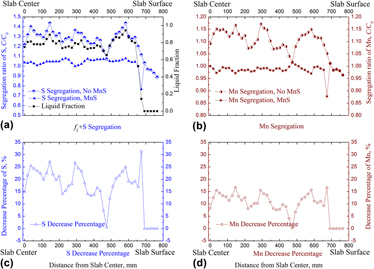
Modeling on solute enrichment and inclusion precipitation during the solidification process of high sulfur steel slab
-
- Journal:
- Journal of Materials Research / Volume 32 / Issue 20 / 27 October 2017
- Published online by Cambridge University Press:
- 11 September 2017, pp. 3854-3863
- Print publication:
- 27 October 2017
-
- Article
- Export citation

High-performance composite with negative Poisson’s ratio
-
- Journal:
- Journal of Materials Research / Volume 32 / Issue 18 / 28 September 2017
- Published online by Cambridge University Press:
- 11 September 2017, pp. 3477-3484
- Print publication:
- 28 September 2017
-
- Article
- Export citation
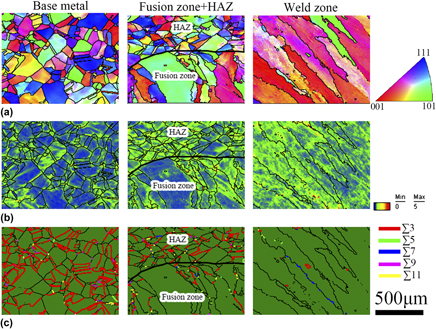
An investigation on microstructure and pitting corrosion behavior of 316L stainless steel weld joint
-
- Journal:
- Journal of Materials Research / Volume 32 / Issue 20 / 27 October 2017
- Published online by Cambridge University Press:
- 11 September 2017, pp. 3904-3911
- Print publication:
- 27 October 2017
-
- Article
- Export citation
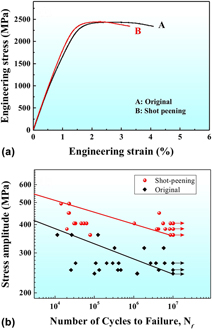
Improvement of notch fatigue properties of ultra-high CM400 maraging steel through shot peening
-
- Journal:
- Journal of Materials Research / Volume 32 / Issue 23 / 14 December 2017
- Published online by Cambridge University Press:
- 11 September 2017, pp. 4424-4432
- Print publication:
- 14 December 2017
-
- Article
- Export citation
