To save content items to your account,
please confirm that you agree to abide by our usage policies.
If this is the first time you use this feature, you will be asked to authorise Cambridge Core to connect with your account.
Find out more about saving content to .
To save content items to your Kindle, first ensure no-reply@cambridge.org
is added to your Approved Personal Document E-mail List under your Personal Document Settings
on the Manage Your Content and Devices page of your Amazon account. Then enter the ‘name’ part
of your Kindle email address below.
Find out more about saving to your Kindle.
Note you can select to save to either the @free.kindle.com or @kindle.com variations.
‘@free.kindle.com’ emails are free but can only be saved to your device when it is connected to wi-fi.
‘@kindle.com’ emails can be delivered even when you are not connected to wi-fi, but note that service fees apply.
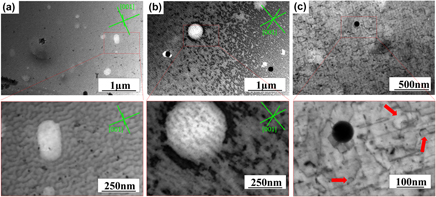
Fatigue is one of the major failure modes of structural materials. While the effects of strengthening precipitates on the mechanical properties of heat treatable aluminum alloys during forming operations are well-studied, only little is known about the related mechanisms during fatigue. We study the influence of precipitates during low cycle fatigue of an Al–Si–Mg alloy by mechanical testing and microstructure characterisation using (scanning) transmission electron microscopy. Specifically, we have investigated under-aged, peak-aged, and over-aged precipitation states. The experiments reveal considerable influence of the precipitate state on the mechanical properties and the formed dislocation structures. Under-aged AA6016 experiences cyclic hardening accompanied by dynamic precipitation and precipitate growth during cyclic deformation, whereas peak-aged AA6016 shows a saturated cyclic stress behavior and the formation of a ‘prevein’-like dislocation structure aligned along [001]Al directions. Over-aged AA6016 exhibits cyclic softening, which is assumed to be due to frequent Orowan-looping of dislocations around incoherent precipitates.
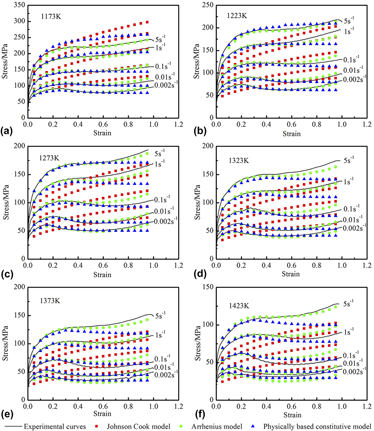
A series of hot compression tests of medium carbon Cr–Ni–Mo-alloyed steel, 34CrNiMo steel, were conducted on a Gleeble-1500 thermal mechanical simulator, in a wide temperature range of 1173–1423 K and at a strain rate range of 0.002–5 s−1. Three constitutive models, namely the Johnson–Cook (JC) model, strain compensated Arrhenius model, and the physically based constitutive model, were established to describe the hot deformation of 34CrNiMo steel. A comparative study of the three models was investigated by comparing the accuracy of prediction of flow stress behavior. The results imply that the JC model is not able to adequately represent the high-temperature flow behavior with the existance of recovery and recrystallization. The Arrhenius-type model based on mathematics has a good prediction in the flow stress behavior in all strain ranges during the hot deformation. The physically based constitutive model gives a better prediction accuracy of the deformation behavior in both flow stress and deformation mechanism.
A powder diffraction measurement system constructed on a beam-line BL5S2 at Aichi Synchrotron Radiation Center in Seto, Japan, has been modified for extensive use of two-dimensional (2D) X-ray detectors. Four flat 2D detectors are currently mounted on the movable stages on supporting rods radially attached to the 2Θ-wheel of the goniometer with the interval of 25°. The 2D powder diffraction intensity data are reduced to conventional 1D format of powder diffraction data by the method based on averaging of the pixel intensities with geometrical corrections, which also enables evaluation of standard uncertainties about the reduced intensity data. The 1D powder diffraction data of a 0.1 mm-capillary LaB6 (NIST SRM660b) sample obtained at the camera length of 340 mm have shown almost symmetric peak profile with slight asymmetry simulated by a beta-distribution profile function.
Laminate sheets attract increasing attention from researchers and engineers. In this paper, Al/Ti/Al laminate sheets were fabricated by using cryogenic roll bonding for first time. The edge defects, mechanical properties, and interface bonding of laminate sheets by cryogenic roll bonding technique were compared with these by room-temperature roll bonding technique. Results show that there are some edge cracks in laminate sheets by room-temperature roll bonding while they do not appear when subjected to cryogenic roll bonding. The ultimate tensile stress of laminate sheets by cryogenic roll bonding increases up to 36.7% compared to that by room-temperature roll bonding. When laminate sheets are rolled to 0.125 mm from 2.025 mm, the interfaces between Al and Ti layers are bonded well for both cryogenic roll bonding and room-temperature roll bonding. Finally, we discussed the improvement in edge quality and mechanical properties and the mechanism of interface bonding of Al/Ti/Al laminate sheets during cryogenic roll bonding.
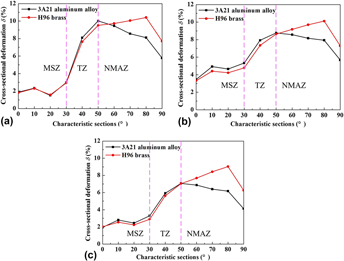
Material mechanical behavior of tube has an essential influence on cross-sectional deformation of rectangular waveguide tube in rotary draw bending (RDB) process. Thus, taking widely used 3A21 aluminum alloy and H96 brass rectangular tubes as research objects, the cross-sectional deformation of these tubes in RDB with and without mandrel was investigated using the reliable three-dimensional finite element models. The results show that when no mandrel is used, compared with 3A21 tube, the position of wrinkle initiation for H96 tube is closer to the final bending section, and the cross-sectional deformation of H96 tube along bending direction is more homogeneous. When a mandrel is used, in bending process, the cross-sectional deformation of 3A21 tube in mandrel support zone (MSZ) is in coincidence with that of H96 tube, and the deformation of 3A21 tube is larger in transition zone (TZ) while smaller in no mandrel affect zone (NMAZ) than that of H96 tube. In retracting mandrel or springback process, the cross-sectional deformation of 3A21 tube in MSZ and TZ is constantly larger than that of H96 tube, while in NMAZ, the deformation of both tubes reverses.
Super-black carbon aerogel sleeves (CAS) with different reflectivities and a clear aperture had been made, by the sol–gel polycondensation of resorcinol (R) and formaldehyde (F) under the catalysis of sodium carbonate (C), and was used to eliminate stray light. We explained that the subwavelength structure is the main factor that leads to the low reflectivity of CA and constructed a simple optical system to measure the exit power from CAS in different directions. We proved that different CASs have different matting effects, and all of these CASs have better matting effects than that of monolithic graphite that has higher reflectivity. To show the fine angular resolution ability of CAS, we measured the faculae from the reflected light of a compact disc and found that the CAS with a clear aperture of 1.0 mm is the best. The super-black CAS could be used in precision optical instruments and to eliminate stray light in the optical.
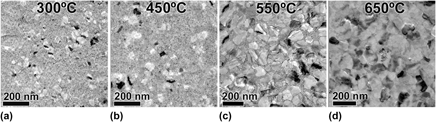
Microstructure and phase evolution in magnetron sputtered nanocrystalline tungsten and tungsten alloy thin films are explored through in situ TEM annealing experiments at temperatures up to 1000 °C. Grain growth in unalloyed nanocrystalline tungsten transpires through a discontinuous process at temperatures up to 550 °C, which is coupled to an allotropic phase transformation of metastable β-tungsten with the A-15 cubic structure to stable body centered cubic (BCC) α-tungsten. Complete transformation to the BCC α-phase is accompanied by the convergence to a unimodal nanocrystalline structure at 650 °C, signaling a transition to continuous grain growth. Alloy films synthesized with compositions of W–20 at.% Ti and W–15 at.% Cr exhibit only the BCC α-phase in the as-deposited state, which indicate the addition of solute stabilizes the films against the formation of metastable β-tungsten. Thermal stability of the alloy films is significantly improved over their unalloyed counterpart up to 1000 °C, and grain coarsening occurs solely through a continuous growth process. The contrasting thermal stability between W–Ti and W–Cr is attributed to different grain boundary segregation states, thus demonstrating the critical role of grain boundary chemistry in the design of solute-stabilized nanocrystalline alloys.
Stretchability of polyimide-supported nanocrystalline Au films with a thickness ranging from 930 to 20 nm was evaluated by uniaxial tensile testing. The results show that the fracture strain gradually decreased with decreasing the film thickness. Such degraded stretchability depends on plastic deformation mechanisms associated with the length scales. As the film thickness is larger than 90 nm, local thinning in the grown grains contributed to the high stretchability. Full dislocation behaviors including dislocation pileup in the 930 nm-thick film, the activation of Frank–Read dislocation source in the 170 nm-thick film and the grain boundary dislocation source in the 90 nm-thick film were dominated plastic deformation. As the film thickness is less than 40 nm, low stretchability of thin films resulted from intergranular fracture, and partial dislocation behaviors became prevailed. Evident grain growth happened in the films studied except for the 20 nm-thick film, which is expected to be involved in the stretchability of the nanocrystalline metal films on flexible substrates.
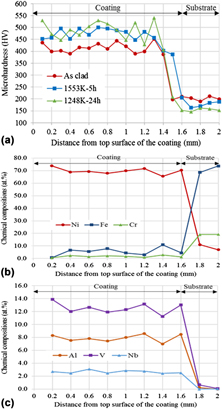
The two-phase Ni3Al and Ni3V intermetallic alloy laser clad on substrate of SUS304 was evaluated by hardness measurement, scanning electron microscopy, electron probe microanalyzer and transmission electron microscopy observations, focusing on the effect of post annealing after laser irradiation. The laser clad coating layer was diluted with approximately 5.4 at.% Fe and 1.6 at.% Cr stemming from the substrate. In the as-clad coating layer, the inhomogeneous eutectoid microstructure due to incomplete phase separation into two intermetallic phases Ni3Al and Ni3V took place. The hardness in the as-clad coating layer was lower than that in post annealed coating layers. In the coating layer annealed at 1553 K for 5 h, a dual two-phase microstructure composed of the primary cuboidal Ni3Al surrounded by the channel regions in which the major constituent is the Ni3V phase was observed, indicating that the complete eutectoid microstructure was developed. In the coating layer annealed at 1248 K for 24 h, the developed microstructure was lamellar-like one composed of the Ni3Al and Ni3V phases. The hardness in the coating layer annealed at 1248 K was the highest in the coatings observed in this study.
Magnesium alloys with the lowest structural density exhibit unique applications in the automotive and aerospace fields. Rare earth addition is a promising method to enhance the mechanical properties of the Mg alloys. In the present study, the magnesium–aluminium (Mg–9Al) alloy containing varying wt% of gadolinium (Gd) is synthesized using the casting technique. The microstructure, mechanical, corrosion, and wear properties of the developed Mg–9Al–xGd alloy are evaluated and compared to the base Mg–9Al alloy. Microstructural investigation shows significant grain refinement and the presence of Al2Gd in addition to β-Mg17Al12 in the Gd-added alloys. Under tensile loads, the developed Mg–9Al–2Gd alloy exhibits enhancements in ultimate and yield strengths. The corrosion resistance of the alloys is found to increase with increasing Gd content and is optimal at 2 wt%. Considering the higher hardness and dispersity of the Al2Gd phase, Mg–9Al–2Gd has exhibited a higher wear resistance than that of the as-cast Mg–9Al alloy.
A series of phase transformations of a novel fluoroaluminosilicate glass forming a range of fluorapatite glass-ceramics on sintering are reported. The sintering process induces formation of fluorapatite, mullite, and anorthite phases within the amorphous silicate matrices of the glass-ceramics. The fluoroaluminosilicate glass, SiO2–Al2O3–P2O5–CaO–CaF2, is prepared from waste materials, such as rice husk ash, pacific oyster shells, and disposable aluminium cans. The thermally induced crystallographic and microstructure evolution of the fluoroaluminosilicate glass towards the fluorapatite glass-ceramics, with applications in dental and bone restoration, are investigated by powder X-ray diffraction and small-angle neutron-scattering techniques.
Polycrystalline copper (99.9%) was fatigued at a total strain amplitude of 0.1 and 0.2%, respectively. The tests were performed in situ under vacuum in a Large Chamber-Scanning Electron Microscope. By a repeated combination of in situ fatigue testing and ex situ focused ion beam milling, a deep insight into the mechanism of fatigue crack initiation and early stages of crack initiation at persistent slip bands (PSBs) and their interaction with grain boundaries was obtained. The EBSD-technique showed early slip activation and the exclusive formation of extrusions in favorably oriented grains until a certain extrusion height was reached. At the total strain amplitude of 0.2%, extrusions are formed not only in favorably oriented grains but also in grains with a lower Schmid factor due to high compatibility stresses at the grain boundaries. Extrusion growth through grain boundaries is affected by the orientation of the primary slip systems in the neighboring grains and the additional anisotropy stresses. It is concluded that early stages of crack initiation are the consequence of the formation of extrusions at PSBs in combination with the clustering of vacancies along the PSB boundaries, as it was proposed by the well-known Essmann–Gösele–Mughrabi model.
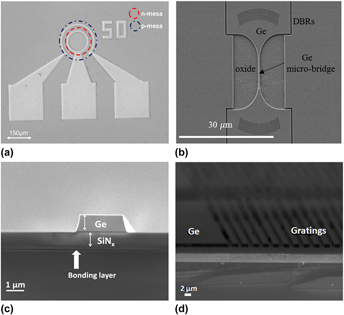
Integration of photonic devices on silicon (Si) substrates is a key method in enabling large scale manufacturing of Si-based photonic–electronic circuits for next generation systems with high performance, small form factor, low power consumption, and low cost. Germanium (Ge) is a promising material due to its pseudo-direct bandgap and its compatibility with Si-CMOS processing. In this article, we present our recent progress on achieving high quality germanium-on-silicon (Ge/Si) materials. Subsequently, the performance of various functional devices such as photodetectors, lasers, waveguides, and sensors that are fabricated on the Ge/Si platform are discussed. Some possible future works such as the incorporation of tin (Sn) into Ge will be proposed. Finally, some applications based on a fully monolithic integrated photonic–electronic chip on an Si platform will be highlighted at the end of this article.
Graphite has been widely used as a negative electrode material in lithium-ion batteries, and recently it has attracted attention for its use in potassium-ion batteries. In this study, the first in situ X-ray diffraction characterisation of a K/graphite electrochemical cell is performed. Various graphite intercalation compounds are found, including the stage three KC36 and stage one KC8 compounds, along with the disappearance of the graphite during the potassiation process. These results show new insights on the non-equilibrium states of potassium-ion intercalation into graphite in K/graphite electrochemical cells.
Helium ion microscopy (HIM), enabled by a gas field ion source (GFIS), is an emerging imaging and nanofabrication technique compatible with many applications in materials science. The scanning electron microscope (SEM) has become ubiquitous in materials science for high-resolution imaging of materials. However, due to the fundamental limitation in focusing of electron beams, ion-beam microscopy is now being developed (e.g., at 20 kV the SEM beam diameter ranges from 0.5 to 1 nm, whereas the HIM offers 0.35 nm). The key technological advantage of the HIM is in its multipurpose design that excels in a variety of disciplines. The HIM offers higher resolution than the best available SEMs as well as the traditional gallium liquid-metal ion source (LMISs) focused ion beams (FIBs), and is capable of imaging untreated biological or other insulating samples with unprecedented resolution, depth of field, materials contrast, and image quality. GFIS FIBs also offer a direct path to defect engineering via ion implantation, three-dimensional direct write using gaseous and liquid precursors, and chemical-imaging options with secondary ion mass spectrometry. HIM covers a wide range of tasks that otherwise would require multiple tools or specialized sample preparation. In this article, we describe the underlying technology, present materials, relevant applications, and offer an outlook for the potential of FIB technology in processing materials.
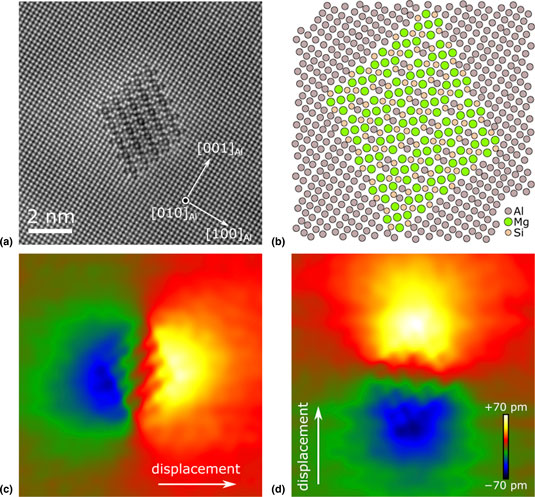
Partial aging of AA6060 aluminum alloys is known to result in a microstructure characterized by needle-shaped Si/Mg-rich precipitates. These precipitates belong to the non-equilibrium β″ phase and are coherent with the face-centered cubic Al lattice, despite of which they can cause considerable hardening. We have investigated the interaction between these β″ precipitates and dislocations using a unique combination of modeling and experimental observations. Dislocation-precipitate interactions are simulated using dislocation dynamics (DD) parameterized with atomistic simulations. The elastic fields due to the precipitates are described by a decay law fitted to high-resolution transmission electron microscopy measurements. These fields are subsequently used in DD to study the strength of individual precipitates as a function of size and dislocation character. Our results can be used to parameterize crystal plasticity models to calculate the strength of AA6060 at the macroscopic level.
New developments in manufacturing and automation, from three-dimensional printing to the “Internet of things,” signify dramatic changes in our society. The push toward quantum materials is driving device fabrication toward atomic precision. Recent results suggest that scanning transmission electron microscopy (STEM) with sub-angstrom scale beams could offer a solution. However, a detailed theoretical understanding of the interaction of the electron beam with solids is needed to form a basis for new technology. This article summarizes the existing literature on electron-beam interactions with solids with a focus on irreversible transformation. We further suggest that the theoretical framework of a two-temperature model developed for fast ion damage in solids could be applicable to predicting the effects of fast electrons. Recent results from STEM-directed epitaxial growth on crystalline–amorphous interfaces are discussed in detail. Finally, perspectives on the development of this field in the near future are offered.