Refine search
Actions for selected content:
26063 results in Abstract analysis
MTK volume 65 Issue 3 Cover and Back matter
-
- Journal:
- Mathematika / Volume 65 / Issue 3 / 2019
- Published online by Cambridge University Press:
- 20 June 2019, pp. b1-b2
- Print publication:
- 2019
-
- Article
-
- You have access
- Export citation
MTK volume 65 Issue 2 Cover and Back matter
-
- Journal:
- Mathematika / Volume 65 / Issue 2 / 2019
- Published online by Cambridge University Press:
- 19 March 2019, pp. b1-b2
- Print publication:
- 2019
-
- Article
-
- You have access
- Export citation
NEW RESULTS ON SUM-PRODUCT TYPE GROWTH OVER FIELDS
- Part of
-
- Journal:
- Mathematika / Volume 65 / Issue 3 / 2019
- Published online by Cambridge University Press:
- 02 April 2019, pp. 588-642
- Print publication:
- 2019
-
- Article
- Export citation
-
We prove a range of new sum-product type growth estimates over a general field $\mathbb{F}$, in particular the special case $\mathbb{F}=\mathbb{F}_{p}$. They are unified by the theme of “breaking the $3/2$ threshold”, epitomizing the previous state of the art. This concerns two questions pivotal for the sum-product theory, which are lower bounds for the number of distinct cross-ratios determined by a finite subset of $\mathbb{F}$, as well as the number of values of the symplectic form determined by a finite subset of $\mathbb{F}^{2}$. We establish the estimate $|R[A]|\gtrsim |A|^{8/5}$ for cardinality of the set $R[A]$ of distinct cross-ratios, defined by triples of elements of a set $A\subset \mathbb{F}$ (sufficiently small if $\mathbb{F}$ has positive characteristic, similarly for the rest of the estimates), pinned at infinity. The cross-ratio bound enables us to break the threshold in the second question: for a non-collinear point set $P\subset \mathbb{F}^{2}$, the number of distinct values of the symplectic form $\unicode[STIX]{x1D714}$ on pairs of distinct points $u,u^{\prime }$ of $P$ is $|\unicode[STIX]{x1D714}(P)|\gtrsim |P|^{2/3+c}$, with an explicit $c$. Symmetries of the cross-ratio underlie its local growth properties under both addition and multiplication, yielding an onset of growth of products of difference sets, which is another main result herein. Our proofs make use of specially suited applications of new incidence bounds over $\mathbb{F}$, which apply to higher moments of representation functions. The technical thrust of the paper uses additive combinatorics to relate and adapt these higher moment bounds to growth estimates. A particular instance of this is breaking the threshold in the few sums, many products question over any $\mathbb{F}$, by showing that if $A$ is sufficiently small and has additive doubling constant $M$, then $|AA|\gtrsim M^{-2}|A|^{14/9}$. This result has a second moment version, which allows for new upper bounds for the number of collinear point triples in the set $A\times A\subset \mathbb{F}^{2}$, the quantity often arising in applications of geometric incidence estimates.


RANDOMNESS AND NON-RANDOMNESS PROPERTIES OF PIATETSKI-SHAPIRO SEQUENCES MODULO $m$
$m$
- Part of
-
- Journal:
- Mathematika / Volume 65 / Issue 4 / 2019
- Published online by Cambridge University Press:
- 14 August 2019, pp. 1051-1073
- Print publication:
- 2019
-
- Article
- Export citation
-
We study Piatetski-Shapiro sequences $(\lfloor n^{c}\rfloor )_{n}$ modulo $m$, for non-integer $c>1$ and positive $m$, and we are particularly interested in subword occurrences in those sequences. We prove that each block $\in \{0,1\}^{k}$ of length $k<c+1$ occurs as a subword with the frequency $2^{-k}$, while there are always blocks that do not occur. In particular, those sequences are not normal. For $1<c<2$, we estimate the number of subwords from above and below, yielding the fact that our sequences are deterministic and not morphic. Finally, using the Daboussi–Kátai criterion, we prove that the sequence $\lfloor n^{c}\rfloor$ modulo $m$ is asymptotically orthogonal to multiplicative functions bounded by 1 and with mean value 0.


FLAG AREA MEASURES
- Part of
-
- Journal:
- Mathematika / Volume 65 / Issue 4 / 2019
- Published online by Cambridge University Press:
- 23 July 2019, pp. 958-989
- Print publication:
- 2019
-
- Article
- Export citation
-
A flag area measure on an $n$-dimensional euclidean vector space is a continuous translation-invariant valuation with values in the space of signed measures on the flag manifold consisting of a unit vector $v$ and a $(p+1)$-dimensional linear subspace containing $v$ with $0\leqslant p\leqslant n-1$. Using local parallel sets, Hinderer constructed examples of $\text{SO}(n)$-covariant flag area measures. There is an explicit formula for his flag area measures evaluated on polytopes, which involves the squared cosine of the angle between two subspaces. We construct a more general sequence of smooth $\text{SO}(n)$-covariant flag area measures via integration over the normal cycle of appropriate differential forms. We provide an explicit description of our measures on polytopes, which involves an arbitrary elementary symmetric polynomial in the squared cosines of the principal angles between two subspaces. Moreover, we show that these flag area measures span the space of all smooth $\text{SO}(n)$-covariant flag area measures, which gives a classification result in the spirit of Hadwiger’s theorem.


ON ITERATED PRODUCT SETS WITH SHIFTS
- Part of
-
- Journal:
- Mathematika / Volume 65 / Issue 4 / 2019
- Published online by Cambridge University Press:
- 21 May 2019, pp. 831-850
- Print publication:
- 2019
-
- Article
- Export citation
-
We prove that, for any finite set $A\subset \mathbb{Q}$ with $|AA|\leqslant K|A|$ and any positive integer $k$, the $k$-fold product set of the shift $A+1$ satisfies the bound This result is essentially optimal when
 $$\begin{eqnarray}|\{(a_{1}+1)(a_{2}+1)\cdots (a_{k}+1):a_{i}\in A\}|\geqslant \frac{|A|^{k}}{(8k^{4})^{kK}}.\end{eqnarray}$$ $K$ is of the order $c\log |A|$, for a sufficiently small constant $c=c(k)$. Our main tool is a multiplicative variant of the $\unicode[STIX]{x1D6EC}$-constants used in harmonic analysis, applied to Dirichlet polynomials.


NEWTON’S METHOD FOR STOCHASTIC FUNCTIONAL EVOLUTION EQUATIONS IN HILBERT SPACES
- Part of
-
- Journal:
- Mathematika / Volume 65 / Issue 3 / 2019
- Published online by Cambridge University Press:
- 25 March 2019, pp. 542-556
- Print publication:
- 2019
-
- Article
- Export citation
LONELY RUNNERS IN FUNCTION FIELDS
- Part of
-
- Journal:
- Mathematika / Volume 65 / Issue 3 / 2019
- Published online by Cambridge University Press:
- 12 April 2019, pp. 677-701
- Print publication:
- 2019
-
- Article
- Export citation
-
The lonely runner conjecture, now over fifty years old, concerns the following problem. On a unit-length circular track, consider $m$ runners starting at the same time and place, each runner having a different constant speed. The conjecture asserts that each runner is lonely at some point in time, meaning at a distance at least $1/m$ from the others. We formulate a function field analogue, and give a positive answer in some cases in the new setting.


MTK volume 65 Issue 4 Cover and Front matter
-
- Journal:
- Mathematika / Volume 65 / Issue 4 / 2019
- Published online by Cambridge University Press:
- 06 September 2019, pp. f1-f2
- Print publication:
- 2019
-
- Article
-
- You have access
- Export citation
On the boundary regularity of phase-fields for Willmore's energy
- Part of
-
- Journal:
- Proceedings of the Royal Society of Edinburgh. Section A: Mathematics / Volume 149 / Issue 4 / August 2019
- Published online by Cambridge University Press:
- 27 December 2018, pp. 1017-1035
- Print publication:
- August 2019
-
- Article
- Export citation
Bifurcation and standing wave solutions for a quasilinear Schrödinger equation
- Part of
-
- Journal:
- Proceedings of the Royal Society of Edinburgh. Section A: Mathematics / Volume 149 / Issue 4 / August 2019
- Published online by Cambridge University Press:
- 27 December 2018, pp. 939-968
- Print publication:
- August 2019
-
- Article
- Export citation
-
We use bifurcation and topological methods to investigate the existence/nonexistence and the multiplicity of positive solutions of the following quasilinear Schrödinger equation
involving sublinear/linear/superlinear nonlinearities at zero or infinity with/without signum condition. In particular, we study the changes in the structure of positive solution with κ as the varying parameter. $$\left\{ {\matrix{ {-\Delta u-\kappa \Delta \left( {u^2} \right)u = \beta u-\lambda \Phi \left( {u^2} \right)u{\mkern 1mu} {\mkern 1mu} } \hfill & {{\rm in}\;\Omega ,} \hfill \cr {u = 0} \hfill & {{\rm on}\;\partial \Omega } \hfill \cr } } \right.$$
Mean values of derivatives of L-functions in function fields: III
- Part of
-
- Journal:
- Proceedings of the Royal Society of Edinburgh. Section A: Mathematics / Volume 149 / Issue 4 / August 2019
- Published online by Cambridge University Press:
- 27 December 2018, pp. 905-913
- Print publication:
- August 2019
-
- Article
- Export citation
Some nonexistence theorems for semilinear fourth-order equations
- Part of
-
- Journal:
- Proceedings of the Royal Society of Edinburgh. Section A: Mathematics / Volume 149 / Issue 3 / June 2019
- Published online by Cambridge University Press:
- 27 December 2018, pp. 761-779
- Print publication:
- June 2019
-
- Article
- Export citation
-
In this paper, we analyse the semilinear fourth-order problem ( − Δ)2u = g(u) in exterior domains of ℝN. Assuming the function g is nondecreasing and continuous in [0, + ∞) and positive in (0, + ∞), we show that positive classical supersolutions u of the problem which additionally verify − Δu > 0 exist if and only if N ≥ 5 and
for some δ > 0. When only radially symmetric solutions are taken into account, we also show that the monotonicity of g is not needed in this result. Finally, we consider the same problem posed in ℝN and show that if g is additionally convex and lies above a power greater than one at infinity, then all positive supersolutions u automatically verify − Δu > 0 in ℝN, and they do not exist when the previous condition fails.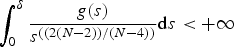 $$\int_0^\delta \displaystyle{{g(s)}\over{s^{(({2(N-2)})/({N-4}))}}} {\rm d}s \lt + \infty$$
Classification of nonnegative solutions to a bi-harmonic equation with Hartree type nonlinearity
- Part of
-
- Journal:
- Proceedings of the Royal Society of Edinburgh. Section A: Mathematics / Volume 149 / Issue 4 / August 2019
- Published online by Cambridge University Press:
- 27 December 2018, pp. 979-994
- Print publication:
- August 2019
-
- Article
- Export citation
-
In this paper, we are concerned with the following bi-harmonic equation with Hartree type nonlinearity
where 0 < γ ⩽ 1 and d ⩾ 9. By applying the method of moving planes, we prove that nonnegative classical solutions u to (𝒫γ) are radially symmetric about some point x0 ∈ ℝd and derive the explicit form for u in the Ḣ2 critical case γ = 1. We also prove the non-existence of nontrivial nonnegative classical solutions in the subcritical cases 0 < γ < 1. As a consequence, we also derive the best constants and extremal functions in the corresponding Hardy-Littlewood-Sobolev inequalities. $$\Delta ^2u = \left( {\displaystyle{1 \over { \vert x \vert ^8}}* \vert u \vert ^2} \right)u^\gamma ,\quad x\in {\open R}^d,$$
Residually many BV homeomorphisms map a null set onto a set of full measure
- Part of
-
- Journal:
- Proceedings of the Royal Society of Edinburgh. Section A: Mathematics / Volume 149 / Issue 4 / August 2019
- Published online by Cambridge University Press:
- 27 December 2018, pp. 1047-1059
- Print publication:
- August 2019
-
- Article
- Export citation
Morse index and symmetry for elliptic problems with nonlinear mixed boundary conditions
- Part of
-
- Journal:
- Proceedings of the Royal Society of Edinburgh. Section A: Mathematics / Volume 149 / Issue 2 / April 2019
- Published online by Cambridge University Press:
- 27 December 2018, pp. 305-324
- Print publication:
- April 2019
-
- Article
- Export citation
-
We consider an elliptic problem of the type
where Ω is a bounded Lipschitz domain in ℝN with a cylindrical symmetry, ν stands for the outer normal and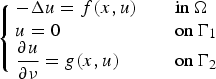 $$\left\{ {\matrix{ {-\Delta u = f(x,u)\quad } \hfill & {{\rm in}\,\Omega } \hfill \cr {u = 0} \hfill & {{\rm on}\,\Gamma _1} \hfill \cr {\displaystyle{{\partial u} \over {\partial \nu }} = g(x,u)} \hfill & {{\rm on}\,\Gamma _2} \hfill \cr } } \right.$$ $\partial \Omega = \overline {\Gamma _1} \cup \overline {\Gamma _2} $.
Under a Morse index condition, we prove cylindrical symmetry results for solutions of the above problem.
As an intermediate step, we relate the Morse index of a solution of the nonlinear problem to the eigenvalues of the following linear eigenvalue problem
For this one, we construct sequences of eigenvalues and provide variational characterization of them, following the usual approach for the Dirichlet case, but working in the product Hilbert space L2 (Ω) × L2(Γ2).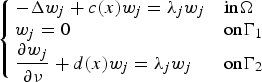 $$\left\{ {\matrix{ {-\Delta w_j + c(x)w_j = \lambda _jw_j} \hfill & {{\rm in }\Omega } \hfill \cr {w_j = 0} \hfill & {{\rm on }\Gamma _1} \hfill \cr {\displaystyle{{\partial w_j} \over {\partial \nu }} + d(x)w_j = \lambda _jw_j} \hfill & {{\rm on }\Gamma _2} \hfill \cr } } \right.$$
Asymptotic analysis of the Ginzburg–Landau functional on point clouds
- Part of
-
- Journal:
- Proceedings of the Royal Society of Edinburgh. Section A: Mathematics / Volume 149 / Issue 2 / April 2019
- Published online by Cambridge University Press:
- 27 December 2018, pp. 387-427
- Print publication:
- April 2019
-
- Article
- Export citation
On the boundary conditions in estimating ∇ω by div ω and curl ω
- Part of
-
- Journal:
- Proceedings of the Royal Society of Edinburgh. Section A: Mathematics / Volume 149 / Issue 3 / June 2019
- Published online by Cambridge University Press:
- 27 December 2018, pp. 739-760
- Print publication:
- June 2019
-
- Article
- Export citation
-
In this paper, we study under what boundary conditions the inequality
holds true. It is known that such an estimate holds if either the tangential or normal component of ω vanishes on the boundary ∂Ω. We show that the vanishing tangential component condition is a special case of a more general one. In two dimensions, we give an interpolation result between these two classical boundary conditions. $${\rm \Vert }\nabla \omega {\rm \Vert }_{L^2(\Omega )}^2 \les C({\rm \Vert }{\rm curl}\omega {\rm \Vert }_{L^2(\Omega )}^2 + {\rm \Vert }{\rm div}\omega {\rm \Vert }_{L^2(\Omega )}^2 + {\rm \Vert }\omega {\rm \Vert }_{L^2(\Omega )}^2 )$$
Remarks on quasi-Reinhardt domains
- Part of
-
- Journal:
- Proceedings of the Royal Society of Edinburgh. Section A: Mathematics / Volume 149 / Issue 2 / April 2019
- Published online by Cambridge University Press:
- 27 December 2018, pp. 297-304
- Print publication:
- April 2019
-
- Article
- Export citation
Singular limits and properties of solutions of some degenerate elliptic and parabolic equations
- Part of
-
- Journal:
- Proceedings of the Royal Society of Edinburgh. Section A: Mathematics / Volume 149 / Issue 2 / April 2019
- Published online by Cambridge University Press:
- 27 December 2018, pp. 353-385
- Print publication:
- April 2019
-
- Article
- Export citation
-
Let n ⩾ 3, 0 ⩽ m < n − 2/n, ρ1 > 0, $\beta>\beta_{0}^{(m)}=(({m\rho_{1}})/({n-2-nm}))$, αm = ((2β + ρ1)/(1 − m)) and α = 2β+ρ1. For any λ > 0, we prove the uniqueness of radially symmetric solution υ(m) of Δ(υm/m) + αmυ + βx · ∇υ = 0, υ > 0, in ℝn∖{0} which satisfies $\lim\nolimits_{|x|\to 0|}|x|^{\alpha _m/\beta }v^{(m)}(x) = \lambda ^{-((\rho _1)/((1-m)\beta ))}$ and obtain higher order estimates of υ(m) near the blow-up point x = 0. We prove that as m → 0+, υ(m) converges uniformly in C2(K) for any compact subset K of ℝn∖{0} to the solution υ of Δlog υ + α υ + β x·∇ υ = 0, υ > 0, in ℝn\{0}, which satisfies $\lim\nolimits_{ \vert x \vert \to 0} \vert x \vert ^{{\alpha}/{\beta}}v(x)=\lambda^{-{\rho_{1}}/{\beta}}$. We also prove that if the solution u(m) of ut = Δ (um/m), u > 0, in (ℝn∖{0}) × (0, T) which blows up near {0} × (0, T) at the rate $ \vert x \vert ^{-{\alpha_{m}}/{\beta}}$ satisfies some mild growth condition on (ℝn∖{0}) × (0, T), then as m → 0+, u(m) converges uniformly in C2 + θ, 1 + θ/2(K) for some constant θ ∈ (0, 1) and any compact subset K of (ℝn∖{0}) × (0, T) to the solution of ut = Δlog u, u > 0, in (ℝn∖{0}) × (0, T). As a consequence of the proof, we obtain existence of a unique radially symmetric solution υ(0) of Δ log υ + α υ + β x·∇ υ = 0, υ > 0, in ℝn∖{0}, which satisfies $\lim\nolimits_{ \vert x \vert \to 0} \vert x \vert ^{{\alpha}/{\beta}}v(x)=\lambda^{-{\rho_{1}}/{\beta}}$.

