Refine search
Actions for selected content:
26063 results in Abstract analysis
Universal localizations via silting
- Part of
-
- Journal:
- Proceedings of the Royal Society of Edinburgh. Section A: Mathematics / Volume 149 / Issue 2 / April 2019
- Published online by Cambridge University Press:
- 27 December 2018, pp. 511-532
- Print publication:
- April 2019
-
- Article
- Export citation
A proof of Boca's Theorem
- Part of
-
- Journal:
- Proceedings of the Royal Society of Edinburgh. Section A: Mathematics / Volume 149 / Issue 4 / August 2019
- Published online by Cambridge University Press:
- 27 December 2018, pp. 869-876
- Print publication:
- August 2019
-
- Article
- Export citation
Nonlocal problems arising from the birth-jump processes
- Part of
-
- Journal:
- Proceedings of the Royal Society of Edinburgh. Section A: Mathematics / Volume 149 / Issue 2 / April 2019
- Published online by Cambridge University Press:
- 27 December 2018, pp. 447-469
- Print publication:
- April 2019
-
- Article
- Export citation
Convergence results for primal and dual history-dependent quasivariational inequalities
- Part of
-
- Journal:
- Proceedings of the Royal Society of Edinburgh. Section A: Mathematics / Volume 149 / Issue 2 / April 2019
- Published online by Cambridge University Press:
- 27 December 2018, pp. 471-494
- Print publication:
- April 2019
-
- Article
- Export citation
A quantitative Carleman estimate for second-order elliptic operators
- Part of
-
- Journal:
- Proceedings of the Royal Society of Edinburgh. Section A: Mathematics / Volume 149 / Issue 4 / August 2019
- Published online by Cambridge University Press:
- 27 December 2018, pp. 915-938
- Print publication:
- August 2019
-
- Article
- Export citation
Minimizing movements for oscillating energies: the critical regime
- Part of
-
- Journal:
- Proceedings of the Royal Society of Edinburgh. Section A: Mathematics / Volume 149 / Issue 3 / June 2019
- Published online by Cambridge University Press:
- 27 December 2018, pp. 719-737
- Print publication:
- June 2019
-
- Article
- Export citation
Real hypersurfaces in the complex quadric with Killing normal Jacobi operator
- Part of
-
- Journal:
- Proceedings of the Royal Society of Edinburgh. Section A: Mathematics / Volume 149 / Issue 2 / April 2019
- Published online by Cambridge University Press:
- 27 December 2018, pp. 279-296
- Print publication:
- April 2019
-
- Article
- Export citation
Existence of normalized solutions for nonlinear fractional Schrödinger equations with trapping potentials
- Part of
-
- Journal:
- Proceedings of the Royal Society of Edinburgh. Section A: Mathematics / Volume 149 / Issue 3 / June 2019
- Published online by Cambridge University Press:
- 27 December 2018, pp. 617-653
- Print publication:
- June 2019
-
- Article
- Export citation
Pólya S3-extensions of ℚ
- Part of
-
- Journal:
- Proceedings of the Royal Society of Edinburgh. Section A: Mathematics / Volume 149 / Issue 6 / December 2019
- Published online by Cambridge University Press:
- 27 December 2018, pp. 1421-1433
- Print publication:
- December 2019
-
- Article
- Export citation
General sharp weighted Caffarelli–Kohn–Nirenberg inequalities
- Part of
-
- Journal:
- Proceedings of the Royal Society of Edinburgh. Section A: Mathematics / Volume 149 / Issue 3 / June 2019
- Published online by Cambridge University Press:
- 27 December 2018, pp. 691-718
- Print publication:
- June 2019
-
- Article
- Export citation
-
In this paper, we will use optimal mass transport combining with suitable transforms to study the sharp constants and optimizers for a class of the Gagliardo–Nirenberg and Caffarelli–Kohn–Nirenberg inequalities. Moreover, we will investigate these inequalities with and without the monomial weights $x_{1}^{A_{1}} \cdots x_{N}^{A_{N}}$ on ℝN.

Lagrangian submanifolds of the nearly Kähler 𝕊3 × 𝕊3 from minimal surfaces in 𝕊3
- Part of
-
- Journal:
- Proceedings of the Royal Society of Edinburgh. Section A: Mathematics / Volume 149 / Issue 3 / June 2019
- Published online by Cambridge University Press:
- 27 December 2018, pp. 655-689
- Print publication:
- June 2019
-
- Article
- Export citation
A problem of integer partitions and numerical semigroups
- Part of
-
- Journal:
- Proceedings of the Royal Society of Edinburgh. Section A: Mathematics / Volume 149 / Issue 4 / August 2019
- Published online by Cambridge University Press:
- 27 December 2018, pp. 969-978
- Print publication:
- August 2019
-
- Article
- Export citation
Autonomous and non-autonomous unbounded attractors under perturbations
- Part of
-
- Journal:
- Proceedings of the Royal Society of Edinburgh. Section A: Mathematics / Volume 149 / Issue 4 / August 2019
- Published online by Cambridge University Press:
- 27 December 2018, pp. 877-903
- Print publication:
- August 2019
-
- Article
- Export citation
Multi-peak positive solutions to a class of Kirchhoff equations
- Part of
-
- Journal:
- Proceedings of the Royal Society of Edinburgh. Section A: Mathematics / Volume 149 / Issue 4 / August 2019
- Published online by Cambridge University Press:
- 27 December 2018, pp. 1097-1122
- Print publication:
- August 2019
-
- Article
- Export citation
-
In the present paper, we consider the nonlocal Kirchhoff problem
where a, b>0, 1<p<5 are constants, ϵ>0 is a parameter. Under some mild assumptions on the function V, we obtain multi-peak solutions for ϵ sufficiently small by Lyapunov–Schmidt reduction method. Even though many results on single peak solutions to singularly perturbed Kirchhoff problems have been derived in the literature by various methods, there exist no results on multi-peak solutions before this paper, due to some difficulties caused by the nonlocal term $$-\left(\epsilon^2a+\epsilon b\int_{{\open R}^{3}}\vert \nabla u \vert^{2}\right)\Delta u+V(x)u=u^{p}, \quad u \gt 0 \quad {\rm in} {\open R}^{3},$$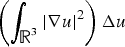 $\left(\int_{{\open R}^{3}} \vert \nabla u \vert^{2}\right)\Delta u$. A remarkable new feature of this problem is that the corresponding unperturbed problem turns out to be a system of partial differential equations, but not a single Kirchhoff equation, which is quite different from most of the elliptic singular perturbation problems.
Regularity of the extremal solutions associated with elliptic systems
- Part of
-
- Journal:
- Proceedings of the Royal Society of Edinburgh. Section A: Mathematics / Volume 149 / Issue 4 / August 2019
- Published online by Cambridge University Press:
- 27 December 2018, pp. 1037-1046
- Print publication:
- August 2019
-
- Article
- Export citation
-
We examine the elliptic system given by
where λ, γ are positive parameters, Ω is a smooth bounded domain in ℝN and f is a C2 positive, nondecreasing and convex function in [0, ∞) such that f(t)/t → ∞ as t → ∞. Assuming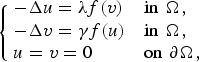 $$\left\{ {\matrix{ {-\Delta u = \lambda f(v)} \hfill & {{\rm in }\,\,\Omega ,} \hfill \cr {-\Delta v = \gamma f(u)} \hfill & {{\rm in }\,\,\Omega ,} \hfill \cr {u = v = 0} \hfill & {{\rm on }\,\,\partial \Omega ,} \hfill \cr } } \right.$$we show that the extremal solution (u*, v*) associated with the above system is smooth provided that N < (2α*(2 − τ+) + 2τ+)/(τ+)max{1, τ+}, where α* > 1 denotes the largest root of the second-order polynomial
 $$0 < \tau _-: = \mathop {\lim \inf }\limits_{t\to \infty } \displaystyle{{f(t){f}^{\prime \prime}(t)} \over {{f}^{\prime}{(t)}^2}} \les \tau _ + : = \mathop {\lim \sup }\limits_{t\to \infty } \displaystyle{{f(t){f}^{\prime \prime}(t)} \over {{f}^{\prime}{(t)}^2}} \les 2,$$As a consequence, u*, v* ∈ L∞(Ω) for N < 5. Moreover, if τ− = τ+, then u*, v* ∈ L∞(Ω) for N < 10.
 $$[P_{f}(\alpha,\tau_{-},\tau_{+}):=(2-\tau_{-})^{2} \alpha^{2}- 4(2-\tau_{+})\alpha+4(1-\tau_{+}).]$$
Existence results for Kirchhoff–type superlinear problems involving the fractional Laplacian
- Part of
-
- Journal:
- Proceedings of the Royal Society of Edinburgh. Section A: Mathematics / Volume 149 / Issue 4 / August 2019
- Published online by Cambridge University Press:
- 27 December 2018, pp. 1061-1081
- Print publication:
- August 2019
-
- Article
- Export citation
-
In this paper, we study the existence and multiplicity of solutions for Kirchhoff-type superlinear problems involving non-local integro-differential operators. As a particular case, we consider the following Kirchhoff-type fractional Laplace equation:
where ( − Δ)s is the fractional Laplace operator, s ∈ (0, 1), N > 2s, Ω is an open bounded subset of ℝN with smooth boundary ∂Ω, $$\matrix{ {\left\{ {\matrix{ {M\left( {\int\!\!\!\int\limits_{{\open R}^{2N}} {\displaystyle{{ \vert u(x)-u(y) \vert ^2} \over { \vert x-y \vert ^{N + 2s}}}} {\rm d}x{\rm d}y} \right){(-\Delta )}^su = f(x,u)\quad } \hfill & {{\rm in }\Omega ,} \hfill \cr {u = 0\quad } \hfill & {{\rm in }{\open R}^N{\rm \setminus }\Omega {\mkern 1mu} ,} \hfill \cr } } \right.} \hfill \cr } $$ $M:{\open R}_0^ + \to {\open R}^ + $ is a continuous function satisfying certain assumptions, and f(x, u) is superlinear at infinity. By computing the critical groups at zero and at infinity, we obtain the existence of non-trivial solutions for the above problem via Morse theory. To the best of our knowledge, our results are new in the study of Kirchhoff–type Laplacian problems.
Prescribed mean curvature equation on the unit ball in the presence of reflection or rotation symmetry
-
- Journal:
- Proceedings of the Royal Society of Edinburgh. Section A: Mathematics / Volume 149 / Issue 3 / June 2019
- Published online by Cambridge University Press:
- 27 December 2018, pp. 781-794
- Print publication:
- June 2019
-
- Article
- Export citation
Perturbed Schrödinger lattice systems: existence of homoclinic solutions
- Part of
-
- Journal:
- Proceedings of the Royal Society of Edinburgh. Section A: Mathematics / Volume 149 / Issue 4 / August 2019
- Published online by Cambridge University Press:
- 27 December 2018, pp. 1083-1096
- Print publication:
- August 2019
-
- Article
- Export citation
Uniform moment propagation for the Becker--Döring equations
- Part of
-
- Journal:
- Proceedings of the Royal Society of Edinburgh. Section A: Mathematics / Volume 149 / Issue 4 / August 2019
- Published online by Cambridge University Press:
- 27 December 2018, pp. 995-1015
- Print publication:
- August 2019
-
- Article
- Export citation
A mean field equation involving positively supported probability measures: blow-up phenomena and variational aspects
- Part of
-
- Journal:
- Proceedings of the Royal Society of Edinburgh. Section A: Mathematics / Volume 149 / Issue 2 / April 2019
- Published online by Cambridge University Press:
- 27 December 2018, pp. 325-352
- Print publication:
- April 2019
-
- Article
- Export citation
