Refine search
Actions for selected content:
26063 results in Abstract analysis
The Klein bottle has stably unbounded homeomorphism group
- Part of
-
- Journal:
- Glasgow Mathematical Journal / Volume 67 / Issue 3 / September 2025
- Published online by Cambridge University Press:
- 04 April 2025, pp. 494-499
-
- Article
-
- You have access
- Open access
- HTML
- Export citation
Codazzi and totally umbilical hypersurfaces in $\mathrm {Sol}_1^4$
- Part of
-
- Journal:
- Glasgow Mathematical Journal / Volume 67 / Issue 3 / September 2025
- Published online by Cambridge University Press:
- 03 April 2025, pp. 487-493
-
- Article
- Export citation
-
In this paper, we prove the non-existence of Codazzi and totally umbilical hypersurfaces, especially totally geodesic hypersurfaces, in the $4$-dimensional model space $\mathrm {Sol}_1^4$.


All, most, some? On diffeomorphisms of the interval that are distorted and/or conjugate to powers of themselves
- Part of
-
- Journal:
- Proceedings of the Edinburgh Mathematical Society / Volume 68 / Issue 3 / August 2025
- Published online by Cambridge University Press:
- 02 April 2025, pp. 909-944
-
- Article
- Export citation
NLP verification: towards a general methodology for certifying robustness
-
- Journal:
- European Journal of Applied Mathematics / Volume 37 / Issue 1 / February 2026
- Published online by Cambridge University Press:
- 02 April 2025, pp. 180-237
-
- Article
-
- You have access
- Open access
- HTML
- Export citation
On some products of groups
- Part of
-
- Journal:
- Proceedings of the Edinburgh Mathematical Society / Volume 68 / Issue 3 / August 2025
- Published online by Cambridge University Press:
- 02 April 2025, pp. 869-897
-
- Article
- Export citation
Newton–Maclaurin type inequalities for linear combinations of elementary symmetric functions
- Part of
-
- Journal:
- Proceedings of the Royal Society of Edinburgh. Section A: Mathematics , First View
- Published online by Cambridge University Press:
- 02 April 2025, pp. 1-18
-
- Article
- Export citation
Derived functors and Hilbert polynomials over hypersurface rings
- Part of
-
- Journal:
- Proceedings of the Edinburgh Mathematical Society / Volume 68 / Issue 3 / August 2025
- Published online by Cambridge University Press:
- 02 April 2025, pp. 898-908
-
- Article
- Export citation
-
Let $(A,\mathfrak{m} )$ be a hypersurface local ring of dimension $d \geq 1$ and let I be an $\mathfrak{m} $-primary ideal. We show that there is a integer rI $\geq\;-1$ (depending only on I) such that if M is any non-free maximal Cohen–Macaulay (= MCM) A-module the function $n \rightarrow \ell(\operatorname{Tor}^A_1(M, A/I^{n+1}))$ (which is of polynomial type) has degree rI. Analogous results hold for Hilbert polynomials associated to Ext-functors. Surprisingly, a key ingredient is the classification of thick subcategories of the stable category of MCM A-modules (obtained by Takahashi, see [11, 6.6]).


Remark on the local well-posedness for NLS with the modulated dispersion
- Part of
-
- Journal:
- Proceedings of the Royal Society of Edinburgh. Section A: Mathematics , First View
- Published online by Cambridge University Press:
- 02 April 2025, pp. 1-12
-
- Article
- Export citation
Numerical solution of a PDE arising from prediction with expert advice
- Part of
-
- Journal:
- European Journal of Applied Mathematics / Volume 37 / Issue 1 / February 2026
- Published online by Cambridge University Press:
- 02 April 2025, pp. 96-122
-
- Article
-
- You have access
- Open access
- HTML
- Export citation
-
This work investigates the online machine learning problem of prediction with expert advice in an adversarial setting through numerical analysis of, and experiments with, a related partial differential equation. The problem is a repeated two-person game involving decision-making at each step informed by $n$ experts in an adversarial environment. The continuum limit of this game over a large number of steps is a degenerate elliptic equation whose solution encodes the optimal strategies for both players. We develop numerical methods for approximating the solution of this equation in relatively high dimensions ( $n\leq 10$) by exploiting symmetries in the equation and the solution to drastically reduce the size of the computational domain. Based on our numerical results we make a number of conjectures about the optimality of various adversarial strategies, in particular about the non-optimality of the COMB strategy.


Solutions with prescribed mass for L2-supercritical NLS equations under Neumann boundary conditions
- Part of
-
- Journal:
- Proceedings of the Royal Society of Edinburgh. Section A: Mathematics , First View
- Published online by Cambridge University Press:
- 02 April 2025, pp. 1-34
-
- Article
-
- You have access
- Open access
- HTML
- Export citation
-
In this article, we investigate the following non-linear Schrödinger (NLS) equation with Neumann boundary conditions:
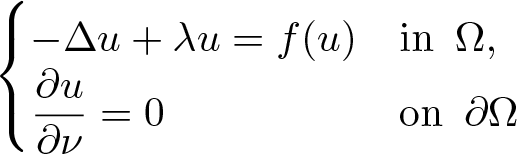 \begin{equation*}\begin{cases}-\Delta u+ \lambda u= f(u) & {\mathrm{in}} \,~ \Omega,\\\displaystyle\frac{\partial u}{\partial \nu}=0 \, &{\mathrm{on}}\,~\partial \Omega\end{cases}\end{equation*}
coupled with a constraint condition:
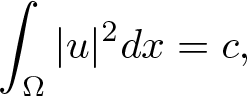 \begin{equation*}\int_{\Omega}|u|^2 dx=c,\end{equation*}
where $\Omega\subset \mathbb{R}^N(N\ge3)$ denotes a smooth bounded domain, ν represents the unit outer normal vector to $\partial \Omega$, c is a positive constant, and λ acts as a Lagrange multiplier. When the non-linearity f exhibits a general mass supercritical growth at infinity, we establish the existence of normalized solutions, which are not necessarily positive solutions and can be characterized as mountain pass type critical points of the associated constraint functional. Our approach provides a uniform treatment of various non-linearities, including cases such as $f(u)=|u|^{p-2}u$, $|u|^{q-2}u+ |u|^{p-2}u$, and $-|u|^{q-2}u+|u|^{p-2}u$, where $2 \lt q \lt 2+\frac{4}{N} \lt p \lt 2^*$. The result is obtained through a combination of a minimax principle with Morse index information for constrained functionals and a novel blow-up analysis for the NLS equation under Neumann boundary conditions.

Spatio-temporal dynamics of a lattice prey–predator system with non-local diffusion in a periodic habitat
- Part of
-
- Journal:
- Proceedings of the Royal Society of Edinburgh. Section A: Mathematics , First View
- Published online by Cambridge University Press:
- 31 March 2025, pp. 1-43
-
- Article
- Export citation
A logarithmic uncertainty principle for functions with radial symmetry
- Part of
-
- Journal:
- Proceedings of the Edinburgh Mathematical Society / Volume 68 / Issue 3 / August 2025
- Published online by Cambridge University Press:
- 31 March 2025, pp. 811-824
-
- Article
- Export citation
-
In this paper, we prove a new uncertainty principle for functions with radial symmetry by differentiating a radial version of the Stein–Weiss inequality. The difficulty is to prove the differentiability in the limit of the best constant that unlike the general case it is not known. We provide also an integral alternative formula for the logarithmic weight $(\log|\xi|)$ in Fourier domain.

Hardy and Rellich Inequalities with Bessel Pairs
- Part of
-
- Journal:
- Proceedings of the Edinburgh Mathematical Society / Volume 68 / Issue 3 / August 2025
- Published online by Cambridge University Press:
- 31 March 2025, pp. 825-842
-
- Article
-
- You have access
- Open access
- HTML
- Export citation
-
In this paper, we establish suitable characterisations for a pair of functions $(W(x),H(x))$ on a bounded, connected domain $\Omega \subset \mathbb{R}^n$ in order to have the following Hardy inequality:
 \begin{equation*}\int_{\Omega} W(x) |\nabla u|_A^2 dx \geq \int_{\Omega} |\nabla d|^2_AH(x)|u|^2 dx, \,\,\, u \in C^{1}_0(\Omega),\end{equation*}
where d(x) is a suitable quasi-norm (gauge), $|\xi|^2_A = \langle A(x)\xi, \xi \rangle$ for $\xi \in \mathbb{R}^n$ and A(x) is an n × n symmetric, uniformly positive definite matrix defined on a bounded domain $\Omega \subset \mathbb{R}^n$. We also give its Lp analogue. As a consequence, we present examples for a standard Laplacian on $\mathbb{R}^n$, Baouendi–Grushin operator, and sub-Laplacians on the Heisenberg group, the Engel group and the Cartan group. Those kind of characterisations for a pair of functions $(W(x),H(x))$ are obtained also for the Rellich inequality. These results answer the open problems of Ghoussoub-Moradifam [16].


Bounds on the Pythagoras number and indecomposables in biquadratic fields
- Part of
-
- Journal:
- Proceedings of the Edinburgh Mathematical Society / Volume 68 / Issue 3 / August 2025
- Published online by Cambridge University Press:
- 31 March 2025, pp. 843-868
-
- Article
- Export citation
-
We show that for all real biquadratic fields not containing $\sqrt{2}$, $\sqrt{3}$, $\sqrt{5}$, $\sqrt{6}$, $\sqrt{7}$ and $\sqrt{13}$, the Pythagoras number of the ring of algebraic integers is at least 6. We also provide an upper bound on the norm and the minimal (codifferent) trace of additively indecomposable integers in some families of these fields.


GMJ volume 67 issue 2 Cover and Back matter
-
- Journal:
- Glasgow Mathematical Journal / Volume 67 / Issue 2 / May 2025
- Published online by Cambridge University Press:
- 28 March 2025, pp. b1-b2
-
- Article
-
- You have access
- Export citation
Every locally compact group is the outer automorphism group of a II1 factor
- Part of
-
- Journal:
- Proceedings of the Royal Society of Edinburgh. Section A: Mathematics , First View
- Published online by Cambridge University Press:
- 28 March 2025, pp. 1-12
-
- Article
- Export citation
-
We prove that every locally compact second countable group G arises as the outer automorphism group $\operatorname{Out} M$ of a II1 factor, which was so far only known for totally disconnected groups, compact groups, and a few isolated examples. We obtain this result by proving that every locally compact second countable group is a centralizer group, a class of Polish groups that arise naturally in ergodic theory and that may all be realized as $\operatorname{Out} M$.
GMJ volume 67 issue 2 Cover and Front matter
-
- Journal:
- Glasgow Mathematical Journal / Volume 67 / Issue 2 / May 2025
- Published online by Cambridge University Press:
- 28 March 2025, pp. f1-f2
-
- Article
-
- You have access
- Export citation
How to beat a Bayesian adversary
- Part of
-
- Journal:
- European Journal of Applied Mathematics / Volume 37 / Issue 1 / February 2026
- Published online by Cambridge University Press:
- 28 March 2025, pp. 73-95
-
- Article
-
- You have access
- Open access
- HTML
- Export citation
TEICHMÜLLER CURVES IN HYPERELLIPTIC COMPONENTS OF MEROMORPHIC STRATA
- Part of
-
- Journal:
- Journal of the Institute of Mathematics of Jussieu / Volume 24 / Issue 4 / July 2025
- Published online by Cambridge University Press:
- 26 March 2025, pp. 1521-1546
- Print publication:
- July 2025
-
- Article
- Export citation
Iterating additive polynomials over finite fields
- Part of
-
- Journal:
- Proceedings of the Edinburgh Mathematical Society / Volume 68 / Issue 3 / August 2025
- Published online by Cambridge University Press:
- 25 March 2025, pp. 795-810
-
- Article
- Export citation
-
Let q be a power of a prime p, let $\mathbb F_q$ be the finite field with q elements and, for each nonconstant polynomial $F\in \mathbb F_{q}[X]$ and each integer $n\ge 1$, let $s_F(n)$ be the degree of the splitting field (over $\mathbb F_q$) of the iterated polynomial $F^{(n)}(X)$. In 1999, Odoni proved that $s_A(n)$ grows linearly with respect to n if $A\in \mathbb F_q[X]$ is an additive polynomial not of the form $aX^{p^h}$; moreover, if q = p and $B(X)=X^p-X$, he obtained the formula $s_{B}(n)=p^{\lceil \log_p n\rceil}$. In this paper we note that $s_F(n)$ grows at least linearly unless $F\in \mathbb F_q[X]$ has an exceptional form and we obtain a stronger form of Odoni’s result, extending it to affine polynomials. In particular, we prove that if A is additive, then $s_A(n)$ resembles the step function $p^{\lceil \log_p n\rceil}$ and we indeed have the identity $s_A(n)=\alpha p^{\lceil \log_p \beta n\rceil}$ for some $\alpha, \beta\in \mathbb Q$, unless A presents a special irregularity of dynamical flavour. As applications of our main result, we obtain statistics for periodic points of linear maps over $\mathbb F_{q^i}$ as $i\to +\infty$ and for the factorization of iterates of affine polynomials over finite fields.


