Refine search
Actions for selected content:
26063 results in Abstract analysis
The invariant subspaces of periodic Fourier multipliers with application to abstract evolution equations
- Part of
-
- Journal:
- Proceedings of the Royal Society of Edinburgh. Section A: Mathematics , First View
- Published online by Cambridge University Press:
- 24 June 2025, pp. 1-47
-
- Article
- Export citation
-
By methods of harmonic analysis, we identify large classes of Banach spaces invariant of periodic Fourier multipliers with symbols satisfying the classical Marcinkiewicz type conditions. Such classes include general (vector-valued) Banach function spaces Φ and/or the scales of Besov and Triebel–Lizorkin spaces defined on the basis of Φ.
We apply these results to the study of the well-posedness and maximal regularity property of an abstract second-order integro-differential equation, which models various types of elliptic and parabolic problems arising in different areas of applied mathematics. In particular, under suitable conditions imposed on a convolutor c and the geometry of an underlying Banach space X, we characterize the conditions on the operators A, B, and P on X such that the following periodic problem
 \begin{equation*}\partial P \partial u + B \partial u + {A} u + c \ast u = f \qquad \textrm{in } {\mathcal D}'({\mathbb{T}}; X)\end{equation*}
is well-posed with respect to large classes of function spaces. The obtained results extend the known theory on the maximal regularity of such problem.
JMJ volume 24 issue 4 Cover and Back matter
-
- Journal:
- Journal of the Institute of Mathematics of Jussieu / Volume 24 / Issue 4 / July 2025
- Published online by Cambridge University Press:
- 23 June 2025, pp. b1-b2
- Print publication:
- July 2025
-
- Article
-
- You have access
- Export citation
PEM series 2 volume 68 issue 2 Cover and Back matter
-
- Journal:
- Proceedings of the Edinburgh Mathematical Society / Volume 68 / Issue 2 / May 2025
- Published online by Cambridge University Press:
- 23 June 2025, pp. b1-b2
-
- Article
-
- You have access
- Export citation
PEM series 2 volume 68 issue 2 Cover and Front matter
-
- Journal:
- Proceedings of the Edinburgh Mathematical Society / Volume 68 / Issue 2 / May 2025
- Published online by Cambridge University Press:
- 23 June 2025, pp. f1-f2
-
- Article
-
- You have access
- Export citation
JMJ volume 24 issue 4 Cover and Front matter
-
- Journal:
- Journal of the Institute of Mathematics of Jussieu / Volume 24 / Issue 4 / July 2025
- Published online by Cambridge University Press:
- 23 June 2025, pp. f1-f2
- Print publication:
- July 2025
-
- Article
-
- You have access
- Export citation
Truncated Jacobi triple product series II: Li, Lin, and Wang’s nonnegativity conjecture
- Part of
-
- Journal:
- Proceedings of the Royal Society of Edinburgh. Section A: Mathematics , First View
- Published online by Cambridge University Press:
- 19 June 2025, pp. 1-15
-
- Article
- Export citation
-
The investigation of truncated theta series was popularized by Andrews and Merca. In this article, we establish an explicit expression with nonnegative coefficients for the bivariate truncated Jacobi triple product series:
 \begin{equation*}\frac{1}{(z,q/z,q;q)_\infty}\sum_{n=0}^{m}(-1)^n(1-z^{n+1})(1-(q/z)^{n+1})q^{\binom{n+1}{2}},\end{equation*}
which can be regarded as a companion to Wang and Yee’s truncation of the triple product identity. As applications, our result confirms a conjecture of Li, Lin, and Wang and implies a family of linear inequalities for a bi-parametric partition function. We also work on another truncated triple product series arising from the work of Xia, Yee, and Zhao and derive similar nonnegativity results and linear inequalities.
Optimal function spaces in weighted Sobolev embeddings with α-homogeneous weights
- Part of
-
- Journal:
- Proceedings of the Royal Society of Edinburgh. Section A: Mathematics , First View
- Published online by Cambridge University Press:
- 19 June 2025, pp. 1-30
-
- Article
-
- You have access
- Open access
- HTML
- Export citation
Congruences modulo powers of 5 for partition k-tuples with 5-cores
- Part of
-
- Journal:
- Proceedings of the Edinburgh Mathematical Society / Volume 68 / Issue 4 / November 2025
- Published online by Cambridge University Press:
- 17 June 2025, pp. 1245-1261
-
- Article
- Export citation
-
A partition is called a t-core if none of its hook lengths is a multiple of t. Let $a_t(n)$ denote the number of t-core partitions of n. Garvan, Kim and Stanton proved that for any $n\geq1$ and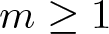 $m\geq1$, $a_t\big(t^mn-(t^2-1)/24\big)\equiv0\pmod{t^m}$, where $t\in\{5,7,11\}$. Let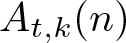 $A_{t,k}(n)$ denote the number of partition k-tuples of n with t-cores. Several scholars have been subsequently investigated congruence properties modulo high powers of 5 for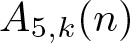 $A_{5,k}(n)$ with $k\in\{2,3,4\}$. In this paper, by utilizing a recurrence related to the modular equation of fifth order, we establish dozens of congruence families modulo high powers of 5 satisfied by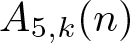 $A_{5,k}(n)$, where $4\leq k\leq25$. Moreover, we deduce an infinite family of internal congruences modulo high powers of 5 for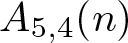 $A_{5,4}(n)$. In particular, we generalize greatly a recent result on a congruence family modulo high powers of 5 enjoyed by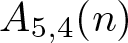 $A_{5,4}(n)$, which was proved by Saikia, Sarma and Talukdar (Indian J. Pure Appl. Math., 2024). Finally, we conjecture that there exists a similar phenomenon for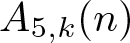 $A_{5,k}(n)$ with $k\geq26$.


Sharp estimates for Gowers norms on discrete cubes
- Part of
-
- Journal:
- Proceedings of the Royal Society of Edinburgh. Section A: Mathematics , First View
- Published online by Cambridge University Press:
- 16 June 2025, pp. 1-27
-
- Article
- Export citation
-
We study optimal dimensionless inequalities
 \begin{equation*} \|f\|_{\textrm{U}^k} \leqslant \|f\|_{\ell^{p_{k,n}}} \end{equation*}
that hold for all functions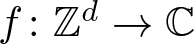 $f\colon\mathbb{Z}^d\to\mathbb{C}$ supported in $\{0,1,\ldots,n-1\}^d$ and estimates
 \begin{equation*} \|\mathbb{1}_A\|_{\textrm{U}^k}^{2^k}\leqslant |A|^{t_{k,n}} \end{equation*}
that hold for all subsets A of the same discrete cubes. A general theory, analogous to the work of de Dios Pont, Greenfeld, Ivanisvili, and Madrid, is developed to show that the critical exponents are related by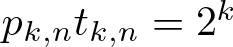 $p_{k,n} t_{k,n} = 2^k$. This is used to prove the three main results of the article:
• an explicit formula for $t_{k,2}$, which generalizes a theorem by Kane and Tao,
• two-sided asymptotic estimates for $t_{k,n}$ as $n\to\infty$ for a fixed $k\geqslant2$, which generalize a theorem by Shao, and
• a precise asymptotic formula for $t_{k,n}$ as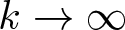 $k\to\infty$ for a fixed $n\geqslant2$.


MIRROR SYMMETRY FOR TROPICAL HYPERSURFACES AND PATCHWORKING
- Part of
-
- Journal:
- Journal of the Institute of Mathematics of Jussieu / Volume 24 / Issue 6 / November 2025
- Published online by Cambridge University Press:
- 11 June 2025, pp. 2387-2425
- Print publication:
- November 2025
-
- Article
-
- You have access
- Open access
- HTML
- Export citation
RIGIDITY FOR VON NEUMANN ALGEBRAS OF GRAPH PRODUCT GROUPS II. SUPERRIGIDITY RESULTS - ADDENDUM
-
- Journal:
- Journal of the Institute of Mathematics of Jussieu / Volume 24 / Issue 6 / November 2025
- Published online by Cambridge University Press:
- 11 June 2025, p. 2133
- Print publication:
- November 2025
-
- Article
- Export citation
ALGEBRAIC DYNAMICAL SYSTEMS FROM LDPC CODES SATISFY A STRONG NEGATION OF THE WEAK PINSKER PROPERTY
- Part of
-
- Journal:
- Journal of the Institute of Mathematics of Jussieu / Volume 24 / Issue 6 / November 2025
- Published online by Cambridge University Press:
- 09 June 2025, pp. 2317-2385
- Print publication:
- November 2025
-
- Article
-
- You have access
- Open access
- HTML
- Export citation
-
We construct an explicit algebraic example of a subshift of finite type over a group $\Gamma $ with an invariant Markov measure which has completely positive sofic entropy (with respect to ‘most’ sofic approximations) and yet does not have a direct Bernoulli factor because its model spaces shatter into exponentially many clusters of sub-exponential size. The example and its analysis are related to random low-density parity-check (LDPC) codes.

INTEGRABLE MODULES OVER QUANTUM SYMMETRIC PAIR COIDEAL SUBALGEBRAS
- Part of
-
- Journal:
- Journal of the Institute of Mathematics of Jussieu / Volume 24 / Issue 6 / November 2025
- Published online by Cambridge University Press:
- 05 June 2025, pp. 2257-2282
- Print publication:
- November 2025
-
- Article
- Export citation
-
We introduce the notion of integrable modules over $\imath $quantum groups (a.k.a. quantum symmetric pair coideal subalgebras). After determining a presentation of such modules, we prove that each integrable module over a quantum group is integrable when restricted to an $\imath $quantum group. As an application, we show that the space of matrix coefficients of all simple integrable modules over an $\imath $quantum group of finite type with specific parameters coincides with Bao-Song’s coordinate ring of the $\imath $quantum group.


SIMPLE TRACIALLY $\mathcal {Z}$-ABSORBING C*-ALGEBRAS
- Part of
-
- Journal:
- Journal of the Institute of Mathematics of Jussieu / Volume 24 / Issue 6 / November 2025
- Published online by Cambridge University Press:
- 04 June 2025, pp. 2135-2179
- Print publication:
- November 2025
-
- Article
- Export citation
-
We define a notion of tracial $\mathcal {Z}$-absorption for simple not necessarily unital C*-algebras, study it systematically and prove its permanence properties. This extends the notion defined by Hirshberg and Orovitz for unital C*-algebras. The Razak-Jacelon algebra, simple nonelementary C*-algebras with tracial rank zero, and simple purely infinite C*-algebras are tracially $\mathcal {Z}$-absorbing. We obtain the first purely infinite examples of tracially $\mathcal {Z}$-absorbing C*-algebras which are not $\mathcal {Z}$-absorbing. We use techniques from reduced free products of von Neumann algebras to construct these examples. A stably finite example was given by Z. Niu and Q. Wang in 2021. We study the Cuntz semigroup of a simple tracially $\mathcal {Z}$-absorbing C*-algebra and prove that it is almost unperforated and the algebra is weakly almost divisible.


Tight Hamilton cycles with high discrepancy
- Part of
-
- Journal:
- Combinatorics, Probability and Computing / Volume 34 / Issue 4 / July 2025
- Published online by Cambridge University Press:
- 30 May 2025, pp. 565-584
-
- Article
-
- You have access
- Open access
- HTML
- Export citation
-
In this paper, we study discrepancy questions for spanning subgraphs of $k$-uniform hypergraphs. Our main result is that, for any integers $k \ge 3$ and $r \ge 2$, any $r$-colouring of the edges of a $k$-uniform $n$-vertex hypergraph $G$ with minimum $(k-1)$-degree $\delta (G) \ge (1/2+o(1))n$ contains a tight Hamilton cycle with high discrepancy, that is, with at least $n/r+\Omega (n)$ edges of one colour. The minimum degree condition is asymptotically best possible and our theorem also implies a corresponding result for perfect matchings. Our tools combine various structural techniques such as Turán-type problems and hypergraph shadows with probabilistic techniques such as random walks and the nibble method. We also propose several intriguing problems for future research.


Elliptic singularities and threefold flops in positive characteristic
- Part of
-
- Journal:
- Proceedings of the Edinburgh Mathematical Society / Volume 68 / Issue 4 / November 2025
- Published online by Cambridge University Press:
- 27 May 2025, pp. 1188-1244
-
- Article
- Export citation
A multiscale model for espresso brewing: Asymptotic analysis and numerical simulation
- Part of
-
- Journal:
- European Journal of Applied Mathematics / Volume 37 / Issue 2 / April 2026
- Published online by Cambridge University Press:
- 27 May 2025, pp. 496-519
-
- Article
-
- You have access
- Open access
- HTML
- Export citation
Cahn–Hilliard equations with singular potential, reaction term and pure phase initial datum
- Part of
-
- Journal:
- European Journal of Applied Mathematics / Volume 37 / Issue 2 / April 2026
- Published online by Cambridge University Press:
- 27 May 2025, pp. 470-495
-
- Article
-
- You have access
- Open access
- HTML
- Export citation
Gelfand–Tsetlin crystals
- Part of
-
- Journal:
- Glasgow Mathematical Journal / Volume 68 / Issue 1 / January 2026
- Published online by Cambridge University Press:
- 22 May 2025, pp. 120-133
-
- Article
- Export citation
Property (◇) for Ore extensions of small Krull dimension
- Part of
-
- Journal:
- Proceedings of the Edinburgh Mathematical Society / Volume 68 / Issue 4 / November 2025
- Published online by Cambridge University Press:
- 21 May 2025, pp. 1169-1187
-
- Article
-
- You have access
- Open access
- HTML
- Export citation
-
This paper is a continuation of a project to determine which skew polynomial algebras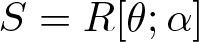 $S = R[\theta; \alpha]$ satisfy property $(\diamond)$, namely that the injective hull of every simple S-module is locally Artinian, where k is a field, R is a commutative Noetherian k-algebra and α is a k-algebra automorphism of R. Earlier work (which we review) and further analysis done here lead us to focus on the case where S is a primitive domain and R has Krull dimension 1 and contains an uncountable field. Then we show first that if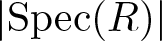 $|\mathrm{Spec}(R)|$ is infinite then S does not satisfy $(\diamond)$. Secondly, we show that when $R = k[X]_{ \lt X \gt }$ and $\alpha (X) = qX$ where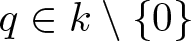 $q \in k \setminus \{0\}$ is not a root of unity then S does not satisfy $(\diamond)$. This is in complete contrast to our earlier result that, when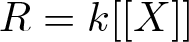 $R = k[[X]]$ and α is an arbitrary k-algebra automorphism of infinite order, S satisfies $(\diamond)$. A number of open questions are stated.


