Refine search
Actions for selected content:
9084 results in Discrete Mathematics, Information Theory and Coding
Chapter 10. - Examples of Coxeter bialgebras
-
- Book:
- Coxeter Bialgebras
- Published online:
- 27 October 2022
- Print publication:
- 17 November 2022, pp 456-521
-
- Chapter
- Export citation
Chapter 15. - Coxeter bimonoids and Coxeter bialgebras
-
- Book:
- Coxeter Bialgebras
- Published online:
- 27 October 2022
- Print publication:
- 17 November 2022, pp 687-713
-
- Chapter
- Export citation
Brownian bridge expansions for Lévy area approximations and particular values of the Riemann zeta function
- Part of
-
- Journal:
- Combinatorics, Probability and Computing / Volume 32 / Issue 3 / May 2023
- Published online by Cambridge University Press:
- 03 November 2022, pp. 370-397
-
- Article
-
- You have access
- Open access
- HTML
- Export citation

Coxeter Bialgebras
-
- Published online:
- 27 October 2022
- Print publication:
- 17 November 2022
Approximately symmetric forms far from being exactly symmetric
- Part of
-
- Journal:
- Combinatorics, Probability and Computing / Volume 32 / Issue 2 / March 2023
- Published online by Cambridge University Press:
- 18 October 2022, pp. 299-315
-
- Article
- Export citation
-
Let $V$ be a finite-dimensional vector space over $\mathbb{F}_p$. We say that a multilinear form $\alpha \colon V^k \to \mathbb{F}_p$ in $k$ variables is $d$-approximately symmetric if the partition rank of difference $\alpha (x_1, \ldots, x_k) - \alpha (x_{\pi (1)}, \ldots, x_{\pi (k)})$ is at most $d$ for every permutation $\pi \in \textrm{Sym}_k$. In a work concerning the inverse theorem for the Gowers uniformity $\|\!\cdot\! \|_{\mathsf{U}^4}$ norm in the case of low characteristic, Tidor conjectured that any $d$-approximately symmetric multilinear form $\alpha \colon V^k \to \mathbb{F}_p$ differs from a symmetric multilinear form by a multilinear form of partition rank at most $O_{p,k,d}(1)$ and proved this conjecture in the case of trilinear forms. In this paper, somewhat surprisingly, we show that this conjecture is false. In fact, we show that approximately symmetric forms can be quite far from the symmetric ones, by constructing a multilinear form $\alpha \colon \mathbb{F}_2^n \times \mathbb{F}_2^n \times \mathbb{F}_2^n \times \mathbb{F}_2^n \to \mathbb{F}_2$ which is 3-approximately symmetric, while the difference between $\alpha$ and any symmetric multilinear form is of partition rank at least $\Omega (\sqrt [3]{n})$.


On mappings on the hypercube with small average stretch
- Part of
-
- Journal:
- Combinatorics, Probability and Computing / Volume 32 / Issue 2 / March 2023
- Published online by Cambridge University Press:
- 18 October 2022, pp. 334-348
-
- Article
- Export citation
-
Let $A \subseteq \{0,1\}^n$ be a set of size $2^{n-1}$, and let $\phi \,:\, \{0,1\}^{n-1} \to A$ be a bijection. We define the average stretch of $\phi$ aswhere the expectation is taken over uniformly random
 \begin{equation*} {\sf avgStretch}(\phi ) = {\mathbb E}[{{\sf dist}}(\phi (x),\phi (x'))], \end{equation*} $x,x' \in \{0,1\}^{n-1}$ that differ in exactly one coordinate.
In this paper, we continue the line of research studying mappings on the discrete hypercube with small average stretch. We prove the following results.
For any set $A \subseteq \{0,1\}^n$ of density $1/2$ there exists a bijection $\phi _A \,:\, \{0,1\}^{n-1} \to A$ such that ${\sf avgStretch}(\phi _A) = O\left(\sqrt{n}\right)$.
For $n = 3^k$ let ${A_{\textsf{rec-maj}}} = \{x \in \{0,1\}^n \,:\,{\textsf{rec-maj}}(x) = 1\}$, where ${\textsf{rec-maj}} \,:\, \{0,1\}^n \to \{0,1\}$ is the function recursive majority of 3’s. There exists a bijection $\phi _{{\textsf{rec-maj}}} \,:\, \{0,1\}^{n-1} \to{A_{\textsf{rec-maj}}}$ such that ${\sf avgStretch}(\phi _{{\textsf{rec-maj}}}) = O(1)$.
Let ${A_{{\sf tribes}}} = \{x \in \{0,1\}^n \,:\,{\sf tribes}(x) = 1\}$. There exists a bijection $\phi _{{\sf tribes}} \,:\, \{0,1\}^{n-1} \to{A_{{\sf tribes}}}$ such that ${\sf avgStretch}(\phi _{{\sf tribes}}) = O(\!\log (n))$.
These results answer the questions raised by Benjamini, Cohen, and Shinkar (Isr. J. Math 2016).


Polynomials over structured grids
- Part of
-
- Journal:
- Combinatorics, Probability and Computing / Volume 32 / Issue 2 / March 2023
- Published online by Cambridge University Press:
- 04 October 2022, pp. 284-298
-
- Article
- Export citation
Sparse recovery properties of discrete random matrices
- Part of
-
- Journal:
- Combinatorics, Probability and Computing / Volume 32 / Issue 2 / March 2023
- Published online by Cambridge University Press:
- 04 October 2022, pp. 316-325
-
- Article
-
- You have access
- Open access
- HTML
- Export citation
-
Motivated by problems from compressed sensing, we determine the threshold behaviour of a random $n\times d \pm 1$ matrix $M_{n,d}$ with respect to the property ‘every $s$ columns are linearly independent’. In particular, we show that for every $0\lt \delta \lt 1$ and $s=(1-\delta )n$, if $d\leq n^{1+1/2(1-\delta )-o(1)}$ then with high probability every $s$ columns of $M_{n,d}$ are linearly independent, and if $d\geq n^{1+1/2(1-\delta )+o(1)}$ then with high probability there are some $s$ linearly dependent columns.


Improved bound for improper colourings of graphs with no odd clique minor
- Part of
-
- Journal:
- Combinatorics, Probability and Computing / Volume 32 / Issue 2 / March 2023
- Published online by Cambridge University Press:
- 30 September 2022, pp. 326-333
-
- Article
-
- You have access
- Open access
- HTML
- Export citation
-
Strengthening Hadwiger’s conjecture, Gerards and Seymour conjectured in 1995 that every graph with no odd $K_t$-minor is properly $(t-1)$-colourable. This is known as the Odd Hadwiger’s conjecture. We prove a relaxation of the above conjecture, namely we show that every graph with no odd $K_t$-minor admits a vertex $(2t-2)$-colouring such that all monochromatic components have size at most $\lceil \frac{1}{2}(t-2) \rceil$. The bound on the number of colours is optimal up to a factor of $2$, improves previous bounds for the same problem by Kawarabayashi (2008, Combin. Probab. Comput. 17 815–821), Kang and Oum (2019, Combin. Probab. Comput. 28 740–754), Liu and Wood (2021, arXiv preprint, arXiv:1905.09495), and strengthens a result by van den Heuvel and Wood (2018, J. Lond. Math. Soc. 98 129–148), who showed that the above conclusion holds under the more restrictive assumption that the graph is $K_t$-minor-free. In addition, the bound on the component-size in our result is much smaller than those of previous results, in which the dependency on $t$ was given by a function arising from the graph minor structure theorem of Robertson and Seymour. Our short proof combines the method by van den Heuvel and Wood for $K_t$-minor-free graphs with some additional ideas, which make the extension to odd $K_t$-minor-free graphs possible.


Towards the 0-statement of the Kohayakawa-Kreuter conjecture
- Part of
-
- Journal:
- Combinatorics, Probability and Computing / Volume 32 / Issue 2 / March 2023
- Published online by Cambridge University Press:
- 27 September 2022, pp. 225-268
-
- Article
-
- You have access
- Open access
- HTML
- Export citation
-
In this paper, we study asymmetric Ramsey properties of the random graph $G_{n,p}$. Let $r \in \mathbb{N}$ and $H_1, \ldots, H_r$ be graphs. We write $G_{n,p} \to (H_1, \ldots, H_r)$ to denote the property that whenever we colour the edges of $G_{n,p}$ with colours from the set $[r] \,{:\!=}\, \{1, \ldots, r\}$ there exists $i \in [r]$ and a copy of $H_i$ in $G_{n,p}$ monochromatic in colour $i$. There has been much interest in determining the asymptotic threshold function for this property. In several papers, Rödl and Ruciński determined a threshold function for the general symmetric case; that is, when $H_1 = \cdots = H_r$. A conjecture of Kohayakawa and Kreuter from 1997, if true, would fully resolve the asymmetric problem. Recently, the $1$-statement of this conjecture was confirmed by Mousset, Nenadov and Samotij.
Building on work of Marciniszyn, Skokan, Spöhel and Steger from 2009, we reduce the $0$-statement of Kohayakawa and Kreuter’s conjecture to a certain deterministic subproblem. To demonstrate the potential of this approach, we show this subproblem can be resolved for almost all pairs of regular graphs. This therefore resolves the $0$-statement for all such pairs of graphs.


Irregular subgraphs
- Part of
-
- Journal:
- Combinatorics, Probability and Computing / Volume 32 / Issue 2 / March 2023
- Published online by Cambridge University Press:
- 23 September 2022, pp. 269-283
-
- Article
- Export citation
-
We suggest two related conjectures dealing with the existence of spanning irregular subgraphs of graphs. The first asserts that any $d$-regular graph on $n$ vertices contains a spanning subgraph in which the number of vertices of each degree between $0$ and $d$ deviates from $\frac{n}{d+1}$ by at most $2$. The second is that every graph on $n$ vertices with minimum degree $\delta$ contains a spanning subgraph in which the number of vertices of each degree does not exceed $\frac{n}{\delta +1}+2$. Both conjectures remain open, but we prove several asymptotic relaxations for graphs with a large number of vertices $n$. In particular we show that if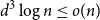 $d^3 \log n \leq o(n)$ then every $d$-regular graph with $n$ vertices contains a spanning subgraph in which the number of vertices of each degree between $0$ and $d$ is $(1+o(1))\frac{n}{d+1}$. We also prove that any graph with $n$ vertices and minimum degree $\delta$ contains a spanning subgraph in which no degree is repeated more than $(1+o(1))\frac{n}{\delta +1}+2$ times.


Uniqueness of the Gibbs measure for the 4-state anti-ferromagnetic Potts model on the regular tree
- Part of
-
- Journal:
- Combinatorics, Probability and Computing / Volume 32 / Issue 1 / January 2023
- Published online by Cambridge University Press:
- 07 September 2022, pp. 158-182
-
- Article
-
- You have access
- Open access
- HTML
- Export citation
-
We show that the $4$-state anti-ferromagnetic Potts model with interaction parameter $w\in (0,1)$ on the infinite $(d+1)$-regular tree has a unique Gibbs measure if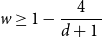 $w\geq 1-\dfrac{4}{d+1_{_{\;}}}$ for all $d\geq 4$. This is tight since it is known that there are multiple Gibbs measures when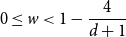 $0\leq w\lt 1-\dfrac{4}{d+1}$ and $d\geq 4$. We moreover give a new proof of the uniqueness of the Gibbs measure for the $3$-state Potts model on the $(d+1)$-regular tree for $w\geq 1-\dfrac{3}{d+1}$ when $d\geq 3$ and for $w\in (0,1)$ when $d=2$.


Degree sequences of sufficiently dense random uniform hypergraphs
- Part of
-
- Journal:
- Combinatorics, Probability and Computing / Volume 32 / Issue 2 / March 2023
- Published online by Cambridge University Press:
- 15 August 2022, pp. 183-224
-
- Article
- Export citation
-
We find an asymptotic enumeration formula for the number of simple $r$-uniform hypergraphs with a given degree sequence, when the number of edges is sufficiently large. The formula is given in terms of the solution of a system of equations. We give sufficient conditions on the degree sequence which guarantee existence of a solution to this system. Furthermore, we solve the system and give an explicit asymptotic formula when the degree sequence is close to regular. This allows us to establish several properties of the degree sequence of a random $r$-uniform hypergraph with a given number of edges. More specifically, we compare the degree sequence of a random $r$-uniform hypergraph with a given number edges to certain models involving sequences of binomial or hypergeometric random variables conditioned on their sum.


4 - Proofs
-
- Book:
- Connecting Discrete Mathematics and Computer Science
- Published online:
- 16 December 2022
- Print publication:
- 04 August 2022, pp 143-214
-
- Chapter
- Export citation
2 - Basic Data Types
-
- Book:
- Connecting Discrete Mathematics and Computer Science
- Published online:
- 16 December 2022
- Print publication:
- 04 August 2022, pp 5-78
-
- Chapter
- Export citation
Reviews
-
- Book:
- Connecting Discrete Mathematics and Computer Science
- Published online:
- 16 December 2022
- Print publication:
- 04 August 2022, pp ii-ii
-
- Chapter
- Export citation
List of Computer ScienceConnections
-
- Book:
- Connecting Discrete Mathematics and Computer Science
- Published online:
- 16 December 2022
- Print publication:
- 04 August 2022, pp xi-xii
-
- Chapter
- Export citation
Contents
-
- Book:
- Connecting Discrete Mathematics and Computer Science
- Published online:
- 16 December 2022
- Print publication:
- 04 August 2022, pp vii-x
-
- Chapter
- Export citation
1 - On the Point of this Book
-
- Book:
- Connecting Discrete Mathematics and Computer Science
- Published online:
- 16 December 2022
- Print publication:
- 04 August 2022, pp 1-4
-
- Chapter
- Export citation
Copyright page
-
- Book:
- Connecting Discrete Mathematics and Computer Science
- Published online:
- 16 December 2022
- Print publication:
- 04 August 2022, pp iv-iv
-
- Chapter
- Export citation
