Refine search
Actions for selected content:
6994 results in Mathematical modeling and methods
Necessary and sufficient condition for oscillations of neutral differential equations
-
- Journal:
- Journal of the Australian Mathematical Society. Series B. Applied Mathematics / Volume 28 / Issue 3 / January 1987
- Published online by Cambridge University Press:
- 17 February 2009, pp. 362-375
-
- Article
-
- You have access
- Export citation
-
Consider the neutral delay differential equation

where p ∈ R, τ ≥ 0, q1 > 0, σ1 ≥ 0, for i = 1, 2, …, k. We prove the following result.
Theorem. A necessary and sufficient condition for the oscillation of all solutions of Eq. (1) is that the characteristic equation
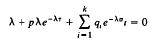
has no real roots.
The deformation of rubber cylinders and tubes by rotation
-
- Journal:
- Journal of the Australian Mathematical Society. Series B. Applied Mathematics / Volume 20 / Issue 1 / June 1977
- Published online by Cambridge University Press:
- 17 February 2009, pp. 62-96
-
- Article
-
- You have access
- Export citation
Conservation laws for second-order parabolic partial differential equations
-
- Journal:
- The ANZIAM Journal / Volume 45 / Issue 3 / January 2004
- Published online by Cambridge University Press:
- 17 February 2009, pp. 333-348
-
- Article
-
- You have access
- Export citation
On an inequality relating to sum sets
-
- Journal:
- Journal of the Australian Mathematical Society. Series B. Applied Mathematics / Volume 37 / Issue 2 / October 1995
- Published online by Cambridge University Press:
- 17 February 2009, pp. 208-211
-
- Article
-
- You have access
- Export citation
ANZ volume 46 issue 2 Cover and Back matter
-
- Journal:
- The ANZIAM Journal / Volume 46 / Issue 2 / October 2004
- Published online by Cambridge University Press:
- 17 February 2009, pp. b1-b3
-
- Article
-
- You have access
- Export citation
Low Reynolds number flow in a heated tube of varying section
-
- Journal:
- Journal of the Australian Mathematical Society. Series B. Applied Mathematics / Volume 25 / Issue 2 / October 1983
- Published online by Cambridge University Press:
- 17 February 2009, pp. 244-260
-
- Article
-
- You have access
- Export citation
The inverse fractional matching problem
-
- Journal:
- Journal of the Australian Mathematical Society. Series B. Applied Mathematics / Volume 40 / Issue 4 / April 1999
- Published online by Cambridge University Press:
- 17 February 2009, pp. 484-496
-
- Article
-
- You have access
- Export citation
Guide expansions for the recursive parametric solution of polynomial dynamical systems
-
- Journal:
- The ANZIAM Journal / Volume 47 / Issue 3 / January 2006
- Published online by Cambridge University Press:
- 17 February 2009, pp. 387-396
-
- Article
-
- You have access
- Export citation
Inertial manifold for a reaction diffusion equation model of competition in a chemostat
-
- Journal:
- Journal of the Australian Mathematical Society. Series B. Applied Mathematics / Volume 33 / Issue 1 / July 1991
- Published online by Cambridge University Press:
- 17 February 2009, pp. 9-15
-
- Article
-
- You have access
- Export citation
Robust guaranteed cost control for descriptor systems with Markov jumping parameters and state delays
-
- Journal:
- The ANZIAM Journal / Volume 47 / Issue 4 / April 2006
- Published online by Cambridge University Press:
- 17 February 2009, pp. 569-580
-
- Article
-
- You have access
- Export citation
On the dynamic analysis of a Leontief model with fixed capitial
-
- Journal:
- Journal of the Australian Mathematical Society. Series B. Applied Mathematics / Volume 27 / Issue 4 / April 1986
- Published online by Cambridge University Press:
- 17 February 2009, pp. 473-487
-
- Article
-
- You have access
- Export citation
The BMAP/G/1 vacation queue with queue-length dependent vacation schedule
-
- Journal:
- Journal of the Australian Mathematical Society. Series B. Applied Mathematics / Volume 40 / Issue 2 / October 1998
- Published online by Cambridge University Press:
- 17 February 2009, pp. 207-221
-
- Article
-
- You have access
- Export citation
Contents of Volume 25
-
- Journal:
- Journal of the Australian Mathematical Society. Series B. Applied Mathematics / Volume 25 / Issue 4 / April 1984
- Published online by Cambridge University Press:
- 17 February 2009, pp. 563-564
-
- Article
-
- You have access
- Export citation
Bifurcation phenomena for an oxidation reaction in a continuously stirred tank reactor. II Diabatic operation
-
- Journal:
- The ANZIAM Journal / Volume 45 / Issue 3 / January 2004
- Published online by Cambridge University Press:
- 17 February 2009, pp. 303-326
-
- Article
-
- You have access
- Export citation
Degree reduction of Bezier curves and its error analysis
-
- Journal:
- Journal of the Australian Mathematical Society. Series B. Applied Mathematics / Volume 36 / Issue 4 / April 1995
- Published online by Cambridge University Press:
- 17 February 2009, pp. 399-413
-
- Article
-
- You have access
- Export citation
ANZ volume 26 issue 4 Cover and Front matter
-
- Journal:
- Journal of the Australian Mathematical Society. Series B. Applied Mathematics / Volume 26 / Issue 4 / April 1985
- Published online by Cambridge University Press:
- 17 February 2009, pp. f1-f2
-
- Article
-
- You have access
- Export citation
Subharmonic orbits in an anharmonic oscillator
-
- Journal:
- Journal of the Australian Mathematical Society. Series B. Applied Mathematics / Volume 38 / Issue 3 / January 1997
- Published online by Cambridge University Press:
- 17 February 2009, pp. 307-315
-
- Article
-
- You have access
- Export citation
Integro-differential equations for the self-organisation of liver zones by competitive exclusion of cell-types
-
- Journal:
- Journal of the Australian Mathematical Society. Series B. Applied Mathematics / Volume 29 / Issue 2 / October 1987
- Published online by Cambridge University Press:
- 17 February 2009, pp. 156-194
-
- Article
-
- You have access
- Export citation
ANZ volume 45 issue 4 Cover and Front matter
-
- Journal:
- The ANZIAM Journal / Volume 45 / Issue 4 / April 2004
- Published online by Cambridge University Press:
- 17 February 2009, pp. f1-f4
-
- Article
-
- You have access
- Export citation
ANZ volume 36 issue 1 Cover and Front matter
-
- Journal:
- Journal of the Australian Mathematical Society. Series B. Applied Mathematics / Volume 36 / Issue 1 / July 1994
- Published online by Cambridge University Press:
- 17 February 2009, pp. f1-f2
-
- Article
-
- You have access
- Export citation
