Refine listing
Actions for selected content:
338 results in 05-XX
Asymptotics of pooling design performance
- Part of
-
- Journal:
- Journal of Applied Probability / Volume 36 / Issue 4 / December 1999
- Published online by Cambridge University Press:
- 14 July 2016, pp. 951-964
- Print publication:
- December 1999
-
- Article
- Export citation
Epidemic processes on digraphs of random mappings
- Part of
-
- Journal:
- Journal of Applied Probability / Volume 36 / Issue 3 / September 1999
- Published online by Cambridge University Press:
- 14 July 2016, pp. 780-798
- Print publication:
- September 1999
-
- Article
- Export citation
Asymptotics of poisson approximation to random discrete distributions: an analytic approach
- Part of
-
- Journal:
- Advances in Applied Probability / Volume 31 / Issue 2 / June 1999
- Published online by Cambridge University Press:
- 01 July 2016, pp. 448-491
- Print publication:
- June 1999
-
- Article
- Export citation
Renewal-type behavior of absorption times in Markov chains
- Part of
-
- Journal:
- Advances in Applied Probability / Volume 26 / Issue 4 / December 1994
- Published online by Cambridge University Press:
- 01 July 2016, pp. 988-1005
- Print publication:
- December 1994
-
- Article
- Export citation
Transient analysis of M/M/1 queues in discrete time by general server vacations
- Part of
-
- Journal:
- Journal of Applied Probability / Volume 31 / Issue A / 1994
- Published online by Cambridge University Press:
- 14 July 2016, pp. 115-129
- Print publication:
- 1994
-
- Article
- Export citation
Decomposition of sets of small or large boundary
- Part of
-
- Journal:
- Mathematika / Volume 40 / Issue 2 / December 1993
- Published online by Cambridge University Press:
- 26 February 2010, pp. 290-304
- Print publication:
- December 1993
-
- Article
- Export citation
-
We shall say that the sets A, B ⊂ Rk are equivalent, if they are equidecomposable using translations; that is, if there are finite decompositions
 and vectors x1,…, xd∈Rk such that Bj = Aj + xj, (j = 1,…,d). We shall denote this fact by
  In [3], Theorem 3 we proved that if A ⊂ Rk is a bounded measurable set of positive measure then A is equivalent to a cube provided that Δ(δA)<k where δA denotes the boundary of A and Δ(E) denotes the packing dimension (or box dimension or upper entropy index) of the bounded set E. This implies, in particular, that any bounded convex set of positive measure is equivalent to a cube. C. A. Rogers asked whether or not the set
 and vectors
  In [3], Theorem 3 we proved that if
On some first-crossing-time probabilities for a two-dimensional random walk with correlated components
- Part of
-
- Journal:
- Advances in Applied Probability / Volume 24 / Issue 2 / June 1992
- Published online by Cambridge University Press:
- 01 July 2016, pp. 441-454
- Print publication:
- June 1992
-
- Article
- Export citation
Asymptotic reliability of consecutive k-out-of-n systems
- Part of
-
- Journal:
- Journal of Applied Probability / Volume 29 / Issue 1 / March 1992
- Published online by Cambridge University Press:
- 14 July 2016, pp. 142-155
- Print publication:
- March 1992
-
- Article
- Export citation
Bijective Proofs of Some n-Color Partition Identities
- Part of
-
- Journal:
- Canadian Mathematical Bulletin / Volume 32 / Issue 3 / 01 September 1989
- Published online by Cambridge University Press:
- 20 November 2018, pp. 327-332
- Print publication:
- 01 September 1989
-
- Article
-
- You have access
- Export citation
Une Note sur les Coefficients Binomiaux de Gauss
- Part of
-
- Journal:
- Canadian Mathematical Bulletin / Volume 32 / Issue 3 / 01 September 1989
- Published online by Cambridge University Press:
- 20 November 2018, pp. 340-343
- Print publication:
- 01 September 1989
-
- Article
-
- You have access
- Export citation
On Kruskal's cascades and counting containments in a set of subsets
- Part of
-
- Journal:
- Mathematika / Volume 30 / Issue 1 / June 1983
- Published online by Cambridge University Press:
- 26 February 2010, pp. 133-141
- Print publication:
- June 1983
-
- Article
- Export citation
-
Let ℱ be a set of m subsets of X = {1,2,…, n}. We study the maximum number λ of containments Y ⊂ Z with Y, Z ∊ ℱ. Theorem 9.
 , if, and only if, ml/n → 1. When n is large and members of ℱ have cardinality k or k–1 we determine λ. For this we bound (ΔN)/N where ΔN is the shadow of Kruskal's k-cascade for the integer N. Roughly, if m ∼ N + ΔN, then λ ∼ kN with infinitely many cases of equality. A by-product is Theorem 7 of LYM posets.
 ,
, On ordered set systems and some conjectures related to the erdös–ko–rado theorem and turán's theorem
- Part of
-
- Journal:
- Mathematika / Volume 28 / Issue 1 / June 1981
- Published online by Cambridge University Press:
- 26 February 2010, pp. 54-66
- Print publication:
- June 1981
-
- Article
- Export citation
-
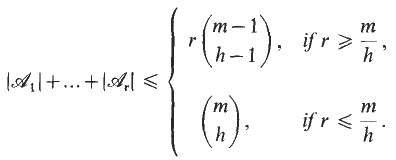
In [10] the following generalization of the Erdös–Ko–Rado [6] theorem was proved:
If 1 ≤ h ≤ m/2 and
 are r sets of h-subsets of {1,…, m} such that
then

Some intersection and union theorems for several families of finite sets
- Part of
-
- Journal:
- Mathematika / Volume 25 / Issue 1 / June 1978
- Published online by Cambridge University Press:
- 26 February 2010, pp. 125-128
- Print publication:
- June 1978
-
- Article
- Export citation
-
In this paper we prove two analogues of the following theorem:
If
 is a collection of distinct subsets of {1, …, m} such that
  , i ≠ j ⇒ Ai ∩ Aj ≠ ∅, Ai ∪ Aj ≠ {1, …, m} then
  .
.
 is a collection of distinct subsets of {1, …,
  ,
,  .
.An asymptotic expansion for the Wedderburn–Etherington sequence
- Part of
-
- Journal:
- Mathematika / Volume 24 / Issue 2 / December 1977
- Published online by Cambridge University Press:
- 26 February 2010, pp. 262-265
- Print publication:
- December 1977
-
- Article
- Export citation
On a problem of P. Erdős
- Part of
-
- Journal:
- Mathematika / Volume 20 / Issue 2 / December 1973
- Published online by Cambridge University Press:
- 26 February 2010, pp. 226-228
- Print publication:
- December 1973
-
- Article
- Export citation
On incomparable collections of sets
- Part of
-
- Journal:
- Mathematika / Volume 20 / Issue 2 / December 1973
- Published online by Cambridge University Press:
- 26 February 2010, pp. 208-209
- Print publication:
- December 1973
-
- Article
- Export citation
On the Euler characteristic of spherical polyhedra and the Euler relation
- Part of
-
- Journal:
- Mathematika / Volume 19 / Issue 2 / December 1972
- Published online by Cambridge University Press:
- 26 February 2010, pp. 139-143
- Print publication:
- December 1972
-
- Article
- Export citation
-
Let En+1, for some integer n ≥ 0, be the (n + 1)-dimensional Euclidean space, and denote by Sn the standard n–sphere in En+1,
 . It is convenient to introduce the (–1)-dimensional sphere
  , where
  denotes the empty set. By an i-dimensional subsphere T of Sn, i = 0 n, we understand the intersection of Sn with some (i+1)-dimensional subspace of En+1. The affine hull of T always contains, with this definition, the origin of En+1.
  is the unique (–1)-dimensional subsphere of Sn. By the spherical hull, sph X, of a set
  , we understand the intersection of all subspheres of Sn containing X. Further we set dim X: = dim sph X. The interior, the boundary and the complement of an arbitrary set
  , with respect to Sn, shall be denoted by int X, bd X and cpl X. Finally we define the relative interior rel int X to be the interior of
  with respect to the usual topology sphZ
  . For
. For  each (n–1)-dimensional subsphere of Sn defines two closed hemispheres of Sn, whose common boundary it is. The two hemispheres of the sphere Sº are denned to be the two one-pointed subsets of Sº. A subset
  is called a closed (spherical) polytope, if it is the intersection of finitely many closed hemispheres, and, if, in addition, it does not contain a subsphere of Sn.
  is called an i-dimensional, relatively open polytope,
  , or shortly an i-open polytope, if there exists a closed polytope
  such that dim P = i and Q = rel int P.
  is called a closed polyhedron, if it is a finite union of closed polytopes P1 …, Pr. The empty set
  is the only (–1)-dimensional closed polyhedron of Sn. We denote by
  the set of all closed polyhedra of Sn.
  is called an i-open polyhedron, for some
  , if there are finitely many i-open polytopes Q1 …, Qr in Sn such that
  , and dim
  . By
. By  we denote the set of all i-open polyhedra. Clearly
  for all
  , and each i-dimensional subsphere of Sn,
  , belongs to
  and to
  , For each i-dimensional subsphere T of Sn, set
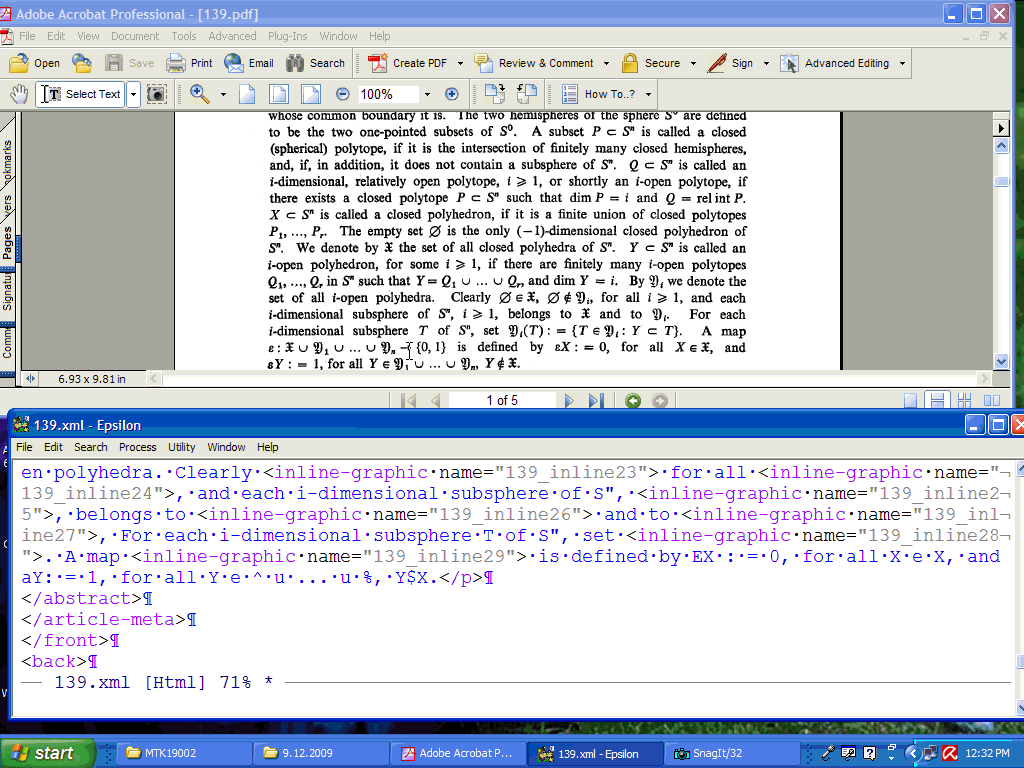
  . A map
  is defined by
  , for all
  , and, for all
  .
.
 . It is convenient to introduce the (–1)-dimensional sphere
  , where
  denotes the empty set. By an
  is the unique (–1)-dimensional subsphere of
  , we understand the intersection of all subspheres of
  , with respect to
  with respect to the usual topology sphZ
  . For
. For  each (
 is called a closed (spherical) polytope, if it is the intersection of finitely many closed hemispheres, and, if, in addition, it does not contain a subsphere of
  is called an
  , or shortly an
  such that dim
  is called a closed polyhedron, if it is a finite union of closed polytopes
  is the only (–1)-dimensional closed polyhedron of S
 the set of all closed polyhedra of S
 is called an
  , if there are finitely many
  , and dim
  . By
. By  we denote the set of all
  for all
  , and each
  , belongs to
  and to
  , For each
  . A map
  is defined by
  , for all
  , and, for all
  .
.An extension of stone's partitioning theorem for ordered sets
- Part of
-
- Journal:
- Mathematika / Volume 18 / Issue 1 / June 1971
- Published online by Cambridge University Press:
- 26 February 2010, pp. 5-7
- Print publication:
- June 1971
-
- Article
- Export citation
