Refine listing
Actions for selected content:
1073 results in 05Cxx
Spanning subdivisions in Dirac graphs
- Part of
-
- Journal:
- Combinatorics, Probability and Computing / Volume 33 / Issue 1 / January 2024
- Published online by Cambridge University Press:
- 20 October 2023, pp. 121-128
-
- Article
- Export citation
-
We show that for every $n\in \mathbb N$ and $\log n\le d\lt n$, if a graph $G$ has $N=\Theta (dn)$ vertices and minimum degree $(1+o(1))\frac{N}{2}$, then it contains a spanning subdivision of every $n$-vertex $d$-regular graph.


NOWHERE-ZERO $3$-FLOWS IN CAYLEY GRAPHS OF ORDER $8p$
$8p$
- Part of
-
- Journal:
- Bulletin of the Australian Mathematical Society / Volume 110 / Issue 1 / August 2024
- Published online by Cambridge University Press:
- 20 October 2023, pp. 1-11
- Print publication:
- August 2024
-
- Article
- Export citation
-
It is proved that Tutte’s $3$-flow conjecture is true for Cayley graphs on groups of order $8p$ where p is an odd prime.


Rainbow spanning structures in graph and hypergraph systems
- Part of
-
- Journal:
- Forum of Mathematics, Sigma / Volume 11 / 2023
- Published online by Cambridge University Press:
- 17 October 2023, e95
-
- Article
-
- You have access
- Open access
- HTML
- Export citation
-
We study the following rainbow version of subgraph containment problems in a family of (hyper)graphs, which generalizes the classical subgraph containment problems in a single host graph. For a collection $\mathit {\mathbf {G}}=\{G_1, G_2,\ldots , G_{m}\}$ of not necessarily distinct k-graphs on the same vertex set $[n]$, a (sub)graph H on $[n]$ is rainbow if there exists an injection $\varphi : E(H)\rightarrow [m]$, such that $e\in E(G_{\varphi (e)})$ for each $e\in E(H)$. Note that if $|E(H)|=m$, then $\varphi $ is a bijection, and thus H contains exactly one edge from each $G_i$.
Our main results focus on rainbow clique-factors in (hyper)graph systems with minimum d-degree conditions. Specifically, we establish the following:
(1) A rainbow analogue of an asymptotical version of the Hajnal–Szemerédi theorem, namely, if $t\mid n$ and $\delta (G_i)\geq (1-\frac {1}{t}+\varepsilon )n$ for each $i\in [\frac {n}{t}\binom {t}{2}]$, then $\mathit {\mathbf {G}}$ contains a rainbow $K_t$-factor;
(2) Essentially, a minimum d-degree condition forcing a perfect matching in a k-graph also forces rainbow perfect matchings in k-graph systems for $d\in [k-1]$.
The degree assumptions in both results are asymptotically best possible (although the minimum d-degree condition forcing a perfect matching in a k-graph is in general unknown). For (1), we also discuss two directed versions and a multipartite version. Finally, to establish these results, we in fact provide a general framework to attack this type of problem, which reduces it to subproblems with finitely many colors.


COMBINATORIAL BOUNDS IN DISTAL STRUCTURES
- Part of
-
- Journal:
- The Journal of Symbolic Logic / Volume 90 / Issue 4 / December 2025
- Published online by Cambridge University Press:
- 13 October 2023, pp. 1377-1409
- Print publication:
- December 2025
-
- Article
- Export citation
Quantum symmetries of Cayley graphs of abelian groups
- Part of
-
- Journal:
- Glasgow Mathematical Journal / Volume 65 / Issue 3 / September 2023
- Published online by Cambridge University Press:
- 12 October 2023, pp. 655-686
-
- Article
- Export citation
Many Hamiltonian subsets in large graphs with given density
- Part of
-
- Journal:
- Combinatorics, Probability and Computing / Volume 33 / Issue 1 / January 2024
- Published online by Cambridge University Press:
- 02 October 2023, pp. 110-120
-
- Article
- Export citation
-
A set of vertices in a graph is a Hamiltonian subset if it induces a subgraph containing a Hamiltonian cycle. Kim, Liu, Sharifzadeh, and Staden proved that for large $d$, among all graphs with minimum degree $d$,
$d$,  $K_{d+1}$ minimises the number of Hamiltonian subsets. We prove a near optimal lower bound that takes also the order and the structure of a graph into account. For many natural graph classes, it provides a much better bound than the extremal one ( $\approx 2^{d+1}$). Among others, our bound implies that an $n$-vertex $C_4$-free graph with minimum degree $d$ contains at least $n2^{d^{2-o(1)}}$ Hamiltonian subsets.


Categories of graphs for operadic structures
- Part of
-
- Journal:
- Mathematical Proceedings of the Cambridge Philosophical Society / Volume 176 / Issue 1 / January 2024
- Published online by Cambridge University Press:
- 28 September 2023, pp. 155-212
- Print publication:
- January 2024
-
- Article
- Export citation
On the metric dimension of circulant graphs
- Part of
-
- Journal:
- Canadian Mathematical Bulletin / Volume 67 / Issue 2 / June 2024
- Published online by Cambridge University Press:
- 28 September 2023, pp. 328-337
- Print publication:
- June 2024
-
- Article
- Export citation
-
In this note, we bound the metric dimension of the circulant graphs $C_n(1,2,\ldots ,t)$. We shall prove that if $n=2tk+t$ and if t is odd, then $\dim (C_n(1,2,\ldots ,t))=t+1$, which confirms Conjecture 4.1.1 in Chau and Gosselin (2017, Opuscula Mathematica 37, 509–534). In Vetrík (2017, Canadian Mathematical Bulletin 60, 206–216; 2020, Discussiones Mathematicae. Graph Theory 40, 67–76), the author has shown that $\dim (C_n(1,2,\ldots ,t))\leq t+\left \lceil \frac {p}{2}\right \rceil $ for $n=2tk+t+p$, where $t\geq 4$ is even, $1\leq p\leq t+1$, and $k\geq 1$. Inspired by his work, we show that $\dim (C_n(1,2,\ldots ,t))\leq t+\left \lfloor \frac {p}{2}\right \rfloor $ for $n=2tk+t+p$, where $t\geq 5$ is odd,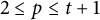 $2\leq p\leq t+1$, and $k\geq 2$.


Tower Gaps in Multicolour Ramsey Numbers
- Part of
-
- Journal:
- Forum of Mathematics, Sigma / Volume 11 / 2023
- Published online by Cambridge University Press:
- 21 September 2023, e84
-
- Article
-
- You have access
- Open access
- HTML
- Export citation
-
Resolving a problem of Conlon, Fox and Rödl, we construct a family of hypergraphs with arbitrarily large tower height separation between their $2$-colour and q-colour Ramsey numbers. The main lemma underlying this construction is a new variant of the Erdős–Hajnal stepping-up lemma for a generalized Ramsey number $r_k(t;q,p)$, which we define as the smallest integer n such that every q-colouring of the k-sets on n vertices contains a set of t vertices spanning fewer than p colours. Our results provide the first tower-type lower bounds on these numbers.


On the zeroes of hypergraph independence polynomials
- Part of
-
- Journal:
- Combinatorics, Probability and Computing / Volume 33 / Issue 1 / January 2024
- Published online by Cambridge University Press:
- 21 September 2023, pp. 65-84
-
- Article
-
- You have access
- Open access
- HTML
- Export citation
-
We study the locations of complex zeroes of independence polynomials of bounded-degree hypergraphs. For graphs, this is a long-studied subject with applications to statistical physics, algorithms, and combinatorics. Results on zero-free regions for bounded-degree graphs include Shearer’s result on the optimal zero-free disc, along with several recent results on other zero-free regions. Much less is known for hypergraphs. We make some steps towards an understanding of zero-free regions for bounded-degree hypergaphs by proving that all hypergraphs of maximum degree $\Delta$ have a zero-free disc almost as large as the optimal disc for graphs of maximum degree $\Delta$ established by Shearer (of radius $\sim 1/(e \Delta )$). Up to logarithmic factors in $\Delta$ this is optimal, even for hypergraphs with all edge sizes strictly greater than $2$. We conjecture that for $k\ge 3$, $k$-uniform linear hypergraphs have a much larger zero-free disc of radius $\Omega (\Delta ^{- \frac{1}{k-1}} )$. We establish this in the case of linear hypertrees.


CORRECTION TO ‘ON THE COMPLEMENT OF THE ZERO-DIVISOR GRAPH OF A PARTIALLY ORDERED SET’
- Part of
-
- Journal:
- Bulletin of the Australian Mathematical Society / Volume 109 / Issue 1 / February 2024
- Published online by Cambridge University Press:
- 18 September 2023, pp. 170-173
- Print publication:
- February 2024
-
- Article
- Export citation
CAYLEY GRAPHS AND GRAPHICAL REGULAR REPRESENTATIONS
- Part of
-
- Journal:
- Bulletin of the Australian Mathematical Society / Volume 109 / Issue 1 / February 2024
- Published online by Cambridge University Press:
- 15 September 2023, pp. 161-162
- Print publication:
- February 2024
-
- Article
-
- You have access
- HTML
- Export citation
COLORING ISOSCELES TRIANGLES IN CHOICELESS SET THEORY
- Part of
-
- Journal:
- The Journal of Symbolic Logic / Volume 90 / Issue 1 / March 2025
- Published online by Cambridge University Press:
- 11 September 2023, pp. 105-134
- Print publication:
- March 2025
-
- Article
- Export citation
-
It is consistent relative to an inaccessible cardinal that ZF+DC holds, and the hypergraph of isosceles triangles on $\mathbb {R}^2$ has countable chromatic number while the hypergraph of isosceles triangles on $\mathbb {R}^3$ has uncountable chromatic number.


ON THE DISTRIBUTION OF IWASAWA INVARIANTS ASSOCIATED TO MULTIGRAPHS
- Part of
-
- Journal:
- Nagoya Mathematical Journal / Volume 253 / March 2024
- Published online by Cambridge University Press:
- 08 September 2023, pp. 48-90
-
- Article
-
- You have access
- Open access
- HTML
- Export citation
-
Let $\ell $ be a prime number. The Iwasawa theory of multigraphs is the systematic study of growth patterns in the number of spanning trees in abelian $\ell $-towers of multigraphs. In this context, growth patterns are realized by certain analogs of Iwasawa invariants, which depend on the prime $\ell $ and the abelian $\ell $-tower of multigraphs. We formulate and study statistical questions about the behavior of the Iwasawa $\mu $ and $\lambda $ invariants.


On the size of maximal intersecting families
- Part of
-
- Journal:
- Combinatorics, Probability and Computing / Volume 33 / Issue 1 / January 2024
- Published online by Cambridge University Press:
- 08 September 2023, pp. 32-49
-
- Article
- Export citation
-
We show that an $n$-uniform maximal intersecting family has size at most $e^{-n^{0.5+o(1)}}n^n$. This improves a recent bound by Frankl ((2019) Comb. Probab. Comput. 28(5) 733–739.). The Spread Lemma of Alweiss et al. ((2020) Proceedings of the 52nd Annual ACM SIGACT Symposium on Theory of Computing.) plays an important role in the proof.


Rotor-Routing Induces the Only Consistent Sandpile Torsor Structure on Plane Graphs
- Part of
-
- Journal:
- Forum of Mathematics, Sigma / Volume 11 / 2023
- Published online by Cambridge University Press:
- 07 September 2023, e78
-
- Article
-
- You have access
- Open access
- HTML
- Export citation
Forcing generalised quasirandom graphs efficiently
- Part of
-
- Journal:
- Combinatorics, Probability and Computing / Volume 33 / Issue 1 / January 2024
- Published online by Cambridge University Press:
- 05 September 2023, pp. 16-31
-
- Article
-
- You have access
- Open access
- HTML
- Export citation
-
We study generalised quasirandom graphs whose vertex set consists of $q$ parts (of not necessarily the same sizes) with edges within each part and between each pair of parts distributed quasirandomly; such graphs correspond to the stochastic block model studied in statistics and network science. Lovász and Sós showed that the structure of such graphs is forced by homomorphism densities of graphs with at most $(10q)^q+q$ vertices; subsequently, Lovász refined the argument to show that graphs with $4(2q+3)^8$ vertices suffice. Our results imply that the structure of generalised quasirandom graphs with $q\ge 2$ parts is forced by homomorphism densities of graphs with at most $4q^2-q$ vertices, and, if vertices in distinct parts have distinct degrees, then $2q+1$ vertices suffice. The latter improves the bound of $8q-4$ due to Spencer.


Subgraph distributions in dense random regular graphs
- Part of
-
- Journal:
- Compositio Mathematica / Volume 159 / Issue 10 / October 2023
- Published online by Cambridge University Press:
- 25 August 2023, pp. 2125-2148
- Print publication:
- October 2023
-
- Article
- Export citation
-
Given a connected graph $H$ which is not a star, we show that the number of copies of $H$ in a dense uniformly random regular graph is asymptotically Gaussian, which was not known even for $H$ being a triangle. This addresses a question of McKay from the 2010 International Congress of Mathematicians. In fact, we prove that the behavior of the variance of the number of copies of $H$ depends in a delicate manner on the occurrence and number of cycles of $3,4,5$ edges as well as paths of $3$ edges in $H$. More generally, we provide control of the asymptotic distribution of certain statistics of bounded degree which are invariant under vertex permutations, including moments of the spectrum of a random regular graph. Our techniques are based on combining complex-analytic methods due to McKay and Wormald used to enumerate regular graphs with the notion of graph factors developed by Janson in the context of studying subgraph counts in $\mathbb {G}(n,p)$.


Anticoncentration in Ramsey graphs and a proof of the Erdős–McKay conjecture
- Part of
-
- Journal:
- Forum of Mathematics, Pi / Volume 11 / 2023
- Published online by Cambridge University Press:
- 24 August 2023, e21
-
- Article
-
- You have access
- Open access
- HTML
- Export citation
-
An n-vertex graph is called C-Ramsey if it has no clique or independent set of size $C\log _2 n$ (i.e., if it has near-optimal Ramsey behavior). In this paper, we study edge statistics in Ramsey graphs, in particular obtaining very precise control of the distribution of the number of edges in a random vertex subset of a C-Ramsey graph. This brings together two ongoing lines of research: the study of ‘random-like’ properties of Ramsey graphs and the study of small-ball probability for low-degree polynomials of independent random variables.
The proof proceeds via an ‘additive structure’ dichotomy on the degree sequence and involves a wide range of different tools from Fourier analysis, random matrix theory, the theory of Boolean functions, probabilistic combinatorics and low-rank approximation. In particular, a key ingredient is a new sharpened version of the quadratic Carbery–Wright theorem on small-ball probability for polynomials of Gaussians, which we believe is of independent interest. One of the consequences of our result is the resolution of an old conjecture of Erdős and McKay, for which Erdős reiterated in several of his open problem collections and for which he offered one of his notorious monetary prizes.

Normal and stable approximation to subgraph counts in superpositions of Bernoulli random graphs
- Part of
-
- Journal:
- Journal of Applied Probability / Volume 61 / Issue 2 / June 2024
- Published online by Cambridge University Press:
- 18 August 2023, pp. 401-419
- Print publication:
- June 2024
-
- Article
- Export citation
-
Real networks often exhibit clustering, the tendency to form relatively small groups of nodes with high edge densities. This clustering property can cause large numbers of small and dense subgraphs to emerge in otherwise sparse networks. Subgraph counts are an important and commonly used source of information about the network structure and function. We study probability distributions of subgraph counts in a community affiliation graph. This is a random graph generated as an overlay of m partly overlapping independent Bernoulli random graphs (layers) $G_1,\dots,G_m$ with variable sizes and densities. The model is parameterised by a joint distribution of layer sizes and densities. When m grows linearly in the number of nodes n, the model generates sparse random graphs with a rich statistical structure, admitting a nonvanishing clustering coefficient and a power-law limiting degree distribution. In this paper we establish the normal and $\alpha$-stable approximations to the numbers of small cliques, cycles, and more general 2-connected subgraphs of a community affiliation graph.


