Refine listing
Actions for selected content:
101 results in 52Bxx
Geometric realizations of the multiplihedra
- Part of
-
- Journal:
- Compositio Mathematica / Volume 146 / Issue 4 / July 2010
- Published online by Cambridge University Press:
- 12 May 2010, pp. 1002-1028
- Print publication:
- July 2010
-
- Article
-
- You have access
- Export citation
On the combinatorial classification of toric log del Pezzo surfaces
- Part of
-
- Journal:
- LMS Journal of Computation and Mathematics / Volume 13 / January 2010
- Published online by Cambridge University Press:
- 01 January 2010, pp. 33-46
-
- Article
-
- You have access
- Export citation
Euler characteristic of primitive T-hypersurfaces and maximal surfaces
- Part of
-
- Journal:
- Journal of the Institute of Mathematics of Jussieu / Volume 9 / Issue 1 / January 2010
- Published online by Cambridge University Press:
- 23 July 2009, pp. 1-27
- Print publication:
- January 2010
-
- Article
- Export citation
Gorenstein rings through face rings of manifolds
- Part of
-
- Journal:
- Compositio Mathematica / Volume 145 / Issue 4 / July 2009
- Published online by Cambridge University Press:
- 01 July 2009, pp. 993-1000
- Print publication:
- July 2009
-
- Article
-
- You have access
- Export citation
Valuations and Tensor Weights on Polytopes
- Part of
-
- Journal:
- Mathematika / Volume 53 / Issue 1 / June 2006
- Published online by Cambridge University Press:
- 21 December 2009, pp. 1-47
- Print publication:
- June 2006
-
- Article
- Export citation
-
Let
 be a finite-dimensional vector space over a square-root closed ordered field
  (this restriction permits an inner product with corresponding norm to be imposed on ). Many properties of the family
  :=() of convex polytopes in can be expressed in terms of valuations (or finitely additive measures). Valuations such as volume, surface area and the Euler characteristic are translation invariant, but others, such as the moment vector and inertia tensor, display a polynomial behaviour under translation. The common framework for such valuations is the polytope (or Minkowski) ring Π:=Π(), and its quotients under various powers of the ideal T of Π which is naturally associated with translations. A central result in the theory is that, in all but one trivial respect, the ring Π/T is actually a graded algebra over . Unfortunately, while the quotients Π/Tk+1 are still graded rings for k > 1, they now only possess a rational algebra structure; to obtain an algebra over , some (weak) continuity assumptions have to be made, although these can be achieved algebraically, by factoring out a further ideal A, the algebra ideal.
 be a finite-dimensional vector space over a square-root closed ordered field
  (this restriction permits an inner product with corresponding norm to be imposed on
  :=
:=Ehrhart Polynomials and Successive Minima
- Part of
-
- Journal:
- Mathematika / Volume 52 / Issue 1-2 / December 2005
- Published online by Cambridge University Press:
- 21 December 2009, pp. 1-16
- Print publication:
- December 2005
-
- Article
- Export citation
The Geometry of an Equifacetal Simplex
- Part of
-
- Journal:
- Mathematika / Volume 52 / Issue 1-2 / December 2005
- Published online by Cambridge University Press:
- 21 December 2009, pp. 31-45
- Print publication:
- December 2005
-
- Article
- Export citation
Voronoĭ's conjecture and space tiling zonotopes
- Part of
-
- Journal:
- Mathematika / Volume 51 / Issue 1-2 / December 2004
- Published online by Cambridge University Press:
- 26 February 2010, pp. 1-10
- Print publication:
- December 2004
-
- Article
- Export citation
Lattice points in lattice polytopes
- Part of
-
- Journal:
- Mathematika / Volume 48 / Issue 1-2 / December 2001
- Published online by Cambridge University Press:
- 26 February 2010, pp. 15-24
- Print publication:
- December 2001
-
- Article
- Export citation
Deterministic and randomized polynomial-time approximation of radii
- Part of
-
- Journal:
- Mathematika / Volume 48 / Issue 1-2 / December 2001
- Published online by Cambridge University Press:
- 26 February 2010, pp. 63-105
- Print publication:
- December 2001
-
- Article
-
- You have access
- Export citation
Reconstruction of polytopes by convex pastings
- Part of
-
- Journal:
- Mathematika / Volume 47 / Issue 1-2 / December 2000
- Published online by Cambridge University Press:
- 26 February 2010, pp. 9-18
- Print publication:
- December 2000
-
- Article
- Export citation
-
Consider a convex polytope X and a family
 of convex sets, satisfying a given property P. Moreover, assume that is closed under operations of cutting and convex pasting along hyperplanes. Necessary and sufficient conditions are given to have
  . As a consequence, it follows that, if all simplices or small enough simplices have the property in question, then X also has that property.
 of convex sets, satisfying a given property P. Moreover, assume that
  . As a consequence, it follows that, if all simplices or small enough simplices have the property in question, then
 A functional analytic interpretation of the number of faces of a polyhedron
- Part of
-
- Journal:
- Mathematika / Volume 47 / Issue 1-2 / December 2000
- Published online by Cambridge University Press:
- 26 February 2010, pp. 1-7
- Print publication:
- December 2000
-
- Article
- Export citation
-
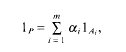
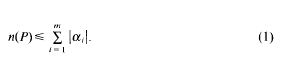
Let P⊂ℝ2 be a polyhedron, that is, the intersection of a finite number of closed half-spaces, and suppose that its characteristic function lP can be expressed as a linear combination
where each Ai is a relatively open and convex set. Let n(P) be the number of all non-empty facets of P. One of the main objectives of this paper is to show that
The lower bound theorem for centrally symmetric simple polytopes
- Part of
-
- Journal:
- Mathematika / Volume 46 / Issue 2 / December 1999
- Published online by Cambridge University Press:
- 26 February 2010, pp. 231-240
- Print publication:
- December 1999
-
- Article
- Export citation
Convex bodies with non-convex cross-section bodies
- Part of
-
- Journal:
- Mathematika / Volume 46 / Issue 1 / June 1999
- Published online by Cambridge University Press:
- 26 February 2010, pp. 127-129
- Print publication:
- June 1999
-
- Article
- Export citation
Triangulations of cyclic polytopes and higher Bruhat orders
- Part of
-
- Journal:
- Mathematika / Volume 44 / Issue 1 / June 1997
- Published online by Cambridge University Press:
- 26 February 2010, pp. 162-194
- Print publication:
- June 1997
-
- Article
- Export citation
-
Recently Edelman and Reiner suggested two poset structures,
 (n, d) and
  (n, d) on the set of all triangulations of the cyclic d-polytope C(n, d) with n vertices. Both posets are generalizations of the well-studied Tamari lattice. While (n, d) is bounded by definition, the same is not obvious for (n, d). In the paper by Edelman and Reiner the bounds of (n, d) were also confirmed for (n, d) whenever d≤5, leaving the general case as a conjecture.
 (
( (
(Equilibrium decompositions of 4-manifolds and abstract regular 5-polytopes
- Part of
-
- Journal:
- Mathematika / Volume 44 / Issue 1 / June 1997
- Published online by Cambridge University Press:
- 26 February 2010, pp. 100-112
- Print publication:
- June 1997
-
- Article
- Export citation
On a class of generalized simplices
- Part of
-
- Journal:
- Mathematika / Volume 43 / Issue 2 / December 1996
- Published online by Cambridge University Press:
- 26 February 2010, pp. 274-285
- Print publication:
- December 1996
-
- Article
- Export citation
Coxeter-associahedra
- Part of
-
- Journal:
- Mathematika / Volume 41 / Issue 2 / December 1994
- Published online by Cambridge University Press:
- 26 February 2010, pp. 364-393
- Print publication:
- December 1994
-
- Article
- Export citation
Iterated fiber polytopes
- Part of
-
- Journal:
- Mathematika / Volume 41 / Issue 2 / December 1994
- Published online by Cambridge University Press:
- 26 February 2010, pp. 348-363
- Print publication:
- December 1994
-
- Article
- Export citation
-
The construction of the fiber polytope ∑(P, Q) of a projection π:P→Q of polytopes is extended to flags of projections. While the faces of the fiber polytope are related to subdivisions of Q induced by the faces of P, those of an iterated fiber polytope are related to discrete homotopies between polyhedral subdivisions. In particular, in the case of projections
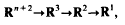
starting with an (n + 1)-simplex, vertices of the successive iterates correspond to, respectively, subsets, permutations and sequences of permutations of an n-set. The first iterate will always be combinatorially an n-cube, and, under certain conditions, the second will have the structure of the (n−1)-dimensional permutohedron.
The volume of duals and sections of polytopes
- Part of
-
- Journal:
- Mathematika / Volume 39 / Issue 1 / June 1992
- Published online by Cambridge University Press:
- 26 February 2010, pp. 67-80
- Print publication:
- June 1992
-
- Article
- Export citation
