Refine listing
Actions for selected content:
416 results in 35Jxx
Generalized Emden-Fowler equations of subcritical growth
- Part of
-
- Journal:
- Journal of the Australian Mathematical Society. Series A. Pure Mathematics and Statistics / Volume 54 / Issue 2 / April 1993
- Published online by Cambridge University Press:
- 09 April 2009, pp. 254-262
-
- Article
-
- You have access
- Export citation
A posteriori error estimates for elliptic boundary-value problems
- Part of
-
- Journal:
- Journal of the Australian Mathematical Society. Series A. Pure Mathematics and Statistics / Volume 39 / Issue 2 / October 1985
- Published online by Cambridge University Press:
- 09 April 2009, pp. 159-168
-
- Article
-
- You have access
- Export citation
Second-order strongly elliptic operators on Lie groups with Hölder continuous coefficients
- Part of
-
- Journal:
- Journal of the Australian Mathematical Society. Series A. Pure Mathematics and Statistics / Volume 63 / Issue 3 / December 1997
- Published online by Cambridge University Press:
- 09 April 2009, pp. 297-363
-
- Article
-
- You have access
- Export citation
-
Let G be a connected Lie group with Lie algebra g and a1, …, ad an algebraic basis of g. Further let Ai denote the generators of left translations, acting on the Lp-spaces Lp(G; dg) formed with left Haar measure dg, in the directions ai. We consider second-order operators
 in divergence form corresponding to a quadratic form with complex coefficients, bounded Hölder continuous principal coefficients cij and lower order coefficients ci, c′ii, c0 ∈ L∞ such that the matrix C= (cij) of principal coefficients satisfies the subellipticity condition
  uniformly over G.
We discuss the hierarchy relating smoothness properties of the coefficients of H with smoothness of the kernel and smoothness of the domain of powers of H on the Lρ-spaces. Moreover, we present Gaussian type bounds for the kernel and its derivatives.
Similar theorems are proved for strongly elliptic operators
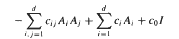 in non-divergence form for which the principal coefficients are at least once differentiable.
 in divergence form corresponding to a quadratic form with complex coefficients, bounded Hölder continuous principal coefficients
  uniformly over
  in non-divergence form for which the principal coefficients are at least once differentiable.
Multiplicity theorems for semilinear elliptic problems depending on a parameter
- Part of
-
- Journal:
- Proceedings of the Edinburgh Mathematical Society / Volume 52 / Issue 1 / February 2009
- Published online by Cambridge University Press:
- 02 February 2009, pp. 171-180
-
- Article
-
- You have access
- Export citation
Multiplicity of positive solutions for a class of problems with critical growth in ℝN
- Part of
-
- Journal:
- Proceedings of the Edinburgh Mathematical Society / Volume 52 / Issue 1 / February 2009
- Published online by Cambridge University Press:
- 02 February 2009, pp. 1-21
-
- Article
-
- You have access
- Export citation
-
Using variational methods, we establish the existence and multiplicity of positive solutions for the following class of problems:

where λ,β∈(0,∞), q∈(1,2*−1), 2*=2N/(N−2), N≥3, V,Z:ℝN→ℝ are continuous functions verifying some hypotheses.
Infinitely many arbitrarily small solutions for singular elliptic problems with critical Sobolev–Hardy exponents
- Part of
-
- Journal:
- Proceedings of the Edinburgh Mathematical Society / Volume 52 / Issue 1 / February 2009
- Published online by Cambridge University Press:
- 02 February 2009, pp. 97-108
-
- Article
-
- You have access
- Export citation
-
Let Ω ⊂ ℝN be a bounded domain such that 0 ∈ Ω, N ≥ 3, 2*(s) = 2(N − s)/(N − 2), 0 ≤ s < 2,
 . We obtain the existence of infinitely many solutions for the singular critical problem
  with Dirichlet boundary condition for suitable positive number λ.
 . We obtain the existence of infinitely many solutions for the singular critical problem
  with Dirichlet boundary condition for suitable positive number λ.
ON SCHRÖDINGER EQUATIONS WITH INDEFINITE NONLINEARITIES
- Part of
-
- Journal:
- Bulletin of the Australian Mathematical Society / Volume 79 / Issue 1 / February 2009
- Published online by Cambridge University Press:
- 10 March 2009, pp. 115-128
- Print publication:
- February 2009
-
- Article
-
- You have access
- Export citation
-
In this paper we consider the problem of finding standing waves – solutions to nonlinear Schrödinger equations with vanishing potential and sign-changing nonlinearities. This involves searching for solutions of the problem (1)
 We show that the problem has a solution, and the maximum point of the solution is concentrated on a minimum point of some function as ε→0.
MINIMAL GRAPHS WITH DISCONTINUOUS BOUNDARY VALUES
- Part of
-
- Journal:
- Journal of the Australian Mathematical Society / Volume 86 / Issue 1 / February 2009
- Published online by Cambridge University Press:
- 01 February 2009, pp. 75-95
-
- Article
-
- You have access
- Export citation
EXISTENCE OF POSITIVE EVANESCENT SOLUTIONS TO SOME QUASILINEAR ELLIPTIC EQUATIONS
- Part of
-
- Journal:
- Bulletin of the Australian Mathematical Society / Volume 78 / Issue 1 / August 2008
- Published online by Cambridge University Press:
- 01 August 2008, pp. 157-162
- Print publication:
- August 2008
-
- Article
-
- You have access
- Export citation
-
We establish that the elliptic equation
 defined in an exterior domain of ℝn, n≥3, has a positive solution which decays to 0 as
  under quite general assumptions upon f and g.
 under quite general assumptions upon
 ON A CLASS OF SOBOLEV FUNCTIONS AND ITS APPLICATIONS TO HIGHER-ORDER ELLIPTIC EQUATIONS
- Part of
-
- Journal:
- Journal of the Australian Mathematical Society / Volume 84 / Issue 3 / June 2008
- Published online by Cambridge University Press:
- 01 June 2008, pp. 405-417
-
- Article
-
- You have access
- Export citation
MULTIPLE SOLUTIONS FOR A DIRICHLET PROBLEM WITH p-LAPLACIAN AND SET-VALUED NONLINEARITY
- Part of
-
- Journal:
- Bulletin of the Australian Mathematical Society / Volume 77 / Issue 2 / April 2008
- Published online by Cambridge University Press:
- 01 April 2008, pp. 285-303
- Print publication:
- April 2008
-
- Article
-
- You have access
- Export citation
SYMMETRY RESULT FOR SOME OVERDETERMINED VALUE PROBLEMS
- Part of
-
- Journal:
- The ANZIAM Journal / Volume 49 / Issue 4 / April 2008
- Published online by Cambridge University Press:
- 01 April 2008, pp. 479-494
-
- Article
-
- You have access
- Export citation
Positive solutions for Dirichlet problems of singular quasilinear elliptic equations via variational methods
- Part of
-
- Journal:
- Mathematika / Volume 51 / Issue 1-2 / December 2004
- Published online by Cambridge University Press:
- 26 February 2010, pp. 187-202
- Print publication:
- December 2004
-
- Article
- Export citation
-
This paper studies the existence and multiplicity of positive solutions of the following problem:
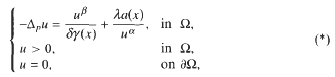
where Ω⊂RN(N≥3) is a smooth bounded domain,
 , 1 < p < N, and 0 < α < 1, p - 1 < β < p* - 1 (p* = Np/(N - p)) and 0 < γ < N + ((β + 1)(p - N)/p) are three constants. Also δ(x) = dist(x, ∂Ω), a ∈ Lp and λ < 0 is a real parameter. By using the direct method of the calculus of variations, Ekeland's Variational Principle and an idea of G. Tarantello, it is proved that problem (*) has at least two positive weak solutions if λ is small enough.
 , 1 <
, 1 < Scattering of tidal waves by reefs and spits
- Part of
-
- Journal:
- Mathematika / Volume 47 / Issue 1-2 / December 2000
- Published online by Cambridge University Press:
- 26 February 2010, pp. 355-370
- Print publication:
- December 2000
-
- Article
- Export citation
Multiple solutions for semilinear elliptic problems
- Part of
-
- Journal:
- Mathematika / Volume 47 / Issue 1-2 / December 2000
- Published online by Cambridge University Press:
- 26 February 2010, pp. 307-317
- Print publication:
- December 2000
-
- Article
- Export citation
On transformations of the biharmonic equation
- Part of
-
- Journal:
- Mathematika / Volume 32 / Issue 1 / June 1985
- Published online by Cambridge University Press:
- 26 February 2010, pp. 118-130
- Print publication:
- June 1985
-
- Article
- Export citation
-
Consider a point transformation of the biharmonic equation
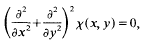
namely a coordinate transformation

together with a change of dependent variable given by

for some multiplier F(ξ, η).
