Refine search
Actions for selected content:
238502 results in Physics and Astronomy

Turbulent pipe flow of thixotropic fluids
-
- Journal:
- Journal of Fluid Mechanics / Volume 1011 / 25 May 2025
- Published online by Cambridge University Press:
- 16 May 2025, A45
-
- Article
-
- You have access
- Open access
- HTML
- Export citation
-
Complex materials with internal microstructure such as suspensions and emulsions exhibit time-dependent rheology characterised by viscoelasticity and thixotropy. In many large-scale applications such as turbulent pipe flow, the elastic response occurs on a much shorter time scale than the thixotropy, hence these flows are purely thixotropic. The fundamental dynamics of thixotropic turbulence is poorly understood, particularly the interplay between microstructural state, rheology and turbulence structure. To address this gap, we conduct direct numerical simulations (DNS) of fully developed turbulent pipe flow of a model thixotropic (Moore) fluid as a function of the thixoviscous number $\Lambda$, which characterises the thixotropic kinetic rate relative to turbulence eddy turnover time, ranging from slow ( $\Lambda \ll 1$) to fast ( $\Lambda \gg 1$) kinetics. Analysis of DNS results in the Lagrangian frame shows that, as expected, in the limits of slow and fast kinetics, these time-dependent flows behave as time-independent purely viscous (generalised Newtonian) analogues. For intermediate kinetics ( $\Lambda \sim 1$), the rheology is governed by a path integral of the thixotropic fading memory kernel over the distribution of Lagrangian shear history, the latter of which is modelled via a simple stochastic model for the radially non-stationary pipe flow. The DNS computations based on this effective viscosity closure exhibit excellent agreement with the fully thixotropic model for $\Lambda =1$, indicating that the purely viscous (generalised Newtonian) analogue persists for arbitrary values of $\Lambda \in (0,\infty ^+)$ and across nonlinear rheology models. These results significantly simplify our understanding of turbulent thixotropic flow, and provide insights into the structure of these complex time-dependent flows.


Electrohydrodynamic deformation of liquid film underneath a topographical template
-
- Journal:
- Journal of Fluid Mechanics / Volume 1011 / 25 May 2025
- Published online by Cambridge University Press:
- 16 May 2025, A46
-
- Article
- Export citation
References
-
- Book:
- Phase Transitions
- Published online:
- 01 May 2025
- Print publication:
- 15 May 2025, pp 370-388
-
- Chapter
- Export citation
Preface
-
- Book:
- Phase Transitions
- Published online:
- 01 May 2025
- Print publication:
- 15 May 2025, pp xiii-xvi
-
- Chapter
- Export citation
Part I - General Aspects
-
- Book:
- Phase Transitions
- Published online:
- 01 May 2025
- Print publication:
- 15 May 2025, pp 1-2
-
- Chapter
- Export citation
9 - Superconductors
- from Part II - Applications
-
- Book:
- Phase Transitions
- Published online:
- 01 May 2025
- Print publication:
- 15 May 2025, pp 300-331
-
- Chapter
- Export citation
FLM volume 1009 Cover and Front matter
-
- Journal:
- Journal of Fluid Mechanics / Volume 1009 / 10 May 2025
- Published online by Cambridge University Press:
- 15 May 2025, p. f1
-
- Article
-
- You have access
- Export citation

Constructing turbulence models using the kinetic Fokker–Planck equation
-
- Journal:
- Journal of Fluid Mechanics / Volume 1011 / 25 May 2025
- Published online by Cambridge University Press:
- 15 May 2025, A44
-
- Article
- Export citation
1 - Introduction to phase transitions
- from Part I - General Aspects
-
- Book:
- Phase Transitions
- Published online:
- 01 May 2025
- Print publication:
- 15 May 2025, pp 3-61
-
- Chapter
- Export citation
2 - Dynamics of phase transitions
- from Part I - General Aspects
-
- Book:
- Phase Transitions
- Published online:
- 01 May 2025
- Print publication:
- 15 May 2025, pp 62-100
-
- Chapter
- Export citation
Foreword
-
- Book:
- Phase Transitions
- Published online:
- 01 May 2025
- Print publication:
- 15 May 2025, pp xi-xii
-
- Chapter
- Export citation

How a self-propelled fin gains hydrodynamic advantages behind a circular cylinder with vortex-induced vibrations
-
- Journal:
- Journal of Fluid Mechanics / Volume 1011 / 25 May 2025
- Published online by Cambridge University Press:
- 15 May 2025, A26
-
- Article
- Export citation
-
The interaction of a swimmer with unsteady vortices in complex flows remains a topic of interest and open discussion. The present study, employing the immersed boundary method with a flexible fin model, explores swimming behaviours behind a circular cylinder with vortex-induced vibration (VIV). Five distinct swimming modes are identified on the $U_r$– $G_0$ plane, where $U_r$ denotes the reduced velocity, and $G_0$ represents the fin’s initial position. These modes include drifting upstream I/II (DU-I/II), Karman gait I/II (KG-I/II), and large oscillation (LO), with the DU-II, KG-II and LO modes being newly reported. The fin can either move around or cross through the vortex cores in the KG-I and KG-II modes, respectively, for energy saving and maintaining a stable position. When the upstream cylinder vibrates with its maximum amplitude, a double-row vortex shedding forms in the wake, allowing the DU-II mode to occur with the fin to achieve high-speed locomotion. This is attributed to a significant reduction in the streamwise velocity caused by vortex-induced velocity. Furthermore, a symmetry breaking is observed in the fin’s wake in the DU-II mode, potentially also contributing to high-speed locomotion. Overall, compared to the case without an upstream cylinder, we demonstrate that a self-propelled fin gains hydrodynamic advantages with various swimming modes in different VIV wakes. Interestingly, increased power transferred from flows by the oscillating cylinder leads to a more favourable environment for the downstream fin’s propulsion, indicating that a fin in VIV wakes obtains more advantages compared to the vortex street generated by a stationary cylinder.


Pressure and vorticity scaling in anguilliform and carangiform swimming
-
- Journal:
- Journal of Fluid Mechanics / Volume 1010 / 10 May 2025
- Published online by Cambridge University Press:
- 15 May 2025, A28
-
- Article
-
- You have access
- Open access
- HTML
- Export citation
-
The scaling of pressure and vorticity in aquatic swimming can provide insights into the mechanisms of propulsion. This is investigated through self-propelled, wall-resolved, large-eddy simulations of a lamprey (an anguilliform swimmer) and a mackerel (a carangiform swimmer) using the curvilinear immersed boundary method. It is observed that the pressure around the swimmers scales with theoretical fluid acceleration, which includes both local body and the convective acceleration, for anguilliform swimmers, whereas it scales with both acceleration and the angle of attack (AoA) for carangiform swimmers. This indicates that the main mechanism for propulsion in anguilliform swimmers is added mass (unsteady), whereas both lift-based (steady) and added mass (unsteady) are at play for carangiform swimmers. Furthermore, it is observed that the vorticity in the boundary layer of the swimmer initially follows the body rotation at low speeds but not at high speeds during the quasisteady swimming. This is explained by identifying the scaling of vorticity components: one due to body rotation and the other due to shear, which scale with Strouhal number ( $St$) and Reynolds number ( $\sqrt {Re}$), respectively. Here $St$ (body rotation) dominates at low speeds, but $\sqrt {Re}$ (shear) dominates at high speeds. Finally, it is observed that the pressure decreases as the swimming speed increases. This counterintuitive observation is explained by showing that both fluid acceleration and AoA decrease as swimming speed increases. This suggests that for efficient swimming, the pressure difference across the body should be minimised, but high enough to overcome the viscous drag.


Modelling the evolution of Richtmyer–Meshkov mixing width during shock compression phases
-
- Journal:
- Journal of Fluid Mechanics / Volume 1011 / 25 May 2025
- Published online by Cambridge University Press:
- 15 May 2025, A39
-
- Article
- Export citation
Restricted projections to lines in $\mathbb{R}^{n+1}$
- Part of
-
- Journal:
- Mathematical Proceedings of the Cambridge Philosophical Society / Volume 179 / Issue 1 / July 2025
- Published online by Cambridge University Press:
- 15 May 2025, pp. 105-143
- Print publication:
- July 2025
-
- Article
- Export citation
-
We prove the following restricted projection theorem. Let $n\ge 3$ and $\Sigma \subset S^{n}$ be an $(n-1)$-dimensional $C^2$ manifold such that $\Sigma$ has sectional curvature $\gt1$. Let $Z \subset \mathbb{R}^{n+1}$ be analytic and let $0 \lt s \lt \min\{\dim Z, 1\}$. Then In particular, for almost every
 \begin{equation*} \dim \{z \in \Sigma\; :\; \dim (Z \cdot z) \lt s\} \le (n-2)+s = (n-1) + (s-1) \lt n-1.\end{equation*} $z \in \Sigma$, $\dim (Z \cdot z) = \min\{\dim Z, 1\}$.
The core idea, originated from Käenmäki–Orponen–Venieri, is to transfer the restricted projection problem to the study of the dimension lower bound of Furstenberg sets of cinematic family contained in $C^2([0,1]^{n-1})$. This cinematic family of functions with multivariables are extensions of those of one variable by Pramanik–Yang–Zahl and Sogge. Since the Furstenberg sets of cinematic family contain the affine Furstenberg sets as a special case, the dimension lower bound of Furstenberg sets improves the one by Héra, Héra–Keleti–Máthé and Dąbrowski–Orponen–Villa.
Moreover, our method to show the restricted projection theorem can also give a new proof for the Mattila projection theorem in $\mathbb{R}^n$ with $n \ge 3$.


Forced convection in two-phase core-annular flows
-
- Journal:
- Journal of Fluid Mechanics / Volume 1011 / 25 May 2025
- Published online by Cambridge University Press:
- 15 May 2025, A41
-
- Article
-
- You have access
- Open access
- HTML
- Export citation
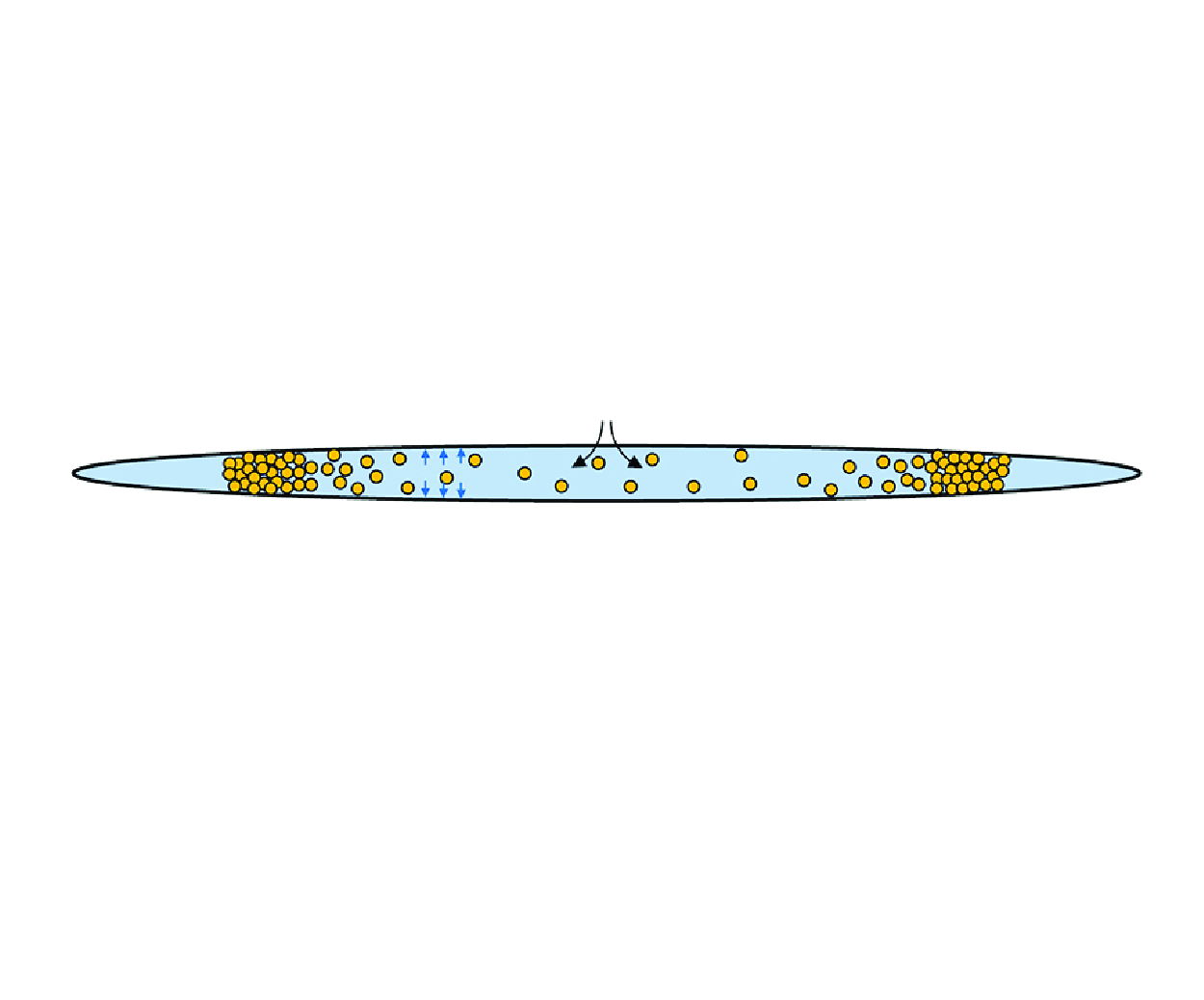
Dynamic plugging of a plane-strain hydraulic fracture driven by slurry flow
-
- Journal:
- Journal of Fluid Mechanics / Volume 1010 / 10 May 2025
- Published online by Cambridge University Press:
- 15 May 2025, A23
-
- Article
-
- You have access
- Open access
- HTML
- Export citation
Materials Index
-
- Book:
- Phase Transitions
- Published online:
- 01 May 2025
- Print publication:
- 15 May 2025, pp 389-390
-
- Chapter
- Export citation
FUV to FIR SED modelling of NGC 205
-
- Journal:
- Publications of the Astronomical Society of Australia / Volume 42 / 2025
- Published online by Cambridge University Press:
- 15 May 2025, e043
-
- Article
-
- You have access
- Open access
- HTML
- Export citation
-
New far ultraviolet imaging of the galaxy NGC 205 is presented, which shows the emission is significantly offset ( $\sim5^{\prime\prime}$ NW) from the optical and infrared centers of the galaxy. Spectral energy distribution (SED) modelling is applied to investigate the spatial dependence of the star formation history (SFH) of NGC 205, using data from far ultraviolet to far infrared. The SED model includes young and old stellar populations, gas emission, dust emission and dust absorption. The old stellar population has a total mass of $1.1\times10^8$ M $_{\odot}$ whereas the young population has a much smaller total mass of 3 200 M $_{\odot}$. The best forms of SFH for old and young stars are found to be exponentially declining bursts with start times $t_0$ yr ago and e-folding times $\tau$ yr. The old stellar population has uniform $t_0$ = 9.5 Gyr, with $\tau$ decreasing with radius from 1 Gyr to 500 Myr. The young stellar population has $t_0$ = 900 Myr and $\tau$ = 800 Myr, both uniform across NGC 205. The young and old stellar mass surface densities are exponential in radius with scale lengths of 40 and 110 pc, respectively. The dust heating has a $\sim$ 40% contribution from young stars and $\sim$ 60% from old stars.


Appendix - Landau theory and symmetry
-
- Book:
- Phase Transitions
- Published online:
- 01 May 2025
- Print publication:
- 15 May 2025, pp 353-369
-
- Chapter
- Export citation
