Refine search
Actions for selected content:
238502 results in Physics and Astronomy

Knowledge-integrated additive learning for consistent near-wall modelling of turbulent flows
-
- Journal:
- Journal of Fluid Mechanics / Volume 1011 / 25 May 2025
- Published online by Cambridge University Press:
- 13 May 2025, R1
-
- Article
-
- You have access
- HTML
- Export citation

A laboratory analogy for mixing by shallow cumulus convection
-
- Journal:
- Journal of Fluid Mechanics / Volume 1011 / 25 May 2025
- Published online by Cambridge University Press:
- 13 May 2025, A35
-
- Article
-
- You have access
- Open access
- HTML
- Export citation

Linear and nonlinear dynamics in radiatively forced cold water
-
- Journal:
- Journal of Fluid Mechanics / Volume 1011 / 25 May 2025
- Published online by Cambridge University Press:
- 13 May 2025, A24
-
- Article
- Export citation
-
This paper investigates the linear and nonlinear dynamics of two-dimensional penetrative convection subjected to radiative volumetric thermal forcing, focusing on ice-covered freshwater systems. Linear stability analysis reveals how critical wavenumbers $k_c$ and Rayleigh numbers $Ra_c$ are influenced by the attenuation lengths and incoming heat flux. In this configuration, the system easily becomes unstable with a small $Ra_c$, which is two decades smaller than that of the classical Rayleigh–Bénard convection problem, with typically $O(10)$. Weakly nonlinear analysis figures out that this configuration is supercritical, contrasting with the subcritical case by Veronis (Astrophys. J., vol. 137, 1963, 641–663). Numerical bifurcation solutions are performed from the critical points and over several decades, up to $Ra \sim O(10^6)$. This paper found that the system exhibits multiple steady solutions, and under certain specific conditions, a staircase temperature profile emerges. Meanwhile, we further discuss the influence of incoming heat flux and the Prandtl number $Pr$ on the primary bifurcation. Direct numerical simulations are also carried out, showing that heat is transported more efficiently via unsteady convection.


Integral Zariski dense surface groups in $\textrm{SL}(n,\mathbf{R})$
- Part of
-
- Journal:
- Mathematical Proceedings of the Cambridge Philosophical Society / Volume 179 / Issue 1 / July 2025
- Published online by Cambridge University Press:
- 13 May 2025, pp. 63-78
- Print publication:
- July 2025
-
- Article
-
- You have access
- Open access
- HTML
- Export citation
-
Given a number field K, we show that certain K-integral representations of closed surface groups can be deformed to being Zariski dense while preserving many useful properties of the original representation. This generalises a method due to Long and Thistlethwaite who used it to show that thin surface groups in $\textrm{SL}(2k+1,\mathbf{Z})$ exist for all k.


The origin of vorticity in viscous incompressible flows
-
- Journal:
- Journal of Fluid Mechanics / Volume 1011 / 25 May 2025
- Published online by Cambridge University Press:
- 13 May 2025, A33
-
- Article
-
- You have access
- Open access
- HTML
- Export citation
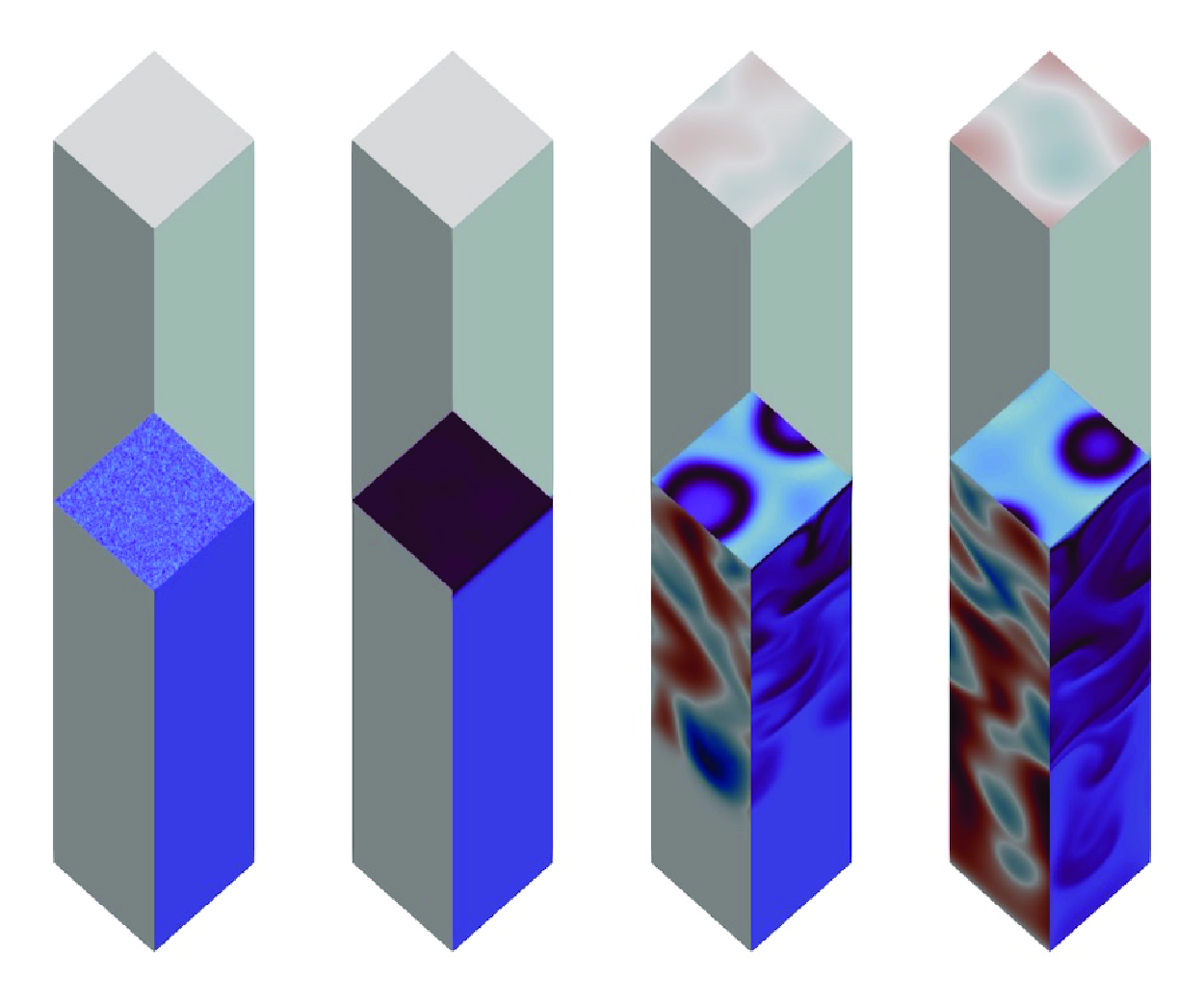
Cabbeling as a catalyst and driver of turbulent mixing
-
- Journal:
- Journal of Fluid Mechanics / Volume 1011 / 25 May 2025
- Published online by Cambridge University Press:
- 13 May 2025, A17
-
- Article
-
- You have access
- Open access
- HTML
- Export citation

Formation of multiple vortex rings from passively flexible nozzles
-
- Journal:
- Journal of Fluid Mechanics / Volume 1011 / 25 May 2025
- Published online by Cambridge University Press:
- 13 May 2025, A3
-
- Article
-
- You have access
- Open access
- HTML
- Export citation
High-power, widely wavelength-tunable, single-frequency pulsed fiber master oscillator power amplifier at 2.8 μm
-
- Journal:
- High Power Laser Science and Engineering / Volume 13 / 2025
- Published online by Cambridge University Press:
- 13 May 2025, e26
-
- Article
-
- You have access
- Open access
- HTML
- Export citation

Microstructure and deformation in suspensions of soft microswimmers
-
- Journal:
- Journal of Fluid Mechanics / Volume 1011 / 25 May 2025
- Published online by Cambridge University Press:
- 13 May 2025, A31
-
- Article
-
- You have access
- Open access
- HTML
- Export citation
-
In recent years, various unique properties of microswimmer suspensions have been revealed. Some microswimmers are deformable; however, the influence of the swimmer’s deformability has been overlooked. The present study examined the impact of soft microswimmers’ membrane deformations in a mono-dispersed dense suspension on microstructure formation. Due to the small size of the microswimmers, the flow field is described by the Stokes equation. The soft microswimmer was modelled as a capsule with a two-dimensional hyperelastic membrane enclosing a Newtonian fluid that is driven by propulsion torques distributed slightly above the membrane surface. Changes to the torque distribution caused the soft swimmer to exhibit different swimming modes as a pusher or puller. Similar to rigid squirmers, soft swimmers displayed self-organised local clusters in the suspension. Membrane deformation changed the mutual interference among swimmers in the cluster, bringing the interactions closer together than those of rigid squirmers. Especially among soft pushers, rotational diffusion due to hydrodynamic interference was reduced and the swimming trajectory became relatively straight. As a result, polar order was less likely to form, especially in regions of high $Ca$. On the other hand, pullers showed strong interactions due to retraction flow and an increase in mean membrane tension. For pushers (pullers), the rear (side) interaction produced the greatest change in tension. These findings are expected to be useful for effort to understand the propulsion mechanisms of medical and industrial soft microrobots, as well as the biological responses of microorganisms induced by mechanical stimuli.


Rectilinear drift and oscillation of a rotating cylinder placed in flow
-
- Journal:
- Journal of Fluid Mechanics / Volume 1011 / 25 May 2025
- Published online by Cambridge University Press:
- 13 May 2025, A32
-
- Article
-
- You have access
- Open access
- HTML
- Export citation
-
The system composed of a circular cylinder free to move along a transverse rectilinear path within a cross-current has often served as a canonical problem to study the vortex-induced vibrations (VIV) developing in the absence of structural restoring force, thus without structural natural frequency. The object of the present work is to extend the exploration of the behaviour of this system when the path is set to an arbitrary orientation, varying from the transverse to the streamwise direction, and the cylinder is forced to rotate about its axis. The investigation is conducted numerically at a Reynolds number equal to $100$, based on the body diameter and oncoming flow velocity, for structure to displaced fluid mass ratios down to $0.01$ and values of the rotation rate (ratio between body surface and oncoming flow velocities) ranging from $0$ to $1$. When the transverse symmetry is broken by the orientation of the trajectory or the forced rotation, the cylinder drifts along the rectilinear path, at a velocity that can be predicted by a quasi-steady approach. Three distinct regimes are encountered: a pure drift regime, where the body translates at a constant velocity, and two oscillatory regimes, characterised by contrasted forms of displacement fluctuation about the drifting motion, but both closely connected to flow unsteadiness. VIV, nearly sinusoidal, persist over a wide range of path orientations, for all rotation rates. On the other hand, irregular jumps of the body, triggered by the rotation and named saccades, emerge when the trajectory is aligned, or almost aligned, with the current. The two forms of response differ by their regularity, but also by their amplitudes and frequencies, which deviate by one or more orders of magnitude. The rotation attenuates both VIV and saccades. Yet, an increase of the rotation rate enhances the erratic nature of the saccade regime.


Close-contact melting on hydrophobic textured surfaces: confinement and meniscus effects
-
- Journal:
- Journal of Fluid Mechanics / Volume 1010 / 10 May 2025
- Published online by Cambridge University Press:
- 13 May 2025, A46
-
- Article
-
- You have access
- Open access
- HTML
- Export citation
-
We investigate the dynamics of close-contact melting (CCM) on ‘gas-trapped’ hydrophobic surfaces, with specific focus on the effects of geometrical confinement and the liquid–air meniscus below the liquid film. By employing dual-series and perturbation methods under the assumption of small meniscus deflections, we obtain numerical solutions for the effective slip lengths associated with velocity $\lambda$ and temperature $\lambda _t$ fields, across various values of aspect ratio $\Lambda$ (defined as the ratio of the film thickness $h$ to the structure’s periodic length $l$) and gas–liquid fraction $\phi$. Asymptotic solutions of $\lambda$ and $\lambda _t$ for $\Lambda \ll 1$ and $\Lambda \gg 1$ are derived and summarised for different surface structures, interface shapes and $\Lambda$, which reveal a different trend of $\lambda$ for $\Lambda \ll 1$ and depending on the presence of a meniscus. In the context of constant-pressure CCM, our results indicate that longitudinal grooves can enhance heat transfer under the effects of confinement and a meniscus when $\Lambda \lesssim 0.1$ and $\phi \lt 1 - 0.5^{2/3} \approx 0.37$. For gravity-driven CCM, the parameters of $l$ and $\phi$ determine whether the melting rate is enhanced, reduced or nearly unaffected. We construct a phase diagram based on the parameter matrix $(\log _{10} l, \phi )$ to delineate these three regimes. Lastly, we derive two asymptotic solutions for predicting the variation in time of the unmelted solid height.


Pseudo-turbulence induced by settling spheroids in a quiescent fluid
-
- Journal:
- Journal of Fluid Mechanics / Volume 1011 / 25 May 2025
- Published online by Cambridge University Press:
- 13 May 2025, A22
-
- Article
- Export citation
-
In this study, we investigate the sedimentation of spheroidal particles in an initially quiescent fluid by means of particle-resolved direct numerical simulations. Settling particles with three different shapes – oblate spheroid, sphere and prolate spheroid – but fixed Galileo number $Ga=80$ and density ratio $\gamma =2$ at volume fraction $\phi =1\%$ are considered. Oblate and prolate particles are found to form column-like clusters as a consequence of the wake-induced hydrodynamic interactions in the suspension. This effect, together with the change of particle orientation, enhances the mean settling velocity of the dispersed phase. In contrast, spherical particles do not exhibit clustering, and settle with hindered velocity in the suspension. Furthermore, we focus on the pseudo-turbulence induced by the settling particles. We report a non-Gaussian distribution of the fluid velocity and a robust $-3$ power law of the energy spectra. By scrutinizing the scale-by-scale budget, we find that the anisotropy of the particle-induced pseudo-turbulence is manifested not only by the uneven allocation of turbulence kinetic energy among the different velocity components, but also by the anisotropic distribution of energy in spectral space. The fluid–particle interactions inject energy into the vertical velocity component, thus sustaining the turbulence, while pressure redistributes the kinetic energy among the different velocity components. The clustering of oblate/prolate particles significantly increases the energy input at large scales, forcing elongated flow structures. Moreover, the redistribution and nonlinear transfer of the energy are also intensified in the presence of particle clustering, which reduces the anisotropy of the particle-induced pseudo-turbulence.


Coupled inflow vapour velocity and surface wettability effect on condensation heat transfer characteristics: a volume-of-fluid method study
-
- Journal:
- Journal of Fluid Mechanics / Volume 1011 / 25 May 2025
- Published online by Cambridge University Press:
- 13 May 2025, A13
-
- Article
- Export citation
-
This study employs volume-of-fluid-based computational fluid dynamics modelling to investigate the coupled effects of surface wettability and inflow vapour velocity on R134a ( $p/p_{cri}=0.25$) condensation heat transfer in horizontal tubes. The results demonstrate that both the condensation heat transfer coefficient (HTC) and Nusselt number consistently increase with rising vapour velocity, indicating enhanced convective heat transfer at higher flow rates. Within this overall trend, the influence of surface wettability varies significantly across different velocity regimes. At moderate inlet velocities (10 m s−1), surface wettability demonstrates maximum impact, with the HTC enhancement exceeding 19.1% between peak and minimum values, optimising at contact angles of 120 $^\circ$–140 $^\circ$. As velocity increases to 20 m s−1, while surface wettability effects persist with $\gt$11.7 % enhancement, convective heat transfer becomes increasingly dominant, showing $\gt$38.8 % improvement in the maximum HTC compared with the 10 m s−1 case. At higher velocities (40 m s−1), the influence of surface wettability diminishes substantially, with the HTC variation reducing to $\gt$1.04 %. At extreme velocities (80 m s−1), surface tension effects become negligible compared with vapour shear forces, resulting in minimal (0.53 %) variation across different contact angles. The equivalent Reynolds number peaks at 20 m s−1, indicating optimal conditions for condensate formation and flow characteristics. These findings provide crucial insights for condensation system design, suggesting that while increasing velocity generally enhances heat transfer performance, surface wettability modifications are most effective at moderate velocities, while high-velocity applications should prioritise flow dynamics and system geometry optimisation.


The implications of a fluid yield stress
-
- Journal:
- Journal of Fluid Mechanics / Volume 1011 / 25 May 2025
- Published online by Cambridge University Press:
- 13 May 2025, P1
-
- Article
-
- You have access
- Open access
- HTML
- Export citation
Almost sure upper bound for a model problem for multiplicative chaos in number theory
- Part of
-
- Journal:
- Mathematical Proceedings of the Cambridge Philosophical Society / Volume 179 / Issue 1 / July 2025
- Published online by Cambridge University Press:
- 13 May 2025, pp. 29-44
- Print publication:
- July 2025
-
- Article
- Export citation
Spanwise wall forcing can reduce turbulent heat transfer more than drag
-
- Journal:
- Journal of Fluid Mechanics / Volume 1010 / 10 May 2025
- Published online by Cambridge University Press:
- 13 May 2025, A59
-
- Article
-
- You have access
- Open access
- HTML
- Export citation
-
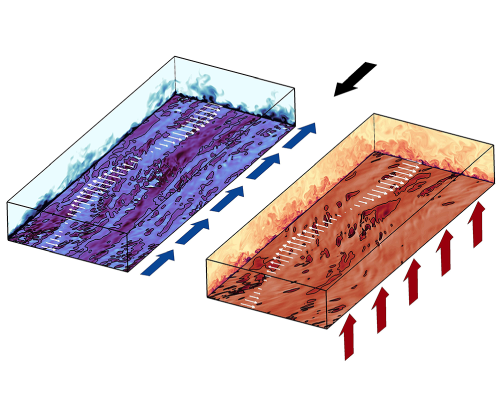
Direct numerical simulations are performed for turbulent forced convection in a half-channel flow with a wall oscillating either as a spanwise plane oscillation or to generate a streamwise travelling wave. The friction Reynolds number is fixed at $Re_{\tau _0} = 590$, but the Prandtl number $Pr$ is varied from 0.71 to 20. For $Pr\gt 1$, the heat transfer is reduced by more than the drag, 40 % compared with 30 % at $Pr=7.5$. This outcome is related to the different responses of the velocity and thermal fields to the Stokes layer. It is shown that the Stokes layer near the wall attenuates the large-scale energy of the turbulent heat flux and the turbulent shear stress, but amplifies their small-scale energy. At higher Prandtl numbers, the thinning of the conductive sublayer means that the energetic scales of the turbulent heat flux move closer to the wall, where they are exposed to a stronger Stokes layer production, increasing the contribution of the small-scale energy amplification. A predictive model is derived for the Reynolds and Prandtl number dependence of the heat-transfer reduction based on the scaling of the thermal statistics. The model agrees well with the computations for Prandtl numbers up to 20.


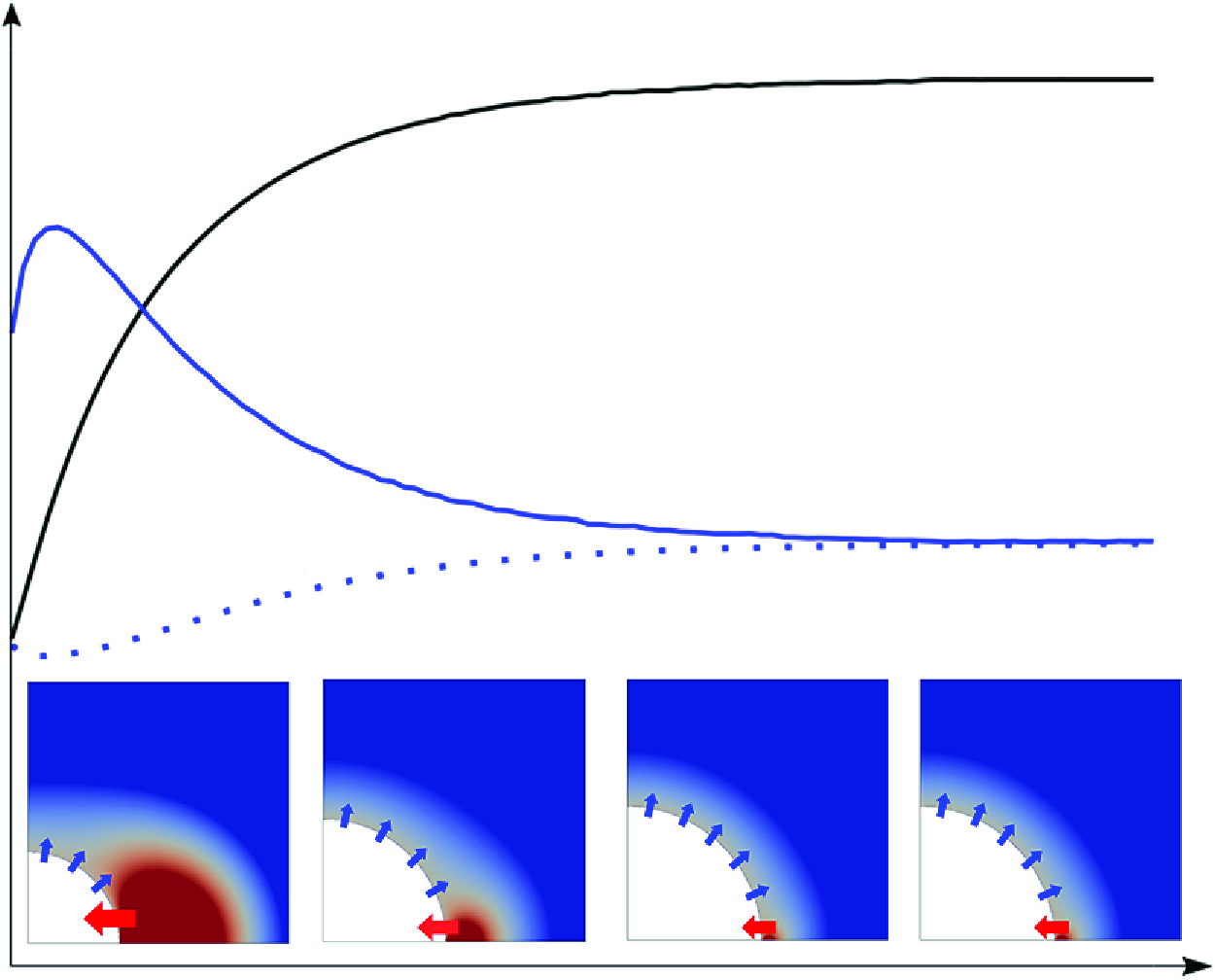
Dynamic equilibrium of electrochemical bubbles growing on micro-electrodes
-
- Journal:
- Journal of Fluid Mechanics / Volume 1011 / 25 May 2025
- Published online by Cambridge University Press:
- 13 May 2025, A23
-
- Article
-
- You have access
- Open access
- HTML
- Export citation

Experimental study of velocity statistics in wall-bounded turbulent emulsions
-
- Journal:
- Journal of Fluid Mechanics / Volume 1011 / 25 May 2025
- Published online by Cambridge University Press:
- 13 May 2025, A14
-
- Article
- Export citation

Resonant standing internal waves in a basin filled with two liquids separated by a pycnocline
-
- Journal:
- Journal of Fluid Mechanics / Volume 1011 / 25 May 2025
- Published online by Cambridge University Press:
- 13 May 2025, A16
-
- Article
-
- You have access
- Open access
- HTML
- Export citation

Drift of a semi-permeable vesicle through an osmotic gradient: anomalous velocity amplification due to a proximate wall
-
- Journal:
- Journal of Fluid Mechanics / Volume 1011 / 25 May 2025
- Published online by Cambridge University Press:
- 13 May 2025, A18
-
- Article
-
- You have access
- Open access
- HTML
- Export citation
-
A spherical vesicle is made up of a liquid core bounded by a semi-permeable membrane that is impermeable to solute molecules. When placed in an externally imposed gradient of solute concentration, the osmotic pressure jump across the membrane results in an inward trans-membrane solvent flux at the solute-depleted side of the vesicle, and and outward flux in its solute-enriched side. As a result, a freely suspended vesicle drifts down the concentration gradient, a phenomenon known as osmophoresis. An experimental study of lipid vesicles observed drift velocities that are more than three orders of magnitude larger than the linearised non-equilibrium prediction (Nardi et al., Phys. Rev. Lett., vol. 82, 1999, pp. 5168–5171). Inspired by this study, we analyse osmophoresis of a vesicle in close proximity to an impermeable wall, where the vesicle–wall separation $a\delta$ is small compared with the vesicle radius $a$. Due to intensification of the solute concentration gradient in the narrow gap between the membrane and the wall, the ‘osmophoretic’ force and torque on a stationary vesicle scale as an irrational power, $1/\sqrt {2}-1\ (\approx -0.29289\ldots )$, of $\delta$. Both the rectilinear velocity $\mathcal V$ and the angular velocity $\unicode {x1D6FA}$ of a freely suspended vesicle scale as the ratio of that power to $\ln \delta$. In contrast to the classical problem of sedimentation parallel to a wall, where the ratio $a\unicode {x1D6FA}/\mathcal V$ approaches $1/4$ as $\delta \to 0$, here the ratio approaches unity, as though the vesicle performs pure rigid-body rolling without slippage. Our approximations are in excellent agreement with hitherto unexplained numerical computations in the literature.


