Refine search
Actions for selected content:
238502 results in Physics and Astronomy

Refinements in the nonlinear term of a turbulence predictive model based on atmospheric surface layer observations
-
- Journal:
- Journal of Fluid Mechanics / Volume 1011 / 25 May 2025
- Published online by Cambridge University Press:
- 14 May 2025, A25
-
- Article
- Export citation

A multi-horizon peridynamics for coupled fluid flow and heat transfer
-
- Journal:
- Journal of Fluid Mechanics / Volume 1010 / 10 May 2025
- Published online by Cambridge University Press:
- 14 May 2025, A66
-
- Article
-
- You have access
- Open access
- HTML
- Export citation
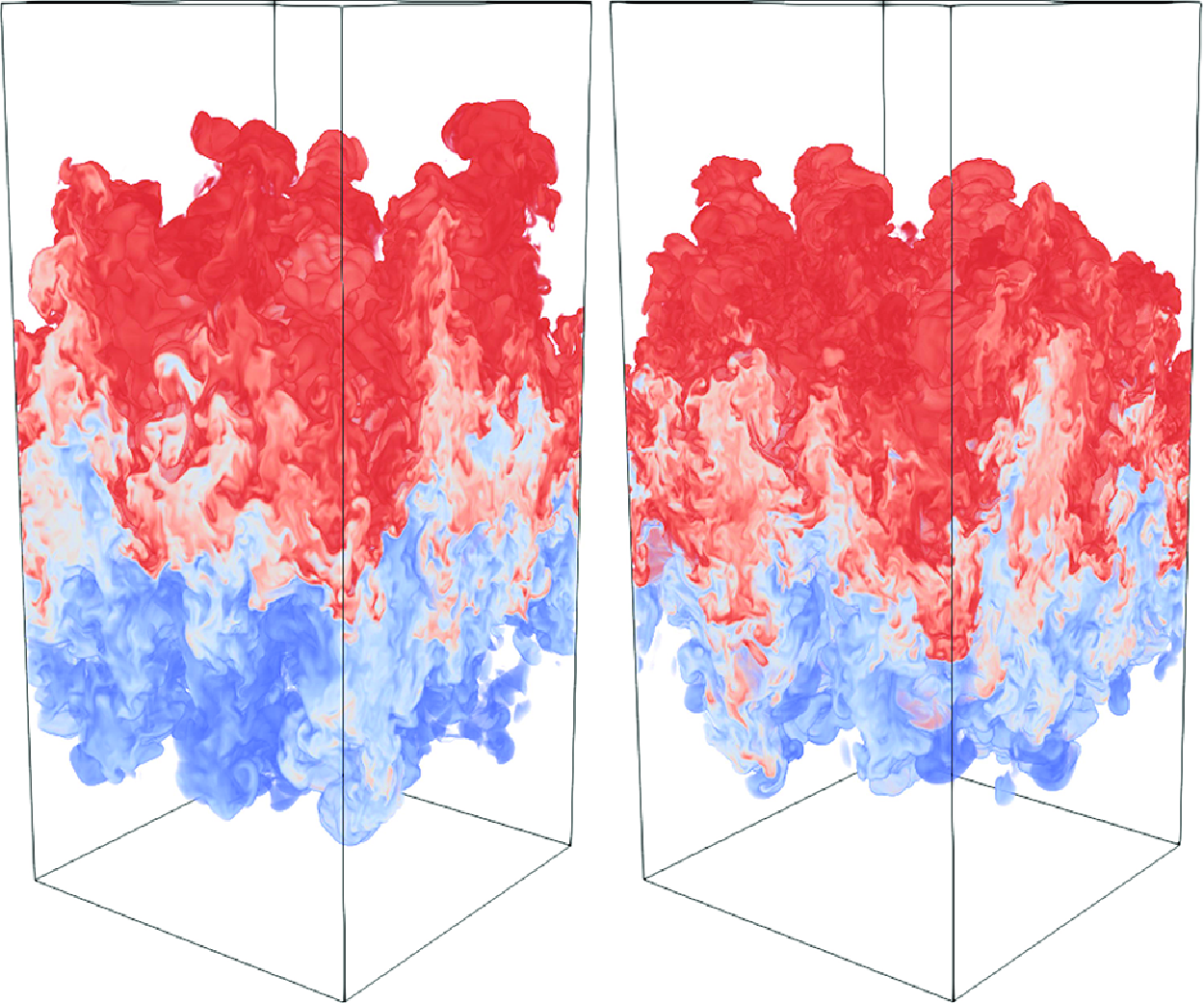
Multi-scale dynamics of scalar transfer in Rayleigh–Taylor turbulent mixing
-
- Journal:
- Journal of Fluid Mechanics / Volume 1011 / 25 May 2025
- Published online by Cambridge University Press:
- 14 May 2025, A4
-
- Article
-
- You have access
- Open access
- HTML
- Export citation
-
Miscible Rayleigh–Taylor (RT) turbulence exhibits a wide range of length scales in both the velocity and density fields, leading to complex deformations of isoscalar surfaces and enhanced mixing due to nonlinear interactions among different scales. Through high-resolution numerical simulations and a coarse-graining analysis, we demonstrate that the variance of the heavy fluid concentration, initially maximised by the unstable stratification, progressively cascades from larger to smaller scales, eventually dissipates at the smallest scale. The transfer of scalar variance, $\Pi ^Y$, primarily governed by the filtered strain rate tensor, is effectively captured by a nonlinear model that links $\Pi ^Y$ to the isoscalar surface stretching. On the other hand, the backscatter of scalar variance transfer, represented by the negative component of $\Pi ^Y$, is influenced by the filtered vorticity field. Furthermore, we examine the directional anisotropy of scalar transfer in RT turbulence, enhancing the accuracy of the nonlinear model by separating the horizontal mean of the mass fraction from its fluctuating part.


Taylor dispersion for coupled electroosmotic and pressure-driven flows in all time regimes
-
- Journal:
- Journal of Fluid Mechanics / Volume 1011 / 25 May 2025
- Published online by Cambridge University Press:
- 14 May 2025, A36
-
- Article
-
- You have access
- Open access
- HTML
- Export citation

Optimised flow control based on automatic differentiation in compressible turbulent channel flows
-
- Journal:
- Journal of Fluid Mechanics / Volume 1011 / 25 May 2025
- Published online by Cambridge University Press:
- 14 May 2025, A1
-
- Article
-
- You have access
- Open access
- HTML
- Export citation
-
This study presents an automatic differentiation (AD)-based optimisation framework for flow control in compressible turbulent channel flows. Using a differentiable solver, JAX-Fluids, we designed fully differentiable boundary conditions that allow for the precise calculation of gradients with respect to boundary control variables. This facilitates the efficient optimisation of flow control methods. The framework’s adaptability and effectiveness are demonstrated using two boundary conditions: opposition control and tunable permeable walls. Various optimisation targets are evaluated, including wall friction and turbulent kinetic energy (TKE), across different time horizons. In each optimisation, there were around $4\times 10^4$ control variables and $3\times 10^{9}$ state variables in a single episode. Results indicate that TKE targeted opposition control achieves a more stable and significant reduction in drag, with effective suppression of turbulence throughout the channel. In contrast, strategies that focus directly on minimising wall friction were found to be less effective, exhibiting instability and increased turbulence in the outer region. The tunable permeable walls also show potential to achieve stable drag reduction through a ‘flux-inducing’ mechanism. This study demonstrates the advantages of AD-based optimisation in complex flow control scenarios and provides physical insight into the choice of the quantity of interest for improved optimisation performance.


Non-modal analysis of Rayleigh–Bénard convection with and without bounded shear flows in viscoelastic fluids
-
- Journal:
- Journal of Fluid Mechanics / Volume 1011 / 25 May 2025
- Published online by Cambridge University Press:
- 14 May 2025, A37
-
- Article
- Export citation

Feigenbaum universality in subcritical Taylor–Couette flow
-
- Journal:
- Journal of Fluid Mechanics / Volume 1010 / 10 May 2025
- Published online by Cambridge University Press:
- 14 May 2025, A36
-
- Article
-
- You have access
- Open access
- HTML
- Export citation

Gravitational effects on Faraday instability in a viscoelastic liquid
-
- Journal:
- Journal of Fluid Mechanics / Volume 1011 / 25 May 2025
- Published online by Cambridge University Press:
- 14 May 2025, A28
-
- Article
-
- You have access
- Open access
- HTML
- Export citation

Dynamics of inviscid droplets on fibres: from instability to oscillations
-
- Journal:
- Journal of Fluid Mechanics / Volume 1011 / 25 May 2025
- Published online by Cambridge University Press:
- 14 May 2025, A34
-
- Article
- Export citation

An insulating plate drifting over a thermally convecting fluid: the effect of heating mode on plate motion and coupling mode
-
- Journal:
- Journal of Fluid Mechanics / Volume 1010 / 10 May 2025
- Published online by Cambridge University Press:
- 14 May 2025, A33
-
- Article
- Export citation
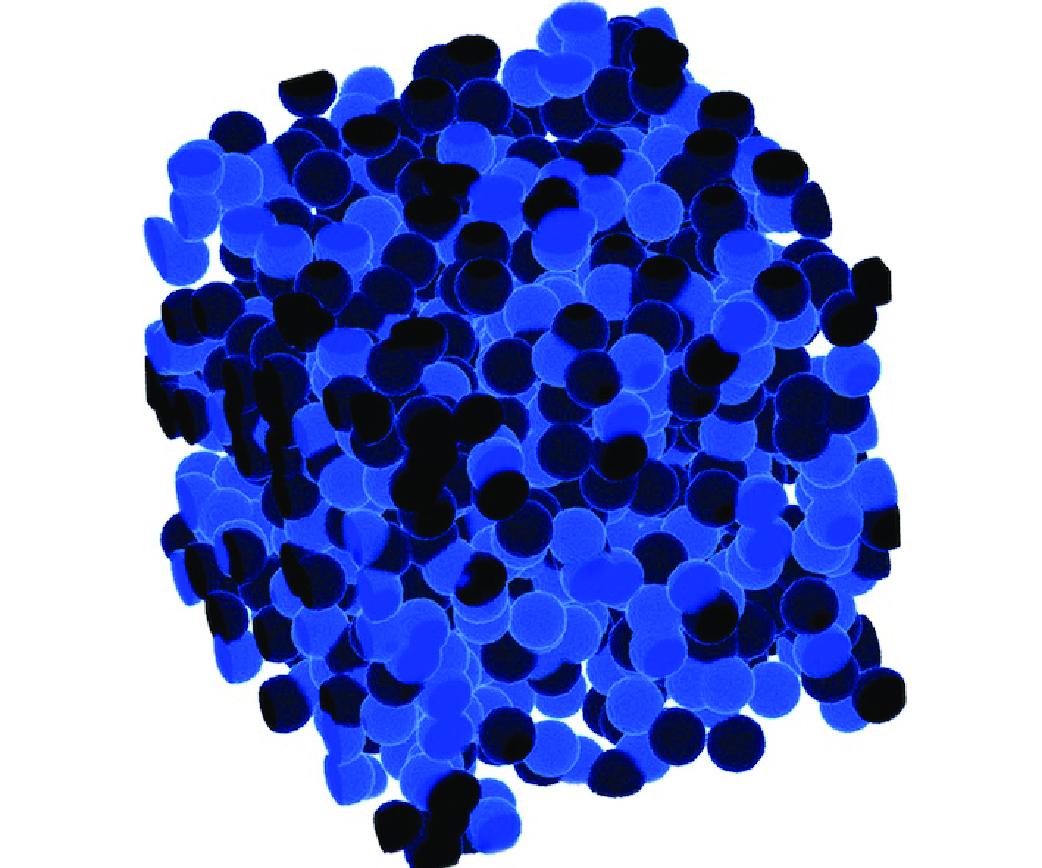
Mean field lattice Boltzmann model for reactive mixtures in porous media
-
- Journal:
- Journal of Fluid Mechanics / Volume 1011 / 25 May 2025
- Published online by Cambridge University Press:
- 14 May 2025, A9
-
- Article
-
- You have access
- Open access
- HTML
- Export citation
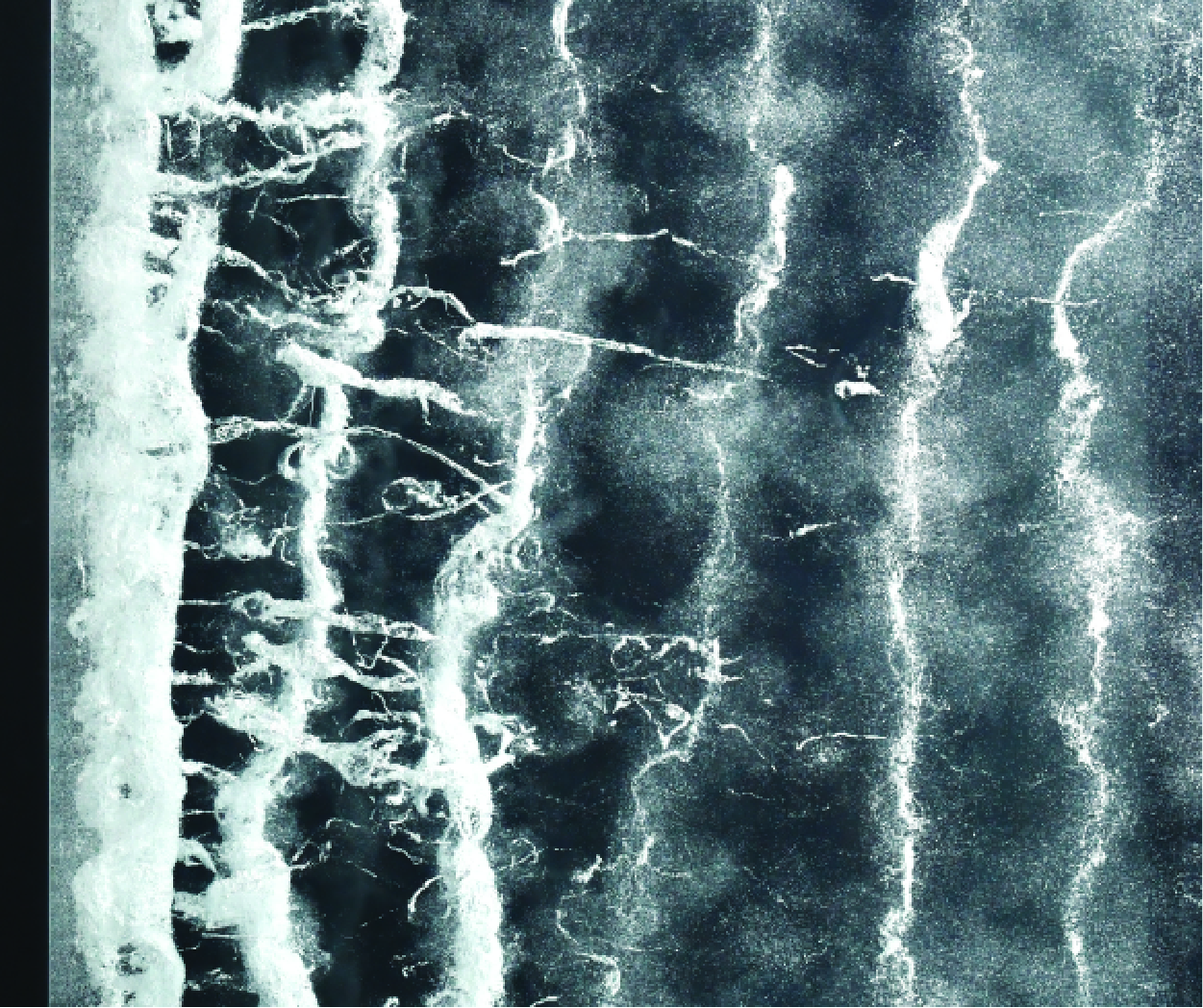
Cavitation nucleation dynamics in structured turbulence
-
- Journal:
- Journal of Fluid Mechanics / Volume 1011 / 25 May 2025
- Published online by Cambridge University Press:
- 14 May 2025, R4
-
- Article
-
- You have access
- Open access
- HTML
- Export citation
-
The effect of nucleation on cavitation inception in a high-Reynolds-number von Kármán wake from a bluff two-dimensional hydrofoil is studied experimentally in a variable pressure water tunnel. Nucleation effects are studied by seeding the flow with sparse monodisperse nuclei populations, with the critical pressure nominally equal to vapour pressure. The injected nuclei population and incipient cavitation events were imaged simultaneously using high-speed cameras to precisely quantify the number of activated nuclei of the total available. Three-dimensional spatial characterisation (orientation and location) of the incipient structures is obtained using two high-speed cameras mounted to the side and below the tunnel test section. Inception was observed predominantly in the stretched cores of secondary structures, with a negligible proportion of events occurring in the primary vortices. A broad peak in the vertical angle distribution is observed about the streamwise axis; however, events at all angles are seen. A symmetric distribution was observed for the horizontal angle, with a dominant orientation $45^{\circ }$ from the free-stream direction. The majority of events occur at approximately one hydrofoil thickness downstream of the hydrofoil trailing edge, with a bimodal symmetric distribution about the hydrofoil vertical centre plane. Nuclei activation rate is determined from the acoustic measurements, and was found to be proportional to the number of the injected nuclei. A power law increase in activation rate was observed following a decrease in cavitation number and an increase in Reynolds number. The nuclei activation rate was of the order of $0.1{-}10 \, \mathrm {s^{-1}}$, which combined with seeding rates of the orderof $100{-}1000 \, \mathrm {s^{-1}}$ reveals inception to be a rare occurrence (0.001 %–10 % of nuclei being activated), requiring the confluence of two unlikely events, the occurrence of a subvapour pressure vortex core with capture of a sufficiently weak nuclei. The presented study provides new insights into the physics of cavitation nucleation and inception and provides a comprehensive dataset for development of computational models.


Motion of a single microalga with one defective flagellum
-
- Journal:
- Journal of Fluid Mechanics / Volume 1010 / 10 May 2025
- Published online by Cambridge University Press:
- 14 May 2025, A20
-
- Article
- Export citation
-
We experimentally identify a rotational motion of a single microalga (Chlamydomonas reinhardtii) within a microcontainer believed to be induced by one defective flagellum. We numerically adapt the classic two-dimensional squirmer model to replicate this unique motion by partially inhibiting the slip velocity on the boundaries of the squirmer. Subsequently, we employ a lattice Boltzmann method to simulate the motion of the single microalga with one defective flagellum. We examine the influence of swimming Reynolds numbers, self-propelling strength ( $\beta$) and angle ( $\alpha$) on the locomotion of the squirmer with one defective flagellum. The results indicate that a large $\beta$ leads to a large rotational diameter, positively correlating with the speed. Additionally, we observe that a low self-propelling strength ( $\beta =0.5$) yields a monotonically increasing speed for the squirmer with $\alpha$. In general, high $\beta$ values result in fast speeds for the squirmer. This differs from the behaviour observed in a classic squirmer ( $\alpha =360^{\circ }$), where high $\beta$ leads to a slow speed of puller ( $\beta \gt 0$) owing to weak fluid inertia effects. Meanwhile, the energy expenditure increases monotonically with $\alpha$, contrasting with the non-monotonic trends observed for swimming speed and rotational diameter.


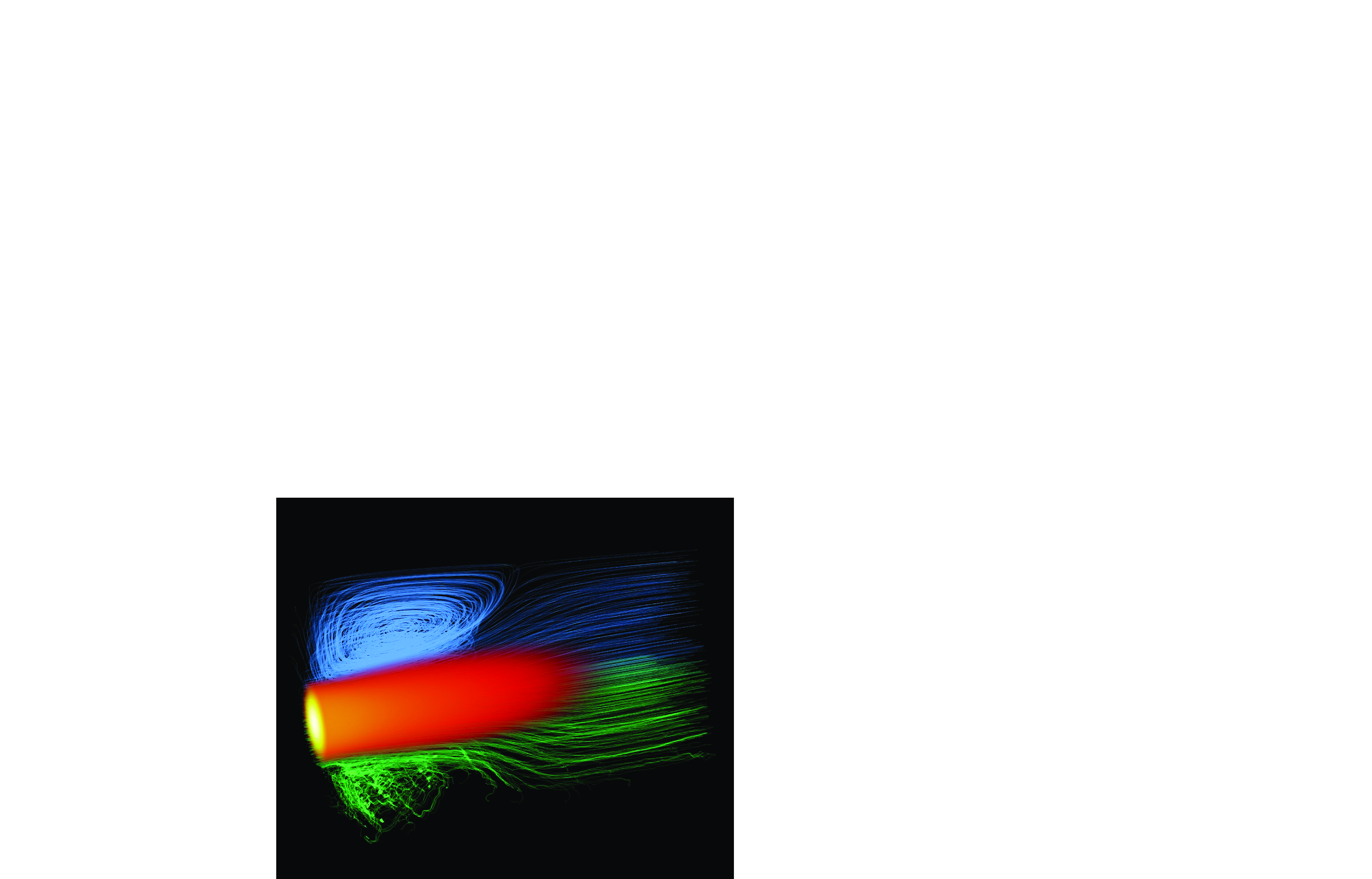
Learning rheological parameters of non-Newtonian fluids from velocimetry data
-
- Journal:
- Journal of Fluid Mechanics / Volume 1011 / 25 May 2025
- Published online by Cambridge University Press:
- 14 May 2025, R3
-
- Article
-
- You have access
- Open access
- HTML
- Export citation

Role of soluble surfactant in linear stability of a liquid film flowing down a compliant substrate
-
- Journal:
- Journal of Fluid Mechanics / Volume 1011 / 25 May 2025
- Published online by Cambridge University Press:
- 13 May 2025, A6
-
- Article
- Export citation

Complex-network modeling of reversal events in two-dimensional turbulent thermal convection
-
- Journal:
- Journal of Fluid Mechanics / Volume 1011 / 25 May 2025
- Published online by Cambridge University Press:
- 13 May 2025, A30
-
- Article
-
- You have access
- Open access
- HTML
- Export citation
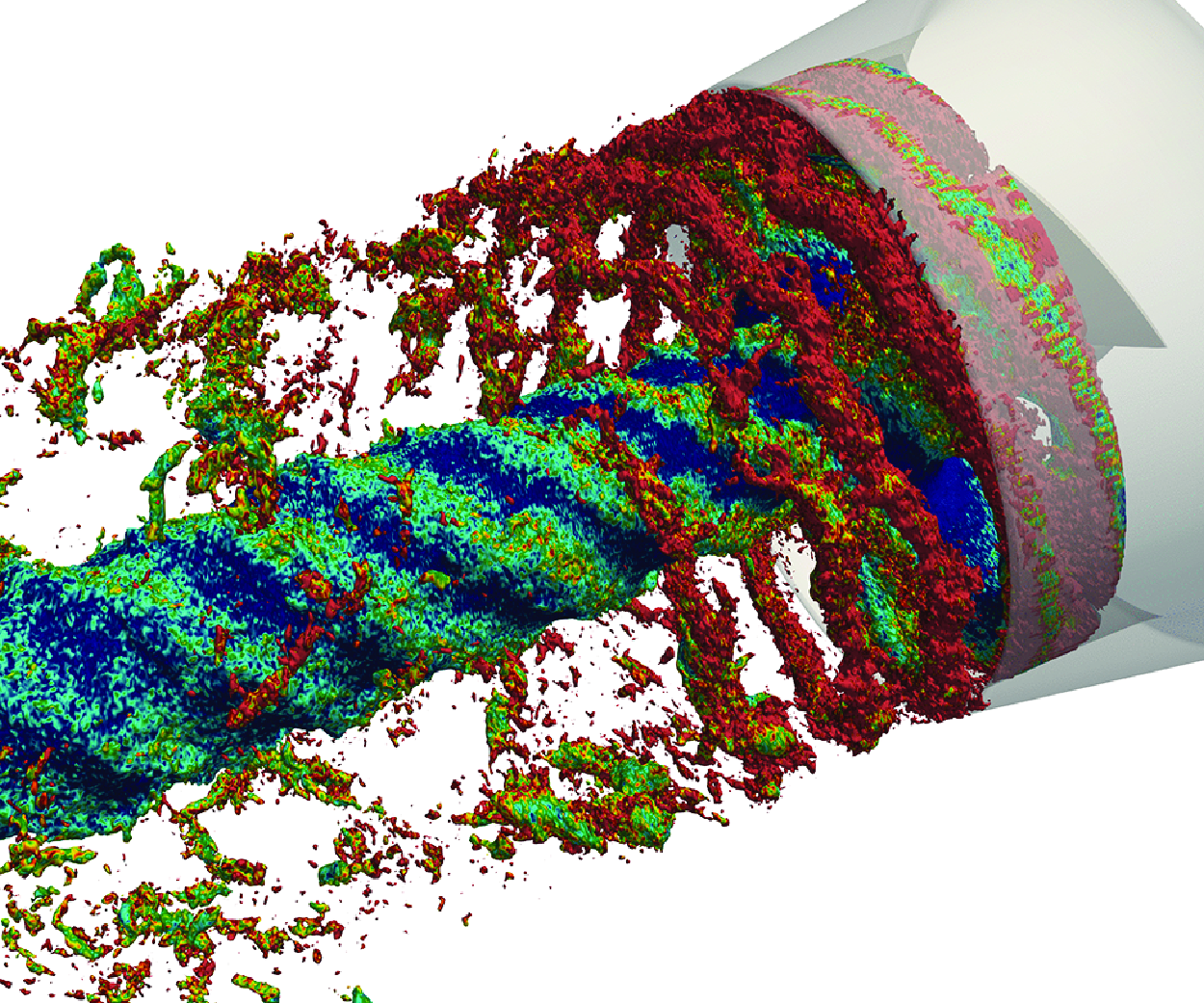
Comparison between the wake systems of conventional and ducted propellers
-
- Journal:
- Journal of Fluid Mechanics / Volume 1011 / 25 May 2025
- Published online by Cambridge University Press:
- 13 May 2025, A15
-
- Article
-
- You have access
- Open access
- HTML
- Export citation
-
The wake systems of ducted and conventional marine propellers are compared for a highly loaded condition by exploiting results of large eddy simulations, conducted on a cylindrical grid consisting of 3.5 billion points. The results demonstrate a dramatic change of both performance and flow physics, due to the nozzle. The efficiency of propulsion is increased by about $30\,\%$, but the thrust generated by the propeller is reduced, replaced in most part by that produced by its nozzle. As a result, weaker coherent structures are shed in the wake on the ducted propeller, compared with the conventional one. Meanwhile, the tip leakage vortices experience a faster instability into smaller turbulent structures. Therefore, the wake signature of the ducted propeller, detrimental to its interaction with downstream bodies, is reduced, compared with that of the conventional propeller operating with no duct. The source of the faster instability of the tip leakage vortices is different from the typical one of the tip vortices shed by conventional propellers. The latter is attributable to phenomena of short- and long-wave instabilities of the helices of each tip vortex, eventually leading to mutual inductance, leapfrogging and breakup into turbulence. In contrast, the former is tied to the shear developed between the tip leakage vortices and the boundary layer of the inner surface of the nozzle, rather than to the interaction between vortices shed by different blades.

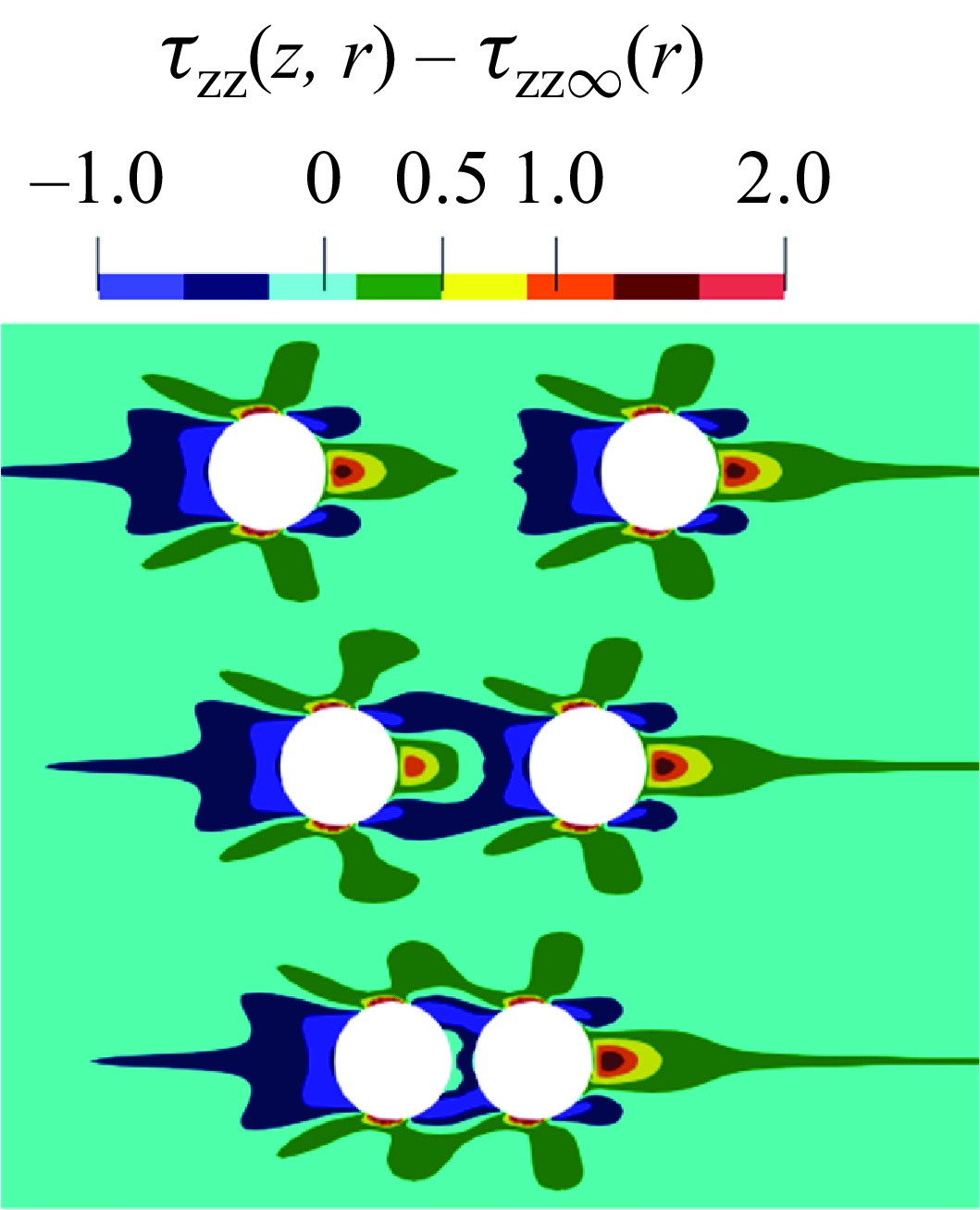
Numerical simulations of the pressure-driven flow of pairs of rigid spheres in elastoviscoplastic fluids
-
- Journal:
- Journal of Fluid Mechanics / Volume 1011 / 25 May 2025
- Published online by Cambridge University Press:
- 13 May 2025, A20
-
- Article
-
- You have access
- Open access
- HTML
- Export citation
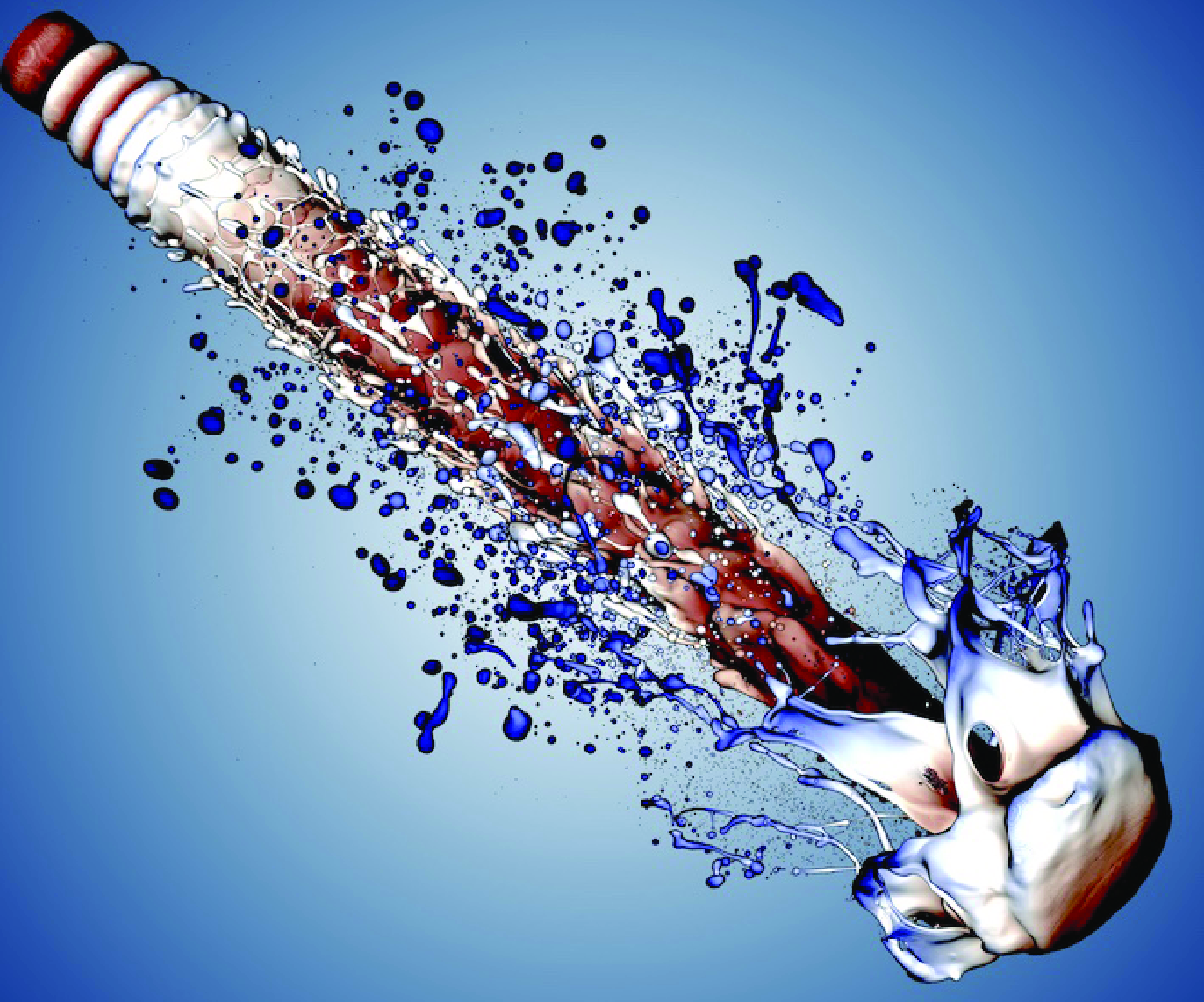
The atomising pulsed jet
-
- Journal:
- Journal of Fluid Mechanics / Volume 1009 / 10 May 2025
- Published online by Cambridge University Press:
- 13 May 2025, A35
-
- Article
-
- You have access
- Open access
- HTML
- Export citation
-
Direct numerical simulations of the injection of a pulsed round liquid jet in a stagnant gas are performed in a series of runs of geometrically progressing resolution. The Reynolds and Weber numbers and the density ratio are sufficiently large for reaching a complex high-speed atomisation regime but not so large so that the small length scales of the flow are impossible to resolve, except for a very small liquid-sheet thickness. The Weber number based on grid size is then small, an indication that the simulations are very well resolved. Computations are performed using octree adaptive mesh refinement with a finite volume method and height-function computation of curvature, down to a specified minimum grid size $\varDelta$. Qualitative analysis of the flow and its topology reveals a complex structure of ligaments, sheets, droplets and bubbles that evolve and interact through impacts, ligament breakup, sheet rupture and engulfment of air bubbles in the liquid. A rich gallery of images of entangled structures is produced. Most processes occurring in this type of atomisation are reproduced in detail, except at the instant of thin sheet perforation or breakup. We analyse droplet statistics, showing that as the grid resolution is increased, the small-scale part of the distribution does not converge, and contains a large number of droplets close in order of magnitude to the minimum grid size with a significant peak at $d = 3\varDelta$. This non-convergence arises from the numerical sheet breakup effect, in which the interface becomes rough just before it breaks. The rough appearance of the interface is associated with a high-wavenumber oscillation of the curvature. To recover convergence, we apply the controlled ‘manifold death’ numerical procedure, in which thin sheets are detected, and then pierced by fiat before they reach a set critical thickness $h_c$ that is always larger than $6 \varDelta$. This allows convergence of the droplet frequency above a certain critical diameter $d_c$, above and close to $h_c$. A unimodal distribution is observed in the converged range. The number of holes pierced in the sheet is a free parameter in the manifold death procedure; however, we use the Kibble–Zurek theory to predict the number of holes expected on heuristic physical grounds.


Propagation and attenuation of sound waves in partially ionised and dissociated plasma flows
-
- Journal:
- Journal of Fluid Mechanics / Volume 1011 / 25 May 2025
- Published online by Cambridge University Press:
- 13 May 2025, A11
-
- Article
-
- You have access
- Open access
- HTML
- Export citation
