Refine search
Actions for selected content:
238502 results in Physics and Astronomy

Asymptotic coefficients of the attached-eddy model derived from an adiabatic atmosphere
-
- Journal:
- Journal of Fluid Mechanics / Volume 1011 / 25 May 2025
- Published online by Cambridge University Press:
- 13 May 2025, A29
-
- Article
-
- You have access
- Open access
- HTML
- Export citation
-
The attached-eddy model (AEM) predicts that the mean streamwise velocity and streamwise velocity variance profiles follow a logarithmic shape, while the vertical velocity variance remains invariant with height in the overlap region of high Reynolds number wall-bounded turbulent flows. Moreover, the AEM coefficients are presumed to attain asymptotically constant values at very high Reynolds numbers. Here, the AEM predictions are examined using sonic anemometer measurements in the near-neutral atmospheric surface layer, with a focus on the logarithmic behaviour of the streamwise velocity variance. Utilizing an extensive 210-day dataset collected from a 62 m meteorological tower located in the Eastern Snake River Plain, Idaho, USA, the inertial sublayer is first identified by analysing the measured momentum flux and mean velocity profiles. The logarithmic behaviour of the streamwise velocity variance and the associated ‘ $-1$’ scaling of the streamwise velocity energy spectra are then investigated. The findings indicate that the Townsend–Perry coefficient ( $A_1$) is influenced by mild non-stationarity that manifests itself as a Reynolds number dependence. After excluding non-stationary runs, and requiring the bulk Reynolds number defined using the atmospheric boundary layer height to be larger than $4 \times 10^{7}$, the inferred $A_1$ converges to values ranging between 1 and 1.25, consistent with laboratory experiments. Furthermore, nine benchmark cases selected through a restrictive quality control reveal a close relation between the ‘ $-1$’ scaling in the streamwise velocity energy spectrum and the logarithmic behaviour of streamwise velocity variance. However, additional data are required to determine whether the plateau value of the pre-multiplied streamwise velocity energy spectrum is identical to $A_1$.


On inhomogeneous Poissonian pair correlations
- Part of
-
- Journal:
- Mathematical Proceedings of the Cambridge Philosophical Society / Volume 179 / Issue 1 / July 2025
- Published online by Cambridge University Press:
- 13 May 2025, pp. 17-27
- Print publication:
- July 2025
-
- Article
-
- You have access
- Open access
- HTML
- Export citation
Orbifold Euler characteristics for compactified universal Jacobians over $\overline{\mathcal{M}}_{g,\,n}$
- Part of
-
- Journal:
- Mathematical Proceedings of the Cambridge Philosophical Society / Volume 179 / Issue 1 / July 2025
- Published online by Cambridge University Press:
- 13 May 2025, pp. 1-16
- Print publication:
- July 2025
-
- Article
-
- You have access
- Open access
- HTML
- Export citation
-
We calculate the orbifold Euler characteristics of all the degree d fine universal compactified Jacobians over the moduli space of stable curves of genus g with n marked points, as defined by Pagani and Tommasi. We show that this orbifold Euler characteristic agrees with the Euler characteristic of $\overline{\mathcal{M}}_{0, 2g+n}$ up to a combinatorial factor, and in particular, is independent of the degree d and the choice of degree d fine compactified universal Jacobian.


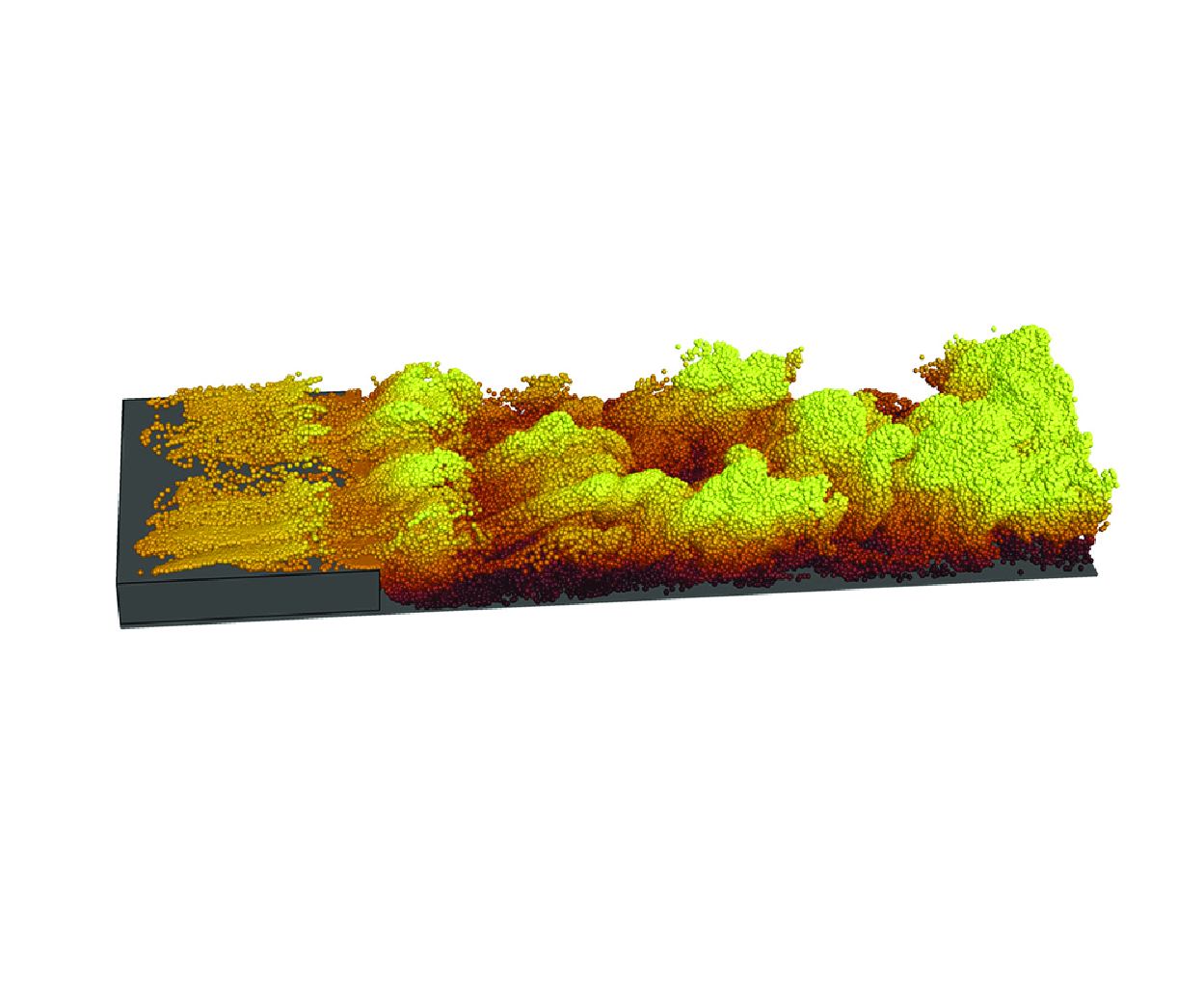
Near-wall effect on vortex dynamics in the flow around a rectangular cylinder
-
- Journal:
- Journal of Fluid Mechanics / Volume 1011 / 25 May 2025
- Published online by Cambridge University Press:
- 13 May 2025, A21
-
- Article
- Export citation
-
This study presents a novel investigation into the vortex dynamics of flow around a near-wall rectangular cylinder based on direct numerical simulation at $Re=1000$, marking the first in-depth exploration of these phenomena. By varying aspect ratios ( $L/D = 5$, $10$,
$10$,  $15$) and gap ratios ( $G/D = 0.1$, $0.3$, $0.9$), the study reveals the vortex dynamics influenced by the near-wall effect, considering the incoming laminar boundary layer flow. Both $L/D$ and $G/D$ significantly influence vortex dynamics, leading to behaviours not observed in previous bluff body flows. As $G/D$ increases, the streamwise scale of the upper leading edge (ULE) recirculation grows, delaying flow reattachment. At smaller $G/D$, lower leading edge (LLE) recirculation is suppressed, with upper Kelvin–Helmholtz vortices merging to form the ULE vortex, followed by instability, differing from conventional flow dynamics. Larger $G/D$ promotes the formation of an LLE shear layer. An intriguing finding at $L/D = 5$ and $G/D = 0.1$ is the backward flow of fluid from the downstream region to the upper side of the cylinder. At $G/D = 0.3$, double-trailing-edge vortices emerge for larger $L/D$, with two distinct flow behaviours associated with two interactions between gap flow and wall recirculation. These interactions lead to different multiple flow separations. For $G/D = 0.9$, the secondary vortex (SV) from the plate wall induces the formation of a tertiary vortex from the lower side of the cylinder. Double-SVs are observed at $L/D = 5$. Frequency locking is observed in most cases, but is suppressed at $L/D = 10$ and $G/D = 0.9$, where competing shedding modes lead to two distinct evolutions of the SV.


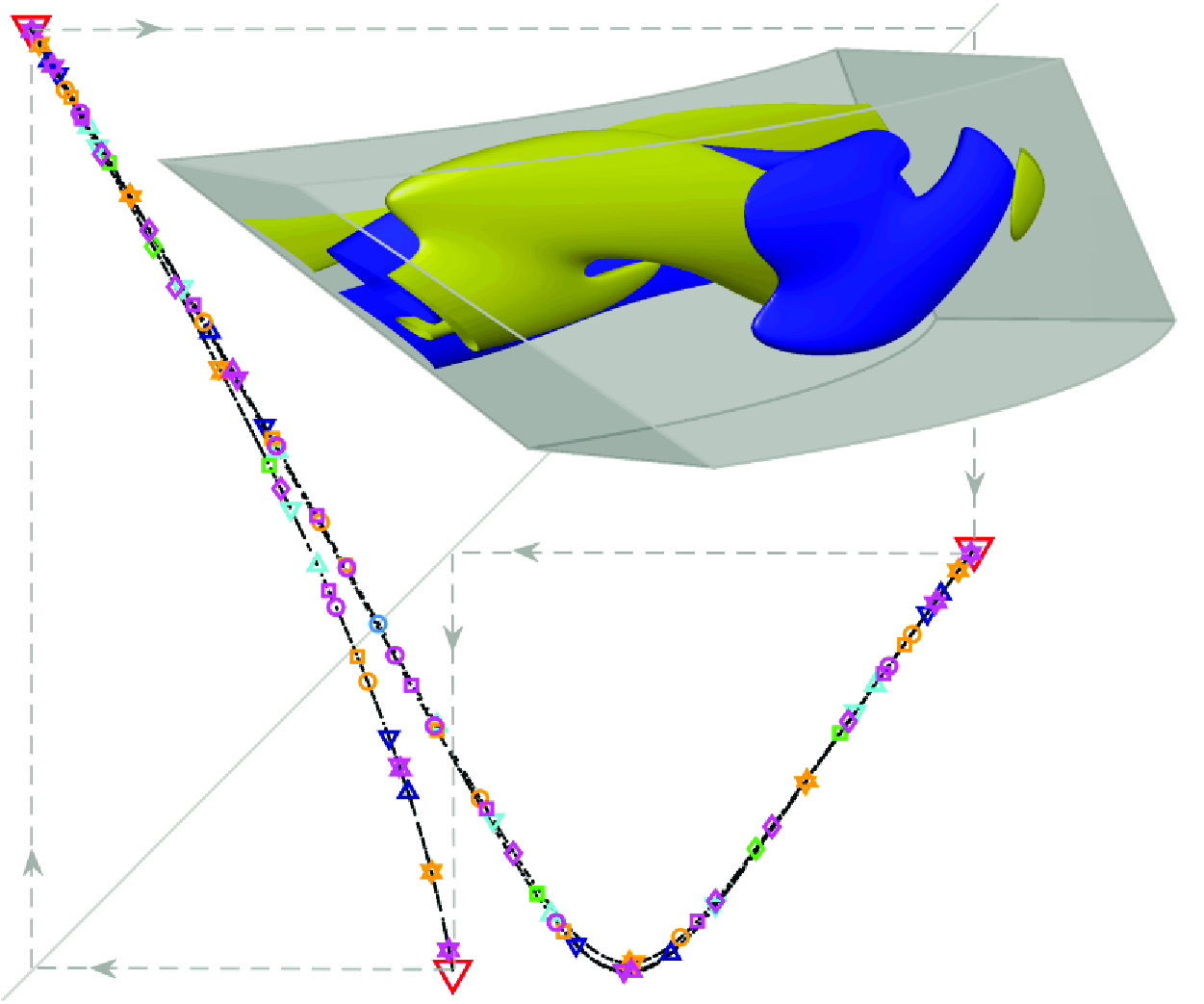
Mathematically established chaos and forecast of statistics with recurrent patterns in Taylor–Couette flow
-
- Journal:
- Journal of Fluid Mechanics / Volume 1011 / 25 May 2025
- Published online by Cambridge University Press:
- 13 May 2025, R2
-
- Article
-
- You have access
- Open access
- HTML
- Export citation

Transient motion of a swimming sheet in the inertial regime
-
- Journal:
- Journal of Fluid Mechanics / Volume 1011 / 25 May 2025
- Published online by Cambridge University Press:
- 13 May 2025, A2
-
- Article
- Export citation
-
Undulatory swimming is among the most common swimming forms found in nature across various length scales. In this study, we analyse the inertial effects of both the fluid and the swimmer on the transient motion of undulatory swimming using Taylor’s waving sheet model. We derive the transient velocity of the sheet for combined longitudinal and transverse waves in the Laplace domain, identifying three contributions to the velocity: the ‘slip’ velocity, fluid convection and a hydrodynamic force contribution. By numerically inverting the Laplace transform, we obtain the time history of the velocity for swimmers with varying swimming parameters and initial configurations. The acceleration performance of two types of swimmers is analysed by considering three dimensionless parameters: the acceleration rate $1/T$, sheet mass $M$, and Reynolds number $Re$, representing the effects of unsteady, convective and swimmer inertia, respectively. Under a relatively strong inertia effect, the start-up time scales as $\sim TM^2\,Re$ and $\sim TM^2$ for longitudinal and transverse waving sheets, respectively. Under weak inertia effects, the start-up time approximately reaches a constant for longitudinal waves, while it scales as $\sim T$ for transverse waves. Additionally, the transverse waving may induce a velocity overshoot, and enhances the burst swimming performance.


Large cuts in hypergraphs via energy
- Part of
-
- Journal:
- Mathematical Proceedings of the Cambridge Philosophical Society / Volume 179 / Issue 1 / July 2025
- Published online by Cambridge University Press:
- 13 May 2025, pp. 45-61
- Print publication:
- July 2025
-
- Article
- Export citation
-
A simple probabilistic argument shows that every r-uniform hypergraph with m edges contains an r-partite subhypergraph with at least $({r!}/{r^r})m$ edges. The celebrated result of Edwards states that in the case of graphs, that is $r=2$, the resulting bound $m/2$ can be improved to $m/2+\Omega(m^{1/2})$, and this is sharp. We prove that if $r\geq 3$, then there is an r-partite subhypergraph with at least $({r!}/{r^r}) m+m^{3/5-o(1)}$ edges. Moreover, if the hypergraph is linear, this can be improved to $({r!}/{r^r}) m+m^{3/4-o(1)}$, which is tight up to the o(1) term. These improve results of Conlon, Fox, Kwan and Sudakov. Our proof is based on a combination of probabilistic, combinatorial, and linear algebraic techniques, and semidefinite programming.
A key part of our argument is relating the energy $\mathcal{E}(G)$ of a graph G (i.e. the sum of absolute values of eigenvalues of the adjacency matrix) to its maximum cut. We prove that every m edge multigraph G has a cut of size at least $m/2+\Omega({\mathcal{E}(G)}/{\log m})$, which might be of independent interest.


Transition between rotation- and buoyancy-dominated regimes in rotating convection: the effect of boundary conditions
-
- Journal:
- Journal of Fluid Mechanics / Volume 1011 / 25 May 2025
- Published online by Cambridge University Press:
- 13 May 2025, A7
-
- Article
-
- You have access
- Open access
- HTML
- Export citation
-
In rotating convection, analysis of heat transfer reveals a distinct shift in behaviour as the system transitions from a steep scaling regime near the onset of convection to a shallower scaling at higher Rayleigh numbers ( $Ra$), irrespective of whether the top and bottom plates have stress-free, no-slip or no boundaries (homogeneous convection). However, while most research on this transition focuses on no-slip boundary conditions, geophysical and astrophysical flows commonly involve stress-free and homogeneous convection models as well. This study delves into the transition from the rapidly rotating regime to the non-rotating one with both stress-free and homogeneous models, leveraging direct numerical simulations (DNS) and existing literature data. Our findings unveil that for stress-free boundary conditions, the transitional Rayleigh number ( $Ra_T$) exhibits a relationship $Ra_T\sim Ek^{-12/7}$, whereas for homogeneous rotating convection, $Ra_T\sim Ek^{-2}\, Pr$, where $Ek$ denotes the Ekman number, and $Pr$ denotes the Prandtl number. Both of these relationships align with the data obtained through DNS.



Collisions of elliptic vortex rings upon flat walls
-
- Journal:
- Journal of Fluid Mechanics / Volume 1011 / 25 May 2025
- Published online by Cambridge University Press:
- 13 May 2025, A19
-
- Article
-
- You have access
- Open access
- HTML
- Export citation
-
Head-on collisions between elliptic vortex rings (EVRs) and walls were studied experimentally using planar laser-induced fluorescence visualisations and time-resolved particle image velocimetry. Aspect ratios of $AR=2$ and 4 EVRs at a Reynolds number of $Re=4000$ were used. Collision locations were based on four key axis-switching stages of freely translating EVRs, which would shed light upon how axis-switching behaviour and aspect ratio variations affect the collision outcomes. Results show that non-uniform circumferential induced velocities in both colliding EVRs produce different behaviours along major and minor planes, where vortex-stretching/compression and hence circumferential flows play key roles in the vortex dynamics. Non-uniform formations of secondary/tertiary EVRs also lead to varied entanglements around the primary EVRs. As such, secondary vortex rings form vortex loops that may congregate along the collision axis, depending on the exact collision location. Vortex-core trajectories show the net primary/secondary vortex-core movements result from a balance between EVR diameter expansion due to collision and EVR segment motions associated with the axis-switching stage at the point of collision. Confinement effects are also observed to dominate over aspect ratio effects when the collision occurs closest to the orifice. While increasing the aspect ratio leads to different vortex-stretching/compression behaviour and more varied vortex-core trajectories due to the greater non-uniform induced velocities, they could still be understood by the preceding interpretations. Finally, three-dimensional vortex flows are reconstructed based on the experimental results to further explain the flow mechanisms.


Numerical studies of bypass transition delay on a wing using optimal control theory
-
- Journal:
- Journal of Fluid Mechanics / Volume 1011 / 25 May 2025
- Published online by Cambridge University Press:
- 13 May 2025, A10
-
- Article
-
- You have access
- Open access
- HTML
- Export citation
Strain optimisation for ReBCO high-temperature superconducting stellarator coils in SIMSOPT
-
- Journal:
- Journal of Plasma Physics / Volume 91 / Issue 2 / April 2025
- Published online by Cambridge University Press:
- 12 May 2025, E71
-
- Article
-
- You have access
- Open access
- HTML
- Export citation

Deformation, dynamics and rheology of immersed elastic capsules in an inertial shear flow
-
- Journal:
- Journal of Fluid Mechanics / Volume 1010 / 10 May 2025
- Published online by Cambridge University Press:
- 09 May 2025, A52
-
- Article
-
- You have access
- Open access
- HTML
- Export citation

On the settling and clustering behaviour of polydisperse gas–solid flows
-
- Journal:
- Journal of Fluid Mechanics / Volume 1010 / 10 May 2025
- Published online by Cambridge University Press:
- 09 May 2025, A27
-
- Article
-
- You have access
- Open access
- HTML
- Export citation
-
Sedimenting flows occur in a range of society-critical systems, such as circulating fluidised bed reactors and pyroclastic density currents (PDCs), the most hazardous volcanic process. In these systems, mass loading is sufficiently high ( $\gg \mathcal {O}(1)$) and momentum coupling between the phases gives rise to mesoscale behaviour, such as formation of coherent structures capable of generating and sustaining turbulence in the carrier phase and directly impacting large-scale quantities of interest, such as settling time. While contemporary work has explored the physical processes underpinning these multiphase phenomena for monodispersed particles, polydispersed behaviour has been largely understudied. Since all real-world flows are polydisperse, understanding the role of polydispersity in gas–solid systems is critical for informing closures that are accurate and robust. This work characterises the sedimentation behaviour of two polydispersed gas–solid flows, with properties of the particles sampled from historical PDC ejecta. Highly resolved data at two volume fractions (1 % and 10 %) are collected using an EulerLagrange framework and is compared with monodisperse configurations of particles with diameters equivalent to the arithmetic mean of the polydisperse configurations. From these data, we find that polydispersity has an important impact on cluster formation and structure and that this is most pronounced for dilute flows. At higher volume fraction, the effect of polydispersity is reduced. We also propose a new metric for predicting the degree of clustering, termed ‘surface loading’, and a model for the coefficient of drag that accurately captures the settling velocity observed in the high-fidelity data.


Effects of pressure-gradient histories on skin friction and mean flow of high Reynolds number turbulent boundary layers over smooth and rough walls
- Part of
-
- Journal:
- Journal of Fluid Mechanics / Volume 1010 / 10 May 2025
- Published online by Cambridge University Press:
- 09 May 2025, A30
-
- Article
-
- You have access
- Open access
- HTML
- Export citation
-
Experiments are conducted over smooth and rough walls to explore the influence of pressure-gradient histories on skin friction and mean flow of turbulent boundary layers. Different pressure-gradient histories are imposed on the boundary layer through an aerofoil mounted in the free stream. Hot-wire measurements are taken at different free-stream velocities downstream of the aerofoil where the flow has locally recovered to zero pressure gradient but retains the history effects. Direct skin friction measurements are also made using oil film interferometry for smooth walls and a floating-element drag balance for rough walls. The friction Reynolds number, $Re_\tau$, varies between $3000$ and $27\,000$, depending both on the surface conditions and the free-stream velocity ensuring sufficient scale separation. Results align with previous findings, showing that adverse pressure gradients just upstream of the measurement location increase wake strength and reduce the local skin friction while favourable pressure gradients suppress the wake and increase skin friction. The roughness length scale, $y_0$, remains constant across different pressure-gradient histories for rough wall boundary layers. Inspired by previous works, a new correlation is proposed to infer skin friction based on the mean flow. The difference in skin friction by matching the turbulence profiles and flow structure between an arbitrary pressure-gradient history and zero pressure-gradient condition can be predicted using only the local wake strength parameter ( $\Pi$), and the variations in wake strength for different histories are related to a weighted integral of the pressure-gradient history normalised by local quantities. This allows us to develop a general correlation that can be used to infer skin friction for turbulent boundary layers experiencing arbitrary pressure-gradient histories.


Quasi-steady shock refraction phenomenon at a diffusive fast–slow interface
-
- Journal:
- Journal of Fluid Mechanics / Volume 1010 / 10 May 2025
- Published online by Cambridge University Press:
- 09 May 2025, A16
-
- Article
- Export citation
-
The quasi-steady shock refraction at a diffusive air–SF $_6$ interface (fast–slow type) is investigated numerically and theoretically. A new refraction pattern where both shock and expansion waves are simultaneously present in the reflected waves (named RRR-E) is first observed at the diffusive interface. The new refraction pattern is a regular pattern that is not expected to occur in classical shock refraction at a sharp fast–slow interface. Through the shock polar method, continuous refraction processes occur within the diffusion layer to satisfy the kinematic relationship between the reflected wave and the transmitted shock, which results in the RRR-E formation. Subsequently, the conditions for the RRR-E occurrence are obtained theoretically and verified numerically. In the phase diagram of the refraction patterns, the presence of RRR-E results in the transition boundaries of different refraction patterns at the sharp fast–slow interface no longer being valid. Specifically, the appearance of RRR-E delays the Mach reflection refraction (MRR) process, which is of great significance for the design of scramjet engines.


Bridging the Rossby number gap in rapidly rotating thermal convection
-
- Journal:
- Journal of Fluid Mechanics / Volume 1010 / 10 May 2025
- Published online by Cambridge University Press:
- 09 May 2025, A42
-
- Article
- Export citation
-
Geophysical and astrophysical fluid flows are typically driven by buoyancy and strongly constrained at large scales by planetary rotation. Rapidly rotating Rayleigh–Bénard convection (RRRBC) provides a paradigm for experiments and direct numerical simulations (DNS) of such flows, but the accessible parameter space remains restricted to moderately fast rotation rates (Ekman numbers ${ {Ek}} \gtrsim 10^{-8}$), while realistic ${Ek}$ for geo- and astrophysical applications are orders of magnitude smaller. On the other hand, previously derived reduced equations of motion describing the leading-order behaviour in the limit of very rapid rotation ( $ {Ek}\to 0$) cannot capture finite rotation effects, and the physically most relevant part of parameter space with small but finite ${Ek}$ has remained elusive. Here, we employ the rescaled rapidly rotating incompressible Navier–Stokes equations (RRRiNSE) – a reformulation of the Navier–Stokes–Boussinesq equations informed by the scalings valid for ${Ek}\to 0$, recently introduced by Julien et al. (2024) – to provide full DNS of RRRBC at unprecedented rotation strengths down to $ {Ek}=10^{-15}$ and below, revealing the disappearance of cyclone–anticyclone asymmetry at previously unattainable Ekman numbers ( ${Ek}\approx 10^{-9}$). We also identify an overshoot in the heat transport as ${Ek}$ is varied at fixed $\widetilde { {Ra}} \equiv {Ra}{Ek}^{4/3}$, where $Ra$ is the Rayleigh number, associated with dissipation due to ageostrophic motions in the boundary layers. The simulations validate theoretical predictions based on thermal boundary layer theory for RRRBC and show that the solutions of RRRiNSE agree with the reduced equations at very small ${Ek}$. These results represent a first foray into the vast, largely unexplored parameter space of very rapidly rotating convection rendered accessible by RRRiNSE.


Scaling of pressure fluctuation in turbulent internal flows
-
- Journal:
- Journal of Fluid Mechanics / Volume 1010 / 10 May 2025
- Published online by Cambridge University Press:
- 09 May 2025, A54
-
- Article
- Export citation

Large-eddy simulation of the flow over a realistic riverine geometry
-
- Journal:
- Journal of Fluid Mechanics / Volume 1010 / 10 May 2025
- Published online by Cambridge University Press:
- 09 May 2025, A35
-
- Article
-
- You have access
- Open access
- HTML
- Export citation

Drag reduction in surfactant-contaminated superhydrophobic channels at high Péclet numbers
-
- Journal:
- Journal of Fluid Mechanics / Volume 1010 / 10 May 2025
- Published online by Cambridge University Press:
- 09 May 2025, A58
-
- Article
-
- You have access
- Open access
- HTML
- Export citation

Pore-scale study of brine evaporation and salt precipitation mechanisms during CO2 injection
-
- Journal:
- Journal of Fluid Mechanics / Volume 1010 / 10 May 2025
- Published online by Cambridge University Press:
- 09 May 2025, A31
-
- Article
-
- You have access
- Open access
- HTML
- Export citation
