Refine search
Actions for selected content:
238502 results in Physics and Astronomy
Frontmatter
-
- Book:
- Phase Transitions
- Published online:
- 01 May 2025
- Print publication:
- 15 May 2025, pp i-iv
-
- Chapter
- Export citation
Contents
-
- Book:
- Phase Transitions
- Published online:
- 01 May 2025
- Print publication:
- 15 May 2025, pp vii-x
-
- Chapter
- Export citation
Part II - Applications
-
- Book:
- Phase Transitions
- Published online:
- 01 May 2025
- Print publication:
- 15 May 2025, pp 101-102
-
- Chapter
- Export citation
4 - Coupling of ferroic degrees of freedom: multiferroics
- from Part II - Applications
-
- Book:
- Phase Transitions
- Published online:
- 01 May 2025
- Print publication:
- 15 May 2025, pp 151-174
-
- Chapter
- Export citation
Uniform sets with few progressions via colourings
- Part of
-
- Journal:
- Mathematical Proceedings of the Cambridge Philosophical Society / Volume 179 / Issue 1 / July 2025
- Published online by Cambridge University Press:
- 15 May 2025, pp. 79-103
- Print publication:
- July 2025
-
- Article
-
- You have access
- Open access
- HTML
- Export citation
-
Ruzsa asked whether there exist Fourier-uniform subsets of $\mathbb Z/N\mathbb Z$ with density $\alpha$ and 4-term arithmetic progression (4-AP) density at most $\alpha^C$, for arbitrarily large C. Gowers constructed Fourier uniform sets with density $\alpha$ and 4-AP density at most $\alpha^{4+c}$ for some small constant $c \gt 0$. We show that an affirmative answer to Ruzsa’s question would follow from the existence of an $N^{o(1)}$-colouring of [N] without symmetrically coloured 4-APs. For a broad and natural class of constructions of Fourier-uniform subsets of $\mathbb Z/N\mathbb Z$, we show that Ruzsa’s question is equivalent to our arithmetic Ramsey question.
We prove analogous results for all even-length APs. For each odd $k\geq 5$, we show that there exist $U^{k-2}$-uniform subsets of $\mathbb Z/N\mathbb Z$ with density $\alpha$ and k-AP density at most $\alpha^{c_k \log(1/\alpha)}$. We also prove generalisations to arbitrary one-dimensional patterns.


8 - Non-equilibrium phase transitions
- from Part II - Applications
-
- Book:
- Phase Transitions
- Published online:
- 01 May 2025
- Print publication:
- 15 May 2025, pp 272-299
-
- Chapter
- Export citation
General Index
-
- Book:
- Phase Transitions
- Published online:
- 01 May 2025
- Print publication:
- 15 May 2025, pp 391-396
-
- Chapter
- Export citation

Statistical analysis of vertical velocity and buoyancy in convective boundary layers
-
- Journal:
- Journal of Fluid Mechanics / Volume 1011 / 25 May 2025
- Published online by Cambridge University Press:
- 15 May 2025, A40
-
- Article
-
- You have access
- Open access
- HTML
- Export citation

Self-excited instability and transition to turbulence in laminar separation bubbles induced by surface waviness
-
- Journal:
- Journal of Fluid Mechanics / Volume 1011 / 25 May 2025
- Published online by Cambridge University Press:
- 15 May 2025, A27
-
- Article
-
- You have access
- Open access
- HTML
- Export citation
7 - Glassy phenomena in materials with disorder
- from Part II - Applications
-
- Book:
- Phase Transitions
- Published online:
- 01 May 2025
- Print publication:
- 15 May 2025, pp 238-271
-
- Chapter
- Export citation
Dedication
-
- Book:
- Phase Transitions
- Published online:
- 01 May 2025
- Print publication:
- 15 May 2025, pp v-vi
-
- Chapter
- Export citation
10 - Quantum phase transitions
- from Part II - Applications
-
- Book:
- Phase Transitions
- Published online:
- 01 May 2025
- Print publication:
- 15 May 2025, pp 332-352
-
- Chapter
- Export citation
5 - Caloric and multicaloric materials
- from Part II - Applications
-
- Book:
- Phase Transitions
- Published online:
- 01 May 2025
- Print publication:
- 15 May 2025, pp 175-199
-
- Chapter
- Export citation
6 - Liquid crystals and topological defects
- from Part II - Applications
-
- Book:
- Phase Transitions
- Published online:
- 01 May 2025
- Print publication:
- 15 May 2025, pp 200-237
-
- Chapter
- Export citation
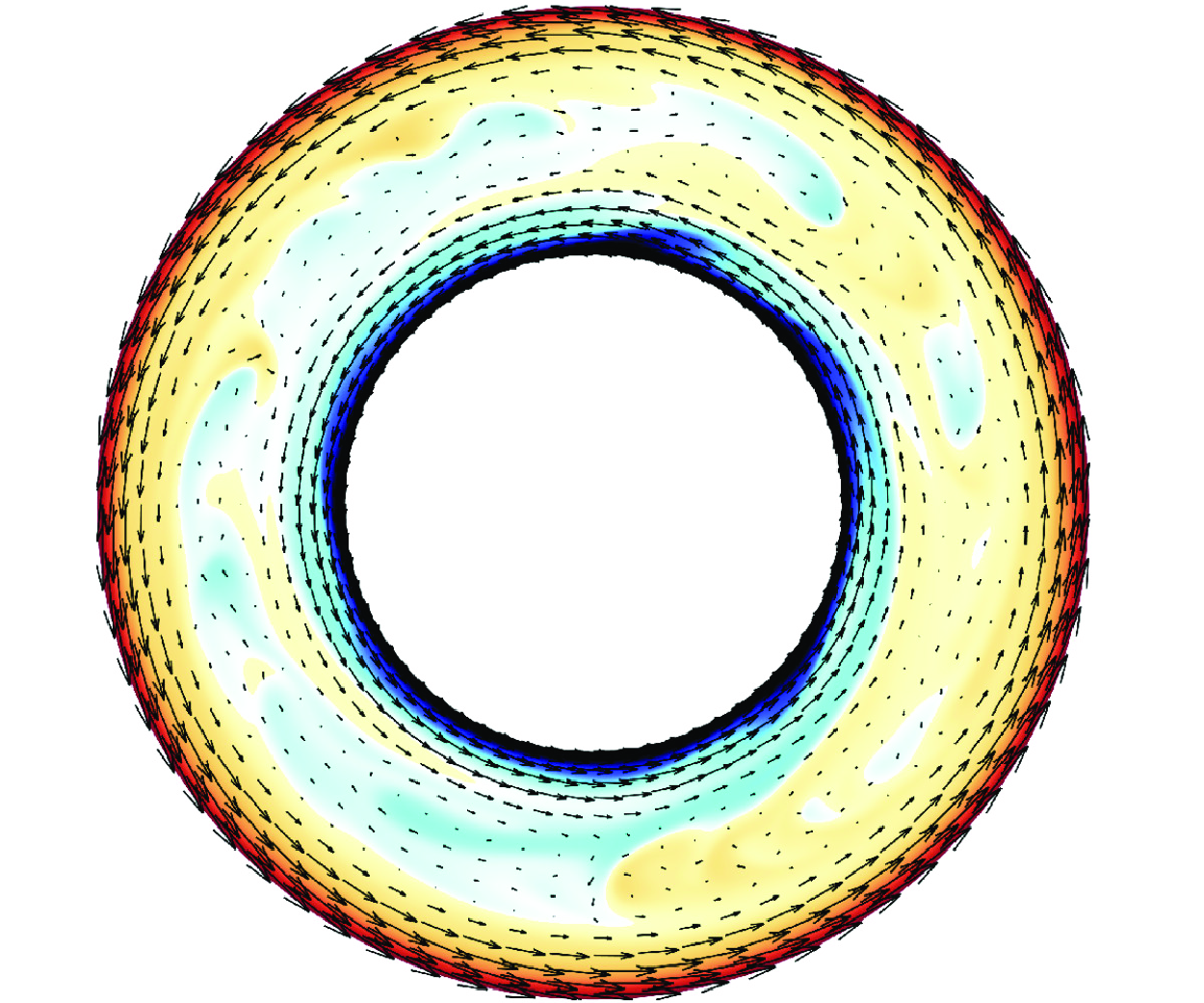
Centrifugal convection with oscillating rotating velocity
-
- Journal:
- Journal of Fluid Mechanics / Volume 1010 / 10 May 2025
- Published online by Cambridge University Press:
- 15 May 2025, A17
-
- Article
- Export citation
-
We perform direct numerical simulations of centrifugal convection with an oscillating rotational velocity of small amplitude to study the effects of oscillatory boundary motion. The oscillation period is the main control parameter, with its range corresponding to a Womersley number in the range $1\lt Wo\lt 300$. Oscillating boundaries generate a circumferential shear flow, which significantly inhibits heat transfer, with maximum suppression $87\,\%$ observed in the present parameter space. Through analysis of the background flow, we find that as the oscillation period increases, the increasing penetration depth of the oscillation and weakening local shear strength result in non-monotonic changes in heat transfer. Under high-frequency oscillation, the characteristic length scale of the viscous layer induced by the oscillation is smaller than the convective length scale, and shear manifests primarily as a continuous suppression of the boundary layer. In contrast, under low-frequency oscillation, the shear flow covers the entire region but with weak strength. The suppression effect of such shear flow exhibits periodicity, leading to alternating phases of convection inhibition and convection generation. The present findings explore the physical mechanisms behind the suppression of convective heat transfer by oscillation, and offer a new strategy for controlling convection systems, with potential implications for both fundamental research and industrial applications.

3 - Ferroic materials
- from Part II - Applications
-
- Book:
- Phase Transitions
- Published online:
- 01 May 2025
- Print publication:
- 15 May 2025, pp 103-150
-
- Chapter
- Export citation

A generalised multiparameter linear stability and sensitivity analysis method
-
- Journal:
- Journal of Fluid Mechanics / Volume 1011 / 25 May 2025
- Published online by Cambridge University Press:
- 15 May 2025, A12
-
- Article
- Export citation
-
A generalised multiparameter model for linear modal stability and sensitivity analysis is developed. The stability and sensitivity equations are derived from a generalised vector-form governing equation comprised of multiple dimensionless parameters that represent different physical forces affecting the system’s stability. By introducing adjoint variables and constructing the Lagrangian identity, a differential relationship between the eigenvalue of the perturbation mode and dimensionless parameters is determined and defined as the global sensitivity gradient. It provides the constraint that must be satisfied for changes in different dimensionless parameters along the isoeigenvalue curve, which aids in the fast computation of the neutral curve. Moreover, the global sensitivity gradient can directly and intuitively evaluate the competitive relationship among the influences of various parameters on system instability. Based on the global sensitivity gradient, an optimal stability control strategy for transitioning from an unstable state to a stable state is discussed. Additionally, the relative sensitivity function is also introduced to investigate the influence of relative parameter variations on instability. To demonstrate the effectiveness of this method, three applications are presented: two-dimensional flow around a circular cylinder with a single dimensionless parameter Re; three-dimensional axisymmetric magnetohydrodynamic (MHD) flow around a sphere with two parameters Re and $N$; and two-dimensional MHD mixed convection with three parameters Re, ${\textit{Gr}}$ and $\textit{Ha}$.


Optimising branched fluidic networks: a unifying approach including laminar and turbulent flows, rough walls and non-Newtonian fluids
-
- Journal:
- Journal of Fluid Mechanics / Volume 1011 / 25 May 2025
- Published online by Cambridge University Press:
- 15 May 2025, A42
-
- Article
-
- You have access
- Open access
- HTML
- Export citation
-
Power minimisation in branched fluidic networks has gained significant attention in biology and engineering. The optimal network is defined by channel radii that minimise the sum of viscous dissipation and the volumetric energetic cost of the fluid. For limit cases including laminar flows, high-Reynolds-number turbulence or smooth-channel approximations, optimal solutions are known. However, current methods do not allow optimisation for a large intermediate part of the parameter space which is typically encountered in realistic fluidic networks that exhibit turbulent flow. Here, we present a unifying optimisation approach based on the Darcy friction factor, which has been determined for a wide range of flow regimes and fluid models and is applicable to the entire parameter space: (i) laminar and turbulent flows, including networks that exhibit both flow types, (ii) non-Newtonian fluids (powerlaw, Bingham and Herschel–Bulkley) and (iii) networks with arbitrary wall roughness, including non-uniform relative roughness. The optimal channel radii are presented analytically and graphically. All existing limit cases are recovered, and a concise framework is presented for systematic optimisation of fluidic networks. Finally, the parameter $x$ in the optimisation relationship $Q\propto R^{x}$, with $Q$ the flow rate and $R$ the channel radius, was approximated as a function of the Reynolds number, revealing in which case the entire network can be optimised based on one optimal channel radius, and in which case all radii must be optimised individually. Our approach can be extended to a wide range of fluidic networks for which the friction factor is known, such as different channel curvatures, bubbly flows or specific wall slip conditions.


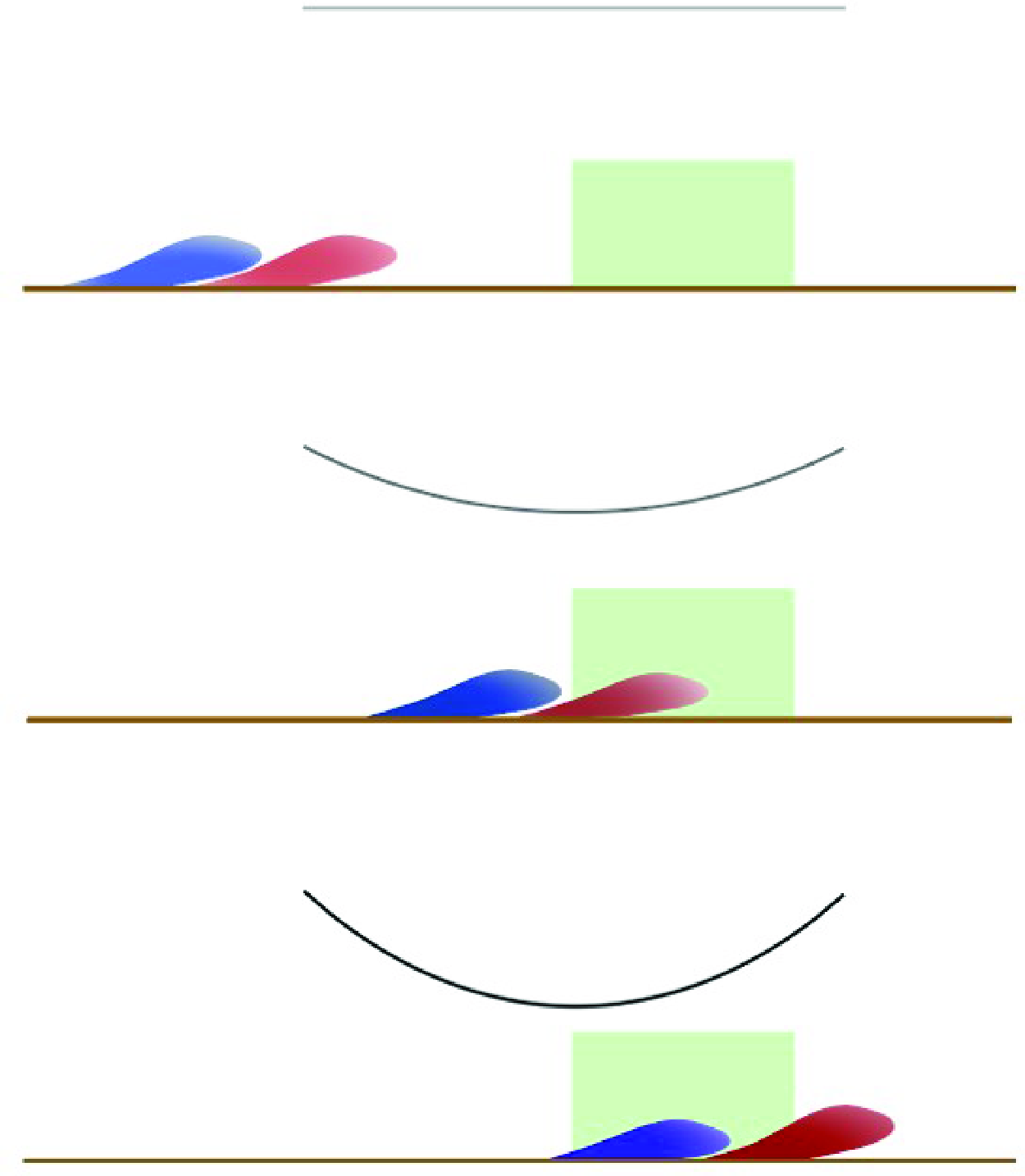
Turbulent boundary layers under spatially and temporally varying pressure gradients
-
- Journal:
- Journal of Fluid Mechanics / Volume 1010 / 10 May 2025
- Published online by Cambridge University Press:
- 14 May 2025, A61
-
- Article
-
- You have access
- Open access
- HTML
- Export citation
-
The spatiotemporal dynamics of a turbulent boundary layer subjected to an unsteady pressure gradient are studied. A dynamic sequence of favourable to adverse pressure gradients (FAPGs) is imposed by deforming a section of the wind tunnel ceiling, transitioning the pressure gradient from zero to a strong FAPG within 0.07 s. At the end of the transient, the acceleration parameter is $K$ =
$K$ =  $6 \times 10^{-6}$ in the favourable pressure gradient (FPG) region and $K$ =
$K$ =  $-4.8 \times 10^{-6}$ in the adverse pressure gradient (APG) region. The resulting unsteady response of the boundary layer is compared with equivalent steady pressure gradient cases in terms of turbulent statistics and coherent structures. While the steady FAPG effects, as shown by Parthasarathy & Saxton-Fox (2023), caused upstream stabilisation in the FPG, a milder APG response downstream, and the formation of an internal layer, the unsteady case presented in this paper shows a reduced stabilisation in the FPG region, a stronger APG response and a weaker internal layer. This altered response is hypothesised to stem from the different spatiotemporal pressure gradient histories experienced by turbulent structures when the pressure gradient changes at a time scale comparable to their convection.


Obliquely interacting solitary waves and wave wakes in free-surface flows
-
- Journal:
- Journal of Fluid Mechanics / Volume 1011 / 25 May 2025
- Published online by Cambridge University Press:
- 14 May 2025, A8
-
- Article
- Export citation
