Refine search
Actions for selected content:
238152 results in Physics and Astronomy

Dynamics of turbulent energy and dissipation in channel flow
-
- Journal:
- Journal of Fluid Mechanics / Volume 996 / 10 October 2024
- Published online by Cambridge University Press:
- 26 September 2024, A12
-
- Article
- Export citation
-
The dynamics of turbulent kinetic energy (TKE), turbulence dissipation rate (TDR) and turbulence production rate (TPR) are explored in fully developed turbulent channel flow using direct numerical simulations up to $\textit {Re}_\tau \approx 2000$ with minimal computational box for large-scale structures. Time correlation analysis based on volume-averaged TKE and TDR shows a well-defined average time lag, as in periodic/homogeneous turbulence, which, unlike periodic/homogeneous turbulence, appears to be Reynolds-number-dependent. On the basis of a spatio-temporal correlation analysis, we show that plane-averaged TKE fluctuations in the near-equilibrium region are transported towards both the core and near-wall regions, and are positively correlated with plane-averaged TDR fluctuations there with combined wall-distance and time lags. In the path towards the core region, the wall-distance lag is very close to the time lag multiplied by the friction velocity. The path towards the near-wall region has a wide spread of time lags, which increases with Reynolds number. The spatio-temporal correlation paths both towards the core and towards the wall are reproduced when the reference plane TKE is conditionally averaged on either ejections or sweeps, and are in fact stronger in correlation values in the case of ejections, which are better organised than sweeps. While volume-averaged TPR evidently precedes volume-averaged TKE, a more complex picture of non-local space–time correlations between reference plane TKE and TPR is revealed. A mechanistic model is proposed to elucidate these correlations between TKE and TPR through the interaction between the mean shear and the Reynolds shear stress.

Numerical simulation of an expanding magnetic field plasma thruster: a comparative study for argon, xenon and iodine fuel gases
-
- Journal:
- Journal of Plasma Physics / Volume 90 / Issue 4 / August 2024
- Published online by Cambridge University Press:
- 26 September 2024, 905900411
-
- Article
- Export citation
Energy exchanges between coherent modes in the near wake of a wind turbine model at different tip speed ratios
-
- Journal:
- Journal of Fluid Mechanics / Volume 996 / 10 October 2024
- Published online by Cambridge University Press:
- 26 September 2024, A8
-
- Article
-
- You have access
- Open access
- HTML
- Export citation
-
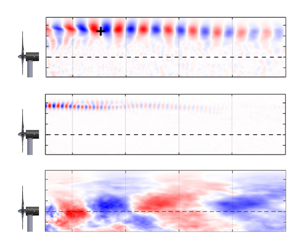
In this work we investigate the spatio-temporal nature of various coherent modes present in a wind turbine wake using a combination of new particle image velocimetry experiments and data from Biswas & Buxton (J. Fluid Mech., vol. 979, 2024, A34). A multiscale triple decomposition of the acquired velocity field is sought to extract the coherent modes and, thereafter, the energy exchanges to and from them are studied using the multiscale triple decomposed coherent kinetic energy budgets developed by Baj & Buxton (Phys. Rev. Fluids, vol. 2, 2017, 114607). Different frequencies forming the tip vortex system (such as the blade passing frequency, turbine's rotational frequency and their harmonics) are found to be energised by different sources such as production from the mean flow or nonlinear triadic interaction or both, similar to the primary, secondary or the mixed modes discussed in Biswas et al. (J. Fluid Mech., vol. 941, 2022, A36). The tip vortex system forms a complex network of nonlinear triadic energy transfers, the nature and the magnitudes of which depend on the tip speed ratio ( $\lambda$). Contrastingly, the modes associated with the sheddings from the nacelle or tower and wake meandering are found to be primarily energised by the mean flow. We show that the tip vortex system exchanges energy with the mean flow primarily through the turbine's rotational frequency. In fact, the system transfers energy back to the mean flow through the turbine's rotational frequency at some distance downstream marking the onset location of wake recovery ( $x_{wr}$). Here $x_{wr}$ is shown to reduce with $\lambda$ due to stronger interaction and earlier merging of the tip vortices at a higher $\lambda$.


Criteria for dynamic stall onset and vortex shedding in low-Reynolds-number flows
-
- Journal:
- Journal of Fluid Mechanics / Volume 996 / 10 October 2024
- Published online by Cambridge University Press:
- 26 September 2024, A11
-
- Article
-
- You have access
- Open access
- HTML
- Export citation
-
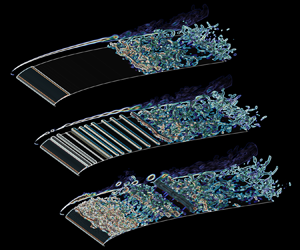
Dynamic stall at low Reynolds numbers, $Re \sim O(10^4)$, exhibits complex flow physics with co-existing laminar, transitional and turbulent flow regions. Current state-of-the-art stall onset criteria use parameters that rely on flow properties integrated around the leading edge. These include the leading edge suction parameter or $LESP$ (Ramesh et al., J. Fluid Mech., vol. 751, 2014, pp. 500–538) and boundary enstrophy flux or $BEF$ (Sudharsan et al., J. Fluid Mech., vol. 935, 2022, A10), which have been found to be effective for predicting stall onset at moderate to high $Re$. However, low- $Re$ flows feature strong vortex-shedding events occurring across the entire airfoil surface, including regions away from the leading edge, altering the flow field and influencing the onset of stall. In the present work, the ability of these stall criteria to effectively capture and localize these vortex shedding events in space and time is investigated. High-resolution large-eddy simulations for an SD7003 airfoil undergoing a constant-rate, pitch-up motion at two $Re$ (10 000 and 60 000) and two pitch rates reveal a rich variety of unsteady flow phenomena, including instabilities, transition, vortex formation, merging and shedding, which are described in detail. While stall onset is reflected in both $LESP$ and $BEF$, local vortex-shedding events are identified only by the $BEF$. Therefore, $BEF$ can be used to identify both dynamic stall onset and local vortex-shedding events in space and time.


A physics-constrained deep learning surrogate model of the runaway electron avalanche growth rate
-
- Journal:
- Journal of Plasma Physics / Volume 90 / Issue 4 / August 2024
- Published online by Cambridge University Press:
- 26 September 2024, 905900409
-
- Article
-
- You have access
- Open access
- HTML
- Export citation
Multiplexed pseudo-deterministic photon source with asymmetric switching elements
-
- Journal:
- Research Directions: Quantum Technologies / Volume 2 / 2024
- Published online by Cambridge University Press:
- 26 September 2024, e3
-
- Article
-
- You have access
- Open access
- HTML
- Export citation

Spreading of a viscous drop after impact onto a spherical target
-
- Journal:
- Journal of Fluid Mechanics / Volume 996 / 10 October 2024
- Published online by Cambridge University Press:
- 26 September 2024, A10
-
- Article
-
- You have access
- Open access
- HTML
- Export citation
Evanescent and inertial-like waves in rigidly rotating odd viscous liquids
-
- Journal:
- Journal of Fluid Mechanics / Volume 996 / 10 October 2024
- Published online by Cambridge University Press:
- 26 September 2024, A13
-
- Article
-
- You have access
- Open access
- HTML
- Export citation
-
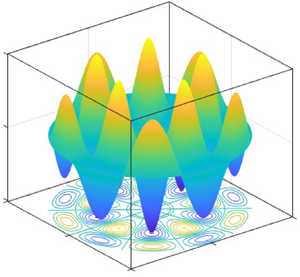
Three-dimensional non-rotating odd viscous liquids give rise to Taylor columns and support axisymmetric inertial-like waves (J. Fluid Mech., vol. 973, 2023, A30). When an odd viscous liquid is subjected to rigid-body rotation however, there arise in addition a plethora of other phenomena that need to be clarified. In this paper, we show that three-dimensional incompressible or two-dimensional compressible odd viscous liquids, rotating rigidly with angular velocity $\varOmega$, give rise to both oscillatory and evanescent inertial-like waves or a combination thereof (which we call of mixed type) that can be non-axisymmetric. By evanescent, we mean that along the radial direction, typically when moving away from a solid boundary, the velocity field decreases exponentially. These waves precess in a prograde or retrograde manner with respect to the rotating frame. The oscillatory and evanescent waves resemble respectively the body and wall-modes observed in (non-odd) rotating Rayleigh–Bénard convection (J. Fluid Mech., vol. 248, 1993, pp. 583–604). We show that the three types of waves (wall, body or mixed) can be classified with respect to pairs of planar wavenumbers $\kappa$ which are complex, real or a combination, respectively. Experimentally, by observing the precession rate of the patterns, it would be possible to determine the largely unknown values of the odd viscosity coefficients. This formulation recovers as special cases recent studies of equatorial or topological waves in two-dimensional odd viscous liquids which provided examples of the bulk–interface correspondence at frequencies $\omega <2\varOmega$. We finally point out that the two- and three-dimensional problems are formally equivalent. Their difference then lies in the way data propagate along characteristic rays in three dimensions, which we demonstrate by classifying the resulting Poincaré–Cartan equations.


Two-dimensional turbulence on the ellipsoid
-
- Journal:
- Journal of Fluid Mechanics / Volume 996 / 10 October 2024
- Published online by Cambridge University Press:
- 26 September 2024, A9
-
- Article
-
- You have access
- Open access
- HTML
- Export citation
-
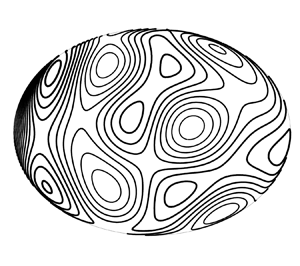
Two-dimensional turbulence transfers its energy towards the lowest mode in the domain, but domain geometry exerts a powerful control. On the sphere, with its three axes of rotational symmetry, angular momentum conservation prevents energy from entering the three lowest modes – those corresponding to the spherical harmonics $Y_1^0$ and $Y_1^{\pm 1}$ – because the amplitudes of these three modes are proportional to the three conserved components of the angular momentum vector. Non-spherical ellipsoids partly or completely break the rotational symmetry corresponding to angular momentum conservation. The flow on spheroids, which have only one axis of rotational symmetry, conserves only a single component of angular momentum. If the axis of symmetry is taken to be the $z$-axis, then only the $z$-component of angular momentum is conserved. Energy can flow into the other two lowest modes. The general triaxial ellipsoid breaks all rotational symmetries, thus angular momentum is not conserved, and energy can flow into any mode. We describe numerical experiments that confirm these predictions.


Searching for stellar population in the molecular cloud GRSMC 045.49+00.04
-
- Journal:
- Publications of the Astronomical Society of Australia / Volume 41 / 2024
- Published online by Cambridge University Press:
- 25 September 2024, e055
-
- Article
- Export citation
-
Understanding the characteristics of young stellar populations is essential for deriving insights into star formation processes within parent molecular clouds and the influence of massive stars on these processes. This study primarily aims to investigate the young stellar objects (YSOs) within the molecular cloud G 045.49+00.04, including three ultra-compact HII (UC HII) regions: G 45.48+0.13 (IRAS 19117+1107), G 45.45+0.06 (IRAS 19120+1103), and G 45.47+0.05. We used near-, mid-, and far-infrared photometric data along with radiation transfer models and the modified blackbody fitting to identify and study the YSOs and the interstellar medium (ISM). In total, we identified 1482 YSOs in a 12 arcmin radius covering GRSMC 045.49+00.04, with a mass range from 1.5 M ${}_{\odot}$ to 22 M ${}_{\odot}$. Of these, 315 objects form relatively dense clusters in the UC HII regions, close to the IRAS 19120+1103 and 19117+1107 sources. In each UC HII region, several high-mass stars have been identified, which in all likelihood are responsible for the ionization. The YSOs with 21.8 M ${}_{\odot}$ and 13.7 ± 0.4 M ${}_{\odot}$ are associated with IRAS 19120+1103 and 19117+1107, respectively. The non-cluster YSOs (1168) are uniformly distributed on the field. The distribution of YSOs from both samples on the colour-magnitude diagram and by the evolutionary ages is different. About 75% of objects in the IRAS clusters are concentrated around the Zero Age Main Sequence and have a well-defined peak at an age of Log(Age[years]) $\approx$ 6.75, with a narrow spread. The non-cluster objects have two concentrations located to the right and left of the 0.1 Myr isochrone and two well-defined peaks at Log(Age) $\approx$ 6.25 and 5.25. The fraction of the near-infrared excess stars, as well as the mass function confirm that the evolutionary age of the cluster is about 1 Myr. The K luminosity functions’ α slopes for the IRAS clusters and non-cluster objects are 0.32 ± 0.04 and 0.72 ± 0.13, respectively. The steeper α slope is suggesting that the non-cluster objects are less evolved, which is well consistent with the evolutionary age. Similar results – including evolutionary age, narrow age spread, and the less evolved nature of non-cluster objects – were also observed for the YSOs in the neighbouring G 45.14+00.14. The both regions (G 045.49+00.04 and G 45.14+00.14) are located and distinguished by their brightness and density at the edge of the bubble around the highly variable X-ray binary GRS 1915+105, which includes a black hole and a K-giant companion. Based on the above, we can assume that the process of star formation in the young IRAS clusters was triggered by the GRS 1915+105-initiated shock front inside the ISM massive condensation, through the process of ‘collecting and collapse’. Most non-cluster objects probably belong to a later generation. Their formation could be triggered by the recurrent activity of GRS 1915+105 and/or through the edge collapse scenario and mass accumulation through the gas flows along the ISM filaments.


The use of patterned heating in controlling pressure losses within sloping channels
-
- Journal:
- Journal of Fluid Mechanics / Volume 996 / 10 October 2024
- Published online by Cambridge University Press:
- 25 September 2024, A5
-
- Article
-
- You have access
- Open access
- HTML
- Export citation
Scaling of vertical coherence and logarithmic energy profile for wall-attached eddies during sand and dust storms
-
- Journal:
- Journal of Fluid Mechanics / Volume 996 / 10 October 2024
- Published online by Cambridge University Press:
- 25 September 2024, A7
-
- Article
- Export citation
-
High-frequency observation data, including all three components of instantaneous fluctuating velocity, temperature, as well as particulate matter 10 ( $PM_{10}$), collected from the unstable atmospheric surface layer at $z/L = -0.11$ and $-$0.12, $L$ being the Obukhov length, during sand and dust storms (SDS), were used to explore the scaling of vertical coherence and the logarithmic energy profile for wall-attached eddies. The present results demonstrate good agreement with the self-similar range of the wall-attached features for velocity and temperature components, as well as for $PM_{10}$ at lower heights ( $z<15$ m) during SDS. Following the idea depicted by Davenport (Q. J. R. Meteorol., vol. 372, 1961, pp. 194–211), an empirically derived transfer kernel comprises implicit filtering via a scale-dependent gain and phase, parametrically defined as $|H_L^2(f)|=\exp (c_1-c_2\delta /\lambda _x)$, where $c_1$ and $c_2$ are parameters, $\delta$ is the boundary layer thickness and $\lambda _x$ is the streamwise wavelength. Linear coherence spectrum analysis is applied as a filter to separate the coherent and incoherent portions. After this separation procedure, the turbulence intensity decay for wall-attached eddies is described in a log–linear manner, which also identifies how the scaling parameter differs between the measured components. These findings present abundant features of wall-attached eddies during SDS which further are used to improve/enrich existing near-wall models.



Evolution of water wave packets by wind in shallow water
-
- Journal:
- Journal of Fluid Mechanics / Volume 996 / 10 October 2024
- Published online by Cambridge University Press:
- 25 September 2024, A4
-
- Article
- Export citation

Mechanism of enhanced impulse and entrainment of a pulsed jet through a flexible nozzle
- Part of
-
- Journal:
- Journal of Fluid Mechanics / Volume 996 / 10 October 2024
- Published online by Cambridge University Press:
- 25 September 2024, A6
-
- Article
-
- You have access
- Open access
- HTML
- Export citation
-
The present experimental study shows that a nozzle with optimal flexibility can enhance the impulse and entrainment of a pulsed jet. Near the nozzle exit, vortex rings emanating from the flexible nozzle move faster because of the timely release of the elastic energy (stored during the expansion) to the jet, which is maximized at the structural stiffness that needs to be optimally tuned to the jet acceleration. The total circulation, hydrodynamic impulse and entrained fluid volume are enhanced substantially. Interestingly, we find that the same condition for optimal flexibility to maximize the hydrodynamic impulse and circulation of the primary vortex ring of the continuous jet (Choi & Park, J. Fluid Mech., vol. 949, 2022, A39) holds universally for the pulsed jet, indicating that abrupt jet termination is irrelevant to the impulse augmentation mechanism. Compared to the rigid counterpart, increments of the impulse ( ${\sim }400\,\%$) and entrainment ( ${\sim }220\,\%$) of a pulsed jet in the present study are considerably larger than those ( $200\,\%$ and $50\,\%$, respectively) in a continuous jet from previous studies, which is attributed to the significant suppression of negative pressure at the nozzle exit by the collapsing motion of the flexible nozzle in the phase with the jet-driven upstream propagation of the surface wave on the nozzle. This universal mechanism provides a guideline for a novel jet propulsor using a flexible nozzle, for example, for small-scale underwater robots.


Bubble-induced convection and flow instability in liquid vessels
-
- Journal:
- Journal of Fluid Mechanics / Volume 996 / 10 October 2024
- Published online by Cambridge University Press:
- 24 September 2024, A2
-
- Article
-
- You have access
- Open access
- HTML
- Export citation
-
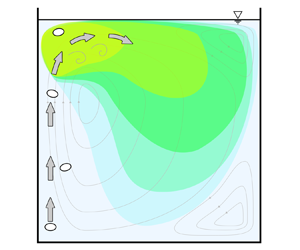
Buoyancy-driven bubbly flows play pivotal roles in various scenarios, such as the oxygenation and mixing in the upper ocean and the reaction kinetics in chemical and bio-reactors. This work focuses on the convective flow induced by the localised release of large air bubbles ( $D_b=3.7$ mm, ${Re}_b=950$) in a water tank, exploring the resulting flow and the transition from laminar to disturbed states as a function of the Rayleigh number ranging from $3\times 10^3$ to $2\times 10^5$. At low ${Ra}$ the flow is smooth and laminar with weak temporal oscillations, while a highly disturbed state appears above a critical value ${Ra}_c$. A theoretical analysis is presented that links the mean flow circulation to the Rayleigh number. Through an experimental investigation, utilising three-dimensional particle tracking velocimetry and flow visualisation, we confirm the theory presented, and characterise the laminar to disturbed transition in the system. These findings not only enhance our fundamental understanding of buoyancy-driven convective flows but also hold significant implications for practical applications, particularly in the optimisation of bio-reactor design and other industrial processes reliant on controlled convective dynamics.


Probing the soft X-ray properties and multi-wavelength variability of SN2023ixf and its progenitor
-
- Journal:
- Publications of the Astronomical Society of Australia / Volume 41 / 2024
- Published online by Cambridge University Press:
- 24 September 2024, e059
-
- Article
-
- You have access
- Open access
- HTML
- Export citation
-
We present a detailed analysis of nearly two decades of optical/UV and X-ray data to study the multi-wavelength pre-explosion properties and post-explosion X-ray properties of nearby SN2023ixf located in M101. We find no evidence of precursor activity in the optical to UV down to a luminosity of $\lesssim$ $1.0\times10^{5}\, \textrm{L}_{\odot}$, while X-ray observations covering nearly 18 yr prior to explosion show no evidence of luminous precursor X-ray emission down to an absorbed 0.3–10.0 keV X-ray luminosity of $\sim$ $6\times10^{36}$ erg s $^{-1}$. Extensive Swift observations taken post-explosion did not detect soft X-ray emission from SN2023ixf within the first $\sim$3.3 days after first light, which suggests a mass-loss rate for the progenitor of $\lesssim$ $5\times10^{-4}\,\textrm{M}_{\odot}$ yr $^{-1}$ or a radius of $\lesssim$ $4\times10^{15}$ cm for the circumstellar material. Our analysis also suggests that if the progenitor underwent a mass-loss episode, this had to occur $>$0.5–1.5 yr prior to explosion, consistent with previous estimates. Swift detected soft X-rays from SN2023ixf $\sim$ $4.25$ days after first light, and it rose to a peak luminosity of $\sim10^{39}$ erg s $^{-1}$ after 10 days and has maintained this luminosity for nearly 50 days post first light. This peak luminosity is lower than expected, given the evidence that SN2023ixf is interacting with dense material. However, this might be a natural consequence of an asymmetric circumstellar medium. X-ray spectra derived from merging all Swift observations over the first 50 days are best described by a two-component bremsstrahlung model consisting of a heavily absorbed and hotter component similar to that found using NuSTAR, and a less-absorbed, cooler component. We suggest that this soft component arises from cooling of the forward shock similar to that found in Type IIn SN2010jl.


GaLactic and Extragalactic All-sky Murchison Widefield Array eXtended (GLEAM-X) survey II: Second Data Release
-
- Journal:
- Publications of the Astronomical Society of Australia / Volume 41 / 2024
- Published online by Cambridge University Press:
- 24 September 2024, e054
-
- Article
-
- You have access
- Open access
- HTML
- Export citation
-
We present the second data release for the GaLactic and Extragalactic All-sky Murchison Widefield Array eXtended (GLEAM-X) survey. This data release is an area of 12 892-deg $^2$ around the South Galactic Pole region covering 20 h40 m $\leq$RA $\leq$6 h40 m, -90 $^\circ$ $\leq$Dec $\leq$+30 $^\circ$. Observations were taken in 2020 using the Phase-II configuration of the Murchison Widefield Array (MWA) and covering a frequency range of 72–231 MHz with twenty frequency bands. We produce a wideband source finding mosaic over 170–231 MHz with a median root-mean-squared noise of $1.5^{+1.5}_{-0.5}$ mJy beam $^{-1}$. We present a catalogue of 624 866 components, including 562 302 components which are spectrally fit. This catalogue is 98% complete at 50 mJy, and a reliability of 98.7% at a 5 $\sigma$ level, consistent with expectations for this survey. The catalogue is made available via Vizier, and the PASA datastore and accompanying mosaics for this data release are made available via AAO Data Central and SkyView.


Settling of two rigidly connected spheres
-
- Journal:
- Journal of Fluid Mechanics / Volume 995 / 25 September 2024
- Published online by Cambridge University Press:
- 24 September 2024, A15
-
- Article
-
- You have access
- Open access
- HTML
- Export citation
-
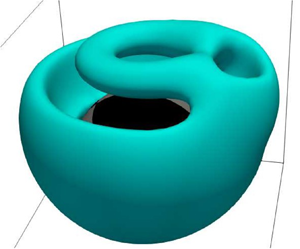
Laboratory experiments and particle-resolved simulations are employed to investigate the settling dynamics of a pair of rigidly connected spherical particles of unequal size. They yield a detailed picture of the transient evolution and the terminal values of the aggregate's orientation angle and its settling and drift velocities as functions of the aspect ratio and the Galileo number $Ga$, which denotes the ratio of buoyancy and viscous forces acting on the aggregate. At low to moderate values of $Ga$, the aggregate's orientation and velocity converge to their terminal values monotonically, whereas for higher $Ga$-values the aggregate tends to undergo a more complex motion. If the aggregate assumes an asymmetric terminal orientation, it displays a non-zero terminal drift velocity. For diameter ratios much larger than one and small $Ga$, the terminal orientation of the aggregate becomes approximately vertical, whereas when $Ga$ is sufficiently large for flow separation to occur, the aggregate orients itself such that the smaller sphere is located at the separation line. Empirical scaling laws are obtained for the terminal settling velocity and orientation angle as functions of the aspect ratio and $Ga$ for diameter ratios from 1 to 4 and particle-to-fluid density ratios from 1.3 to 5. An analysis of the accompanying flow field shows the formation of vortical structures exhibiting complex topologies in the aggregate's wake, and indicates the formation of a horizontal pressure gradient across the larger sphere, which represents the main reason for the emergence of the drift velocity.


FLM volume 992 Cover and Front matter
-
- Journal:
- Journal of Fluid Mechanics / Volume 992 / 10 August 2024
- Published online by Cambridge University Press:
- 24 September 2024, p. f1
-
- Article
-
- You have access
- Export citation
Influence of thermal buoyancy on the wake dynamics of a heated square cylinder
-
- Journal:
- Journal of Fluid Mechanics / Volume 996 / 10 October 2024
- Published online by Cambridge University Press:
- 24 September 2024, A3
-
- Article
-
- You have access
- Open access
- HTML
- Export citation
-
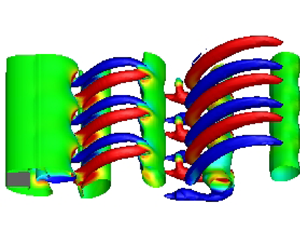
Direct numerical simulation of the three-dimensional (3-D) wake transition of a heated square cylinder subjected to horizontal cross-flow is performed in the presence of buoyancy. In order to capture the effects of large-scale heating, a non-Oberbeck–Boussinesq model is utilized, which includes the governing equations for compressible gas flow. All computations are performed at low free stream Mach number $M=0.1$ using air (free stream Prandtl number, $Pr=0.71$) as the working fluid. The 3-D instability modes A and B, which correspond to free stream Reynolds numbers of 180 and 250, are observed with longer and shorter spanwise wavelengths, respectively, and the onset of three-dimensionality is triggered at a Reynolds number of 173. In the presence of buoyancy, baroclinic vorticity production in the near-wake plays an important role for streamwise vorticity generation. The chaotic wake of the Mode-A instability bifurcates into periodic and quasiperiodic wakes at various heating levels, expressed by the overheat ratio, $\varepsilon =(T_w-T_\infty )/T_\infty$, where $T_w$ and $T_\infty$ are the temperature of the cylinder surface and the ambient air, respectively. At low heating ( $\varepsilon =0.2$), the 3-D Mode-A instability is suppressed leading to a two-dimensional wake flow. Further increase in heating, again brings back the three-dimensionality in the wake through Mode-E instability. The variation of thermophysical properties and the effective Reynolds number with increase in heating level around the cylinder is examined. It is shown that the effect of thermophysical properties competes with the baroclinic streamwise vorticity generation at higher levels of heating ( $\varepsilon \geqslant 0.4$) to control the 3-D modes and wake dynamics.


