Refine search
Actions for selected content:
238141 results in Physics and Astronomy

Detachment of leading-edge vortex enhances wake capture force production
-
- Journal:
- Journal of Fluid Mechanics / Volume 995 / 25 September 2024
- Published online by Cambridge University Press:
- 19 September 2024, A6
-
- Article
-
- You have access
- Open access
- HTML
- Export citation
-
During stroke reversals, insect wings interact with their own wake flow from the preceding half-stroke, resulting in an unsteady aerodynamic mechanism known as ‘wing–wake interaction’ or ‘wake capture’. To better elucidate this mechanism, we numerically solved the incompressible Navier–Stokes equations at Reynolds numbers $10^2$ and $10^3$. Simulations were conducted for wing planforms defined using the beta function distribution with varying aspect ratios ( $AR=2\unicode{x2013}6$) and radial centroid locations ( $\hat {r}_1=0.4\unicode{x2013}0.6$), whilst employing representative normal hovering kinematics. The wake development from the considered flapping wing planforms was investigated, and the wake capture contribution to aerodynamic force production was quantified by comparing the force generation between the fifth and first stroke cycles at multiple sections along the wingspan. Our results revealed that on the inboard wing region experiencing an attached leading-edge vortex (LEV) structure, wing–wake interaction is dominated by an unsteady downwash effect, resulting in a reduction in local force production. However, in regions closer to the wingtip experiencing detachment of the LEV, wing–wake interaction is dominated by an unsteady upwash effect, leading to an increase in local force production. Consequently, the global wake capture force production is controlled by the extent of LEV detachment, which primarily increases with the increase of wing aspect ratio. This suggests that for normal hovering flapping wings, the typical loss in translational force production due to wingtip stall is partially mitigated by wake capture effects.


Self-similarity and recurrence in stability spectra of near-extreme Stokes waves
-
- Journal:
- Journal of Fluid Mechanics / Volume 995 / 25 September 2024
- Published online by Cambridge University Press:
- 19 September 2024, A2
-
- Article
-
- You have access
- Open access
- HTML
- Export citation
-
We consider steady surface waves in an infinitely deep two-dimensional ideal fluid with potential flow, focusing on high-amplitude waves near the steepest wave with a 120 $^{\circ }$ corner at the crest. The stability of these solutions with respect to coperiodic and subharmonic perturbations is studied, using new matrix-free numerical methods. We provide evidence for a plethora of conjectures on the nature of the instabilities as the steepest wave is approached, especially with regards to the self-similar recurrence of the stability spectrum near the origin of the spectral plane.

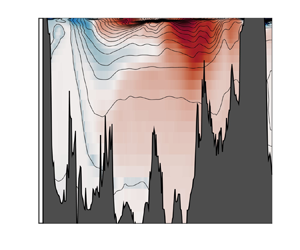
Negative available potential energy dissipation as the fundamental criterion for double diffusive instabilities
-
- Journal:
- Journal of Fluid Mechanics / Volume 994 / 10 September 2024
- Published online by Cambridge University Press:
- 18 September 2024, A5
-
- Article
-
- You have access
- Open access
- HTML
- Export citation
A case for the moral duty of specific human germline genetic engineering
-
- Journal:
- International Journal of Astrobiology / Volume 23 / 2024
- Published online by Cambridge University Press:
- 18 September 2024, e17
-
- Article
-
- You have access
- Open access
- HTML
- Export citation
FLM volume 991 Cover and Front matter
-
- Journal:
- Journal of Fluid Mechanics / Volume 991 / 25 July 2024
- Published online by Cambridge University Press:
- 18 September 2024, p. f1
-
- Article
-
- You have access
- Export citation

Subcritical transitional flow in two-dimensional plane Poiseuille flow
-
- Journal:
- Journal of Fluid Mechanics / Volume 994 / 10 September 2024
- Published online by Cambridge University Press:
- 18 September 2024, A6
-
- Article
- Export citation
-
Recently, subcritical transition to turbulence in the quasi-two-dimensional (quasi-2-D) shear flow with strong linear friction (Camobreco et al., J. Fluid Mech., vol. 963, 2023, R2) has been demonstrated by the 2-D mechanism at $Re = 71\,211$, and the nonlinear Tollmien–Schlichting (TS) waves related to the edge state were approached independently of initial optimal disturbances. For 2-D plane Poiseuille flow, transition to the fully developed turbulence requires that the Reynolds number is several times larger than the critical Reynolds number $Re_c$ (Markeviciute & Kerswell, J. Fluid Mech., vol. 917, 2021, A57). In this paper, we observed the subcritical transitional flow in 2-D plane Poiseuille flow driven by the nonlinear TS waves by both linear and nonlinear optimal disturbances ( $Re < Re_c$) with different quantitative edge states. The nonlinear optimal disturbances could trigger the sustained subcritical transitional flow for $Re \geqslant 2400$. The initial energy for nonlinear optimal disturbance is more efficient than the linear optimal disturbance in reaching the subcritical transitional flow for $2400 \leqslant Re \leqslant 5000$. Moreover, the initial energy of linear optimal disturbance is larger than the energy of its edge state. The nonlinear TS waves along the edge state are formed by the nonlinear optimal disturbances to trigger transitional flow, which agrees well with the main conclusions of Camobreco et al. (J. Fluid Mech., vol. 963, 2023, R2), while the required $Re$ of 2-D plane Poiseuille flow is much smaller.


Improved axial confinement in the open trap by the combination of helical and short mirrors
-
- Journal:
- Journal of Plasma Physics / Volume 90 / Issue 4 / August 2024
- Published online by Cambridge University Press:
- 18 September 2024, 905900405
-
- Article
- Export citation
-
The paper presents experimental results from the SMOLA device, which was built in the Budker Institute of Nuclear Physics for the verification of the helical mirror confinement idea. This concept involves active control of axial losses from the confinement zone in an open magnetic trap through the use of multiple mirrors that move in the plasma frame of reference. The discussed experiments focused on determining the cumulative effect of a helical mirror system in combination with a short segment of a stronger magnetic field. Combination of these two methods of axial flow suppression results in higher efficiency compared with each method individually. Different combinations of the mirrors were tested. The most effective flow suppression was observed if the short mirror was placed between the confinement region and the helical mirror. In this configuration, an effective mirror ratio of $R_{{\rm eff}} = 32.6\pm 7.8$
 was achieved, along with a more than three-fold increase in plasma density within the confinement region. The possibility of a cumulative effect of different types of magnetic mirrors offers a way to improve the confinement performance of the reactor-grade mirror confinement devices.
Nonlinear solution of classical three-wave interaction via finite-dimensional quantum model
- Part of
-
- Journal:
- Journal of Plasma Physics / Volume 90 / Issue 3 / June 2024
- Published online by Cambridge University Press:
- 18 September 2024, 805900302
-
- Article
-
- You have access
- Open access
- HTML
- Export citation
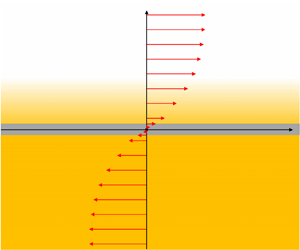
Stratified Resistive Tearing Instability
-
- Journal:
- Journal of Fluid Mechanics / Volume 994 / 10 September 2024
- Published online by Cambridge University Press:
- 18 September 2024, A3
-
- Article
-
- You have access
- Open access
- HTML
- Export citation
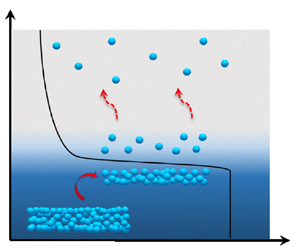
Molecular kinetic modelling of non-equilibrium evaporative flows
-
- Journal:
- Journal of Fluid Mechanics / Volume 994 / 10 September 2024
- Published online by Cambridge University Press:
- 18 September 2024, A16
-
- Article
-
- You have access
- Open access
- HTML
- Export citation

Collision of liquid drops: bounce or merge?
-
- Journal:
- Journal of Fluid Mechanics / Volume 995 / 25 September 2024
- Published online by Cambridge University Press:
- 18 September 2024, A1
-
- Article
-
- You have access
- Open access
- HTML
- Export citation
Correlations between X-rays, visible light and drive-beam energy loss observed in plasma wakefield acceleration experiments at FACET-II
- Part of
-
- Journal:
- Journal of Plasma Physics / Volume 90 / Issue 4 / August 2024
- Published online by Cambridge University Press:
- 18 September 2024, 965900401
-
- Article
-
- You have access
- HTML
- Export citation
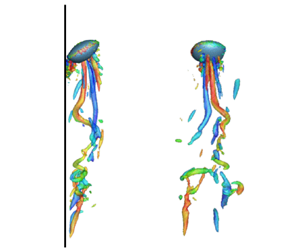
A numerical study on the turbulence characteristics in an air–water upward bubbly pipe flow
-
- Journal:
- Journal of Fluid Mechanics / Volume 994 / 10 September 2024
- Published online by Cambridge University Press:
- 18 September 2024, A10
-
- Article
-
- You have access
- Open access
- HTML
- Export citation
-
A high-resolution numerical simulation of an air–water turbulent upward bubbly flow in a pipe is performed to investigate the turbulence characteristics and bubble interaction with the wall. We consider three bubble equivalent diameters and three total bubble volume fractions. The bulk and bubble Reynolds numbers are $Re_{bulk}= u_{bulk} D/\nu _w = 5300$ and $Re_{bub}= (\langle u_{bub}\rangle - u_{bulk}) d_{eq}/\nu _w = 533\unicode{x2013}1000$, respectively, where $u_{bulk}$ is the water bulk velocity, $\langle u_{bub}\rangle$ is the overall bubble mean velocity, $D$ is the pipe diameter and $\nu _w$ is the water kinematic viscosity. The mean water velocity near the wall significantly increases due to bubble interaction with the wall, and the root-mean-square water velocity fluctuations are proportional to $\bar {\psi }(r)^{0.4}$, where $\bar {\psi } (r)$ is the mean bubble volume fraction. For the cases considered, the bubble-induced turbulence suppresses the shear-induced turbulence and becomes the dominant flow characteristic at all radial locations including near the wall. Rising bubbles near the wall mostly bounce against the wall rather than slide along the wall or hang around the wall without collision. Low-speed streaks observed in the near-wall region in the absence of bubbles nearly disappear due to the bouncing bubbles. These bouncing bubbles generate counter-rotating vortices in their wake, and increase the skin friction by sweeping high-speed water towards the wall. We also suggest an algebraic Reynolds-averaged Navier–Stokes model considering the interaction between shear-induced and bubble-induced turbulence. This model provides accurate predictions for a wide range of liquid bulk Reynolds numbers.


FLM volume 989 Cover and Front matter
-
- Journal:
- Journal of Fluid Mechanics / Volume 989 / 25 June 2024
- Published online by Cambridge University Press:
- 18 September 2024, p. f1
-
- Article
-
- You have access
- Export citation
Experimental investigation of three-dimensional Rayleigh–Taylor instability of a gaseous interface
-
- Journal:
- Journal of Fluid Mechanics / Volume 994 / 10 September 2024
- Published online by Cambridge University Press:
- 18 September 2024, A7
-
- Article
-
- You have access
- Open access
- HTML
- Export citation
-
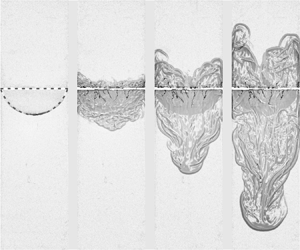
Validating the theoretical work on Rayleigh–Taylor instability (RTI) through experiments with an exceptionally clean and well-characterized initial condition has been a long-standing challenge. Experiments were conducted to study the three-dimensional RTI of an SF $_6$–air interface at moderate Atwood numbers. A novel soap film technique was developed to create a discontinuous gaseous interface with controllable initial conditions. Spectrum analysis revealed that the initial perturbation of the soap film interface is half the size of an entire single-mode perturbation. The correlation between the initial interface perturbation and Atwood numbers was determined. Due to the steep and highly curved feature of the initial soap film interface, the early-time evolution of RTI exhibits significant nonlinearity. In the quasi-steady regime, various potential flow models accurately predict the late-time bubble velocities by considering the channel width as the perturbation wavelength. Differently, the late-time spike velocities are described by these potential flow models using the wavelength of the entire single-mode perturbation. These findings indicate that the bubble evolution is influenced primarily by the spatial constraint imposed by walls, while the spike evolution is influenced mainly by the initial curvature of the spike tip. Consequently, a recent potential flow model was adopted to describe the time-varying amplitude growth induced by RTI. Furthermore, the self-similar growth factors for bubbles and spikes were determined from experiments and compared with existing studies, revealing that a large amplitude in the initial soap film interface promotes the spike development.


Modon solutions in an N-layer quasi-geostrophic model
-
- Journal:
- Journal of Fluid Mechanics / Volume 994 / 10 September 2024
- Published online by Cambridge University Press:
- 18 September 2024, R1
-
- Article
-
- You have access
- Open access
- HTML
- Export citation

Coupled unsteady actuator disc and linear theory of an oscillating foil propulsor
-
- Journal:
- Journal of Fluid Mechanics / Volume 995 / 25 September 2024
- Published online by Cambridge University Press:
- 18 September 2024, R1
-
- Article
-
- You have access
- Open access
- HTML
- Export citation
Crowding accelerates the rotation of a bacterial rotor
-
- Journal:
- Journal of Fluid Mechanics / Volume 994 / 10 September 2024
- Published online by Cambridge University Press:
- 18 September 2024, A12
-
- Article
- Export citation
Quantized tensor networks for solving the Vlasov–Maxwell equations
- Part of
-
- Journal:
- Journal of Plasma Physics / Volume 90 / Issue 3 / June 2024
- Published online by Cambridge University Press:
- 18 September 2024, 805900301
-
- Article
- Export citation
-
The Vlasov–Maxwell equations provide an ab initio description of collisionless plasmas, but solving them is often impractical because of the wide range of spatial and temporal scales that must be resolved and the high dimensionality of the problem. In this work, we present a quantum-inspired semi-implicit Vlasov–Maxwell solver that uses the quantized tensor network (QTN) framework. With this QTN solver, the cost of grid-based numerical simulation of size $N$
 is reduced from $O(N)$
 to $O(\text {poly}(D))$
 , where $D$
 is the ‘rank’ or ‘bond dimension’ of the QTN and is typically set to be much smaller than $N$
 . We find that for the five-dimensional test problems considered here, a modest $D=64$
 appears to be sufficient for capturing the expected physics despite the simulations using a total of $N=2^{36}$
 grid points, which would require $D=2^{18}$
 for full-rank calculations. Additionally, we observe that a QTN time evolution scheme based on the Dirac–Frenkel variational principle allows one to use somewhat larger time steps than prescribed by the Courant–Friedrichs–Lewy constraint. As such, this work demonstrates that the QTN format is a promising means of approximately solving the Vlasov–Maxwell equations with significantly reduced cost.


Resurrection of a superhydrophobic cylinder impacting onto liquid bath
-
- Journal:
- Journal of Fluid Mechanics / Volume 994 / 10 September 2024
- Published online by Cambridge University Press:
- 18 September 2024, A11
-
- Article
- Export citation
