Refine search
Actions for selected content:
238141 results in Physics and Astronomy

Influence of outer large-scale motions on near-wall structures in compressible turbulent channel flows
-
- Journal:
- Journal of Fluid Mechanics / Volume 994 / 10 September 2024
- Published online by Cambridge University Press:
- 18 September 2024, A14
-
- Article
- Export citation
-
The influence of outer large-scale motions (LSMs) on near-wall structures in compressible turbulent channel flows is investigated. To separate the compressibility effects, velocity fluctuations are decomposed into solenoidal and dilatational components using the Helmholtz decomposition method. Solenoidal velocity fluctuations manifest as near-wall streaks and outer large-scale structures. The spanwise drifting of near-wall solenoidal streaks is found to be driven by the outer LSMs, while LSMs have a trivial influence on the spanwise density of solenoidal streaks, consistent with the outer LSM impacts found in incompressible flows (Zhou et al., J. Fluid Mech., vol. 940, 2022, p. A23). Dilatational motions are characterized by the near-wall small-scale travelling-wave packets and the large-scale parts in the outer region. The streamwise advection velocity of the near-wall structures remains at $16 \sim 18u_{\tau }$, hardly influenced by Mach numbers, Reynolds numbers and wall temperatures. The spanwise drifting of near-wall dilatational structures, quantified by the particle image velocimetry method, follows a mechanism distinct from solenoidal streaks. This drifting velocity is notably larger than those of the solenoidal streaks, and the influence of outer LSMs is not the primary trigger for this drifting.

Imaging pulsar census of the galactic plane using MWA VCS data
-
- Journal:
- Publications of the Astronomical Society of Australia / Volume 41 / 2024
- Published online by Cambridge University Press:
- 18 September 2024, e045
-
- Article
-
- You have access
- Open access
- HTML
- Export citation
-
Traditional pulsar surveys have primarily employed time-domain periodicity searches. However, these methods are susceptible to effects like scattering, eclipses, and orbital motion. At lower radio frequencies ( $\lesssim$300 MHz), factors such as dispersion measure and pulse broadening become more prominent, reducing the detection sensitivity. On the other hand, image domain searches for pulsars are not limited by these effects and can extend the parameter space to regions inaccessible to traditional search techniques. Therefore, we have developed a pipeline to form 1-second full Stokes images from offline correlated high time-resolution data from the Murchison Widefield Array (MWA). This led to the development of image-based methodologies to identify new pulsar candidates. In this paper, we applied these methodologies to perform a low-frequency image-based pulsar census of the galactic plane (12 MWA observations, covering $\sim$6 000 $\textrm{deg}^\textrm{2}$ sky). This work focuses on the detection of the known pulsar population which were present in the observed region of the sky using both image-based and beamformed methods. This resulted in the detection of 83 known pulsars, with 16 pulsars found only in Stokes I images but not in periodicity searches applied in beamformed data. Notably, for 14 pulsars these are the first reported low-frequency detections. This underscores the importance of image-based searches for pulsars that may be undetectable in time-series data, due to scattering and/or dispersive smearing at low frequencies. This highlights the importance of low-frequency flux density measurements in refining pulsar spectral models and investigating the spectral turnover of pulsars at low frequencies.


Encoding of linear kinetic plasma problems in quantum circuits via data compression
- Part of
-
- Journal:
- Journal of Plasma Physics / Volume 90 / Issue 4 / August 2024
- Published online by Cambridge University Press:
- 18 September 2024, 805900401
-
- Article
-
- You have access
- Open access
- HTML
- Export citation
-
We propose an algorithm for encoding linear kinetic plasma problems in quantum circuits. The focus is on modelling electrostatic linear waves in a one-dimensional Maxwellian electron plasma. The waves are described by the linearized Vlasov–Ampère system with a spatially localized external current that drives plasma oscillations. This system is formulated as a boundary-value problem and cast in the form of a linear vector equation $\boldsymbol {A}{\boldsymbol{\psi} } = \boldsymbol {b}$
 to be solved by using the quantum signal processing algorithm. The latter requires encoding of matrix $\boldsymbol {A}$
 in a quantum circuit as a sub-block of a unitary matrix. We propose how to encode $\boldsymbol {A}$
 in a circuit in a compressed form and discuss how the resulting circuit scales with the problem size and the desired precision.


Reactive experimental control of turbulent jets
-
- Journal:
- Journal of Fluid Mechanics / Volume 994 / 10 September 2024
- Published online by Cambridge University Press:
- 18 September 2024, A15
-
- Article
- Export citation
High-time resolution GPU imager for FRB searches at low radio frequencies
-
- Journal:
- Publications of the Astronomical Society of Australia / Volume 41 / 2024
- Published online by Cambridge University Press:
- 18 September 2024, e042
-
- Article
-
- You have access
- Open access
- HTML
- Export citation
-
Fast Radio Bursts (FRBs) are millisecond dispersed radio pulses of predominately extra-galactic origin. Although originally discovered at GHz frequencies, most FRBs have been detected between 400 and 800 MHz. Nevertheless, only a handful of FRBs were detected at radio frequencies $\le$400 MHz. Searching for FRBs at low frequencies is computationally challenging due to increased dispersive delay that must be accounted for. Nevertheless, the wide field of view (FoV) of low-frequency telescopes – such as the the Murchison Widefield Array (MWA), and prototype stations of the low-frequency Square Kilometre Array (SKA-Low) – makes them promising instruments to open a low-frequency window on FRB event rates, and constrain FRB emission models. The standard approach, inherited from high-frequencies, is to form multiple tied-array beams to tessellate the entire FoV and perform the search on the resulting time series. This approach, however, may not be optimal for low-frequency interferometers due to their large FoVs and high spatial resolutions leading to a large number of beams. Consequently, there are regions of parameter space in terms of number of antennas and resolution elements (pixels) where interferometric imaging is computationally more efficient. Here we present a new high-time resolution imager BLINK implemented on modern graphical processing units (GPUs) and intended for radio astronomy data. The main goal for this imager is to become part of a fully GPU-accelerated FRB search pipeline. We describe the imager and present its verification on real and simulated data processed to form all-sky and widefield images from the MWA and prototype SKA-Low stations. We also present and compare benchmarks of the GPU and CPU code executed on laptops, desktop computers, and Australian supercomputers. The code is publicly available at https://github.com/PaCER-BLINK-Project/imager and can be applied to data from any radio telescope.

On the three-dimensional structure of instabilities beneath shallow-shoaling internal waves
-
- Journal:
- Journal of Fluid Mechanics / Volume 995 / 25 September 2024
- Published online by Cambridge University Press:
- 18 September 2024, R2
-
- Article
-
- You have access
- Open access
- HTML
- Export citation
Available energy of plasmas with small fluctuations
-
- Journal:
- Journal of Plasma Physics / Volume 90 / Issue 4 / August 2024
- Published online by Cambridge University Press:
- 18 September 2024, 905900401
-
- Article
-
- You have access
- Open access
- HTML
- Export citation

Attracting dynamical modes of highly elastic fibres settling under gravity in a viscous fluid
-
- Journal:
- Journal of Fluid Mechanics / Volume 994 / 10 September 2024
- Published online by Cambridge University Press:
- 18 September 2024, A13
-
- Article
-
- You have access
- Open access
- HTML
- Export citation
The effects of finite electron inertia on helicity-barrier-mediated turbulence
-
- Journal:
- Journal of Plasma Physics / Volume 90 / Issue 4 / August 2024
- Published online by Cambridge University Press:
- 18 September 2024, 905900403
-
- Article
-
- You have access
- Open access
- HTML
- Export citation
An experimental study of a quasi-impulsive backwards wave force associated with the secondary load cycle on a vertical cylinder
-
- Journal:
- Journal of Fluid Mechanics / Volume 994 / 10 September 2024
- Published online by Cambridge University Press:
- 18 September 2024, A9
-
- Article
-
- You have access
- Open access
- HTML
- Export citation

Hydrodynamic coupling of a cilia–mucus system in Herschel–Bulkley flows
-
- Journal:
- Journal of Fluid Mechanics / Volume 994 / 10 September 2024
- Published online by Cambridge University Press:
- 18 September 2024, A8
-
- Article
- Export citation
Observation of significant photosynthesis in garden cress and cyanobacteria under simulated illumination from a K dwarf star
-
- Journal:
- International Journal of Astrobiology / Volume 23 / 2024
- Published online by Cambridge University Press:
- 18 September 2024, e18
-
- Article
-
- You have access
- Open access
- HTML
- Export citation
Thermal boundary layer dynamics in low-Prandtl-number Rayleigh–Bénard convection
-
- Journal:
- Journal of Fluid Mechanics / Volume 994 / 10 September 2024
- Published online by Cambridge University Press:
- 18 September 2024, A4
-
- Article
-
- You have access
- Open access
- HTML
- Export citation
-
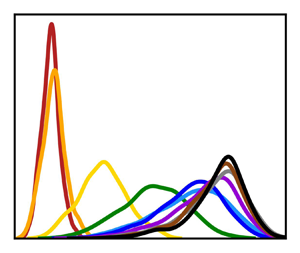
In this experimental study, we explore the dynamics of the thermal boundary layer in liquid metal Rayleigh–Bénard convection, covering the parameter ranges of $0.026 \leq$ Prandtl numbers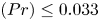 $(Pr) \leq 0.033$ and Rayleigh numbers ( $Ra$) up to $2.9\times 10^9$. Our research focuses on characterising the thermal boundary layer near the top plate of a cylindrical convection cell with an aspect ratio of 0.5, distinguishing between two distinct regions: the shear-dominated region around the centre of the top plate and a location near the side wall where the boundary layer is expected to be affected by the impact or ejection of thermal plumes. The dependencies of the boundary layer thickness on $Ra$ at these positions reveal deviating scaling exponents with the difference diminishing as $Ra$ increases. We find stronger fluctuations in the boundary layer and increasing deviation from the Prandtl–Blasius–Pohlhausen profile with increasing $Ra$, as well as in the measurements outside the centre region. Our data illustrate the complex interplay between flow dynamics and thermal transport in low- $Pr$ convection.


Measuring the stellar and planetary parameters of the 51 Eridani system
-
- Journal:
- Publications of the Astronomical Society of Australia / Volume 41 / 2024
- Published online by Cambridge University Press:
- 18 September 2024, e043
-
- Article
- Export citation
-
In order to study exoplanets, a comprehensive characterisation of the fundamental properties of the host stars – such as angular diameter, temperature, luminosity, and age, is essential, as the formation and evolution of exoplanets are directly influenced by the host stars at various points in time. In this paper, we present interferometric observations taken of directly imaged planet host 51 Eridani at the CHARA Array. We measure the limb-darkened angular diameter of 51 Eridani to be $\theta_\mathrm{LD} = 0.450\pm 0.006$ mas and combining with the Gaia zero-point corrected parallax, we get a stellar radius of $1.45 \pm 0.02$ R $_{\odot}$. We use the PARSEC isochrones to estimate an age of $23.2^{+1.7}_{-2.0}$ Myr and a mass of $1.550^{+0.006}_{-0.005}$ M $_{\odot}$. The age and mass agree well with values in the literature, determined through a variety of methods ranging from dynamical age trace-backs to lithium depletion boundary methods. We derive a mass of $4.1\pm0.4$ M $_\mathrm{Jup}$ for 51 Eri b using the Sonora Bobcat models, which further supports the possibility of 51 Eri b forming under either the hot-start formation model or the warm-start formation model.


FLM volume 990 Cover and Front matter
-
- Journal:
- Journal of Fluid Mechanics / Volume 990 / 10 July 2024
- Published online by Cambridge University Press:
- 18 September 2024, p. f1
-
- Article
-
- You have access
- Export citation
Spatial distribution of self-seeded air lasers induced by the femtosecond laser filament plasma
-
- Journal:
- Journal of Plasma Physics / Volume 90 / Issue 4 / August 2024
- Published online by Cambridge University Press:
- 18 September 2024, 905900404
-
- Article
- Export citation
3D relativistic MHD simulations of the gamma-ray binaries
-
- Journal:
- Publications of the Astronomical Society of Australia / Volume 41 / 2024
- Published online by Cambridge University Press:
- 18 September 2024, e048
-
- Article
- Export citation
-
In gamma-ray binaries neutron star is orbiting a companion that produces a strong stellar wind. We demonstrate that observed properties of ‘stellar wind’–‘pulsar wind’ interaction depend both on the overall wind thrust ratio, as well as more subtle geometrical factors: the relative direction of the pulsar’s spin, the plane of the orbit, the direction of motion, and the instantaneous line of sight. Using fully 3D relativistic magnetohydrodynamical simulations we find that the resulting intrinsic morphologies can be significantly orbital phase-dependent: a given system may change from tailward-open to tailward-closed shapes. As a result, the region of unshocked pulsar wind can change by an order of magnitude over a quarter of the orbit. We calculate radiation maps and synthetic light curves for synchrotron (X-ray) and inverse-Compton emission (GeV-TeV), taking into account $\gamma $– $\gamma $ absorption. Our modelled light curves are in agreement with the phase-dependent observed light curves of LS5039.


Internal heating profiles for which downward conduction is impossible
-
- Journal:
- Journal of Fluid Mechanics / Volume 993 / 25 August 2024
- Published online by Cambridge University Press:
- 17 September 2024, A5
-
- Article
-
- You have access
- Open access
- HTML
- Export citation
-
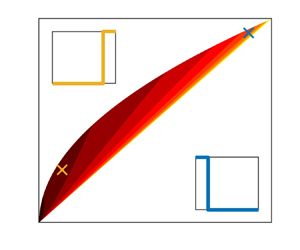
We consider an internally heated fluid between parallel plates with fixed thermal fluxes. For a large class of heat sources that vary in the direction of gravity, we prove that $\smash { \smash {{\langle {\delta T} \rangle _h}} } \geq \sigma R^{-1/3} - \mu$, where $\smash { \smash {{\langle {\delta T} \rangle _h}} }$ is the average temperature difference between the bottom and top plates, $R$ is a ‘flux’ Rayleigh number and the constants $\sigma,\mu >0$ depend on the geometric properties of the internal heating. This result implies that mean downward conduction (for which $\smash { \smash {{\langle {\delta T} \rangle _h}} }< 0$) is impossible for a range of Rayleigh numbers smaller than a critical value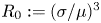 $R_0:=(\sigma /\mu )^{3}$. The bound demonstrates that $R_0$ depends on the heating distribution and can be made arbitrarily large by concentrating the heating near the bottom plate. However, for any given fixed heating profile of the class we consider, the corresponding value of $R_0$ is always finite. This points to a fundamental difference between internally heated convection and its limiting case of Rayleigh–Bénard convection with fixed-flux boundary conditions, for which $\smash {{\langle {\delta T} \rangle _h}}$ is known to be positive for all $R$.
$R$.


On the stability of fully nonlinear hydraulic-fall solutions to the forced water wave problem
-
- Journal:
- Journal of Fluid Mechanics / Volume 993 / 25 August 2024
- Published online by Cambridge University Press:
- 16 September 2024, A9
-
- Article
-
- You have access
- Open access
- HTML
- Export citation
Magnetohydrodynamic flow control in Hele-Shaw cells
-
- Journal:
- Journal of Fluid Mechanics / Volume 993 / 25 August 2024
- Published online by Cambridge University Press:
- 13 September 2024, A11
-
- Article
- Export citation
