Refine search
Actions for selected content:
238160 results in Physics and Astronomy
26 - Humans and Animals
- from Part V - Language, Our Greatest Gift
-
- Book:
- Life and Language Beyond Earth
- Published online:
- 16 September 2023
- Print publication:
- 21 September 2023, pp 425-432
-
- Chapter
- Export citation
Glossary
-
- Book:
- Life and Language Beyond Earth
- Published online:
- 16 September 2023
- Print publication:
- 21 September 2023, pp 593-615
-
- Chapter
- Export citation
Figure credits
-
- Book:
- Life and Language Beyond Earth
- Published online:
- 16 September 2023
- Print publication:
- 21 September 2023, pp 624-625
-
- Chapter
- Export citation
Contents
-
- Book:
- Life and Language Beyond Earth
- Published online:
- 16 September 2023
- Print publication:
- 21 September 2023, pp v-xiv
-
- Chapter
- Export citation
5 - Star Formation and Planets
- from Part II - The Universe We Live In
-
- Book:
- Life and Language Beyond Earth
- Published online:
- 16 September 2023
- Print publication:
- 21 September 2023, pp 58-68
-
- Chapter
- Export citation
Physics basis for the Wisconsin HTS Axisymmetric Mirror (WHAM)
- Part of
-
- Journal:
- Journal of Plasma Physics / Volume 89 / Issue 5 / October 2023
- Published online by Cambridge University Press:
- 20 September 2023, 975890501
-
- Article
-
- You have access
- Open access
- HTML
- Export citation
Interpolatory input and output projections for flow control
-
- Journal:
- Journal of Fluid Mechanics / Volume 971 / 25 September 2023
- Published online by Cambridge University Press:
- 20 September 2023, A27
-
- Article
-
- You have access
- Open access
- HTML
- Export citation
-
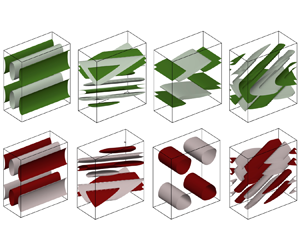
Eigenvectors of the observability and controllability Gramians represent responsive and receptive flow structures that enjoy a well-established connection to resolvent forcing and response modes. However, whereas resolvent modes have demonstrated great potential to guide sensor and actuator placement, observability and controllability modes have been leveraged exclusively in the context of model reduction via input and output projections. In this work, we introduce interpolatory, rather than orthogonal, input and output projections, that can be leveraged for sensor and actuator placement and open-loop control design. An interpolatory projector is an oblique projector with the property of preserving certain entries in the vector being projected. We review the connection between the resolvent operator and the Gramians, and present several numerical examples where we perform both orthogonal and interpolatory input and output projections onto the dominant forcing and response subspaces. Input projections are used to identify dynamically relevant disturbances, place sensors to measure disturbances, and place actuators for feedforward control in the linearized Ginzburg–Landau equation. Output projections are used to identify coherent structures and place sensors aiming at state reconstruction in the turbulent flow in a minimal channel at $Re_{\tau }=185$. The framework does not require data snapshots and relies only on knowledge of the steady or mean flow.

Equilibrium β-limits dependence on bootstrap current in classical stellarators
-
- Journal:
- Journal of Plasma Physics / Volume 89 / Issue 5 / October 2023
- Published online by Cambridge University Press:
- 20 September 2023, 905890508
-
- Article
-
- You have access
- Open access
- HTML
- Export citation
-
While it is important to design stellarators with high magnetohydrodynamic stability $\beta$
 -limit, it is also crucial to ensure that good magnetic surfaces exist in a large range of $\beta$
 values. As $\beta$
 increases, pressure-driven currents perturb the vacuum magnetic field and often lead to the emergence of magnetic field line chaos, which can worsen the confinement and is the cause of another kind of $\beta$
 -limit, the so-called equilibrium $\beta$
 -limit. In this paper, we explore numerically the dependence of the equilibrium $\beta$
 -limit on the bootstrap current strength in a classical stellarator geometry using the stepped pressure equilibrium code. We develop a diagnostic to determine whether or not magnetic islands are expected to participate significantly to radial transport, and we build an analytical model to predict the expected equilibrium $\beta$
 -limit, which recovers the main features of the numerical results. This research opens the possibility to include additional targets in stellarator optimization functions, provides additional understanding on the existence of magnetic surfaces at large $\beta$
 , and is a step forward in the understanding of the equilibrium $\beta$
 -limit.


Self-sustained azimuthal aeroacoustic modes. Part 1. Symmetry breaking of the mean flow by spinning waves
-
- Journal:
- Journal of Fluid Mechanics / Volume 971 / 25 September 2023
- Published online by Cambridge University Press:
- 19 September 2023, A21
-
- Article
-
- You have access
- Open access
- HTML
- Export citation
Surfactant amplifies yield-stress effects in the capillary instability of a film coating a tube
-
- Journal:
- Journal of Fluid Mechanics / Volume 971 / 25 September 2023
- Published online by Cambridge University Press:
- 19 September 2023, A24
-
- Article
-
- You have access
- Open access
- HTML
- Export citation
Self-sustained azimuthal aeroacoustic modes. Part 2. Effect of a swirling mean flow on the modal dynamics
-
- Journal:
- Journal of Fluid Mechanics / Volume 971 / 25 September 2023
- Published online by Cambridge University Press:
- 19 September 2023, A22
-
- Article
-
- You have access
- Open access
- HTML
- Export citation

Pore-resolved investigation of turbulent open channel flow over a randomly packed permeable sediment bed
-
- Journal:
- Journal of Fluid Mechanics / Volume 971 / 25 September 2023
- Published online by Cambridge University Press:
- 19 September 2023, A23
-
- Article
- Export citation
-
Pore-resolved direct numerical simulations are performed to investigate the interactions between streamflow turbulence and groundwater flow through a randomly packed porous sediment bed for three permeability Reynolds numbers, $Re_K=2.56$, 5.17 and 8.94, representative of natural stream or river systems. Time–space averaging is used to quantify the Reynolds stress, form-induced stress, mean flow and shear penetration depths, and mixing length at the sediment–water interface (SWI). The mean flow and shear penetration depths increase with $Re_K$ and are found to be nonlinear functions of non-dimensional permeability. The peaks and significant values of the Reynolds stresses, form-induced stresses, and pressure variations are shown to occur in the top layer of the bed, which is also confirmed by conducting simulations of just the top layer as roughness elements over an impermeable wall. The probability distribution functions (p.d.f.s) of normalized local bed stress are found to collapse for all Reynolds numbers, and their root-mean-square fluctuations are assumed to follow logarithmic correlations. The fluctuations in local bed stress and resultant drag and lift forces on sediment grains are mainly a result of the top layer; their p.d.f.s are symmetric with heavy tails, and can be well represented by a non-Gaussian model fit. The bed stress statistics and the pressure data at the SWI potentially can be used in providing better boundary conditions in modelling of incipient motion and reach-scale transport in the hyporheic zone.


On the low-frequency unsteadiness in shock wave–turbulent boundary layer interactions
-
- Journal:
- Journal of Fluid Mechanics / Volume 971 / 25 September 2023
- Published online by Cambridge University Press:
- 19 September 2023, A28
-
- Article
-
- You have access
- Open access
- HTML
- Export citation

Statistical characterization of a shock interacting with an inclined gas column
-
- Journal:
- Journal of Fluid Mechanics / Volume 971 / 25 September 2023
- Published online by Cambridge University Press:
- 19 September 2023, A26
-
- Article
-
- You have access
- Open access
- HTML
- Export citation
-
We present a statistical characterization of the interaction between a planar shock and a finite-diameter, cylindrical column of dense gas based on three-dimensional, large-eddy simulation results. In the simulation, the column of gas is initially inclined at an angle $\alpha _0$ with respect to the shock plane. Effects of the initial column angle on the mixing characteristics are examined at Mach number 2.0 for column incline angles $1^\circ$, $5^\circ$, $10^\circ$ and $30^\circ$. Mean velocity profiles show that the column angle affects the gas velocity components in the vertical plane, but not in the spanwise direction. The gas undergoes higher initial upward acceleration at larger initial column incline angles. With time, the gas motion tends to become one-dimensional in the streamwise direction. Initially, velocity fluctuations are most intense within the interior of the column, but concentrate near the column leading edge over time. At high wavenumbers $\kappa$, the turbulent kinetic energy spectra follow a power-law scaling of $\kappa ^{-1}$. The structure functions of the mass fraction do not clearly demonstrate power-law scaling except at early times for $\alpha _0=30^\circ$, manifesting overall trends very similar to those observed in earlier experiments. Probability distributions of the mass fraction show independence of the mean and the standard deviation of the mixed gas on $\alpha _0$. The column angle was also found to have little effect on the mixing efficiency characterized by the molecular mixedness. Velocity components in the streamwise and transverse directions tend towards a bimodal distribution for larger $\alpha _{0}$.


A self-propelling clapping body
-
- Journal:
- Journal of Fluid Mechanics / Volume 971 / 25 September 2023
- Published online by Cambridge University Press:
- 19 September 2023, A25
-
- Article
-
- You have access
- Open access
- HTML
- Export citation
-
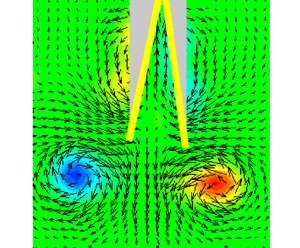
We report an experimental study of the motion of a clapping body consisting of two flat plates pivoted at the leading edge by a torsion spring. Clapping motion and forward propulsion of the body are initiated by the sudden release of the plates, initially held apart at an angle $2\theta _o$. Results are presented for the clapping and forward motions, and for the wake flow field for 24 cases, where depth-to-length ratio ( $d^* = 1.5,1\text { and }0.5$), spring stiffness per unit depth ( $Kt$), body mass ( $m_b$) and initial separation angle ( $2\theta _o = 45^{\circ }\text { and }60^{\circ }$) are varied. The body initially accelerates rapidly forward, then slowly retards to nearly zero velocity. Whereas the acceleration phase involves a complex interaction between plate and fluid motions, the retardation phase is simply fluid dynamic drag slowing the body. The wake consists of either a single axis-switching elliptical vortex loop (for $d^* = 1\text { and }1.5$) or multiple vortex loops (for $d^* = 0.5$). The body motion is nearly independent of $d^*$ and most affected by variation in $\theta _o$ and $Kt$. Using conservation of linear momentum and conversion of spring strain energy into kinetic energy in the fluid and body, we obtain a relation for the translation velocity of the body in terms of the various parameters. Approximately 80 % of the initial stored energy is transferred to the fluid, only 20 % to the body. The experimentally obtained cost of transport lies between 2 and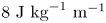 $8\ \mathrm {J}\ \mathrm {kg}^{-1}\ \mathrm {m}^{-1}$.


Searching for the log law in open channel flow
-
- Journal:
- Journal of Fluid Mechanics / Volume 971 / 25 September 2023
- Published online by Cambridge University Press:
- 18 September 2023, A15
-
- Article
-
- You have access
- Open access
- HTML
- Export citation
-
We carry out direct numerical simulations of flow in a plane open channel at friction Reynolds number up to ${{Re}}_{\tau } \approx 6000$. We find solid evidence for the presence of universal large-scale organization in the outer layer, with eddies that are larger and stronger than in the closed channel flow. As a result, velocity fluctuations are found to be stronger than in closed channels, throughout the depth. The inner-layer peak of the streamwise velocity variance is observed to grow logarithmically, as in Townsend's attached-eddy model (Townsend, The Structure of Turbulent Shear Flow, 2nd edn, Cambridge University Press, 1976), but saturation of the growth cannot be discarded based on the present data. Although we do not observe a clear outer peak of the streamwise velocity variance, we present substantial evidence that such a peak should emerge at a Reynolds number barely higher than achieved herein. The most striking feature of the flow is the presence of an extended logarithmic layer, with associated Kármán constant asymptoting to $k \approx 0.375$, in line with observations made in shear-free Couette–Poiseuille flow (Coleman et al., Flow Turbul. Combust., vol. 99, issue 3, 2017, pp. 553–564). The virtual absence of a wake region and of corrective terms to the log law in the present flow leads us to conclude that deviations from the log law observed in internal flows are likely due to the effects of the opposing walls, rather than the presence of a driving pressure gradient.


Invariants of the velocity gradient tensor in a spatially developing compressible round jet
-
- Journal:
- Journal of Fluid Mechanics / Volume 971 / 25 September 2023
- Published online by Cambridge University Press:
- 18 September 2023, A18
-
- Article
- Export citation
-
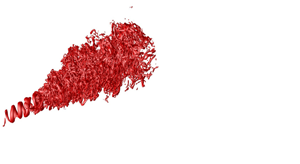
Direct numerical simulation of a compressible round jet is carried out at Mach number of 0.9 and Reynolds number of 3600 and the data are used to perform velocity gradient tensor (VGT) analysis for different regions of the spatially developing jet. For the developed portion of the jet, the classical teardrop shape is observed for the joint probability density function (p.d.f.) of Q and R (second and third invariants of the VGT). In the region just after the potential core, between $X = 10$ and 15 $r_0$ ( $r_0$ is the jet inlet radius), an inclination towards the third quadrant is observed in the Q–R joint p.d.f. which represents the presence of tube-like structures. It is also shown that this inclination in the turbulent/non-turbulent (T/NT) boundary and interface towards the third quadrant is mainly a contribution of points that lie in regions with negative dilatation. Regions with weak expansion also show this third quadrant inclination to some extent. Points that lie in regions with relatively higher positive dilatation show no such inclination towards the third quadrant but are inclined towards the fourth quadrant which indicates the presence of sheet-like structures. Similarly for the domain segment $X = 15$ to 20 $r_0$, it is observed that points that lie in the regions with positive dilatation have a joint p.d.f. with an inclination towards fourth quadrant, which suggests the presence of sheet-like structures at the T/NT boundary and interface. Points that lie in regions with negative dilatation show the appearance of a third quadrant lobe.


Flow-induced diffusion in a packed lattice of squirmers
-
- Journal:
- Journal of Fluid Mechanics / Volume 971 / 25 September 2023
- Published online by Cambridge University Press:
- 18 September 2023, A17
-
- Article
- Export citation
-
Mass transport in suspensions of swimming microorganisms is one of the most important factors for the colonisation and growth of microorganisms. Hydrodynamic interactions among swimming microorganisms play an important role in mass transport, especially in highly concentrated suspensions. To elucidate the influence of highly concentrated cells on mass transport, we numerically simulated mass transport in lattices of squirmers that were fixed in space and oriented in the same direction. The effects of different volume fractions, Péclet numbers ( $Pe$) and lattice configurations on mass transport were quantified by tracking Lagrangian material points that move with background flow with Brownian diffusivity. Although the flow field became periodic in space and each streamline basically extended in one direction, the motion of tracer particles became diffusive over long durations due to Brownian motion and cross-flows. Flow-induced diffusion was anisotropic and significantly enhanced over Brownian diffusion in the longitudinal direction. We also investigated mass transport in random configurations of squirmers to reproduce more general conditions. Similar enhanced diffusion was also observed in the random configurations, indicating that the flow-induced diffusion appears regardless of the configurations. The present flow-induced diffusion did not follow $Pe$ dependency of the conventional Taylor dispersion due to the cross-flows. The time and velocity scales were proposed, which enabled us to predict the flow-induced diffusivity from the data of the flow field and Brownian diffusivity without solving the mass conservation equation. The findings reported here improve our understanding of the transport phenomena in packed suspensions of swimming microorganisms.


Does Maxwell's hypothesis of air saturation near the surface of evaporating liquid hold at all spatial scales?
-
- Journal:
- Journal of Fluid Mechanics / Volume 971 / 25 September 2023
- Published online by Cambridge University Press:
- 18 September 2023, A20
-
- Article
-
- You have access
- Open access
- HTML
- Export citation
-
The classical model of evaporation of liquids hinges on Maxwell's assumption that the air near the liquid's surface is saturated. It allows one to find the evaporative flux without considering the interface separating liquid and air. Maxwell's hypothesis is based on an implicit assumption that the vapour-emission capacity of the interface exceeds the throughput of air (i.e. its ability to pass the vapour on to infinity). If this is indeed so, then the air adjacent to the liquid would get quickly saturated, justifying Maxwell's hypothesis. In the present paper, the so-called diffuse-interface model is used to account for the interfacial physics and thus derive a generalised version of Maxwell's boundary condition for the near-interface vapour density. It is then applied to a spherical drop floating in air. It turns out that the vapour-emission capacity of the interface exceeds the throughput of air only if the drop's radius is $r_{d}\gtrsim 10\ \mathrm {\mu } \mathrm {m}$, but for $r_{d}\approx 2\ \mathrm {\mu } {\rm m}$, the two are comparable. For $r_{d} \lesssim 1\ \mathrm {\mu } {\rm m}$, evaporation is interface-driven, and the resulting evaporation rate is noticeably smaller than that predicted by the classical model.


Nonlinear saturation of resistive tearing modes in a cylindrical tokamak with and without solving the dynamics
-
- Journal:
- Journal of Plasma Physics / Volume 89 / Issue 5 / October 2023
- Published online by Cambridge University Press:
- 18 September 2023, 905890507
-
- Article
-
- You have access
- Open access
- HTML
- Export citation
