Contents
Original Article
Periodic expansion of one by Salem numbers
- Part of:
-
- Published online by Cambridge University Press:
- 14 October 2022, pp. 2841-2862
-
- Article
- Export citation
-
We show that for a Salem number $\beta $ of degree d, there exists a positive constant $c(d)$ where $\beta ^m$ is a Parry number for integers m of natural density $\ge c(d)$. Further, we show $c(6)>1/2$ and discuss a relation to the discretized rotation in dimension $4$.
$4$.


Arbitrarily slow decay in the Möbius disjointness conjecture
- Part of:
-
- Published online by Cambridge University Press:
- 09 September 2022, pp. 2863-2880
-
- Article
-
- You have access
- Open access
- HTML
- Export citation
-
Sarnak’s Möbius disjointness conjecture asserts that for any zero entropy dynamical system $(X,T)$, $({1}/{N})\! \sum _{n=1}^{N}\! f(T^{n} x) \mu (n)= o(1)$ for every $f\in \mathcal {C}(X)$ and every $x\in X$. We construct examples showing that this $o(1)$ can go to zero arbitrarily slowly. In fact, our methods yield a more general result, where in lieu of $\mu (n)$, one can put any bounded sequence $a_{n}$ such that the Cesàro mean of the corresponding sequence of absolute values does not tend to zero. Moreover, in our construction, the choice of x depends on the sequence $a_{n}$ but $(X,T)$ does not.


Subsystem entropies of shifts of finite type and sofic shifts on countable amenable groups
- Part of:
-
- Published online by Cambridge University Press:
- 08 September 2022, pp. 2881-2914
-
- Article
-
- You have access
- Open access
- HTML
- Export citation
-
In this work, we study the entropies of subsystems of shifts of finite type (SFTs) and sofic shifts on countable amenable groups. We prove that for any countable amenable group G, if X is a G-SFT with positive topological entropy $h(X)> 0$, then the entropies of the SFT subsystems of X are dense in the interval $[0, h(X)]$. In fact, we prove a ‘relative’ version of the same result: if X is a G-SFT and $Y \subset X$ is a subshift such that $h(Y) < h(X)$, then the entropies of the SFTs Z for which $Y \subset Z \subset X$ are dense in $[h(Y), h(X)]$. We also establish analogous results for sofic G-shifts.


On conjugacy of natural extensions of one-dimensional maps
- Part of:
-
- Published online by Cambridge University Press:
- 20 September 2022, pp. 2915-2937
-
- Article
- Export citation
-
We prove that for any non-degenerate dendrite D, there exist topologically mixing maps $F : D \to D$ and $f : [0, 1] \to [0, 1]$ such that the natural extensions (as known as shift homeomorphisms) $\sigma _F$ and $\sigma _f$ are conjugate, and consequently the corresponding inverse limits are homeomorphic. Moreover, the map f does not depend on the dendrite D and can be selected so that the inverse limit $\underleftarrow {\lim } (D,F)$ is homeomorphic to the pseudo-arc. The result extends to any finite number of dendrites. Our work is motivated by, but independent of, the recent result of the first and third author on conjugation of Lozi and Hénon maps to natural extensions of dendrite maps.


Correlation of the renormalized Hilbert length for convex projective surfaces
- Part of:
-
- Published online by Cambridge University Press:
- 08 September 2022, pp. 2938-2973
-
- Article
-
- You have access
- Open access
- HTML
- Export citation
The Assouad dimension of self-affine measures on sponges
- Part of:
-
- Published online by Cambridge University Press:
- 08 September 2022, pp. 2974-2996
-
- Article
-
- You have access
- Open access
- HTML
- Export citation
-
We derive upper and lower bounds for the Assouad and lower dimensions of self-affine measures in $\mathbb {R}^d$ generated by diagonal matrices and satisfying suitable separation conditions. The upper and lower bounds always coincide for $d=2,3$, yielding precise explicit formulae for those dimensions. Moreover, there are easy-to-check conditions guaranteeing that the bounds coincide for $d \geqslant 4$. An interesting consequence of our results is that there can be a ‘dimension gap’ for such self-affine constructions, even in the plane. That is, we show that for some self-affine carpets of ‘Barański type’ the Assouad dimension of all associated self-affine measures strictly exceeds the Assouad dimension of the carpet by some fixed $\delta>0$ depending only on the carpet. We also provide examples of self-affine carpets of ‘Barański type’ where there is no dimension gap and in fact the Assouad dimension of the carpet is equal to the Assouad dimension of a carefully chosen self-affine measure.


Perturbations of graphs for Newton maps I: bounded hyperbolic components
- Part of:
-
- Published online by Cambridge University Press:
- 31 August 2022, pp. 2997-3025
-
- Article
- Export citation
-
We consider graphs consisting of finitely many internal rays for degenerating Newton maps and state a convergence result. As an application, we prove that a hyperbolic component in the moduli space of quartic Newton maps is bounded if and only if every element has degree $2$ on the immediate basin of each root. This provides the first complete description of bounded hyperbolic components in a complex two-dimensional moduli space.

Flows, growth rates, and the veering polynomial
- Part of:
-
- Published online by Cambridge University Press:
- 04 October 2022, pp. 3026-3107
-
- Article
- Export citation
-
For a pseudo-Anosov flow $\varphi $ without perfect fits on a closed $3$-manifold, Agol–Guéritaud produce a veering triangulation $\tau $ on the manifold M obtained by deleting the singular orbits of $\varphi $. We show that $\tau $ can be realized in M so that its 2-skeleton is positively transverse to $\varphi $, and that the combinatorially defined flow graph $\Phi $ embedded in M uniformly codes the orbits of $\varphi $ in a precise sense. Together with these facts, we use a modified version of the veering polynomial, previously introduced by the authors, to compute the growth rates of the closed orbits of $\varphi $ after cutting M along certain transverse surfaces, thereby generalizing the work of McMullen in the fibered setting. These results are new even in the case where the transverse surface represents a class in the boundary of a fibered cone of M. Our work can be used to study the flow $\varphi $ on the original closed manifold. Applications include counting growth rates of closed orbits after cutting along closed transverse surfaces, defining a continuous, convex entropy function on the ‘positive’ cone in $H^1$ of the cut-open manifold, and answering a question of Leininger about the closure of the set of all stretch factors arising as monodromies within a single fibered cone of a $3$-manifold. This last application connects to the study of endperiodic automorphisms of infinite-type surfaces and the growth rates of their periodic points.


Rational points on nonlinear horocycles and pigeonhole statistics for the fractional parts of $\sqrt {n}$
- Part of:
-
- Published online by Cambridge University Press:
- 08 September 2022, pp. 3108-3130
-
- Article
-
- You have access
- Open access
- HTML
- Export citation
-
In this paper, we investigate pigeonhole statistics for the fractional parts of the sequence $\sqrt {n}$. Namely, we partition the unit circle $ \mathbb {T} = \mathbb {R}/\mathbb {Z}$ into N intervals and show that the proportion of intervals containing exactly j points of the sequence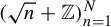 $(\sqrt {n} + \mathbb {Z})_{n=1}^N$ converges in the limit as $N \to \infty $. More generally, we investigate how the limiting distribution of the first $sN$ points of the sequence varies with the parameter $s \geq 0$. A natural way to examine this is via point processes—random measures on $[0,\infty )$ which represent the arrival times of the points of our sequence to a random interval from our partition. We show that the sequence of point processes we obtain converges in distribution and give an explicit description of the limiting process in terms of random affine unimodular lattices. Our work uses ergodic theory in the space of affine unimodular lattices, building upon work of Elkies and McMullen [Gaps in $\sqrt {n}$ mod 1 and ergodic theory. Duke Math. J. 123 (2004), 95–139]. We prove a generalisation of equidistribution of rational points on expanding horocycles in the modular surface, working instead on nonlinear horocycle sections.


On images of subshifts under embeddings of symbolic varieties
- Part of:
-
- Published online by Cambridge University Press:
- 01 August 2022, pp. 3131-3149
-
- Article
-
- You have access
- Open access
- HTML
- Export citation
-
We show that the image of a subshift X under various injective morphisms of symbolic algebraic varieties over monoid universes with algebraic variety alphabets is a subshift of finite type, respectively a sofic subshift, if and only if so is X. Similarly, let G be a countable monoid and let A, B be Artinian modules over a ring. We prove that for every closed subshift submodule $\Sigma \subset A^G$ and every injective G-equivariant uniformly continuous module homomorphism $\tau \colon \! \Sigma \to B^G$, a subshift $\Delta \subset \Sigma $ is of finite type, respectively sofic, if and only if so is the image $\tau (\Delta )$. Generalizations for admissible group cellular automata over admissible Artinian group structure alphabets are also obtained.


Quenched and annealed equilibrium states for random Ruelle expanding maps and applications
- Part of:
-
- Published online by Cambridge University Press:
- 09 September 2022, pp. 3150-3192
-
- Article
- Export citation
Front Cover (OFC, IFC) and matter
ETS volume 43 issue 9 Cover and Front matter
-
- Published online by Cambridge University Press:
- 08 August 2023, pp. f1-f2
-
- Article
-
- You have access
- Export citation
Back Cover (OBC, IBC) and matter
ETS volume 43 issue 9 Cover and Back matter
-
- Published online by Cambridge University Press:
- 08 August 2023, pp. b1-b2
-
- Article
-
- You have access
- Export citation