Contents
Research Article
Qualitative Analysis of Solutions for a Class of Anisotropic Elliptic Equations with Variable Exponent
- Part of:
-
- Published online by Cambridge University Press:
- 15 December 2015, pp. 541-557
-
- Article
- Export citation
-
We are concerned with the degenerate anisotropic problem

We first establish the existence of an unbounded sequence of weak solutions. We also obtain the existence of a non-trivial weak solution if the nonlinear term f has a special form. The proofs rely on the fountain theorem and Ekeland's variational principle.
On p-adic analytic continuation with applications to generating elements
- Part of:
-
- Published online by Cambridge University Press:
- 10 June 2015, pp. 1-10
-
- Article
-
- You have access
- Export citation
-
Given a prime number p and the Galois orbit O(T) of an integral transcendental element T of
 , the topological completion of the algebraic closure of the field of p-adic numbers, we study the p-adic analytic continuation around O(T) of functions defined by limits of sequences of restricted power series with p-adic integer coefficients. We also investigate applications to generating elements for or for some classes of closed subfields of .
 , the topological completion of the algebraic closure of the field of p-adic numbers, we study the p-adic analytic continuation around O(T) of functions defined by limits of sequences of restricted power series with p-adic integer coefficients. We also investigate applications to generating elements for
 Link Floer Homology Categorifies the Conway Function
- Part of:
-
- Published online by Cambridge University Press:
- 18 January 2016, pp. 813-836
-
- Article
- Export citation
Mutations of Fake Weighted Projective Planes
- Part of:
-
- Published online by Cambridge University Press:
- 10 June 2015, pp. 271-285
-
- Article
-
- You have access
- Export citation
Relative Manin–Mumford for Semi-Abelian Surfaces
- Part of:
-
- Published online by Cambridge University Press:
- 18 January 2016, pp. 837-875
-
- Article
- Export citation
Stochastic Models for Chladni Figures
- Part of:
-
- Published online by Cambridge University Press:
- 10 August 2015, pp. 287-300
-
- Article
-
- You have access
- Export citation
Orthogonally Additive Polynomials and Orthosymmetric Maps in Banach Algebras with Properties 𝔸 and 𝔹
- Part of:
-
- Published online by Cambridge University Press:
- 15 December 2015, pp. 559-568
-
- Article
- Export citation
Inversion is Possible in Groups with no Periodic Automorphisms
- Part of:
-
- Published online by Cambridge University Press:
- 05 June 2015, pp. 11-16
-
- Article
-
- You have access
- Export citation
Triple Factorizations and Supersolubility of Finite Groups
- Part of:
-
- Published online by Cambridge University Press:
- 11 June 2015, pp. 301-309
-
- Article
-
- You have access
- Export citation
Turán-Type Inequalities for Some Lommel Functions of the First Kind
- Part of:
-
- Published online by Cambridge University Press:
- 29 October 2015, pp. 569-579
-
- Article
- Export citation
Coincidence Results for Summing Multilinear Mappings
- Part of:
-
- Published online by Cambridge University Press:
- 03 June 2016, pp. 877-897
-
- Article
- Export citation
On the continuation of solutions of non-autonomous semilinear parabolic problems
- Part of:
-
- Published online by Cambridge University Press:
- 13 July 2015, pp. 17-55
-
- Article
-
- You have access
- Export citation
On some questions related to Koethe's nil ideal problem
- Part of:
-
- Published online by Cambridge University Press:
- 13 February 2015, pp. 57-64
-
- Article
-
- You have access
- Export citation
Elasticity in Polynomial-Type Extensions
- Part of:
-
- Published online by Cambridge University Press:
- 28 March 2016, pp. 581-590
-
- Article
- Export citation
Probability and Bias in Generating Supersoluble Groups
- Part of:
-
- Published online by Cambridge University Press:
- 22 December 2015, pp. 899-909
-
- Article
- Export citation
On Higher Rank Globally Generated Vector Bundles over a Smooth Quadric Threefold
- Part of:
-
- Published online by Cambridge University Press:
- 10 June 2015, pp. 311-337
-
- Article
-
- You have access
- Export citation
Zero-Separating Invariants for Linear Algebraic Groups
- Part of:
-
- Published online by Cambridge University Press:
- 22 December 2015, pp. 911-924
-
- Article
- Export citation
-
Abstract Let G be a linear algebraic group over an algebraically closed field 𝕜 acting rationally on a G-module V with
 its null-cone. Let δ(G, V) and σ(G, V) denote the minimal number d such that for every
 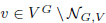 and
and  , respectively, there exists a homogeneous invariant f of positive degree at most d such that f(v) ≠ 0. Then δ(G) and σ(G) denote the supremum of these numbers taken over all G-modules V. For positive characteristics, we show that δ(G) = ∞ for any subgroup G of GL2(𝕜) that contains an infinite unipotent group, and σ(G) is finite if and only if G is finite. In characteristic zero, δ(G) = 1 for any group G, and we show that if σ(G) is finite, then G 0 is unipotent. Our results also lead to a more elementary proof that β sep(G) is finite if and only if G is finite.
 its null-cone. Let δ(G, V) and σ(G, V) denote the minimal number d such that for every
  and
and  , respectively, there exists a homogeneous invariant f of positive degree at most d such that f(v) ≠ 0. Then δ(G) and σ(G) denote the supremum of these numbers taken over all G-modules V. For positive characteristics, we show that δ(G) = ∞ for any subgroup G of GL
q-analogues of Ehrhart polynomials
-
- Published online by Cambridge University Press:
- 17 December 2015, pp. 339-358
-
- Article
-
- You have access
- Export citation
Bounding the Diameter of the Brauer Graph of a Block of a Solvable Group
- Part of:
-
- Published online by Cambridge University Press:
- 17 December 2015, pp. 591-603
-
- Article
- Export citation
On fractional heat equations with non-local initial conditions
- Part of:
-
- Published online by Cambridge University Press:
- 08 July 2015, pp. 65-76
-
- Article
-
- You have access
- Export citation