To save content items to your account,
please confirm that you agree to abide by our usage policies.
If this is the first time you use this feature, you will be asked to authorise Cambridge Core to connect with your account.
Find out more about saving content to .
To save content items to your Kindle, first ensure no-reply@cambridge.org
is added to your Approved Personal Document E-mail List under your Personal Document Settings
on the Manage Your Content and Devices page of your Amazon account. Then enter the ‘name’ part
of your Kindle email address below.
Find out more about saving to your Kindle.
Note you can select to save to either the @free.kindle.com or @kindle.com variations.
‘@free.kindle.com’ emails are free but can only be saved to your device when it is connected to wi-fi.
‘@kindle.com’ emails can be delivered even when you are not connected to wi-fi, but note that service fees apply.
This article extends recent insights from new institutional economics to explore the relevance of the concept of meso-institutions. It does so through the exploration of the case of the Brazilian Forest Code, pointing out how and why meso-institutions play a key role in making public policies effective. More specifically, our study shows how crucial is the complete fulfilling of the functions characterising meso-institutions – namely translation, monitoring, and enforcement, to implement regulations and determine their effectiveness. Lessons are drawn regarding the complexities inherent in the creation, implementation, and operationalisation of rules across a multilayered institutional environment.
Efficient local trajectory optimization of the coordinated manipulator is a bottleneck task in the narrow feeding scenario. To optimize the trajectory locally and generate collision-free trajectories with local support performance, the analytical reinforcement method is proposed. Firstly, multiple coordinated machines operating in the narrow space are transformed into decentralized dynamic constraints for the target manipulator. Combined with the circle envelope method in the dynamic constraint, the collision-free gradient optimization function determines the support region of the local optimal trajectory. Based on the forward kinematics and inverse kinematics method, the collision-prone pose of the target manipulator outside the support region is analytically optimized. And chi-square distribution further ensures the smooth interpolation of the variable-period trajectory outside the fixed-period support region. For the emergency collision avoidance of the coordinated manipulator in the flexible stamping line, the analytical reinforcement method is successfully verified by generating the collision-free and smooth trajectory. It provides an optimization direction for rapidly improving the work efficiency of multi-machine coordination in the narrow feeding scenario.
Language mixing is a common phenomenon in the language input of bilingual children. However, the relation between the frequency of parental language mixing and children’s language development remains unclear. The present study investigates the relation between language mixing as observed in daylong audio recordings (LENA) and as reported by parents in the questionnaire for Quantifying Bilingual Experience (Q-BEx) and children’s language outcomes in the majority and minority language. Participants were 52 3-to-5-year-old Polish-Dutch and Turkish-Dutch children in the Netherlands and Bayesian informative hypothesis evaluations were applied. In 14 out of 15 regression analyses, the LENA and Q-BEx measures yielded similar associations with children’s language outcomes. Parental language mixing was not related to majority language outcomes, but a negative relation was found with expressive vocabulary in the minority language. Longitudinal studies are needed to pinpoint the directionality of this negative relation.
This paper presents a pedagogical experiment in the form of a fictional podcast episode that “aired” in January 2025, featuring Tim Winton’s climate fiction novel Juice (2024). Emerging from a dialogical reading collaboration between three interdisciplinary “scholars, resisters and ordinary grafters” (Winton, 2024, p.116) — Rumen Rachev, Jo Pollitt, and Emma Nicoletti — the paper and podcast operate together through a method we term papercast, centring on three key themes: clouds, atmospheric frictions, and the significance of critically engaging with climate fiction, specifically Juice, amid ongoing climate instability. Simultaneously paper and podcast (papercast), we invite the reader to “listen” visually to the printed material that follows. Through discussion and excerpts from Clouds Running Out of Juice, a creative non-fiction episode of the fictional Ecosophic Generator podcast, the work incorporates AI-generated responses from “listeners” who inhabit the liminal space between present imaginings and future realities. This papercast emerged through asynchronous reading practices and collaborative dialogue, culminating in a three-way conversation that traverses multiple theoretical terrains. Rachev’s investigation as an atmospheric economist into the future-proofing of clouds, Pollitt’s choreographic exploration of everyday weather and experiences of weathering instability, and Nicoletti’s examination of human-atmospheric binaries collectively generate productive tensions between scientific knowledge and creative uncertainty.
Accumulating evidence shows that an increasing number of children and young people (CYP) are reporting mental health problems.
Aims
To investigate emotional disorders (anxiety or depression) among CYP in England between 2004 and 2017, and to identify which disorders and demographic groups have experienced the greatest increase.
Method
Repeated cross-sectional, face-to-face study using data from the Mental Health of Children and Young People surveys conducted in 2004 and 2017, allowing use of nationally representative probability samples of CYP aged 5–16 years in England. A total of 13 561 CYP were included across both survey waves (6898 in 2004 and 6663 in 2017). We assessed the prevalence of any emotional, anxiety and depressive disorder assessed using the Development and Well-Being Assessment and classified according to ICD-10 criteria.
Results
The prevalence of emotional disorders increased from 3.9% in 2004 to 6.0% in 2017, a relative increase of 63% (relative ratio 1.63, 95% CI 1.38, 1.91). This was largely driven by anxiety disorders, which increased from 3.5 to 5.4% (relative ratio 1.63, 95% CI 1.37, 1.93). The largest relative changes were for panic disorder, separation anxiety, social phobia and post-traumatic stress disorder. Changes were similar for different genders and socioeconomic groups, but differed by ethnicity: the most pronounced increase was among White CYP (relative ratio 1.88, 95% CI 1.59, 2.24), compared with no clear change for Black and minority ethnic CYP (relative ratio 0.85, 95% CI 0.52, 1.39). Comorbid psychiatric conditions were present in over a third of CYP with emotional disorders, with the most common being conduct disorder.
Conclusions
Between 2004 and 2017, the increase in emotional disorders among CYP in England was largely driven by anxiety disorders. Socioeconomic inequalities did not narrow. Disaggregating by ethnicity, change was evident only in White CYP, suggesting differential trends in either risk exposure, resilience or reporting by ethnicity.
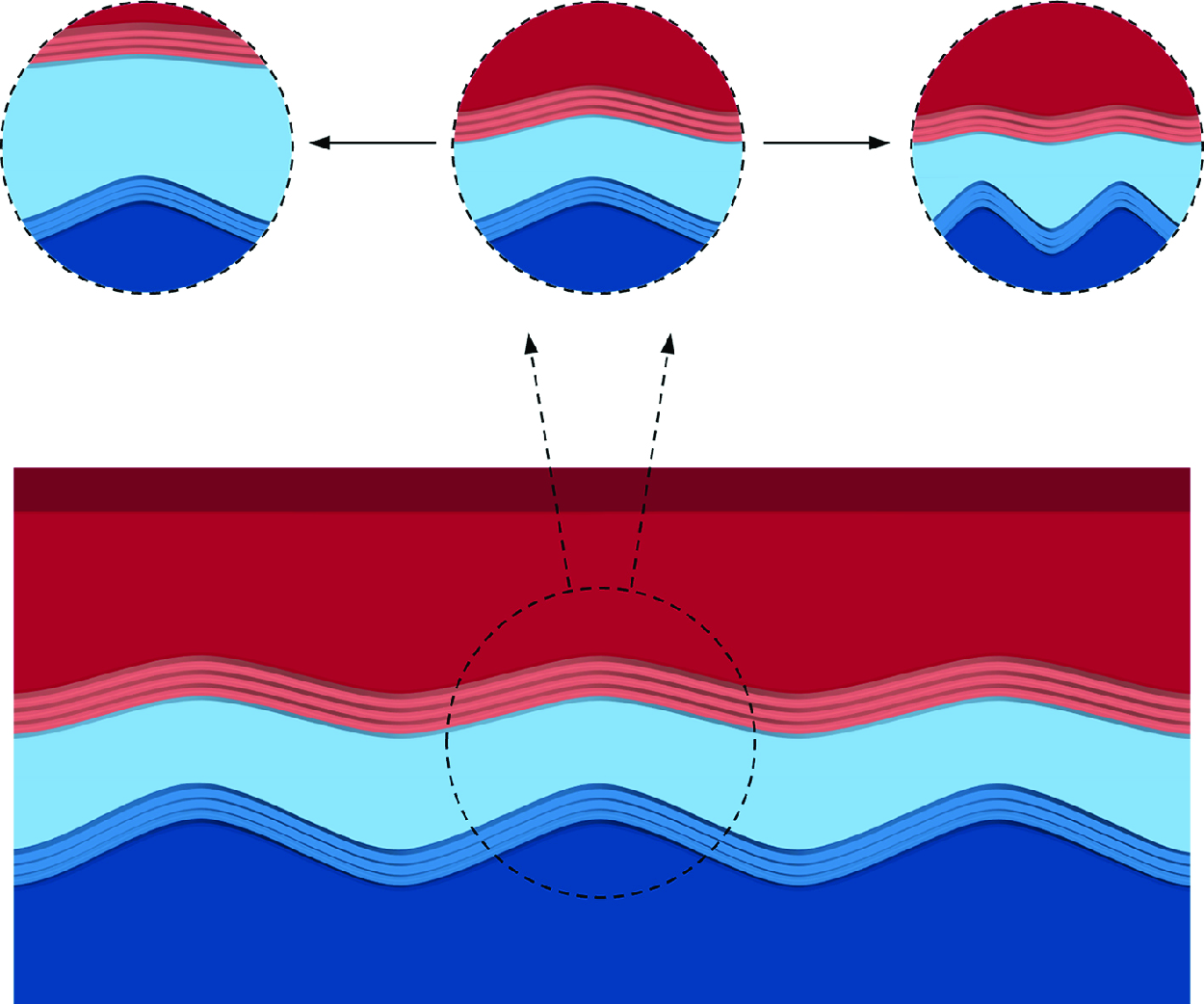
A linear stability model based on a phase-field method is established to study the formation of ripples on the ice surface. The pattern on horizontal ice surfaces, e.g. glaciers and frozen lakes, is found to be originating from a gravity-driven instability by studying ice–water–air flows with a range of water and ice thicknesses. Contrary to gravity, surface tension and viscosity act to suppress the instability. The results demonstrate that a larger value of either water thickness or ice thickness corresponds to a longer dominant wavelength of the pattern, and a favourable wavelength of 90 mm is predicted, in agreement with observations from nature. Furthermore, the profiles of the most unstable perturbations are found to be with two peaks at the ice–water and water–air interfaces whose ratio decreases exponentially with the water thickness and wavenumber.
To examine the challenges and practical realities of providing end-of-life care in welfare evacuation centers following the Noto Peninsula earthquake in Japan, and to identify lessons for improving disaster preparedness in similar settings.
Case presentations
Case 1: A man in his late 90s was transferred to a welfare evacuation center after contracting COVID-19 in a general shelter. He arrived with fever and marked physical decline. Acetaminophen was administered to relieve his fever and provide comfort. His condition gradually worsened, and eight days after arriving at the evacuation shelter, he died peacefully while being closely observed by medical staff. Case 2: A man in his 60s with a history of smoking and alcohol use was found bedridden and incontinent at home and was subsequently moved to a welfare evacuation center. Two days after evacuation, he complained of leg and back pain, which was suspected to be due to arterial occlusion. He was monitored and provided with supportive care at the center, however, pain control remained inadequate. Four days after evacuation, he was found in respiratory arrest and was confirmed dead.
Conclusion
These cases underscore the need for establishing unified guidelines and external support frameworks for end-of-life care in disaster settings. In a disaster-prone country like Japan, scenario-based training and the integration of trained volunteers are essential to ensuring dignified care for vulnerable evacuees.
The objective is to determine if a practical face-to-face emergency disaster incident response training program delivered in the clinical setting will improve self-reported confidence and assessed knowledge of emergency department (ED) nurses to respond to disasters.
Methods
A single site prospective pre-test and post-test randomized controlled trial was adopted for this study. The intervention was a practical face-to-face training program, while the control group completed the required annual mandatory hospital online training.
Results
There was a large difference in post-test median self-reported confidence between groups. There was also a large difference in the proportion of subjects who reached satisfactory levels of self-reported confidence post-test. Regarding assessed knowledge, there was a moderate difference in post-test median knowledge between groups. There was also a moderate difference in the proportion who reached satisfactory levels of knowledge post-test.
Conclusions
This study has shown that ED nurses who undertake a practical face-to-face disaster preparedness education program in the clinical setting, are better prepared to respond to emergency disaster incidents. Organizations should consider the use of a practical structured face-to-face emergency disaster incident response education program to complement and enhance any online emergency and disaster training.
A well-documented pattern of bank lending during crises is allocating credit to insolvent firms at the expense of productive firms, leading to inefficient resource allocation at the macro level. I investigate the role of bank CEOs in influencing such distortions during crises, using the strictly enforced age-based retirement policy of Indian government-controlled banks. I find that banks experiencing a CEO turnover in a crisis are less likely to bail out insolvent borrowers, as the new CEO has a lower incentive to do so. Consequently, the efficiency of credit allocation improves, and the zombification of the economy decreases.
As governments prepare for the decisive round of negotiations for the global plastics treaty in August 2025, trade remains a largely overlooked yet indispensable element in shaping an effective and equitable agreement. We argue that trade, spanning plastic feedstocks, resins, products, and waste, forms the connective tissue of the plastics economy and that it must be embedded in the treaty’s architecture. Drawing on global trade data, country cases, and precedent from multilateral environmental agreements, we demonstrate how trade both drives plastic pollution and can serve as a lever for circularity and sustainability. We outline the asymmetries in global plastics trade and their implications for equity and implementation, especially for small and import-dependent states. The article proposes a suite of actionable recommendations for INC-5.2, including trade-related transparency, WTO-aligned treaty provisions, and dedicated capacity-building support. By integrating trade governance into the plastics treaty, negotiators can build an agreement that is both environmentally ambitious and structurally sound.
Are political activists driven by instrumental motives such as making a career in politics or mobilizing voters? We implement two natural field experiments in which party activists are randomly informed that canvassing is i) effective at mobilizing voters, or ii) effective for enhancing activists’ political careers. We find no effect of the treatments on activists’ intended and actual canvassing behaviour. The null finding holds despite a successful manipulation check and replication study, high statistical power, a natural field setting, and an unobtrusive measurement strategy. Using an expert survey, we show that the null finding shifted Bayesian posterior beliefs about the treatment’s effectiveness toward zero. The evidence thus casts doubt on two popular hypothesized instrumental drivers of political activism – voter persuasion and career concerns – and points toward expressive benefits as more plausible motives.
Plastics and climate change are inseparable issues, both materially and geopolitically. Plastics are derived almost entirely from fossil fuels and have an enormous greenhouse gas footprint. Aligning with the Paris Agreement requires rapid, dramatic decreases in plastic production, contravening the industry’s plans to continue expanding production. The oil, gas and petrochemical industry wields substantial power in both the climate and plastics treaty negotiations and has used that power to stymie progress in both. Rather than repeat the failures of the climate negotiations, plastics negotiators should seek to create a “plastics club” for ambitious action.
A theoretical framework has been established to investigate the modulational instability of electromagnetic waves in magnetized electron–positron plasmas. The framework is capable of analyzing electromagnetic waves of any intensity and plasmas at any temperature. A fully relativistic hydrodynamic model, incorporating relativistic velocities and thermal effects, is used to describe the relativistic dynamics of particles in plasmas. Under the weakly magnetized approximation, a modified nonlinear Schrödinger equation, governing the dynamics of the envelope of electromagnetic waves in plasmas, is obtained. The growth rate of the modulational instability is then given both theoretically and numerically. By analyzing the dependence of the growth rate on some key physical parameters, the coupled interplay of relativistic effects, ponderomotive forces, thermal effects and magnetic fields on electromagnetic waves can be clarified. The findings demonstrate that specific combinations of physical parameters can significantly enhance modulational instability, providing a theoretical basis for controlling the propagation of electromagnetic waves in plasmas. This framework has broad applicability to most current laser–plasma experiments and high-energy radiation phenomena from stellar surfaces.
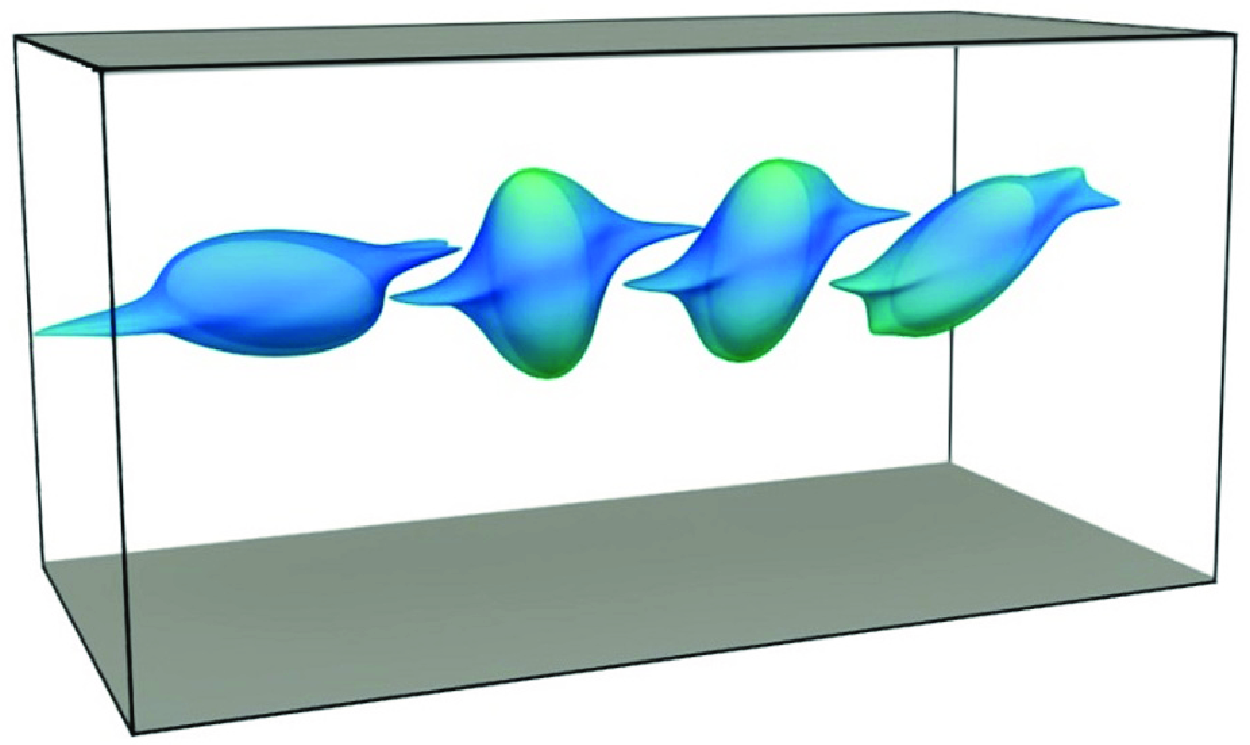
In this work, a systematic study is carried out concerning the dynamic behaviour of finite-size spheroidal particles in non-isothermal shear flows between parallel plates. The simulations rely on a hybrid method combining the lattice Boltzmann method with a finite-difference solver. Fluid–particle and heat–particle interactions are accounted for by using the immersed boundary method. The effect of particle Reynolds number ($\textit{Re}_p=1{-}90$), Grashof number (${Gr}=0{-}200$), initial position and initial orientation of the particle are thoroughly examined. For the isothermal prolate particle, we observed that above a certain Reynolds number, the particle undergoes a pitchfork bifurcation; at an even higher Reynolds number, it returns to the centre position. In contrast, the hot particle behaves differently, with no pitchfork bifurcation. Instead, the Reynolds and Grashof numbers can induce oscillatory tumbling or log-rolling motions in either the lower or upper half of the channel. Heat transfer also plays an important role: at low Grashof numbers, the particle settles near the lower wall, while increasing the Grashof number shifts it towards the upper side. Moreover, the presence of thermal convection increases the rotational speed of the particle. Surprisingly, beyond the first critical Reynolds number, the equilibrium position of the thermal particle shifts closer to the centreline compared with that of a neutrally buoyant isothermal particle. Moreover, higher Grashof numbers can cause the particle to transition from tumbling to log-rolling or even a no-rotation mode. The initial orientation has a stronger influence at low Grashof numbers, while the initial position shows no strong effect in non-isothermal cases.
The glomerular filtration rate (GFR), estimated from serum creatinine (SCr), is widely used in clinical practice for kidney function assessment, but SCr-based equations are limited by non-GFR determinants and may introduce inaccuracies across racial groups. Few studies have evaluated whether advanced modeling techniques enhance their performance.
Methods:
Using multivariable fractional polynomials (MFP), generalized additive models (GAM), random forests (RF), and gradient boosted machines (GBM), we developed four SCr-based GFR-estimating equations in a pooled data set from four cohorts (n = 4665). Their performance was compared to that of the refitted linear regression-based 2021 CKD-EPI SCr equation using bias (median difference between measured GFR [mGFR] and estimated GFR [eGFR]), precision, and accuracy metrics (e.g., P10 and P30, percentage of eGFR within 10% and 30% of mGFR, respectively) in a pooled validation data set from three additional cohorts (n = 2215).
Results:
In the validation data set, the greatest bias and lowest accuracy, were observed in Black individuals for all equations across subgroups defined by race, sex, age, and eGFR. The MFP and GAM equations performed similarly to the refitted CKD-EPI SCr equation, with slight improvements in P10 and P30 in subgroups including Black individuals and females. The GBM and RF equations demonstrated smaller biases, but lower accuracy compared to other equations. Generally, differences among equations were modest overall and across subgroups.
Conclusions:
Our findings suggest that advanced methods provide limited improvement in SCr-based GFR estimation. Future research should focus on integrating novel biomarkers for GFR estimation and improving the feasibility of GFR measurement.
We reprise some common statistical models for actuarial mortality analysis using grouped counts. We then discuss the benefits of building mortality models from the most elementary items. This has two facets. First, models are better based on the mortality of individuals, rather than groups. Second, models are better defined in continuous time, rather than over fixed intervals like a year. We show how Poisson-like likelihoods at the “macro” level are built up by product integration of sequences of infinitesimal Bernoulli trials at the “micro” level. Observed data is represented through a stochastic mortality hazard rate, and counting processes provide the natural notation for left-truncated and right-censored actuarial data, individual or age-grouped. Together these explain the “pseudo-Poisson” behaviour of survival model likelihoods.
Former prisoners are a vulnerable population, and suicide rates among this group are high, particularly following release from prison.
Aims
To explore former prisoners’ engagement with mental health services before death by suicide, and to examine the demographics, clinical history and clinical care of this patient group and compare them with patients who died by suicide who had not been to prison.
Method
The clinical, sociodemographic and care characteristics of patients in contact with mental health services who died by suicide in the UK were examined in a national clinical survey between 1 January 2001 and 31 December 2021, and comparisons were made between former prisoners and patients with no history of being in prison.
Results
Of the 33 381 (median age 46 years, range 10–100; 65.6% male) patients who died by suicide in the UK and had been in contact with mental health services in the 12 months before death, 3335 (11%) were ex-prisoners (male n = 2988, 90%; female n = 347, 10%). Compared with other patients, ex-prisoner patients had higher frequencies of personality disorder, schizophrenia and delusional disorders, as well as childhood abuse. Ex-prisoner patients were more likely to be male, to be aged between 45 and 65 years (median age 39, range 17–89), to live in deprived areas and to have a history of substance misuse. We found no differences in ethnicity.
Conclusions
Mental health services need to focus particularly on patients with a history of being in prison who are experiencing economic adversity and offer substance-use-related interventions to ensure continued patient engagement. The link with deprivation is striking at a time at which rising costs of living are resulting in more health inequalities.